จำนวน Repository ( 30 )
การลดฟอสเฟตในน้ำทิ้งจากกระบวนการซักผ้าโดยใช้เปลือกไข่ไก่และเปลือกหอยแมลงภู่
This research studied the factors that affect the efficiency of phosphate reduction in the wastewater of the washing process with CaCO3 and CaO produced from eggshell and mussel shell. The study found that the optimum condition for adsorption when using CaCO3 from eggshell is to adjust the pH to be equal to 10 take 15 minutes to absorb and add 1 gram of sorbent which can reduce the phosphate content by 25 percent and when changing the adsorbent to CaO the optimum condition for phosphate removal is to adjust the pH to 7 take 15 minutes to absorb and add 1 gram of adsorbent which can reduce the phosphate content by 24 percent. The optimum conditions for adsorption when using CaCO3 from mussel shell were to adjust the pH to 10 take 45 minutes to absorb and add 1 gram of sorbent which can reduce the phosphate content by 25 percent and when changing adsorbents to CaO the optimum condition for phosphate removal is to adjust the pH to 10 take 15 minutes to absorb and add 3 grams of adsorbents which can reduce the phosphate content by 24 percent. In addition when studying the adsorption of impurities in the wastewater such as conductivity turbidity COD and BOD it is found that the optimum reduction conditions can reduce the impurities of the parameters that mentioned above were 19.32 2.60 54.77 and 16.67 percent respectively. CaCO3 and CaO produced from eggshell and mussel shell can be used to absorb impurities in wastewater before releasing into natural water sources.
การผลิตวัสดุปรับปรุงดินจากเศษอาหารและผักตบชวาด้วยกรรมวิธีดีไฮเดรชั่น
The purpose of this study is to produce the soil improvement materials from food waste and water hyacinth by using a dehydration process. The experiments were divided into two parts : 1) the study of the optimum temperature and time for converting food waste and water hyacinths to soil improvement materials by determining the temperatures of 100 °C 150 °C and 200°C in the periods of 1 hour 2 hours and 3 hours respectively 2) the study of nutrient content in the materials before and after mixing into the soil for 5 days. The soil used in the experiment was sampled from Sai Ma Subdistrict Nonthaburi Province. The parameters used to evaluate the ability to improve the soil quality were soil moisture pH electro conductivity total nitrogen total phosphorus total potassium and organic matter. The results showed that the optimum temperature for drying the food waste was 150°C for 2 hours and the optimum temperature for drying the water hyacinth was 200°C for 3 hours. When the materials were mixed into soil it found that the soil drainage was improved. Mixing the materials into soil could increase the pH value from 5.2 to 5.4 and increase the electrical conductivity from 0.72 mS/cm to 14.78 mS/cm. Besides the plant nutrients including Nitrogen phosphorus and potassium also increased after adding soil improvement materials.
การพัฒนาปูนดิบจากเปลือกหอยครางเพื่อส่งเสริมวิสาหกิจชุมชน
This research aimed to study the optimum conditions for making raw lime from shells which consisted of 9 conditions: calcined at three levels of 700 800 and 900 degrees Celsius for 1 2 and 3 hours. Calcium element content in raw lime using X-ray fluorescence (XRF) measurement and structural analysis of calcium compounds by X-Ray Diffraction (XRD). The research results were found. 1. Optimal conditions for making lime mortar are temperature 800 degrees Celsius duration 2 hours. The physical characteristics of raw lime are white and porous. 2. The calcium content from the shells calcination at 800 degrees Celsius for 1 2 and 3 hours was 98.22% 96.70% 97.89%. 3. Changes in the calcium compounds of raw lime obtained by calcining the shell at 800 degrees Celsius for 1 hour were mainly found in the form of calcium carbonate (CaCO3). At 2 3 hours calcium carbonate (CaCO3) is mostly converted to form calcium hydroxide (Ca(OH)2)compound calcium oxide (CaO) compound is formed.
Soil Respiration of Natural Forest, Forest Plantation and Agricutural Incubated Soils
Recently scientists have focused attention on soil as a major source and sink for atmospheric CO2. Three replications of two-depth soils from eleven different ecosystem types from Sakaerat Environmental Research Station (SERS) Sakaerat Silvicultural Research Station (SSRS) and Suranaree University of Technology (SUT) Nakhon Ratchasima were collected during the first week of March 2010. The soils were then incubated at 25°C for three days and measured their respiration rates. The highest soil respiration rate was found in sunflower with 0.823 μmol CO2 g-1 h-1 while the lowest was found in eucalyptus plantation in SUT with 0.005 μmol CO2 g-1 h-1. Additionally between two natural forests at SERS the respiration rate of dry evergreen forest was higher than in dry dipterocarp forest with the value of 0.037 and 0.016 μmol CO2 g-1 h-1 respectively. Whereas the soil respiration rate at SSRS forests was highest in the eucalyptus plantation (0.048 μmol CO2 g-1 h-1) and lowest in acacia plantation (0.027 μmol CO2 g-1 h-1). The overall respiration rate was higher for soils from 0-5 cm than 5-15 cm but not statistically significant difference. Soil water content and pH were positively significant related with soil respiration (p<0.01). Soil carbon however was also positively significant related with soil respiration but in lesser degree (p<0.05). Therefore soil water content and pH should be major driving forces for soil respiration.
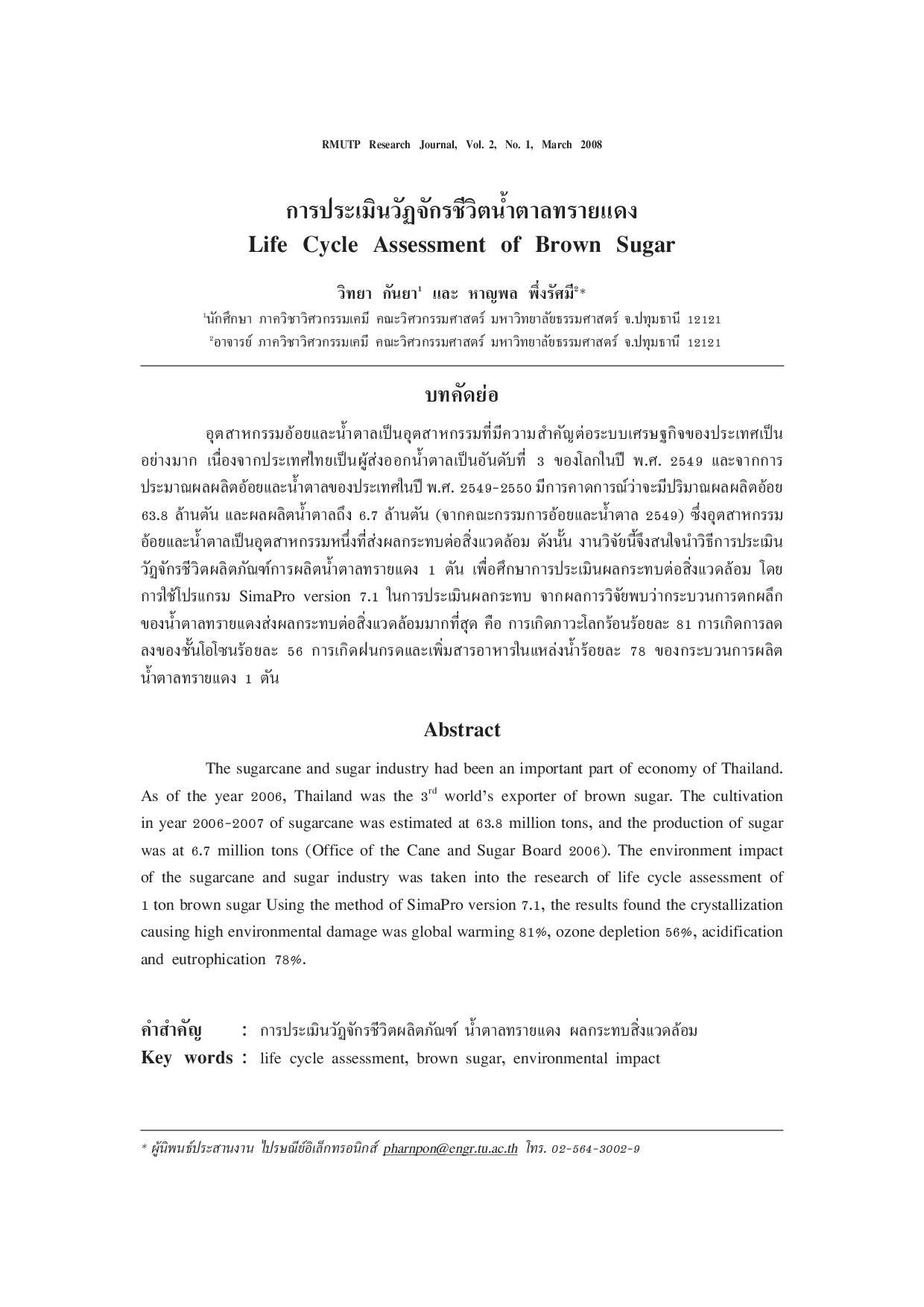
Life Cycle Assessment of Brown Sugar
The sugarcane and sugar industry had been an important part of economy of Thailand. As of the year 2006 Thailand was the 3rd world๛s exporter of brown sugar. The cultivation in year 2006-2007 of sugarcane was estimated at 63.8 million tons and the production of sugar was at 6.7 million tons (Office of the Cane and Sugar Board 2006). The environment impact of the sugarcane and sugar industry was taken into the research of life cycle assessment of 1 ton brown sugar Using the method of SimaPro version 7.1 the results found the crystallization causing high environmental damage was global warming 81% ozone depletion 56% acidification and eutrophication 78%.