จำนวน Repository ( 32 )
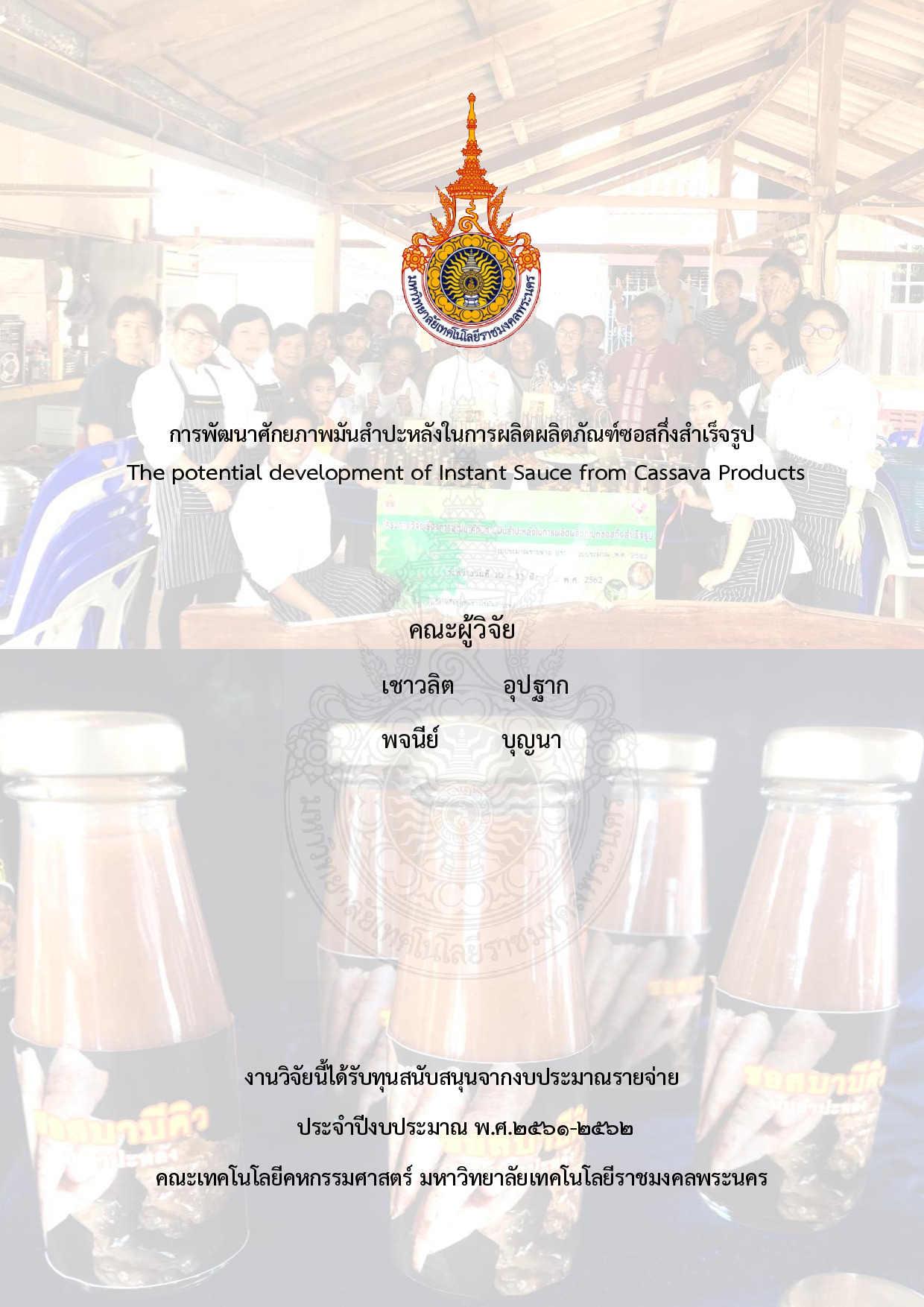
การพัฒนาศักยภาพมันสำปะหลังในการผลิตผลิตภัณฑ์ซอสกึ่งสำเร็จรูป
This research has objectives to study about production process of four types of finished sauce product made from cassava to study about quality of finished sauce product made from cassava to study about consumer test towards finished sauce product made from cassava. From the test it was found that study about quantity of suitable cassava supplement to the four types of finished cassava product by testing about acceptance of testers who were 40 instructors in field of Food and Nutrition field of Food and Nutrition Science and field of Food Service Industry. The method was to give marks for favor in type of 9-point hedonic scale by supplementing cassava into Teriyaki Sauce at levels of 0 20 40 and 60 percent of total ingredient. It was found that the testers accepted the sauce at level of 20 percent which was in the most favorite level. Semi-finished frying sauce supplemented with cassava at level of 0 40 60 and 80 percent of total ingredient; it was found that the testers accepted the level of 60 percent of Barbeque sauce supplemented with cassava at level of 0 40 60 and 80 percent of total ingredient; it was found that the testers accepted level of 40 percent in the level of much favor of semi-finished flavored fermented frying sauce supplemented with cassava at level of 0 20 40 and 60 percent of total ingredient it was found that the testers accepted the sauce at level of 40 percent which is in the level of much favor. Nutritional value of semi-finished sauce product it was found that Teriyaki sauce for 20 percent has moisture value of 78.66 percent fat value of 1.08 percent fiber for 1.36 percent ash for 2.29 percent and protein for 3.34 percent. Semi-finished frying sauce it was found that semi-finished frying sauce supplemented with cassava for 60 percent had moisture value of 80.85 percent fat value of 0.55 percent fiber for 1.35 percent ash for 3.35 and percent and protein for 3.29 percent. cassava for 60 percent it was found that chemical quality had moisture for 82.31 percent fat value for 0.75 percent fiber for 1.51 percent ash for 2.41 percent and protein for 3.37 percent. Semi-finished fermented flavored sauce it was found that semi-finished fermented flavor sauce supplemented with cassava for 40 percent it was found that chemical quality had moisture value for 83.67 percent fat value for 0.07 percent fiber 4.54 percent ash for 4.54 percent and protein for 2.42 percent. However supplementing of cassava into process of finished food products of 4 types; supplementing can be made but there shall be realizing about chemical elements of starting components for example moisture and fat quantity. These components may have effect on physical features for example smell smell and taste and texture. These features affected acceptance of products. The result of study about acceptance of consumers (Consumer test) towards product of semi-finished sauce supplemented with cassava and 100 consumers in Faculty of Home Economics Technology Rajamangala University of Technology Phra Nakhon and people in Tevet Market. Feeling towards acceptance of semi-finished sauce product supplemented with cassava it was found that consumers were satisfactory towards Teriyaki sauce product in moderate favor level having feeling on product in appearance color smell smell and taste in moderate favor level. Feeling towards acceptance of semi-finished sauce product it was found that consumers were satisfactory towards semi-finished frying sauce product 60 percent in moderate favor level having feeling on product in appearance color smell smell and taste in moderate favor level. Feeling towards acceptance of semi-finished fermented sauce product it was found that consumers were satisfactory towards semi-finished fermented sauce product 75 percent in moderate favor level having feeling on product in appearance color smell smell and taste in moderate favor level. Result of technology transfer in project of cassava potential development in production of semi-finished sauce product Tapioca Farmer Community Enterprise Group 480 Khon Buri District and Nong Bunmak District Nakhon Ratchasima Province 45 trainees; most were female having age of 36-45 years to be 96.00 percent. From evaluation it was found that 45 respondents used knowledge to be 100 percent and satisfactory of service receivers in academic aspect and professional aspect towards benefit from service of trainees in level from much to the most to be 100 percent.
การพัฒนาศักยภาพมันสำปะหลังในการผลิต ผลิตภัณฑ์น้ำพริก
The purpose of this research to study the process of destruction of cyanide in cassava. Prior to use in product of Thai pastes and study use of cassava in Thai pastes production of 4 types in tha dang pastes roasted chili paste lohng reuua paste Tamarind chili paste. study physical properties and chemical properties of product and consumer test studies in cassava products affective. in order that transfer technology of development products to the community. The study process to destroy cyanide in cassava before to use in products of pastes. The steaming process in cassava is the low dose of cyanide 18.9 ppm. Studies using cassava to produce 4 types of pastes. The average score of tha dang pastes supplement of cassava 15 percentage in terms of appearance color taste texture and overall liking. The average score was 7.20.7.30.7.00.7.20 and 7.50. This is a preference at a moderate level. Sensory evaluation of roasted paste supplement of cassava 40 percent in terms of appearance color taste texture and overall liking. The average score was 7.86 8.05 7.79 7.86 7.71 and 7.79 This is a preference at a moderate level. Sensory evaluation of lohng reuua paste supplement of cassava 10 percent in terms of appearance color aroma taste texture and overall liking. The average score was 7.30 6.70 7.00 7.50 7.30 and 7.25. This is a preference small and medium-like. Sensory evaluation of tamarind paste supplement of cassava 20 percent in terms of appearance color aroma taste texture and overall liking. The average score was 7.40 7.15 7.15 7.20 7.20 and 7.50. there is a preference moderate inclination. When all 4 types of products were tested for physical chemical and microbiological. we found increasing the amount of cassava in products has affect the color of the products and increase of fat and fiber in the products. All 4 types of cassava products of biomass are no harmful by Thai Industrial Standards Institute. The study on consumer acceptance of the products cassava paste the 4 types. The consumers test responded to the questionnaire were female. The age of the respondents is 21-30year and occupation of the respondents are students. Most of the revenue will be at 10001-15000 baht. The consumers liking the product in rate like very much to like most and accept all 4 types of cassava products. Most consumers buy for storing themselves including buying as souvenirs. The price of products in consumers agree on the price of 35 baht.

ปัจจัยที่มีอิทธิพลต่อความจงรักภักดีของพนักงานที่มีต่อองค์กร กรณีศึกษา กลุ่มธุรกิจอุตสาหกรรมการผลิต ผลิตภัณฑ์อาหาร จังหวัดนนทบุรี
This research was aimed to study employees’ loyalty in manufacturing industry as well as motivation influencing their loyalty. The samples were 360 employees working in the Food manufacturing industry in six districts in Nonthaburi. The questionnaire was used as a tool to collect data which were analyzed by statistics including percentage mean standard deviation. to test the hypothesis T-test one-way Anova and Multiple Regression Analysis were applied. It was found that most employees werefemale over 36 years of age with lower degrees than bachelors degrees 10000 - 15000 baht monthly income and more thansix years of work experiences. In the overall they had average motivation in performing their work in terms of incentives and supporting factors. Most employees were highly loyal to the organization as a whole namely awareness feelings and expressions respectively. The hypothesis testing determined the statistical significance level at 0 . 0 5 revealed that different genders showed different feelings however they were not different in terms of expressions perceptions and loyalty to the organization. Different ages differed in terms of expressive behavior feelings perceptions and loyalty to the organization.
แนวทางการพัฒนาศักยภาพการดำเนินงานของวิสาหกิจชุมชนแปรรูปผลิตภัณฑ์อาหารในจังหวัดสมุทรปราการ
The objectives of this study were :1) to evaluate the basic information :2) to determine the operational status and problems and :3) to study the potential development guidelines for the operation of community enterprises of food processing groups in Samut Prakran Province. Samples selected by stratified random sampling technique were 112 members of community enterprises in Samut Prakran Province. These samples was drawn from the presidents of community enterprises of food processing in Samut Prakran Province which were assessed as the good level in potential operation. Data collection were done by using questionnaire technique while the data were analyzed with frequency percentage mean and standard deviation. The results revealed that the assessment of potential operation of the community enterprises of food processing groups 268 in Samut Prakran Province were at the good level of 114 the average level of 117 and the improvement level of 20. The community enterprises had strong intention to the strengthening of communities and the supportive system from the partite participation consisted of knowledge and developing budget. The overall of operational status was at a high level while the overall of operational problem was at a low level. The potential development guidelines for the operation of community enterprises of food processing groups in Samut Prakran Province were ;1) planning approach: making master plan for all sub-district ;2) organization structure approach: overall operation review with all of members ;3) personnel management approach: creating morale for work performance of personnel together ;4) marketing approach: producing products to meet market needs ;5) production approach: supporting the production knowledge by government sectors and ;6) accounting/ financial approach: making real income and expense accounts.