จำนวน Repository ( 39 )
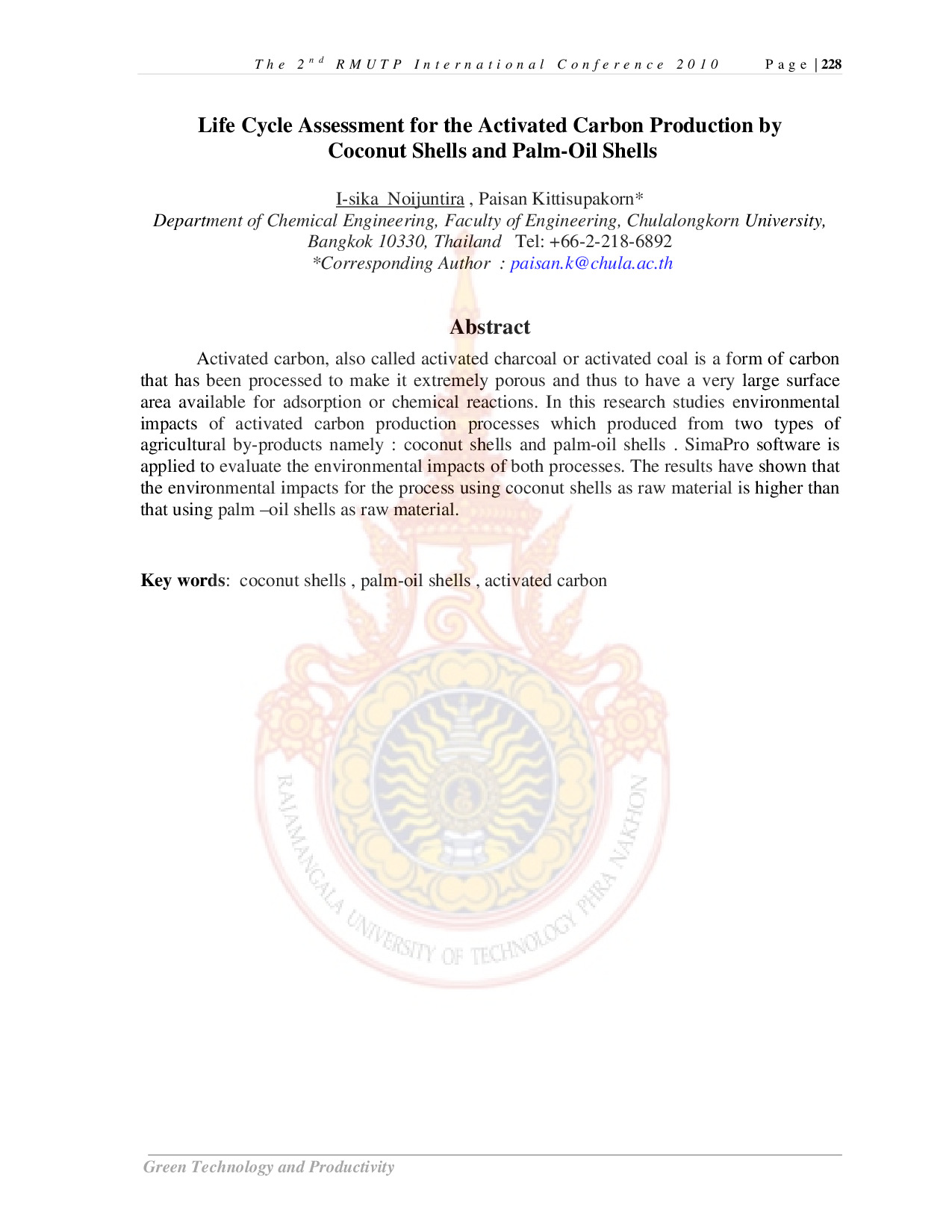
Life Cycle Assessment for the Activated Carbon Production by Coconut Shells and Palm-Oil Shells
Activated carbon also called activated charcoal or activated coal is a form of carbon that has been processed to make it extremely porous and thus to have a very large surface area available for adsorption or chemical reactions. In this research studies environmental impacts of activated carbon production processes which produced from two types of agricultural by-products namely : coconut shells and palm-oil shells . SimaPro software is applied to evaluate the environmental impacts of both processes. The results have shown that the environmental impacts for the process using coconut shells as raw material is higher than that using palm –oil shells as raw material.

An Experimental investigation of the carbonation of blended portland cement palm oil fuel ash mortar in an indoor environment
In this research palm oil fuel ash was utilized as a pozzolanic material in blended Portland cement mortar. The mortar was tested on the normal compressive strength and the negative effect of carbonation in indoor environment using the accelerated carbonation test of 5% CO2 in 50% relative humidity. Three palm oil fuel ash fractions of different fineness viz. coarse original palm oil fuel ash (CPOA) medium palm oil fuel ash (MPOA) and fine palm oil fuel ash (FPOA) were used for the study. Ordinary Portland cement (OPC) was partially replaced by these palm oil fuel ashes at the dosages of 20% and 40% by weight of binder. The results showed that the incorporation of the ashes affected the strength and the carbonation depths of mortars. The strengths of mortar slightly decreased with the increases in the dosage of the ash. The fineness of ash on the other hand improved the strength and the carbonation of the mortars. The mortars containing FPOA exhibited high strength and relatively low carbonation in comparison to those using coarser MPOA and CPOA. The use of FPOA resulted in a strong and dense mortar owing to the increased packing effect and pozzolanic reaction. It was therefore demonstrated that the FPOA could be used as a pozzolanic material to replace part of Portland cement for use in the indoor environment.
Pore structure changes of blended cement pastes containing fly ash, rice husk ash, and palm oil fuel ash caused by carbonation
In this paper the effects of carbonation on pore structure of blended pozzolan cement pastes were investigated. Ordinary Portland cement _OPC_ was partially replaced with ground palm oil fuel ash _POA_ ground rice husk ash _RHA_ and classified fine fly ash _FA_. The strength total porosity specific surface area and pore size distribution were tested. In general incorporation of pozzolans increased the total porosity of blended cement pastes in comparison to that of OPC paste. Carbonation of pastes under 5% CO2 and 50% relative humidity _RH_ for 28 days resulted in filling of the pore voids and possible attack on calcium silicate hydrate _CSH_ depending on the type of pozzolan used. After carbonation total porosity decreased and specific surface areas of the blended pozzolan cement pastes reduced indicating the infilling of voids. Pore size distributions of POA and RHA pastes were different to those of FA pastes. Large pores of the POA and RHA pastes were increased indicating coarsening of pores owing to possible attack on CSH. It is possible that POA and RHA were highly reactive and hence their uses resulting in severe carbonation compared to use of FA.
Strength and chloride resistance of blended Portland cement mortar containing palm oil fuel ash and fly ash
This paper presented a study on the strength and chloride resistance of mortars made with ternary blends of ordinary Portland cement (OPC) ground palm oil fuel ash (POA) and classified fly ash (FA). The mortar mixtures were made with Portland cement type I containing 0-40wt% FA and POA. FA and POA with 1wt%-3wt% retained on a sieve No.325 were used. The compressive strength and rapid chloride penetration depth of mortars were determined. The results reveal that the use of ternary blended cements produces good strength mortars. The use of the blend of FA and POA also produces high strength mortars and excellent resistance to chloride penetration owing to the synergic effect of FA and POA. A mathematical analysis and two-parameter polynomial model were presented to predict the compressive strength. The mathematical model correlated well with the experimental results. The computer 3-D graphics of strength of the ternary blended mortars were also constructed and could be used to aid the understanding and the proportioning of the blended system.
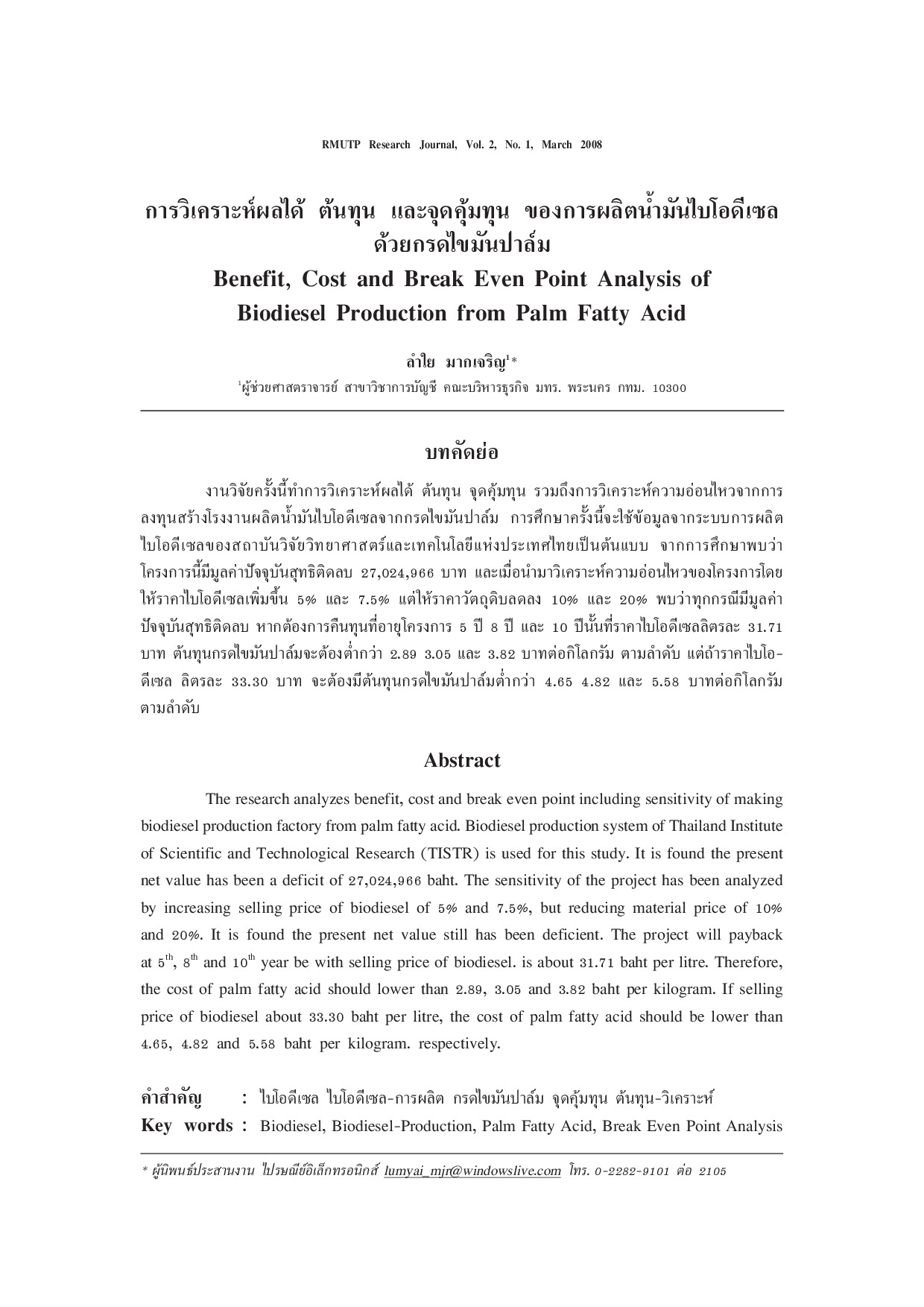
Benefit, Cost and Break Even Point Analysis of Biodiesel Production from Palm Fatty Acid
The research analyzes benefit cost and break even point including sensitivity of making biodiesel production factory from palm fatty acid. Biodiesel production system of Thailand Institute of Scientific and Technological Research (TISTR) is used for this study. It is found the present net value has been a deficit of 27024966 baht. The sensitivity of the project has been analyzed by increasing selling price of biodiesel of 5% and 7.5% but reducing material price of 10% and 20%. It is found the present net value still has been deficient. The project will payback at 5th 8th and 10th year be with selling price of biodiesel. is about 31.71 baht per litre. Therefore the cost of palm fatty acid should lower than 2.89 3.05 and 3.82 baht per kilogram. If selling price of biodiesel about 33.30 baht per litre the cost of palm fatty acid should be lower than 4.65 4.82 and 5.58 baht per kilogram. respectively.