จำนวน Repository ( 29 )
THE PERCEPTION AND EXPECTATION ADMINISTRATORS AND FACULTIES TOWARD THE FACULTY DEVELOPMENT OF RAJAMANGALA UNIVERSITY OF TECHNOLOGY PHRA NAKHON
The purpose of this study was to study and compare instructors’ expectation toward the instructor development in Rajamangala University of Technology Phra Nakhon in 3 aspects; Teaching; Service; and Research. The instructors were classified by gender ages faculty and status. The samples in this research were 228 Instructors in Rajamangala University of Technology Phra Nakhon. The 56 item questionnaires of Likerts rating scales was used as the research instrument. Percentage mean standard deviation t-test for dependent sample t-test for independent sample F-test and LSD analysis were statistical method to analyze data.
The Information Perception about Public Relation of RMUTP's Students and Staffs
This research aims to study The Information Perception About Public Relation of RMUTPs of Students and Staffs by using survey research. The questionnaires are used to collect data from a total of 400 samples. Percentage Mean Standard Deviation t-test one way ANOVA and analysis of variance are use for statistical analysis of data with the level of significance at 0.05. The result of this study show that: I. The difference in sample Demographic Characteristics has difference effect upon the information perception with the level of significance at 0.05 except age and status have no effect upon the information perception. 2. RMUTPs and staffs who received the information from medias of RMUTP has difference effect upon the information and when we compare the media perception with the level of significance at 0.05 this study found the difference between leaflets and Poster
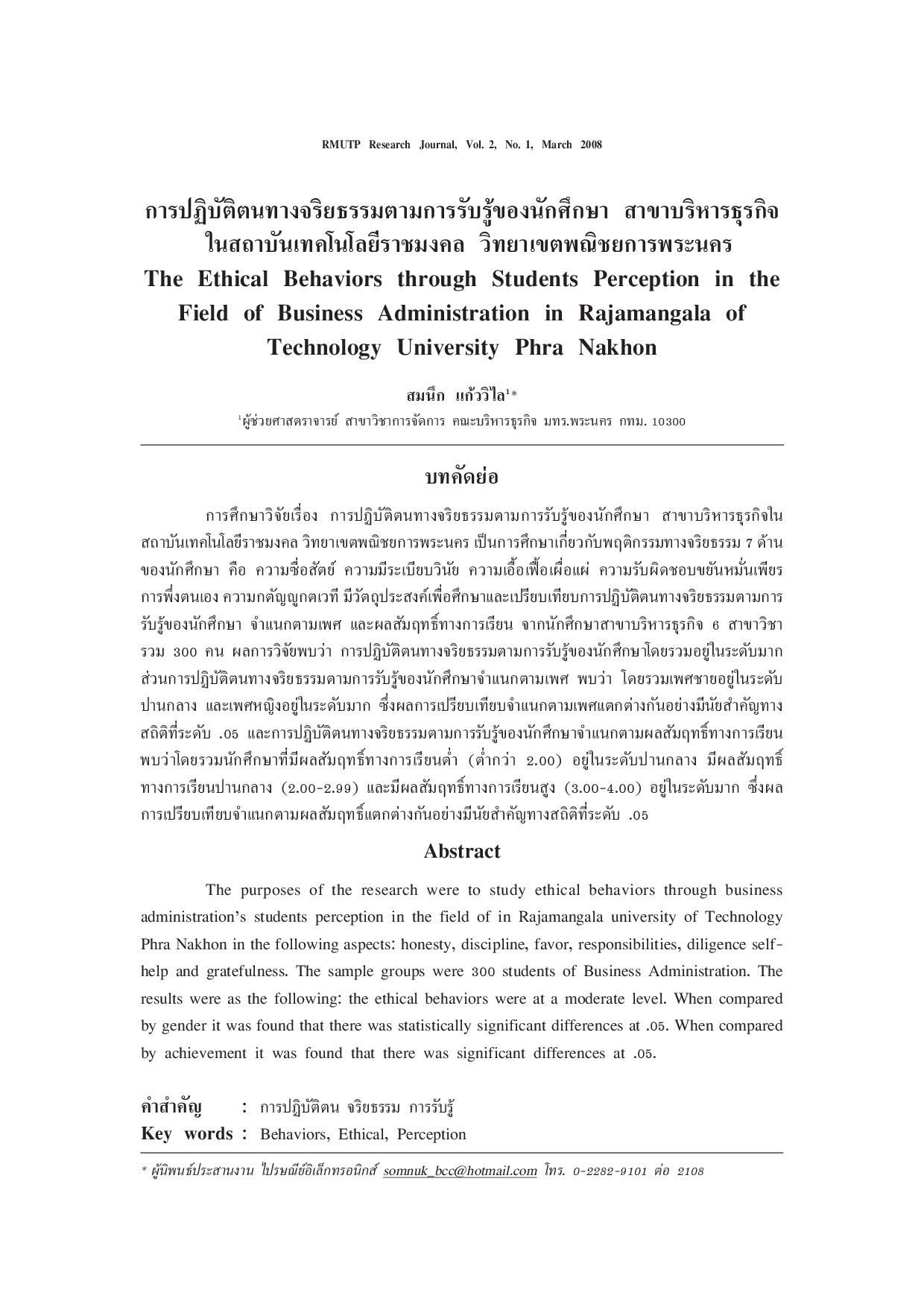
The Ethical Behaviors through Students Perception in the Field of Business Administration in Rajamangala of Technology University Phra Nakhon
The purposes of the research were to study ethical behaviors through business administration’s students perception in the field of in Rajamangala university of Technology Phra Nakhon in the following aspects: honesty discipline favor responsibilities diligence selfhelp and gratefulness. The sample groups were 300 students of Business Administration. The results were as the following: the ethical behaviors were at a moderate level. When compared by gender it was found that there was statistically significant differences at .05. When compared by achievement it was found that there was significant differences at .05.
การมีส่วนร่วมของพนักงานต่อการดำเนินงานด้านความรับผิดชอบต่อสังคม (CSR) ของนิคมอุตสาหกรรม 304 จังหวัดปราจีนบุรี
The purposes of this research were to investigate the perception on activity maneuver and supporting factors regarding employees participation in Corporate Social Responsibility (CSR). The sample consisted of 250 employees of Prachin Buri Industrial Estate 304 Prachin Buri Province. The research results are as follows. The employees’ perception on activity maneuver information in CSR in the overall was at the highest level (= 4.62 S.D. = 0.44). The overall perception on the information had a statistically significant positive relationship with employees’ participation at the .01 level (r = .347). When considering each aspect the perception on activity information positively correlated with participation in CSR activities at the .01 level of significance (r = .295). The results of the appropriate model analysis used to forecast the employees’ perception on CSR activity indicated that the perception of policy information had a p-value of .012 meaning that the policy factor could predict the employees’ information perception at 0.05 statistical significance with a tolerance of .704 the VIF was 1.420. As for the planning aspect the tolerance value was .617 with the VIF value of 1.621 and the activity guideline aspect had its tolerance value of .532 with the VIF value of 1.881. This means that the perception regarding policy planning and guideline aspects was not beyond the Multicollinearity variables because their tolerance values were not lower than .2 and VIF did not exceed 10. Also the results of the regression coefficient analysis of factors affecting the information perception on CSR activities in the form of raw scores (B) were .298 .168 and .209 indicating that the variables predicting the perceived social responsibility included policy (X1) planning (X2) and activity guidelines (X3) and the three variables can together predict the level of awareness of CSR activities. These three factors could jointly predict the information perception on CRS at 11 percent. Factors promoting the employee participation on social responsibility were generally at a moderate level ( = 2.94 S.D. = 1.22) and there was a statistically significant positive correlation with employee participation at the .01 level (r = .855). When looking at each aspect it was found that factors promoting the employee participation in training and activities were positively related to the social responsibility aspect statistically significant at .01 (r = .773) and (r = .841). The results of the analysis of the appropriate models used to predict the factors contributing to employee participation showed that employees’ activity and training participation had the positive influence on CSR activities with p-value of .000 and .001 which was less than 0.05 indicating that their attendance could predict promoting factors of the employee participation statistically significant at the .05 level. This means activity and training participation factors could contribute to the promotion of employee participation statistically significant at the .05 level. While the training had a tolerance value of .225 the VIF value of 4.450 the activity participation had a tolerance value of .259 the VIF value of 3.858. As for being a group member the tolerance ship was .193 with the VIF value of 5.185 showing that participating in training and membership did not go beyond the Multicollinearity due to the tolerance value of not less than 2 and VIF value of not more than 10. The result of the regression coefficient analysis of factors affecting the level of factors contributing to employee participation on CSR operations were .157 .391 and .028 showing that the predicting variables of the employee participation promotion were training (X4) and participation (X5) and group membership (X6). The three variables could predict the level of factors contributing to employees participation on CRS at 72.70%