จำนวน Repository ( 75 )

The plant growth and production from swine farm wastewater usage
The usage of wastewater from swine farm for agriculture have study on the production of three plants such as shallot (Allium ascalonicum L.) marigold (Tagetes erecta L.) and ruzi grass (Bachiaria ruziziensis). The experiment was focusing on the growth production and metals accumulation (Pb Cu Fe Zn) in plant. The results shown that swine farm wastewater were a lot of organic substant and nutrient. The biological oxygen demand and chemical oxygen demand were out of standard. The heavy metals lead zinc copper and iron were amount 0.106 0.218 0.082 และ 0.866 mg/kg respectively. The productivity of shallot and ruzi grass were high growing that treated by swine farm wastewater. The marigold production (flower size dry weight and fresh weight) treated by swine farm wastewater found that were not significant from the marigold production that treated by control water. The amount of lead in shallot ruzi grass and marigold flower were out of standard. The shallot and ruzi root found the amount of zinc out of standard. The amount of copper and iron were not out of standard all three plant.
Utilization of sludge from power plant as cement substitution
The feasibility of wastewater treatment sludge from the power plant was studied as cement substituted material. The sludge were used as the air dried sample and the oven dried sludge at 300o C. Their properties then the optimum ratio of cement substituted portion for cement block were determined. In the control set; cement sand and water ratio were 1 2.75 and 0.825 (w/w) respectively while the treatment set sludge replacing were varied at 10 20 and 30 %. The blocks were produced and cured in tap water for 7 14 and 28 days and tested their compressive strength. The leaching ability of heavy metals namely Cd Cr Cu and Pb were determined by Waste Extraction Test or WET (according to the standard from the Notification of Ministry of Industry A.D. 2005) and Toxicity Characteristic Leaching Procedure; TCLP (US EPA method 1311). The results showed that the solution from cement block curing both of control set treatment block had basicidic pH range 11 – 12 and caused reduction of the heavy metal solubility. The solution conductivity range 5 - 7 mS/cm. The 10% dried sludge cement blocks were the suitable ratio compared with the control set which the maximum compressive strength at 28th day was 253.81 Kg/cm2 and 4.73 % moisture. All metal leaching abilities were less than those Notification and US EPA standard. Those optimum ratios 10 % can be applied to produce cement pot.
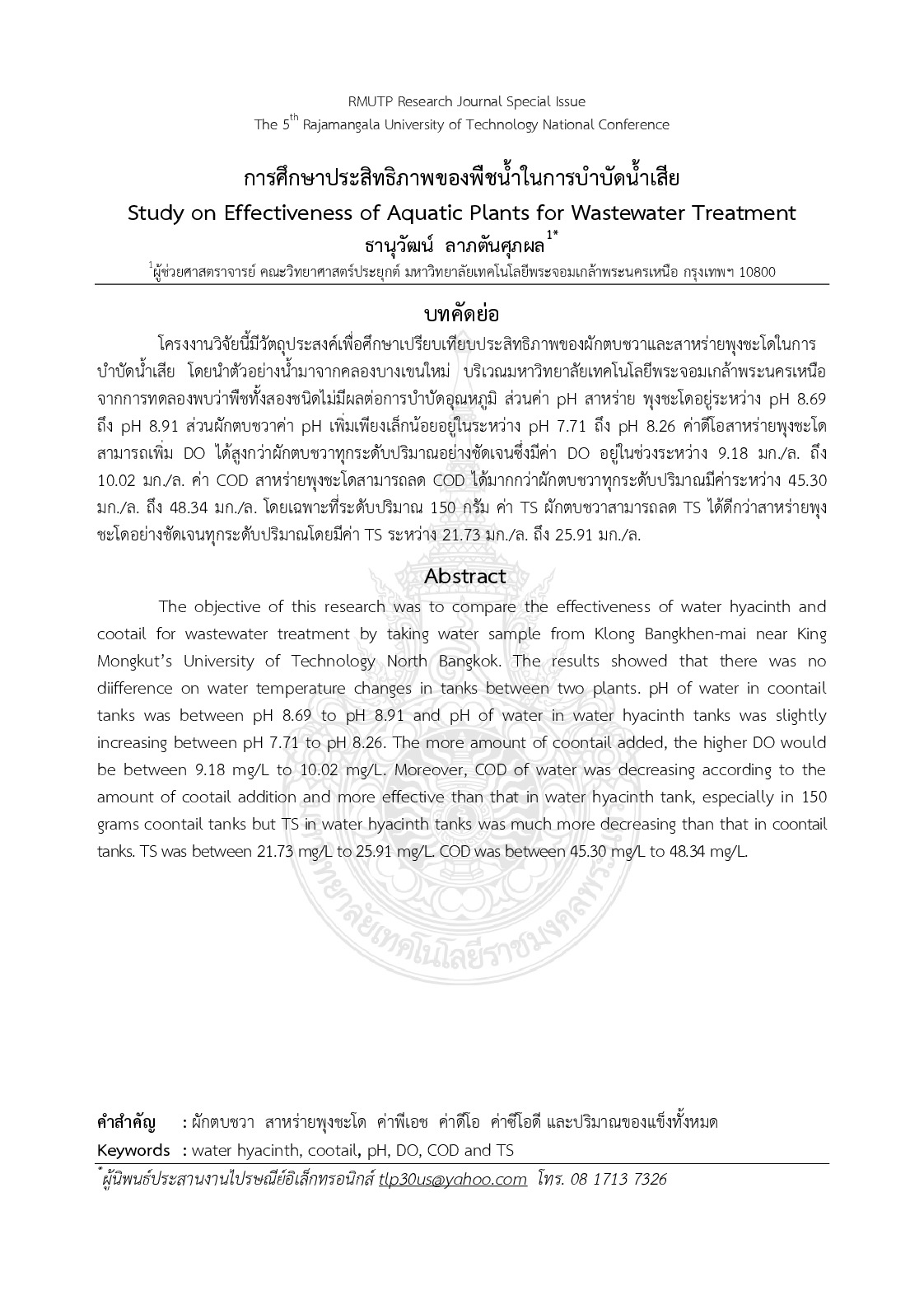
Study on effectiveness of aquatic plants for wastewater treatment
The objective of this research was to compare the effectiveness of water hyacinth and cootail for wastewater treatment by taking water sample from Klong Bangkhen-mai near King Mongkut’s University of Technology North Bangkok. The results showed that there was no diifference on water temperature changes in tanks between two plants. pH of water in coontail tanks was between pH 8.69 to pH 8.91 and pH of water in water hyacinth tanks was slightly increasing between pH 7.71 to pH 8.26. The more amount of coontail added the higher DO would be between 9.18 mg/L to 10.02 mg/L. Moreover COD of water was decreasing according to the amount of cootail addition and more effective than that in water hyacinth tank especially in 150 grams coontail tanks but TS in water hyacinth tanks was much more decreasing than that in coontail tanks. TS was between 21.73 mg/L to 25.91 mg/L. COD was between 45.30 mg/L to 48.34 mg/L.
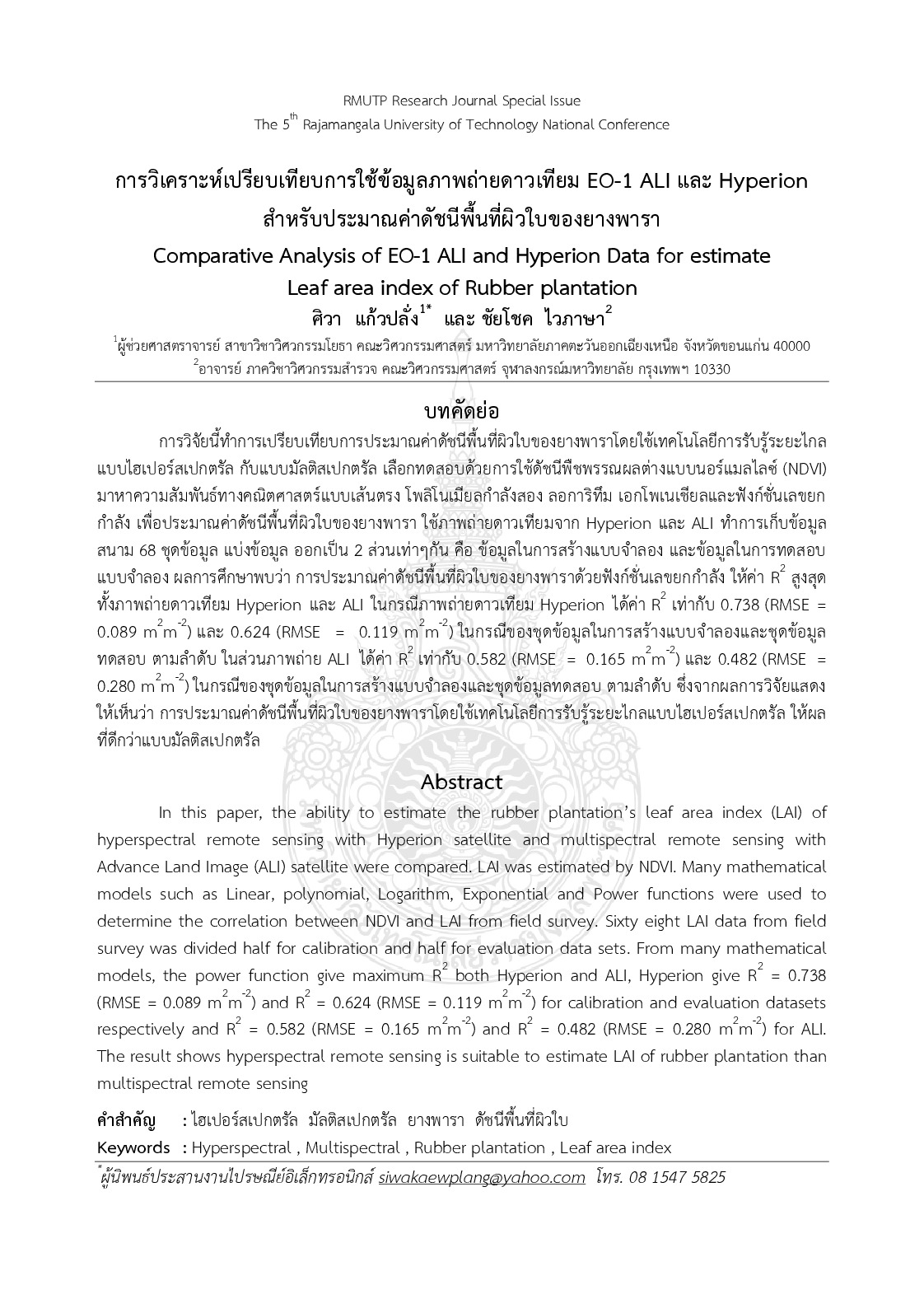
Comparative analysis of EO-1 ALI and Hyperion data for estimate leaf area index of rubber plantation
In this paper the ability to estimate the rubber plantation’s leaf area index (LAI) of hyperspectral remote sensing with Hyperion satellite and multispectral remote sensing with Advance Land Image (ALI) satellite were compared. LAI was estimated by NDVI. Many mathematical models such as Linear polynomial Logarithm Exponential and Power functions were used to determine the correlation between NDVI and LAI from field survey. Sixty eight LAI data from field survey was divided half for calibration and half for evaluation data sets. From many mathematical models the power function give maximum R2 both Hyperion and ALI Hyperion give R2 = 0.738 (RMSE = 0.089 m2m-2) and R2 = 0.624 (RMSE = 0.119 m2m-2) for calibration and evaluation datasets respectively and R2 = 0.582 (RMSE = 0.165 m2m-2) and R2 = 0.482 (RMSE = 0.280 m2m-2) for ALI. The result shows hyperspectral remote sensing is suitable to estimate LAI of rubber plantation than multispectral remote sensing
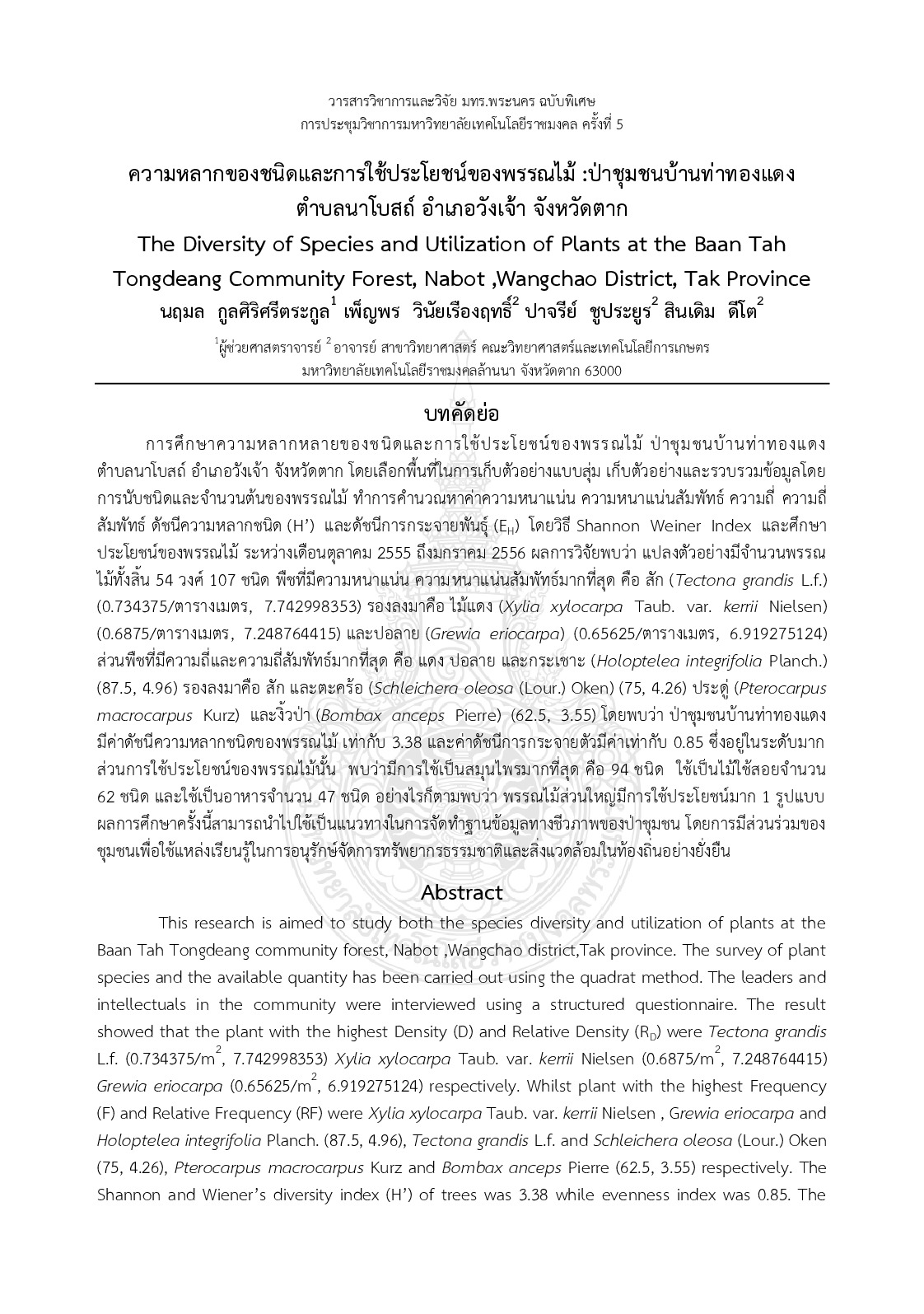
The diversity of species and utilization of plants at the baan tah tongdeang community forest, nabot ,wangchao district, tak province
This research is aimed to study both the species diversity and utilization of plants at the Baan Tah Tongdeang community forest Nabot Wangchao districtTak province. The survey of plant species and the available quantity has been carried out using the quadrat method. The leaders and intellectuals in the community were interviewed using a structured questionnaire. The result showed that the plant with the highest Density (D) and Relative Density (RD) were Tectona grandis L.f. (0.734375/m2 7.742998353) Xylia xylocarpa Taub. var. kerrii Nielsen (0.6875/m2 7.248764415) Grewia eriocarpa (0.65625/m2 6.919275124) respectively. Whilst plant with the highest Frequency (F) and Relative Frequency (RF) were Xylia xylocarpa Taub. var. kerrii Nielsen Grewia eriocarpa and Holoptelea integrifolia Planch. (87.5 4.96) Tectona grandis L.f. and Schleichera oleosa (Lour.) Oken (75 4.26) Pterocarpus macrocarpus Kurz and Bombax anceps Pierre (62.5 3.55) respectively. The Shannon and Wiener’s diversity index (H’) of trees was 3.38 while evenness index was 0.85. The utilization of the plants in the community included 94 species as wood (used as plank furniture firewood charcoal string chemical extraction etc. 62 species as medicinal herbs 47 species as wild vegetables fruits and foods. All of them are utilized in the community. The results of this research would be beneficial for administrative and management as a guideline to preparation a community biological database and learning resources for conservation and sustainable uses of natural resources and environments in Baan Tah Tongdeang community forest.