จำนวน Repository ( 30 )
การพัฒนาผลิตภัณฑ์เห็ดหอมอบแห้งด้วยไมโครเวฟร่วมกับลมร้อนแบบสายพานลำเลียง
Drying an agricultural product with hot air (HA) method causes a long drying time and results in high specific drying energy consumption (SEC). The dried product has high shrinkage percentage and low rehydration. Therefore this research aims to develop dried shiitake mushroom using belt-conveyor combined microwave-hot air drying method (MHB). The shiitake mushroom was dried by MHB at microwave power of 300 W 400 W 500 W and 600 W and air temperature of 65 oC with air velocity of 0.3 m/s and recycled air of 80% and by the HA drying method at air temperature of 65 oC. The samples were dried until their final moisture content less than 11.1% dry basis. The drying kinetics SEC of drying process and quality of dried shiitake mushroom were evaluated. The quality of dried product was considered in terms of color shrinkage rehydration texture water activity and microstructure. The results showed that the shiitake mushroom drying using MHB gave higher drying rate than that of HA drying method leading to short drying time and resulting in low SEC. The drying rate of un-blanched shiitake mushroom was higher than that of blanched shiitake mushroom. Dried shiitake mushroom from MHB drying gave lower values in shrinkage percentages and hardness but higher rehydration and larger pore size than that dried by HA drying. However the color values (L* +a* and +b*) of dried shiitake mushroom in all cases were not significantly different. Meanwhile dried shiitake mushroom from un-blanched case gave lower values in shrinkage percentage and hardness but higher values in all colors and rehydration and larger pore size than those of blanched case.
การศึกษาและพัฒนาวัสดุปลูกพืชน้ำหนักเบาจากกาบมะพร้าวเพื่อใช้กับสวนแนวตั้ง
The study and Development Lightweight growing media by Coir to use a Vertical garden.To create thermal comfort for building users are the main factors causing the air conditioning. The cause of the electrical consumption. Thus bringing the tree into the building. In the past the building that used tree. Create a homey Subsequently it has adopted a large tree used for the purpose of lowering the temperature of the surrounding buildings. Developed into a roof garden Reduce heat to pass through the roof. And is currently being applied in the manner of a green wall. This helps reduce the heat that enters the building through the building envelope as well. The behavior of the tree to absorb water from the roots to the leaves and then passed to photosynthesis. Such a process makes the water evaporates and the air has been cooled by the surrounding trees The Heat pulled away for the evaporation of water. Such a process which happens from time to time no matter how much humidity in the air. The cool environment is another factor that manipulates the ambient environment to environment and buildings The benefits of trees in the green areas of the city this is helping to reduce and prevent the phenomenon of urban heat island The study and Development Lightweight growing media by Coir to use a Vertical To reduce the weight of structural data were collected to design the plant material. Then the data from design professionals and vertical landscaping questionnaire. And interviews to analyze the result. And amends To test plant material vegetation series of 12 trials by planting vegetation. On the wall a series of three experiments wall. (Width 1.20 m. Height 3.00 m.) Of the test data and the growth of vegetation. Found that plants grow well on a series of plant material. The unit is lightweight and planting is not burdened with the weight of the building structure.
บ้านถอดประกอบที่ขนส่งสะดวกเพื่อผู้ประสบภัย
The objectives of this research are to develop the knock down house to create the knowledge to test the properties to construction the prototype and to transfer the technology of easy transport knock down house for sufferer. The load and resistance factor design (LRFD) method was used to design the structure. From the design and testing the easy transport knock down house for sufferer is the square shape building with gable roof. The building size 4.00 x 4.00 square meters and height 2.40 meters which has 16.00 square meters of usable area and 1.20 meters of gable roof height. This knock down house can separate the usable area into 2 parts include bedroom and toilet. The cost of material is 125000 Baht per unit or 7812.5 Baht per square meter. The 6 wheel truck can transport this knock down house. The safety factor (S.F.) of this knock down house equal to 1.86. Moreover the knowledge can register the copyright names “The drawing of easy transport knock down house for sufferer” and draft the research paper names “The easy transport knock down house for sufferer” that are the way to transfer technology to target group.

Permanent-magnetic-field, bean sprout, neodymium welding process
The objective of this research is to investigate microstructure and mechanical properties of brass welded by diffusion welding process. The diffusion welding (DW) of brass welded over lap joints bonding parameters were pressure at temperature 500 650 and 800 0C contact pressure of 12 MPa and holding time for 60 minutes respectively. The microstructure mechanical properties and behaviour during bonding were investigated. The results show that in weld zone (Bond Line) diffusion of atom the brass significantly. The mechanical properties after diffusion welding process increased higher temperature
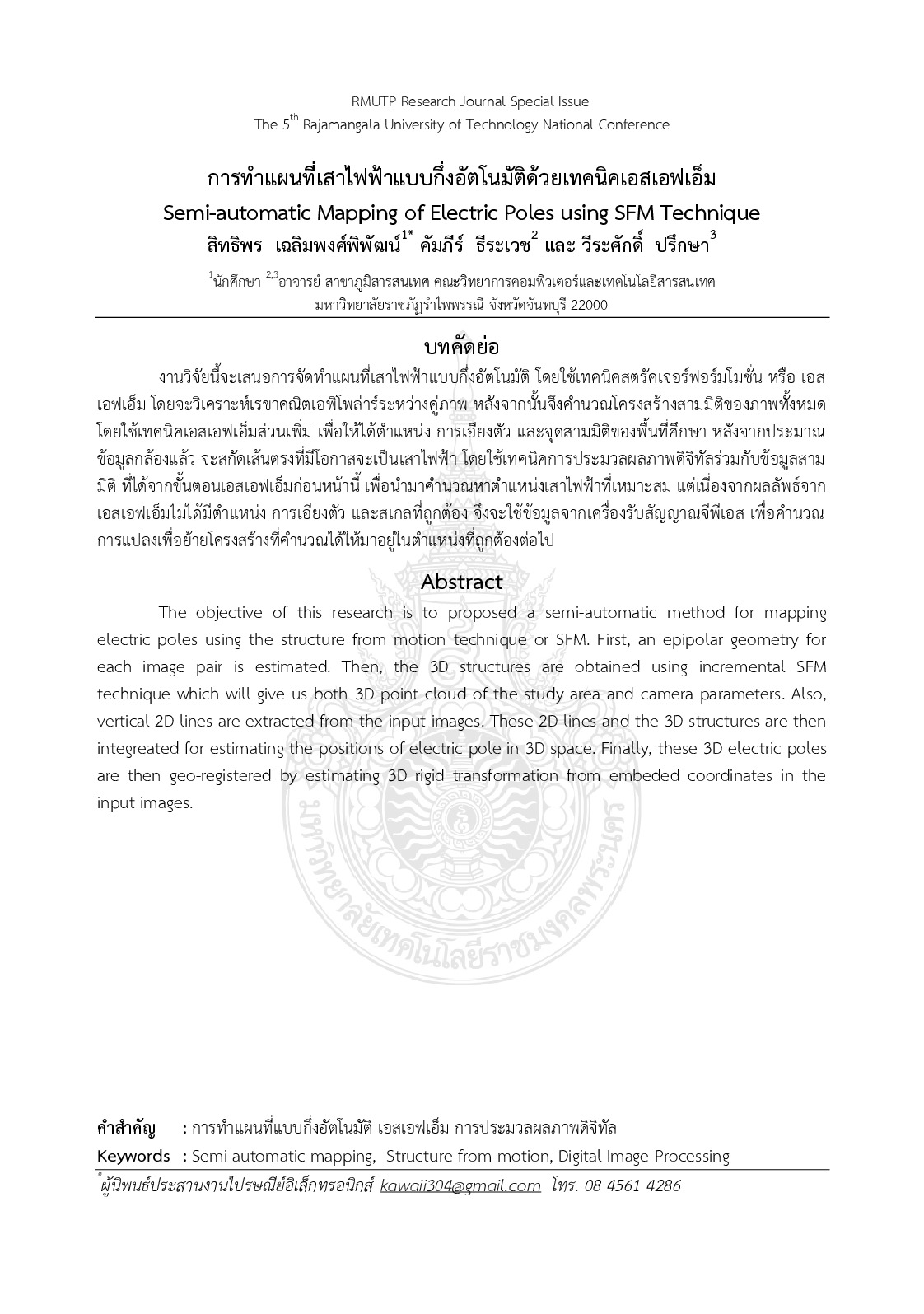
Semi-automatic mapping of electric poles using sfm technique
The objective of this research is to proposed a semi-automatic method for mapping electric poles using the structure from motion technique or SFM. First an epipolar geometry for each image pair is estimated. Then the 3D structures are obtained using incremental SFM technique which will give us both 3D point cloud of the study area and camera parameters. Also vertical 2D lines are extracted from the input images. These 2D lines and the 3D structures are then integreated for estimating the positions of electric pole in 3D space. Finally these 3D electric poles are then geo-registered by estimating 3D rigid transformation from embeded coordinates in the input images.