จำนวน Repository ( 3447 )

Use of disposed waste ash from landfills to replace Portland cement
In this study waste ash was utilized as a pozzolanic material in blended Portland cement in order to reduce negative environmental effects and landfill volume required to dispose of waste ash. The influence of waste ash namely palm oil fuel ash rice husk ash and fly ash on compressive strength and sulfate resistance in mortar were studied and evaluated by some accelerated short–term techniques in sodium sulfate solutions. Ordinary Portland cement (OPC) was partially replaced with ground palm oil fuel ash (POA) ground rice husk ash (RHA) and classified fly ash (FA). Single pozzolan and a blend of equal weight portions of POA RHA and FA were also used. The resistance to sulfate attack of mortar improves substantially with partial replacement of OPC with POA RHA and FA. The use of a blend of equal weight portions of FA and POA or RHA produced mixes with good strength and resistance to sulfate attack. POA RHA and FA have a high potential to be used as a pozzolanic material.
Public Relations Strategic Planning of Intercity Motorway Division, Highways Department
This paper presents public relation strategic planning of Intercity Motorway Division Highways Department. The objective is to know and understand the practical strategy of Intercity Motorway Division by using public relation to publicize to the officers both inside and outside office. The inside officers have to realize the importance of accomplishment of duty performance. The outside officers have to understand the role and duty of division and support their working to create good image and get further plan. This is a study of the opinions from four groups as follows: - 1) Study on the attitude of Intercity Motorway officer towards organization 2) Study on the attitude of highway driver towards Intercity Motorway Division 3) Interview the advertiser opinion towards Intercity Motorway Division 4) Interview people who have accommodation nearby motorway.
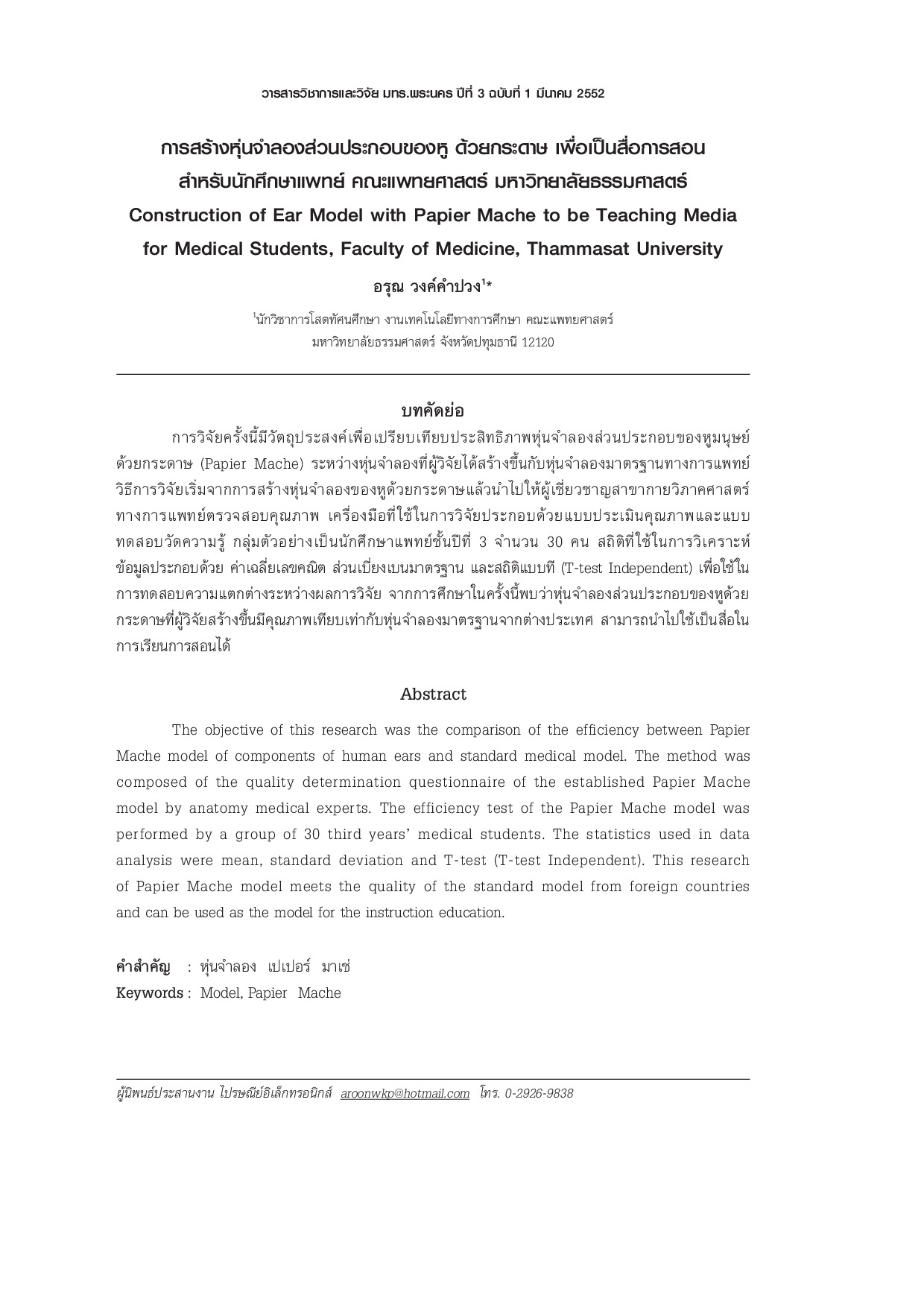
Construction of Ear Model with Papier Mache to be Teaching Media for Medical Students, Faculty of Medicine, Thammasat University
The objective of this research was the comparison of the efficiency between Papier Mache model of components of human ears and standard medical model. The method was composed of the quality determination questionnaire of the established Papier Mache model by anatomy medical experts. The efficiency test of the Papier Mache model was performed by a group of 30 third years’ medical students. The statistics used in data analysis were mean standard deviation and T-test (T-test Independent). This research of Papier Mache model meets the quality of the standard model from foreign countries and can be used as the model for the instruction education.
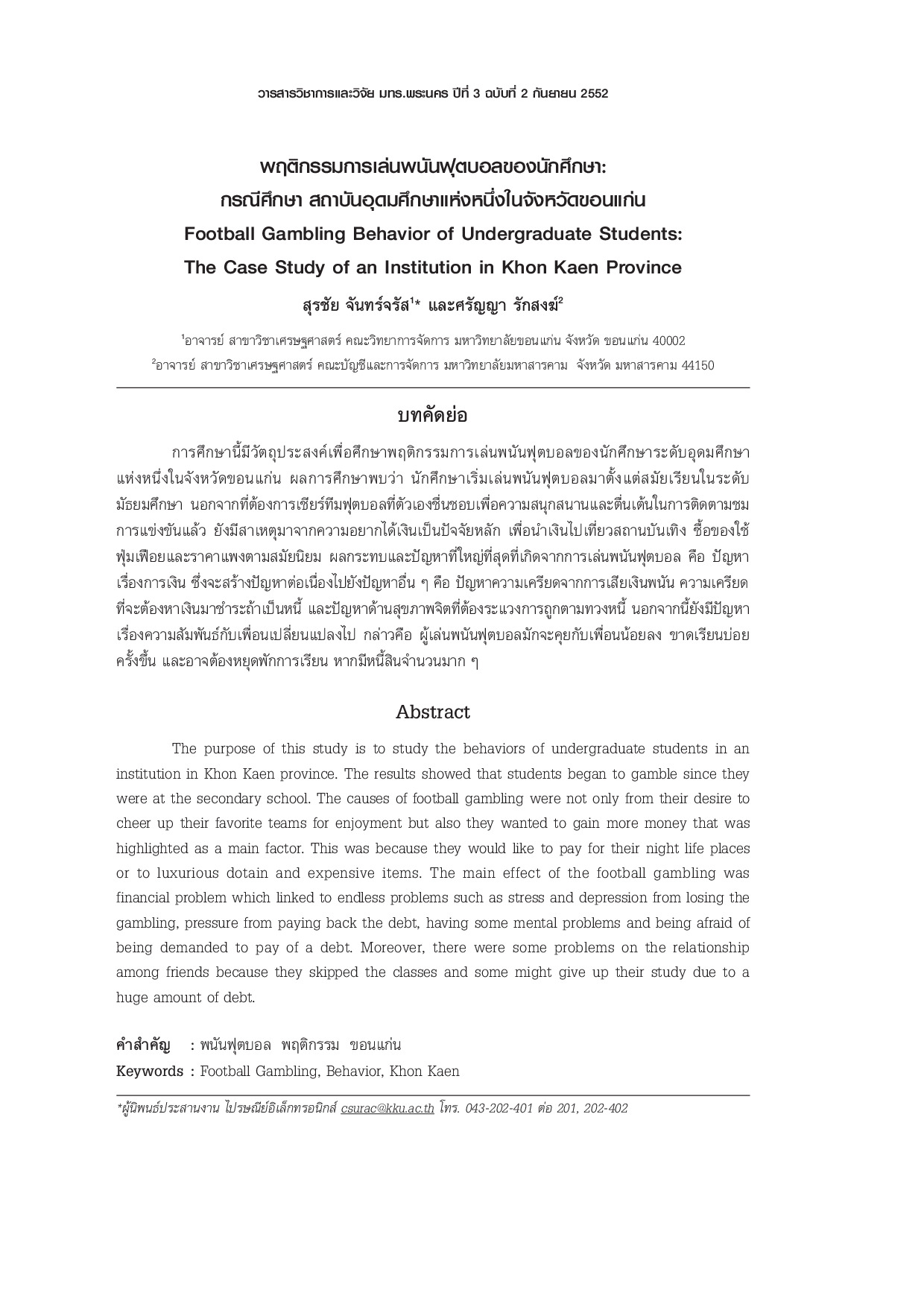
Football Gambling Behavior of Undergraduate Students: The Cass Study of an Institution in Khon Kaen Province
The purpose of this study is to study the behaviors of undergraduate students in an institution in Khon Kaen province. The results showed that students began to gamble since they were at the secondary school. The causes of football gambling were not only from their desire to cheer up their favorite teams for enjoyment but also they wanted to gain more money that was highlighted as a main factor. This was because they would like to pay for their night life places or to luxurious dotain and expensive items. The main effect of the football gambling was financial problem which linked to endless problems such as stress and depression from losing the gambling pressure from paying back the debt having some mental problems and being afraid of being demanded to pay of a debt. Moreover there were some problems on the relationship among friends because they skipped the classes and some might give up their study due to a huge amount of debt.
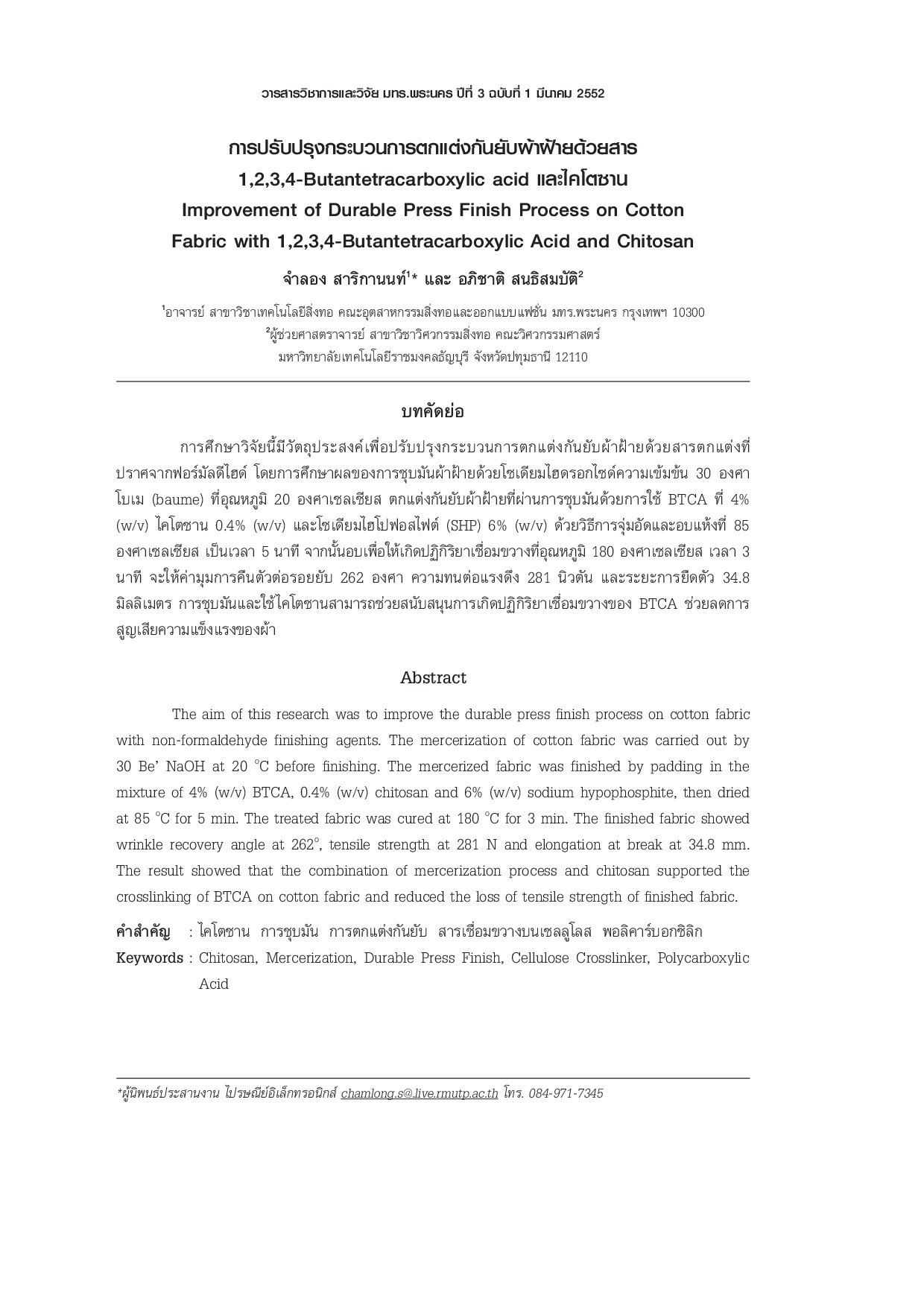
Improvement of Durable Press Finish Process on Cotton Fabric with 1,2,3,4-Butantetracarboxylic Acid and Chitosan
The aim of this research was to improve the durable press finish process on cotton fabric with non-formaldehyde finishing agents. The mercerization of cotton fabric was carried out by 30 Be’ NoOH at 20 C before finishing. The mercerized fabric was finished by padding in the mixture of 4% (w/v) BTCA 0.4% (w/v) chitosam and 6% (w/v) sodium hypophosphite then dried at 85 C for 5 min. The treated fabric was cured at 180 C for 3 min. The finished fabric showed wrinkle recovery angle at 262 tensile strength at 281 N and elongation at break at 34.8 mm. The result showed that the combination of mercerization process and chitosan supported the crosslinking of BTCA on cotton fabric and reduced the loss of tensile strength of finished fabric.