จำนวน Repository ( 3447 )
Development of Sliced Breakfast and Ice Cream Cone From Khao Hom Nil
Development Project of food products from khao Hom Nil for food industry aimed to conduct food processing which consisted of Khao Hom Nil sliced breakfast and Khao Hom Nil ice cream cone. As for Khao Hom Nil sliced breakfast Khao Hom Nil flour to corn flour ratio was 30:30 and it was the most accepted for all attributes. The product obtained was dry crispy but lower puffing capacity than other products sold in markets. It also gave higher nutritional value when compared to other instant breakfast in markets in that it gave high fiber. As for khao hom Nil ice cream cone powdered sugar to shortening ratio was 14%:10% and the product obtained was the most accepted. Determination of water activity and moisture content was at low level. This helped logn-shelf life food.
Development of Value Added Food Product from Freshwater Fish
Development of value added food product from freshwater fish aimed to develop processed food product from 5 types of freshwater fish. Because freshwater fish is found locally and cheap processed and value-added product from freshwater fish would enable a producer to have a wide range of market distribution. The findings of this study demonstrated that the most suitable products were fish sausage with Tom Yam flavour added developed by using seven-stripped carp fish partially substituted with spotted featherback fish at level 50% and 7.5% instant Tom Yum flavour. Pla-Yar produt with herbs product was developed by using Nile tilapia and 3.5% curry paste. Pla-Jor product was developed by using minced lard and thawing 2-week frozen Pla-Jor by microwave at heat level 70% for 1 minute. Fish flake from silver barb fish was developed by crushing to roll and sliding to sheet. Sauce of grilled silver barb fish paste and chill was developed by using silver barb fish partially substituted with shrimp at level 70% and the appropriate drying method was using tray dryer at 73 ◦C for 1 hour.
Drip Irrigation Technology Transferring
This study was a quasi-experimental research of training curriculum for transferring of drip irrigation technology to the farmers in Nongyaplong district Phetchburi Province. The farmers characteristics were required in the following aspects : 1) being the farmer and the owner of farm 2) The location is in lack of water area 3) being able to invest at least 2000 baht per 400 square meters 4) Having interest in drip irrigation technology. There were 30 farmers in this training program the topics of training were : 1) Kind of plants that fit to drip irrigation 2) drip irrigation system 3 ) equipments and tools 4) maintenance the system 5) water supply in drip irrigation technology 6) keeping system after using of equipments. The results after comparing between pre and post test it was found that the farmers gained knowledge in drip irrigation technology and were able to maintain the drip irrigation system; there were statistically significant differences at the level 0.05.
Effects of Malate and Yeast Level in Concentrate Containing High Cassava Chip on Ruminal Fermentation and Digestibility of Nutrients in Dairy Heifers
The objective of this study was to determine the effects of malate level and yeast in concentrate on ruminal fermentation and digestibility of nutrients in heifers. The results revealed that rumen fermentation ruminal microorganisms and digestibility of nutrients were significantly different (P<0.05) as affected by malate level and yeast. In conclusion the combined use of concentrate containing high level of cassava chip at 70%DM with malate at 1000 g and yeast at 2000 g in concentrate could improve rumen fermentation and digestibility of nutrients in dairy heifers.
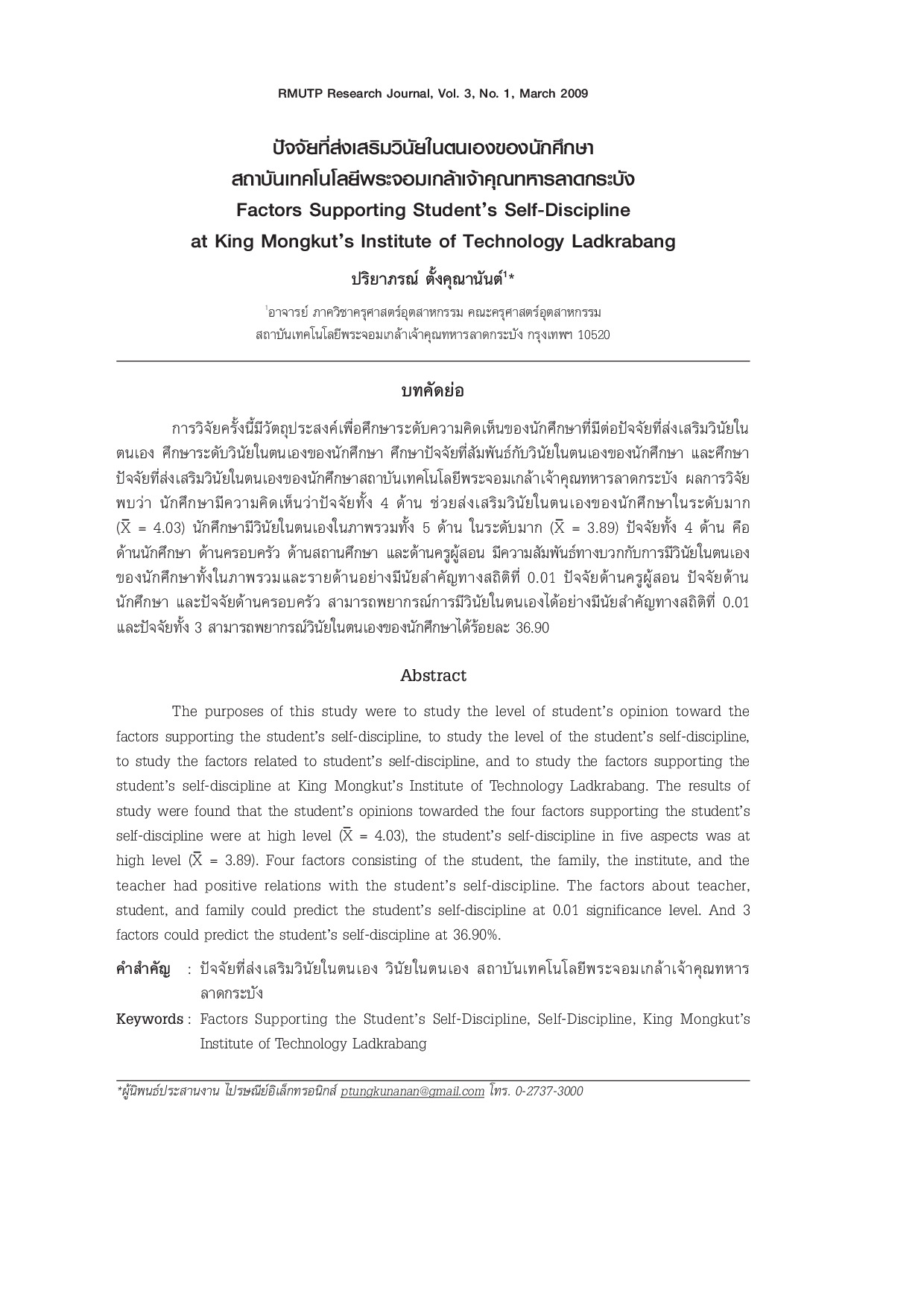
Factors Supporting Student’s Self-Discipline at King Mongkut’s Institute of Technology Ladkrabang
The purposes of this study were to study the level of student’s opinion toward the factors supporting the student’s self-discipline to study the level of the student’s self-discipline to study the factors related to student’s self-discipline and to study the factors supporting the student’s self-discipline at King Mongkut’s Institute of Technology Ladkrabang. The results of study were found that the student’s opinions towarded the four factors supporting the student’s self-discipline were at high level (X = 4.03) the student’s self-discipline in five aspects was at high level (X = 3.89). Four factors consisting of the student the family the institute and the teacher had positive relations with the student’s self-discipline. The factors about teacher student and family could predict the student’s self-discipline at 0.01 significance level. And 3 factors could predict the student’s self-discipline at 36.9%.