จำนวน Repository ( 3447 )
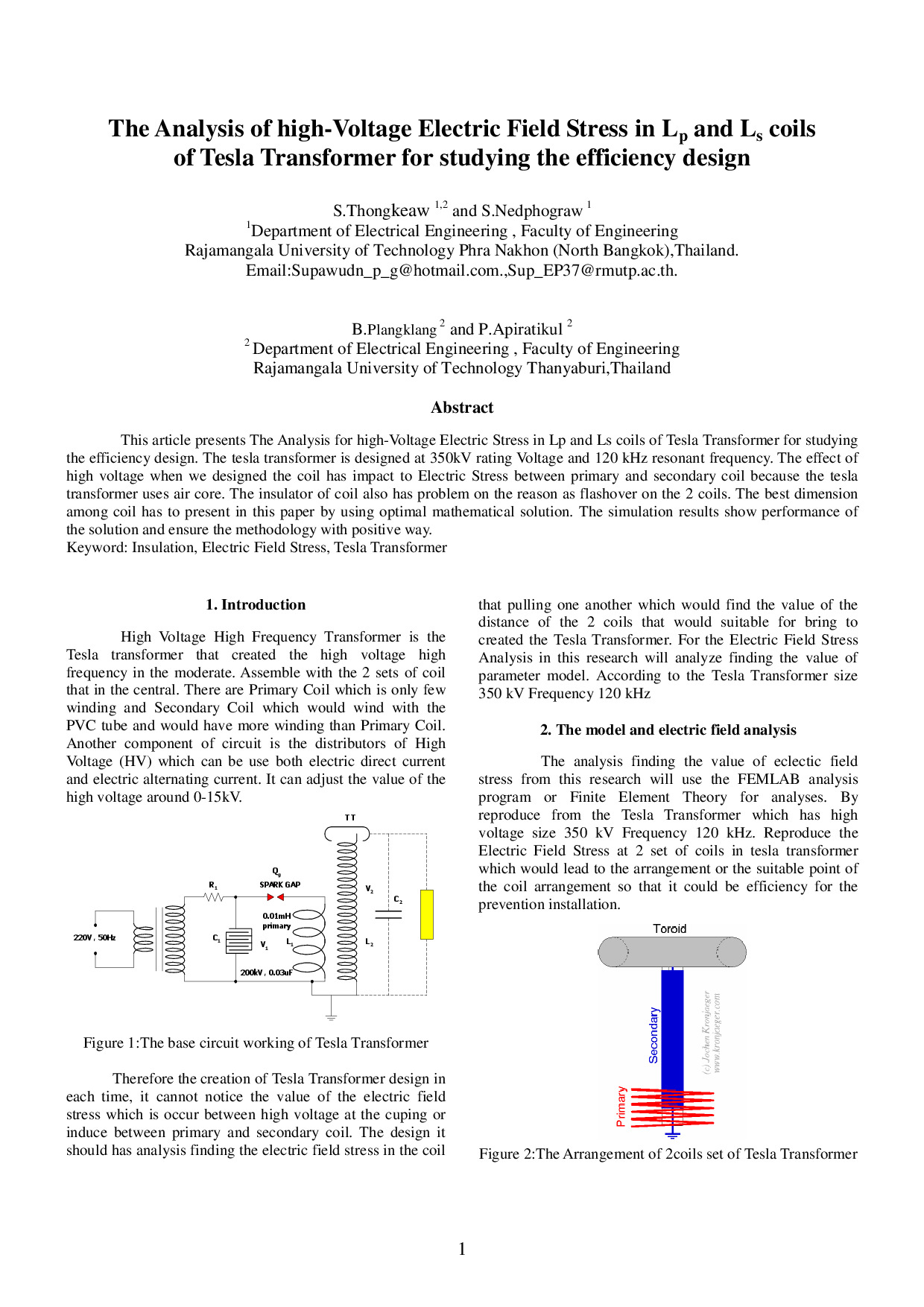
The Analysis of high-Voltage Electric Field Stress in Lp and Ls coils of Tesla Transformer for studying the efficiency design
This article presents The Analysis for high-Voltage Electric Stress in Lp and Ls coils of Tesla Transformer for studying the efficiency design. The tesla transformer is designed at 350kV rating Voltage and 120 kHz resonant frequency. The effect of high voltage when we designed the coil has impact to Electric Stress between primary and secondary coil because the tesla transformer uses air core. The insulator of coil also has problem on the reason as flashover on the 2 coils. The best dimension among coil has to present in this paper by using optimal mathematical solution. The simulation results show performance of the solution and ensure the methodology with positive way.
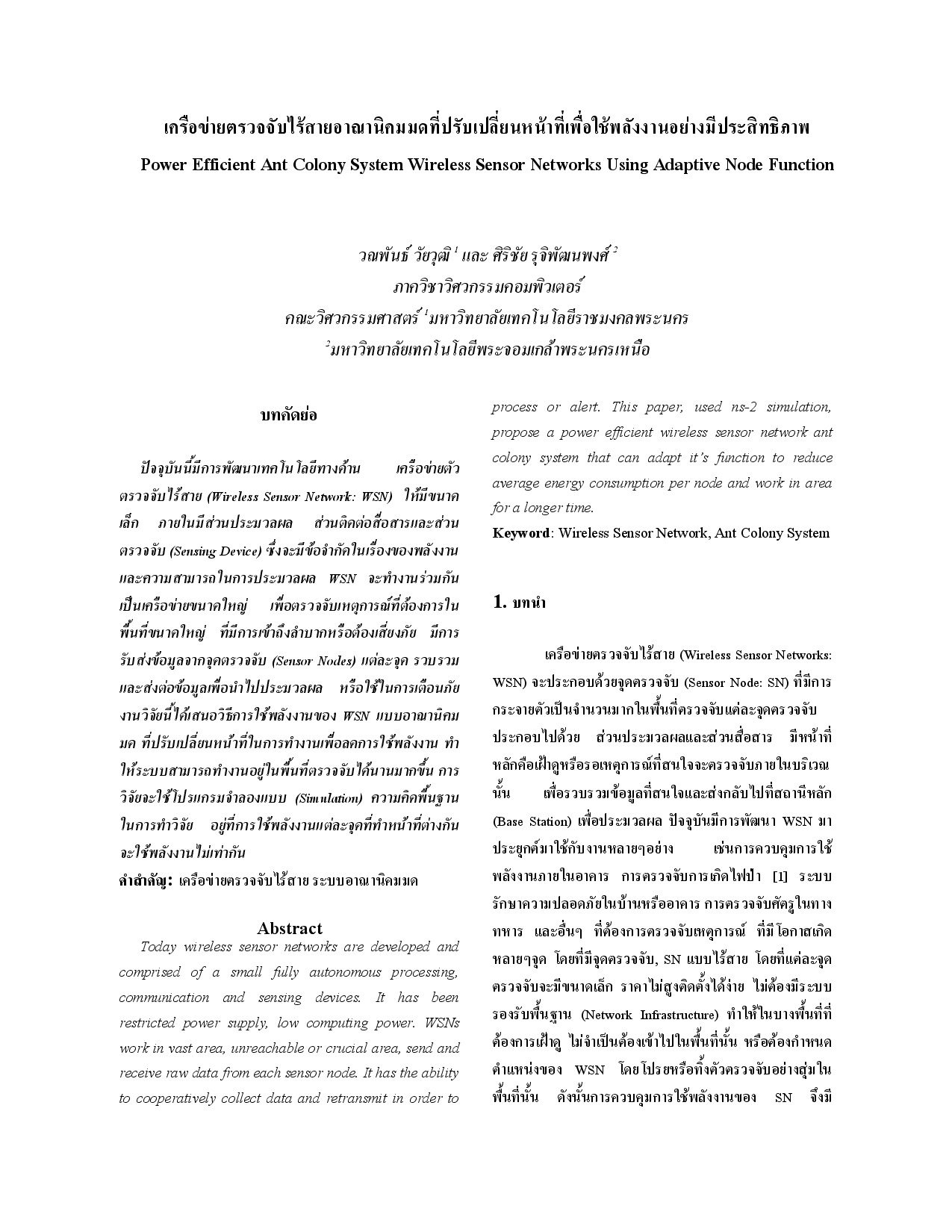
Power Efficient Ant Colony System Wireless Sensor Networks Using Adaptive Node Function
Today wireless sensor networks are developed and comprised of a small fully autonomous processing communication and sensing devices. It has been restricted power supply low computing power. WSNs work in vast area unreachable or crucial area send and receive raw data from each sensor node. It has the ability to cooperatively collect data and retransmit in order to process or alert. This paper used ns-2 simulation propose a power efficient wireless sensor network ant colony system that can adapt it’s function to reduce average energy consumption per node and work in area for a longer time.
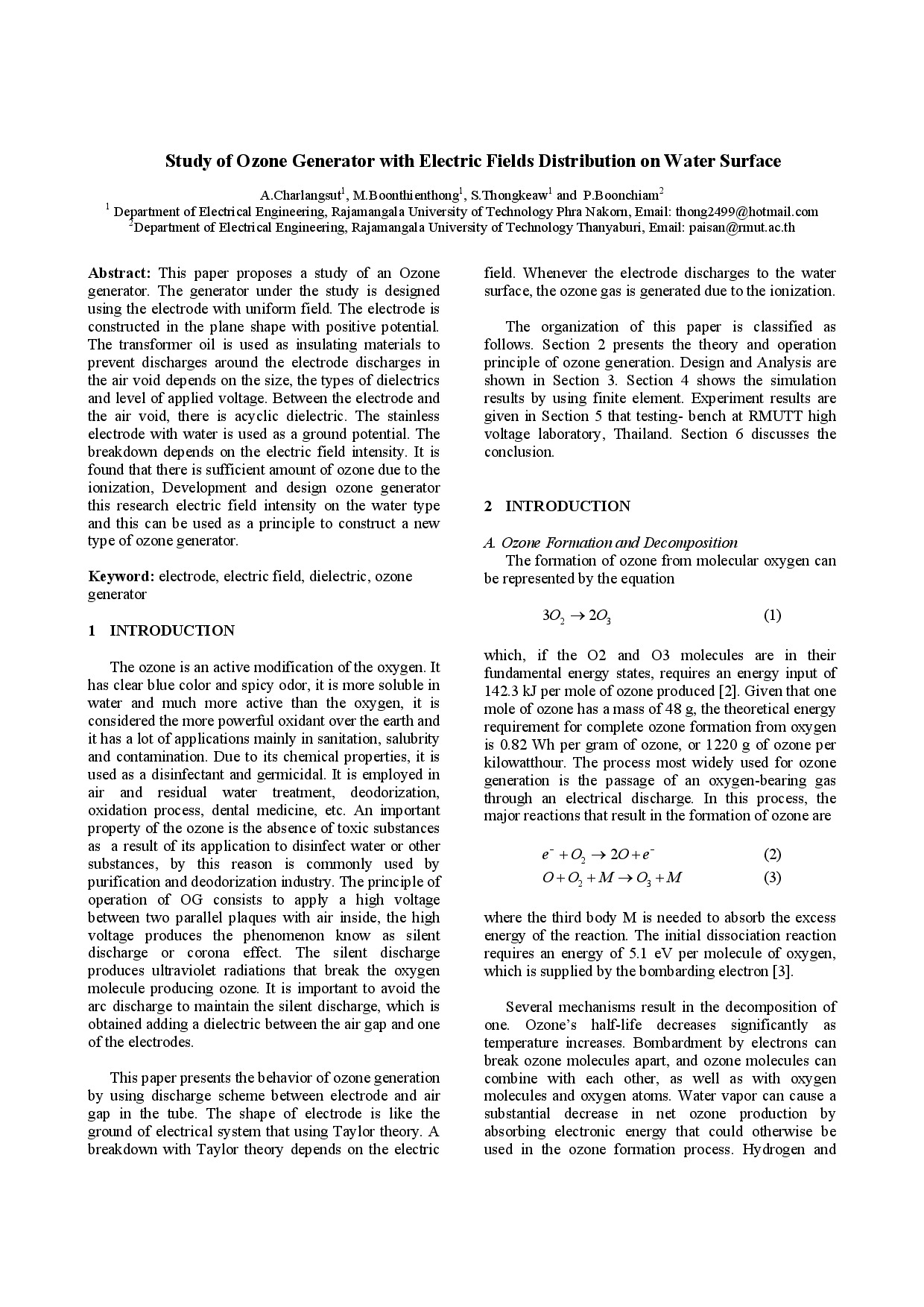
Study of Ozone Generator with Electric Fields Distribution on Water Surface
This paper proposes a study of an Ozone generator. The generator under the study is designed using the electrode with uniform field. The electrode is constructed in the plane shape with positive potential. The transformer oil is used as insulating materials to prevent discharges around the electrode discharges in the air void depends on the size the types of dielectrics and level of applied voltage. Between the electrode and the air void there is acyclic dielectric. The stainless electrode with water is used as a ground potential. The breakdown depends on the electric field intensity. It is found that there is sufficient amount of ozone due to the ionization Development and design ozone generator this research electric field intensity on the water type and this can be used as a principle to construct a new type of ozone generator.

Development of Classified Fly Ash as a Pozzolanic Material
This research studies the potential for using classified fly ash from Mae Moh power plant in Thailand as a pozzolanic material. Three different fly ash finenesses viz. coarse Original Fly Ash (OFA) Medium Fly Ash (MFA) and Fine Fly Ash (FFA) were used for the study. Ordinary Portland Cement (OPC) was partially replaced with fly ash at 20 and 40% by weight of binder. The water to binder ratio was kept constant at 0.5 and the flow of mortar was maintained at 110±5% with the aid of superplasticizer (SP). Compressive strength carbonation depth and porosity test of mortars were determined. FFA has a high potential to be used as a good pozzolanic material. The use of FFA produces mortars with good strength and low porosity. The resistance to carbonation of mortar improves with partial replacement of FFA in comparison with the normal coarse fly ash. The use of FFA results in a strong and dense mortar which is due to better dispersion and filling effect as well as an increase in the pozzolanic reaction.
Use of waste ash from various by-product materials in increasing the durability of mortar
This paper presents a study on the strength and corrosion resistance of mortars made with binary blends of ordinary Portland cement (OPC) and ground rice husk ash (RHA) or ground palm oil fuel ash (POA). The mortar mixtures were made with Portland cement Type I containing 0-40% RHA and POA. RHA and POA with 1-3% by weight retained on a sieve No.325 were used. The water to binder ratio was kept constant at 0.5 and the flow of mortar was maintained at 110±5% with the aid of superplasticizer (SP). Scanning electron microscopy (SEM) was used for analysis. The compressive strength chloride penetration and corrosion resistance of the mortar were determined. The results show that strength as well as the resistance of mortar to chloride and corrosion can be improved by blending with RHA and POA. Thus RHA and POA have a high potential to be used as a good pozzolanic material.