จำนวน Repository ( 3447 )
การศึกษาและพัฒนาเครื่องอบกระดาษใบสับปะรดพลังงานแสงอาทิตย์ร่วมกับฮีตเตอร์
This research was aimed to investigate for pineapple leaf paper drying. In this study process of drying the paper as a final step after the other. Paper drying time takes in solar energy to dry naturally for at least 2-3 days or more without natural sunshine. Solar hybrid energy dryer was designed for drying faster than traditional drying. The development of solar hybrid energy dryer ability to operate continuously. The solar dryer receives the heat from sunshine by passing into the solar panel dimension 1 x 2.6 m2 . The panel was installed on the top of the oven which declined 15 degree from the ground. The dimension of the oven is 1 x 1.05 x 1.30 m3 and have added heat to paraphrase another 2 rooms and heater 4 kW with controller and have added heat to paraphrase another 2 rooms. The dryer installed heater 4 kW with temperature controller and blower 0.22 kW serves as the circulation of heat in the oven to constant flow of 0.138 m3 / s. Experiment research test 3 types ; the use of solar energy alone the use of solar heater with a temperature of 50 55 and 60 °C and the heater only at 50 55 and 60 °C with three temperature settings. The variables in the study such as temperature humidity in the dryer humidity and Solar energy affect the pineapple leaf paper drying time. Experimental results from solar heater hybrid with 60 °C temperature setting was dried in minimum period of 3 hours and half at an average initial moisture content 1043.70% db to the final moisture content of 9.12% db. Highest average temperature in the dryer was 64.33 °C with electrical energy consumption 10.5 kWh. The use of only solar drying was dried in maximum period of 5 hours at an average initial moisture content 1070.98% db to the final moisture content of 15.84% db. Highest average temperature in the dryer was 39.89 °C with minimum electrical energy consumption 10.5 kWh.
การพัฒนาผลิตภัณฑ์ขนมไทยจากพืชสมุนไพรพื้นบ้าน
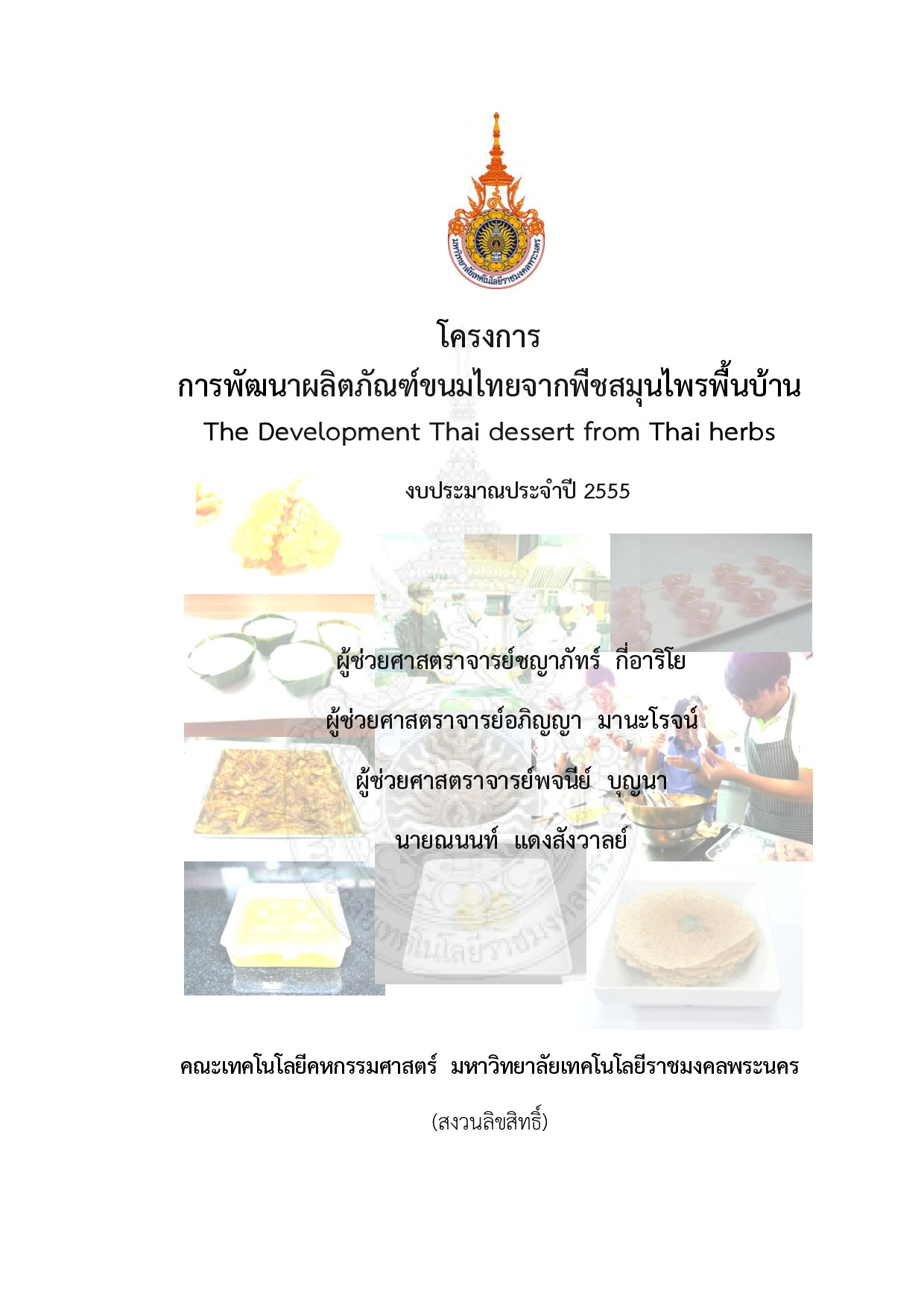
The studies of original recipes of Thai desserts were modified and developed by local Thai herb. There are eight kinds of Thai dessert were selected such as Ta – Ko Mao-Kang (Thai baked custard) Shung–Ha-Ya (Thai streamed custard) Toa-Pap Krob-Kim Ka-Nom-Tom Ka-Nom-Tein-Kaew and Kaow-Tung-Sa-Wey which were developed by dried sweet bael fruit Curcuma powder Mashed lemongrass and Mashed ginger. A result was found that Ta – ko substitution water chestnut from dried sweet bael fruit (marmelos) in level of bael fruit was 100 125 and 150 % by weight of water chestnut. The food expertises like substitution dried sweet bael fruit with 125 % in moderate level. The majority of consumer 85% accepted Ta –ko with 125% of dried sweet bael fruit. Mao-kang was added dried sweet bael fruit in levels of bael fruit was 10 20 and 30% by total weight. The food expertises like added sweet bael fruit with 20% in moderate level. The majority of consumer 95% accepted Maokang with 20 % of dried sweet bael fruit. Shung–ha-ya was added curcuma powder in levels of curcuma powder was 0.5 0.75 and 1% by total weight. The food expertises like added curcuma powder with 0.5% in moderate level. The majority of consumer 81% accepted shung–ha-ya with 0.5% of curcuma powder. Ka-nom-Toa-pap was added curcuma powder in levels of curcuma powder was 1 2 and 3% by total weight. The food expertises like added curcuma powder with 2% in moderate level. The majority of consumer 84% accepted ka-nom-Toa-papwith 2% of curcuma powder. Krob-kim was added mashed lemongrass in levels of mashed lemongrass was 6 8 and 10% by total weight. The food expertises like added mashed lemongrass with 10% in moderate level. The majority of consumer 94% accepted Krob-kim with 10% of mashed lemongrass. Ka-nom-Tom was added mashed lemongrass in levels of mashed lemongrass was 10 15 and 20% by total weight. The food expertises like added mashed lemongrass with 15% in moderate level. The majority of consumer 87% accepted Ka-nom-Tom with 15% of mashed lemongrass. Ka-nom-tein-kaew and kaow-tung-sa-wey was added mashed ginger in levels of mashed ginger was 4 8 and 12% by total weight. The food expertises like added mashed ginger 4% in two products. They like in moderate level. The majority of consumer 79 % accepted Ka-nom-tein-kaew and 93% accepted kaowtung-sa-wey with 4% mashed ginger.

ขนมปังหวานเสริมเนื้อตาลสุก
This research had the following objectives: to study 1) basic sweet bread recipe 2) proper amount of ripe palm fruit pulp for production 3) proper amount of yeast for production 4) product acceptance and 5 of ripe palm fruit pulp added sweet bread was and 5) evaluation of product using sensory test. 4 levels of amount ripe palm fruit pulp were 15 20 25 and 30 percent. 4 levels of amount of yeast were 0.6 1.0 1.4 and 1.8 percent of dough weight. Experiment used Randomized Complete Block Design Average values were analyzed using Analysis of variances and the difference of average values were compared by Duncan’s New Multi Range Test using ready made statistical programs. Acceptance of ripe palm fruit pulp added sweet bread product was evaluated using satisfactory of color oder flavor texture and overall satisfaction 100 evaluators did acceptance test using consumer test and 7 days shelf life was studied
การผลิตแผ่นผนังภายในอาคารที่ทำจากวัสดุเหลือทิ้งจากต้นสบู่ดำ
ในการวิจัยครั้งนี้ มีวัตถุประสงค์เพื่อนาเอาต้นสบู่ดา ไปผลิตเป็นแผ่นผนัง ซึ่งเป็นการนาเศษวัสดุเหลือใช้ทางการเกษตรมาใช้ให้เกิดประโยชน์ ด้วยเหตุนี้ผู้วิจัยจึงเห็นว่าน่าจะนาเอาพืชดังกล่าวไปผลิตเป็นแผ่นผนังภายในอาคารแล้วทดสอบตาม มาตรฐานผลิตภัณฑ์อุตสาหกรรม แผ่นชิ้นไม้อัดชนิดอัดราบ (มอก. 876-2547)ได้แก่ การทดสอบหาค่าความชื้น ความหนาแน่น การดูดซึมและการพองตัวเมื่อแช่น้า หาค่าแรงยึดเหนี่ยวภายใน หรือแรงดึงตั้งฉากกับผิวหน้า และทดสอบหาค่าความต้านทานแรงดัดและมอดูรัสยืดหยุ่น โดยทาการทดลองที่สัดส่วนระหว่างต้นสบู่ดากับกาวยูเรียฟอร์มาลดีไฮล์ที่ 85:15 87:13 89:11 91:9 93:7 และ 95:5 ผลการทดลองพบว่า ขนาดของสบู่ดาที่ใช้อัดขึ้นรูปเป็นแผ่นควรไม่เกิน 2 ซม. สัดส่วนที่เหมาะสม ได้แก่ 89:11 (สัดส่วนระหว่างต้นสบู่ดา 89%ผสมกับกาวยูเรียฟอร์มาลดีไฮล์ 11 %) อุณหภูมิที่ใช้ในการอัดอยู่ที่ 120 องศาเซลเซียส ความหนาแน่นที่เหมาะสมในการอัดแผ่นเท่ากับ 0.80 กรัมต่อลูกบาศก์เซนติเมตร ปริมาณความชื้นก่อนอัดเฉลี่ยอยู่ที่ 8.89% แรงอัดที่เหมาะสมอยู่ที่ 150 ปอนด์ต่อตารางนิ้ว ค่าความชื้นอยู่ 7.64%ค่าความหนาแน่น อยู่ที่ 0.817กรัมต่อลบ.ซม. การพองตัวเมื่อแช่น้าที่ 2 ชม. อยู่ที่ 8.01% การดูดซึมน้าเมื่อแช่น้าที่ 2 ชม อยู่ที่ 14.22% แรงยึดเหนี่ยวภายในอยู่ที่ 0.56 MPa เมกกะปาสคาล ค่าความต้านทานแรงดัด อยู่ที่ 22.36เมกกะปาสคาล(MPa) ค่ามอดุลัสยืดหยุ่นอยู่ที่ 2112 เมกกะปาสคาล (MPa) ซึ่งผลการทดสอบอยู่ในเกณฑ์ตามมาตรฐานผลิตภัณฑ์อุตสาหกรรม แผ่นปาร์ติเคิลบอร์ด (มอก. 876-2547) กล่าวโดยสรุปคือต้นสบู่ดาสามารถนาไปผลิตเป็นแผ่นผนังภายในอาคารได้
การพิมพ์สีธรรมชาติจากเปลือกลูกจากแห้ง
The aim of this research is to study white and colour resist printing of dye extracted from dry nipa palm shell. The printing recipes and fixation condition were studied in this work. The result of white resist printing showed that 30 % owp of sodium carbonate (Na2CO3) was used to be a resisting agent. The steam fixation for 15 minutes was suitable to show a good white resist printing in whiteness and sharpness of printing pattern. The whiteness value was 35.05. The washing and rubbing fastness were good to very good and light fastness was fair. The tensile strengths of warp and weft directions were decreased to 10.29 % and 4.25 % respectively. The colour resist printing was using Curcuma longa Linn. powder as illuminant dye. The dye was miscible in 30 % owp of sodium carbonate. The colour resist printing results were corresponding as white resist printing results. The 15 minute of steam fixation showed a good colour resist printing. The Curcuma longa Linn dye could be fixed on silk fabric and showed a good colour strength and sharpness of pattern. The washing and rubbing fastness were good to very good. And light fastness was fair. The tensile strengths of warp and weft directions were decreased to 18.37 % and 4.18 % respectively.