จำนวน Repository ( 484 )
โครงการวิจัยและพัฒนาผลิตภัณฑ์อุปโภค-บริโภคจากวัสดุเหลือใช้ที่ได้จากการผลิตของโรงงานอุตสาหกรรมขนาดเล็กถึงขนาดกลาง
ผลการศึกษาพบว่า สูตรที่เหมาะสมของเครื่องดื่มนมผสมน้ําผลไม้แท้ 100% พาสเจอไรส์ ประกอบด้วย นมรีโพรเซส 10% น้ําสับปะรดและน้ําลิ้นจี่ชนิดละ 45 % เพคตินชนิด High-methoxy 0.55% และน้ําตาล 1% ผลิตภัณฑ์มีค่าสี2.5Y-5Y 9/2-4 ค่าpH 3.5±0.5 ค่าปริมาณของแข็งที่ละลายน้ําได้ทั้งหมด 13.5±1 องศาบริกซ์ พาสเจอร์ไรส์ที่อุณหภูมิ72 องศาเซลเซียส นาน 15 วินาที เก็บที่อุณหภูมิ 6±1 องศาเซลเซียสได้เป็นเวลา 8 วัน มีโปรตีน 2.8กรัม ไขมัน 2.1กรัมคาร์โบไฮเดรต 8.8 กรัม แคลเซียม 21 มิลลิกรัม และให้พลังงาน 65.3 กิโลแคลอรี่/100 มิลลิลิตร นอกจากนี้ยังพบว่า ผู้บริโภคให้การยอมรับผลิตภัณฑ์ด้วยคะแนนในระดับมากกว่า 7 (ชอบปานกลาง)
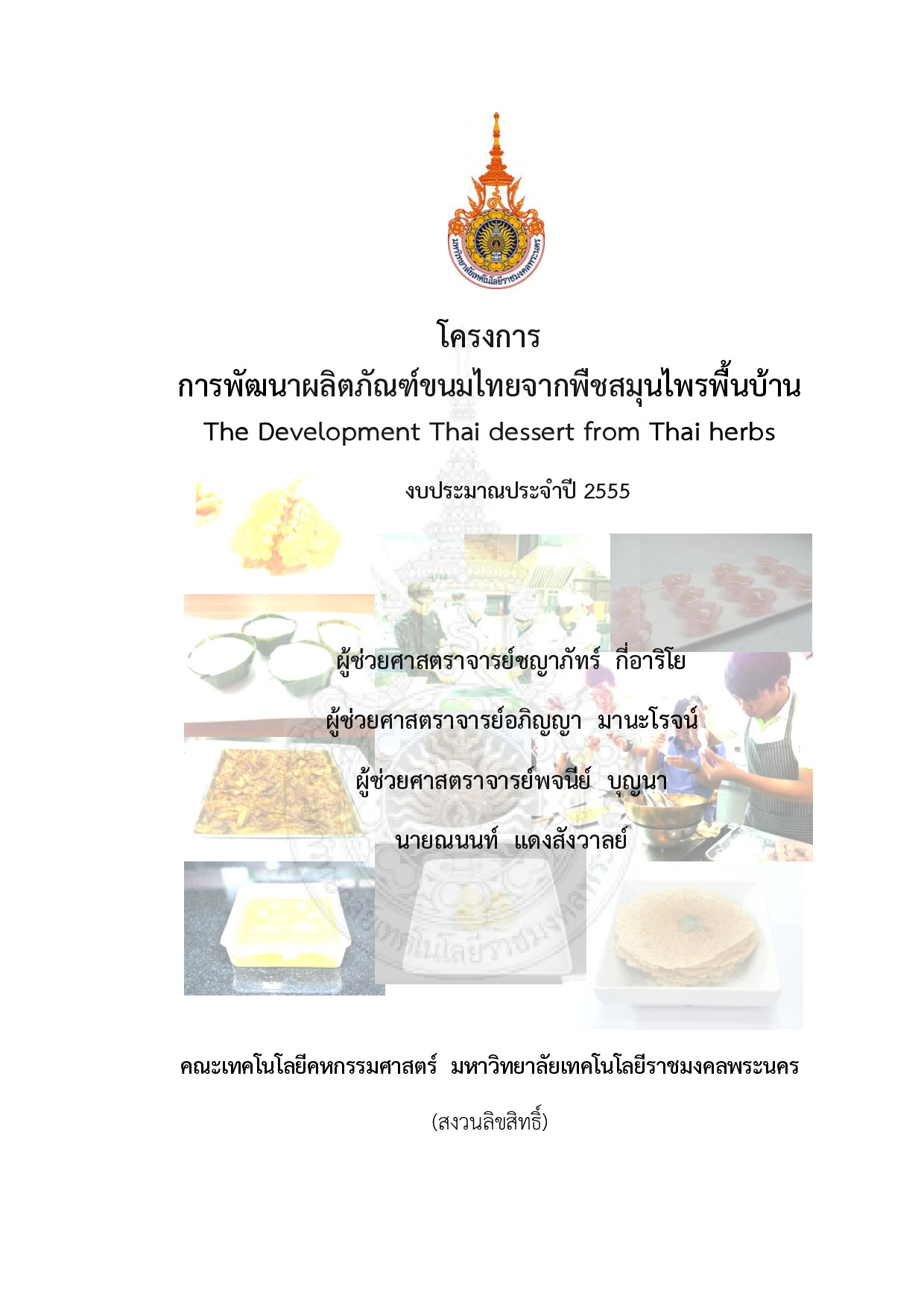
การพัฒนาผลิตภัณฑ์ขนมไทยจากพืชสมุนไพรพื้นบ้าน
The studies of original recipes of Thai desserts were modified and developed by local Thai herb. There are eight kinds of Thai dessert were selected such as Ta – Ko Mao-Kang (Thai baked custard) Shung–Ha-Ya (Thai streamed custard) Toa-Pap Krob-Kim Ka-Nom-Tom Ka-Nom-Tein-Kaew and Kaow-Tung-Sa-Wey which were developed by dried sweet bael fruit Curcuma powder Mashed lemongrass and Mashed ginger. A result was found that Ta – ko substitution water chestnut from dried sweet bael fruit (marmelos) in level of bael fruit was 100 125 and 150 % by weight of water chestnut. The food expertises like substitution dried sweet bael fruit with 125 % in moderate level. The majority of consumer 85% accepted Ta –ko with 125% of dried sweet bael fruit. Mao-kang was added dried sweet bael fruit in levels of bael fruit was 10 20 and 30% by total weight. The food expertises like added sweet bael fruit with 20% in moderate level. The majority of consumer 95% accepted Maokang with 20 % of dried sweet bael fruit. Shung–ha-ya was added curcuma powder in levels of curcuma powder was 0.5 0.75 and 1% by total weight. The food expertises like added curcuma powder with 0.5% in moderate level. The majority of consumer 81% accepted shung–ha-ya with 0.5% of curcuma powder. Ka-nom-Toa-pap was added curcuma powder in levels of curcuma powder was 1 2 and 3% by total weight. The food expertises like added curcuma powder with 2% in moderate level. The majority of consumer 84% accepted ka-nom-Toa-papwith 2% of curcuma powder. Krob-kim was added mashed lemongrass in levels of mashed lemongrass was 6 8 and 10% by total weight. The food expertises like added mashed lemongrass with 10% in moderate level. The majority of consumer 94% accepted Krob-kim with 10% of mashed lemongrass. Ka-nom-Tom was added mashed lemongrass in levels of mashed lemongrass was 10 15 and 20% by total weight. The food expertises like added mashed lemongrass with 15% in moderate level. The majority of consumer 87% accepted Ka-nom-Tom with 15% of mashed lemongrass. Ka-nom-tein-kaew and kaow-tung-sa-wey was added mashed ginger in levels of mashed ginger was 4 8 and 12% by total weight. The food expertises like added mashed ginger 4% in two products. They like in moderate level. The majority of consumer 79 % accepted Ka-nom-tein-kaew and 93% accepted kaowtung-sa-wey with 4% mashed ginger.
การเสริมใยอาหารในผลิตภัณฑ์มาการองด้วยรำข้าวสังข์หยด
The objective of this research to study the three formula basic of macarons amount of Sangyod Rice Bran usage in macarons product and nutritional composition of macarons product. The sensory evaluate of three formula of macarons the second and the third formula basic macarons non-significant in odor liking ( P< ) . However the three formulas are significant in appearance color liking odor liking taste liking texture liking a nd overall liking ( P> ). When consideration in average score 3rd formula of macarons acceptable that the most one formula. Therefore the third formula used to determine the proper amount of Sangyod Rice Bran to add on macarons in the next step. For the Enhancing of Sangyod Rice Bran in macarons. The three levels as follow; added Sangyod Rice Bran for % % and % of all total weight. The taster remains to accept all sample of Sangyod Rice Bran in macarons. Especially at the % of Sangyod Rice Bran to added in macarons to the highest acceptance . However the resulted of added Sangyod Rice Bran at % to decrease in the appearance and overall liking of macarons .Therefore supplementation of fiber in macarons product with Sangy od Rice Bran is not affectin macarons. Furturemore spicies and amount of other bran for macarons production should be intensive studied.
การเสริมใยอาหารในผลิตภัณฑ์มาการองด้วยรำข้าวสังข์หยด
The objective of this research to study the three formula basic of macarons amount of Sangyod Rice Bran usage in macarons product and nutritional composition of macarons product. The sensory evaluate of three formula of macarons the second and the third formula basic macarons non-significant in odor liking (P<). However the three formulas are significant in appearance color liking odor liking taste liking texture liking and overall liking (P>). When consideration in average score 3rd formula of macarons acceptable that the most one formula. Therefore the third formula used to determine the proper amount of Sangyod Rice Bran to add on macarons in the next step. For the Enhancing of Sangyod Rice Bran in macarons. The three levels as follow; added Sangyod Rice Bran for % % and % of all total weight. The taster remains to accept all sample of Sangyod Rice Bran in macarons. Especially at the % of Sangyod Rice Bran to added in macarons to the highest acceptance. However the resulted of added Sangyod Rice Bran at % to decrease in the appearance and overall liking of macarons. Therefore supplementation of fiber in macarons product with Sangyod Rice Bran is not affect in macarons. Furturemore spicies and amount of other bran for macarons production should be intensive studied.
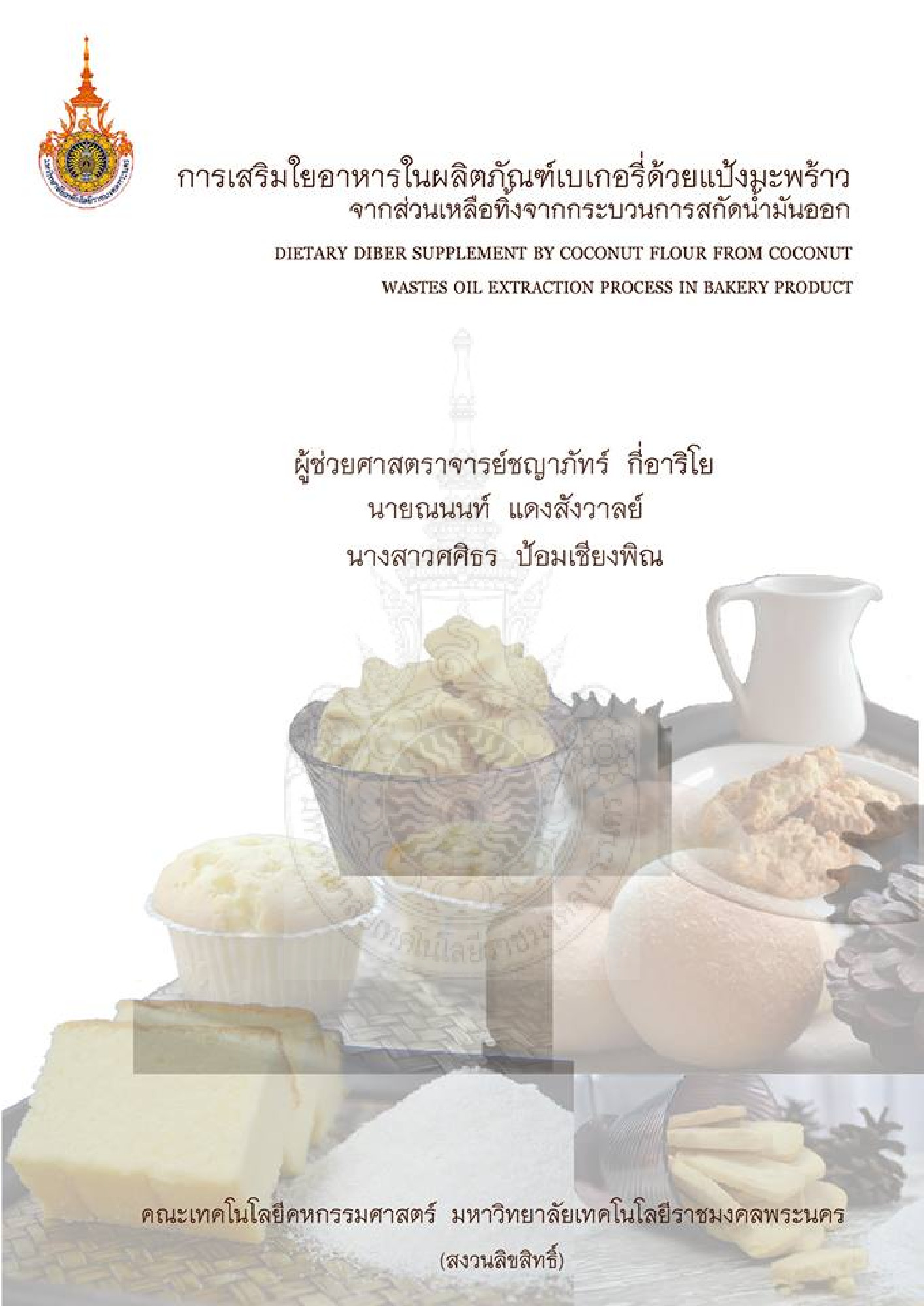
การเสริมใยอาหารในผลิตภัณฑ์เบเกอรี่ด้วยแป้งมะพร้าวจากส่วนเหลือทิ้งจากกระบวนการสกัดน้ำมันออก
The studies of Dietary Fiber Supplement by coconut flour from coconut Wastes Oil Extraction process in Bakery Product was investigated Production of coconut flour from coconut wastes oil extraction drying at 55 ° C for 12 hours and then grinding to powder gave the off-white fine powder. The chemical compositions of coconut flour were 57.70 % carbohydrate 29.4 % fat 6.23 % moisture 5.20 % protein and 1.48 % ash by dye weigh. Butter cake making experiment by substitution of wheat flour with coconut flour at 5 % of wheat flour weigh which has the highest sensory scores comparing butter cake with the control found that increase dietary fiber 1.34 g. /100 g. The majority of the tested consumers (92%) accepted butter cake with 5 % of coconut flour substitution. Muffin making experiment by substitution of wheat flour with coconut flour at 15 % of wheat flour weigh which has the highest sensory scores comparing muffin with the control found that increase dietary fiber 2.34 g /100 g. The majority of the tested consumers (81%) accepted muffin with 15 % of coconut flour substitution. Cornflake cookie making experiment by substitution of wheat flour with coconut flour at 20 % of wheat flour weigh which has the highest sensory scores comparing cornflake cookie with the control found that increase dietary fiber 3.54 g. /100 g. The majority of the tested consumers (94 %) accepted cornflake cookie with 20 % of coconut flour substitution. Butter cookie making experiment by substitution of wheat flour with coconut flour at 10 % of wheat flour weigh which has the highest sensory scorescomparing butter cookie with the control found that increase dietary fiber 3.04 g. /100 g. The majority of the tested consumers (94 %) accepted Butter cookie with 10 % of coconut flour substitution. Frozen cookie making experiment by substitution of wheat flour with coconut flour at 20 % of wheat flour weigh which has the highest sensory scores comparing cookie with the control found that increase dietary fiber 4.02g. /100 g. The majority of the tested consumers (93 %) accepted 20 % of coconut flour substitution. Butter bread making experiment by substitution of wheat flour with coconut flour at 15 % of wheat flour weigh which has the highest sensory scores comparing butter bread with the control found that increase dietary fiber 2.22 g. /100 g. The majority of the tested consumers (75 %) accepted 15% of coconut flour substitution. Whole wheat bread making experiment by substitution of wheat flour with coconut flour at 15 % of wheat flour weigh which has the highest sensory scores comparing whole wheat bread with the control found that increase dietary fiber 2.09 g. /100 g. The majority of the tested consumers (79 %) accepted 15 % of coconut flour substitution. Pie crust making experiment by substitution of wheat flour with coconut flour at 15 % of wheat flour weigh which has the highest sensory scores comparing pie crust with the control found that increase dietary fiber 2.91 g. /100 g. The majority of the tested consumers (82 %) accepted 15 % of coconut flour substitution.