จำนวน Repository ( 3447 )
Green Power Zone
This paper presents the concept prospect and operation of Green Power Zone (GPZ). The GPZ is defined as part of power grid which provides electrical energy with varying quality depends on customer requirement. Different power quality levels in the premium zone can rang from better than normal utility supply to a supply close to an ideal situation. Electrical energy to the zone is supplied through two feeders from two independent substations. The GPZ center is fully equipped with custom power devices namely dynamic voltage restorer (DVR) and distribution static compensator (DSTATCOM) or even unified power quality conditioner (UPQC). The GPZ can also contain a distributed generator (DG) to take care the power interruption situations from the utility. The incoming feeders to the zone can be designed with improved grounding insulation arresters and reclosing. The simulation results are shown the performance of GPZ by using digital computer simulation program.
The Potential of Plant Essential Oils as Biofumigant Agains Fungal Pathogens of Postharvest Tomato
However recognized as more sustainable and safer way for crop production organic agriculture is still facing many technical difficulties. One of the problems is concerning the management of posthavest disease caused by fungal pathogens. Since the applications of synthetic fungicides are prohibited thus organically produced crops are more vulnerable to be attacked by pathogens. Therefore the development of novel reliable and more compliant technologies for diseases management are required. The aim of this study was to demonstrate the potential use of plant essential oils as biofumigant to control of fungal diseases of tomato during storage. We selected three essential oils including clove oil cinnamon oil and ajowan oil for this study. The in vitro test for antifungal activity showed that the volatile headspace of the three oils exhibited potent effect on the test pathogens which includes Botrytis cinerea Fusaruim oxysporum and Aspergillus niger. Then ajowan oil which showed highest inhibitory effect was further evaluated for its effectiveness when applied as biofumigant. Results from the experiment indicated that fumigation with ajowan oil can reduce the occurrence gray mold decay of tomato (caused by B. cinerea) significantly. The rate of control was up to 100 % during fifteen days of storage at 20 ºC. These results support the idea of using the essential oil as biofumigant for protection of postharvest tomato from fungal diseases. However further comprehensive studies are still required especially on the issues concerning the reliability and eco-efficiency of this method at trial and commercial level.
แผ่นเกราะโลหะกันกระสุน
This research project aimed to analyze and design the pattern of a bulletproof metal armor plate as well as build a bulletproof metal armor plate for a small armored regular truck. The methodology consisted of the NIJ standard test and the finite element analysis. The bulletproof plates created were tested for a real firing. Their firing results were compared with those of NIJ-standard using a finite element program in this case applying with the program Ansys/Explicit Dynamic. SolidWorks program is employed as a tool to design and create 3D models of armor plates and bullets. The materials taken in the finite element simulation were SKD11 and SUS304 and the parameters utilized in the research were material types hardness values spacing between the plates and thickness. In the case of two armor plates stacked SKD11 material was designed for the first armor plate to be hit by the bullet. It served to destroy bullets. In addition the second armor plate made of SUS304 material served to absorb energy and obstruct the movement of bullets. For testing a 30-06 caliber M2 AP 166 Gr bullet was selected at a 0-degree angle and the velocities measured and set by the Ansys/Explicit Dynamic program were 901.7 m/s and 880 m/s respectively. The front plate made of SKD11 material with a thickness of 10 mm and the back plate made of SUS304 material with a thickness of 10 mm were fired 1 shot. The results showed that the bullet could penetrate the front armor plate but not penetrate the back-armor plate. In the NIJ 3 standard tests the shooting with a 7.62x51 mm NATO FMJ 148 Gr shell at a 0-degree angle for 5 times with velocities equal to 846.4 841.3 839.1 838.2 and 845.3 m/s was performed on the stacking front and back armor plates both made of SUS304 material with a thickness of 8 mm. The bullet velocity simulated by the Ansys program was 847 m/s resulting in the front plate having a bullet penetration and a slight bulge on the back plate. From the finite element simulation results and the actual test results it was found that the damage to the armor plates detected by both methods was consistent. Therefore the finite element program was selected to simulate the damage of armor plates resistant to penetration according to the NIJ standard Level 4. The results of the research could be concluded that the use of armor plates stacked with suitable different materials in multiple layers would affect the penetration resistance. Increased thickness and optimal spacing between the armor plates were important parameters in penetration resistance. Moreover it revealed that the higher the material hardness the better its ability to resist penetration. In particular this suggestion should be applied to the first armor plate or front armor plate.
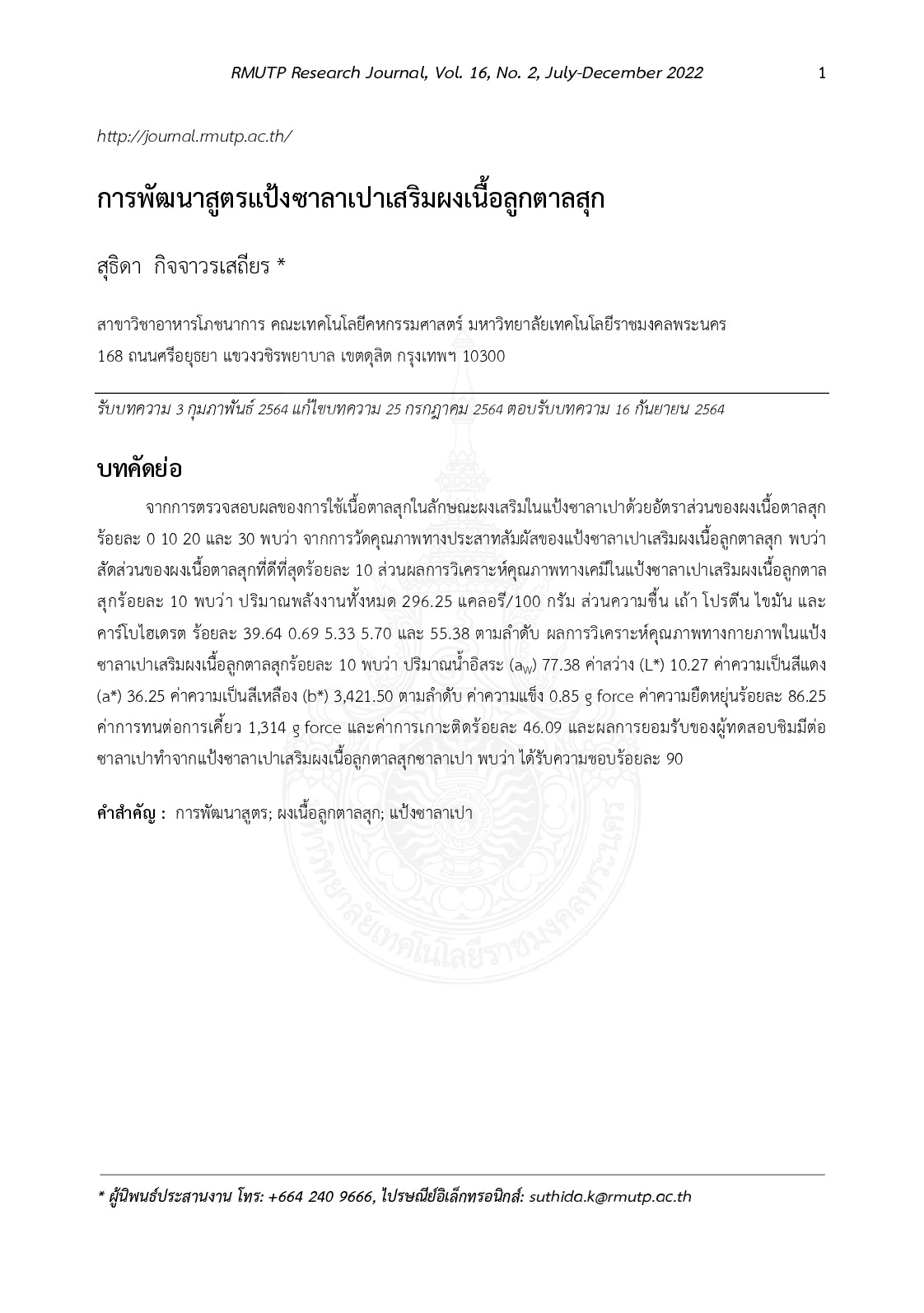
การพัฒนาสูตรแป้งซาลาเปาเสริมผลเนื้อลูกตาลสุก
The results of the using of toddy palm pulp powder form added to steamed buns using ratios of 0 10 20 and 30 %. It was found that from the sensory quality measurements of steamed buns by supplemented toddy palm pulp powder was 10%. As the results of chemical quality analysis of 10% steamed buns by supplemented toddy palm pulp powder was found that the total energy content was 296.25 calories per100g. the moisture ash protein fat and carbohydrate was 39.64 0.69 5.33 5.70 and 55.38 % respectively. The results of physical quality analysis of 10% steamed buns by supplemented toddy palm pulp powder showed that water activity (aw) 77.38 brightness (L*) 10.27 red (a*) 36.25 yellow (b*) 3421.50 respectively Hardness 0.85 g force Springiness 86.25 % Chewiness 1314 g force and Cohesiveness 46.09%. From consumer acceptance testing of 40 testers 90 % of them accepted in this product.