จำนวน Repository ( 952 )
การสร้างระบบการจัดการความเสียหายหม้อแปลงไฟฟ้ากำลังด้วยวิธีการจัดการอุตสาหกรรมอย่างยั่งยืน กรณีศึกษา บริษัท ถิรไทย จำกัด (มหาชน)
This research aimed to establish the power transformer fault management system by applying Sustainable Industrial Management Engineering (SIME.) method. The research tools were electrical and chemical testing. As power transformer is usually huge when it is damaged the possible way to manage such damage is to send such power transformer to the manufacturer’s plant for repair which requires long period of time and high costs of repair. As a result the researcher therefore establish the power transformer fault management system as a tool for assessing damage to decide whether power transformer repair should be instead done at the power station or not in order to decrease the number of power transformer returned to the manufacturing plant for repair. This would eventually help reduce costs and time for repairing power transformer and allows faster period of reuse of power transformer concomitantly. According to the result it would found that the power transformer fault management system by applying Sustainable Industrial Management Engineering (SIME) method could be used as guidance for decision making to have power transformers repaired at the power station as much as possible. This could help reduce average time spent for repair by 84.44 percent with the cost reduction by 68.62 percent when comparing to returning power transformers to the manufacturing plant. This could also be applied in planning for power transformer maintenance prior to the occurrence of any damage to power transformers further.
การพัฒนาแบบจำลองการเรียนการสอนคหกรรมศาสตร์โดยใช้การเรียนแบบผสมผสาน สำหรับนักศึกษามหาวิทยาลัยเทคโนโลยีราชมงคล
This research aimed to develop and evaluate a blended learning model for Home Economics students at Rajamangala University of Technology to increase teaching and learning effectiveness. The model development was collected from 9 experts. Questionnaires were used to ask for their opinions on the model’s 9 components which were 1) teaching and learning objectives 2) student readiness 3) instructor readiness 4) course plan 5) e-learning courseware design and development 6) teaching and learning environmental availability 7) Blended Learning instruction procedure 8) supportive activities and 9) monitoring and evaluation. To test for effectiveness the experimental one-group and pre-posttest method were used. The sampled group was a class of the first-year students enrolling in Science of Cookery Course at Rajamangala University of Technology Phra Nakhon. The findings suggested that the model was practical. Both the knowledge and self-directed learning post-test scores were higher than the pre-test scores. Moreover the students were highly satisfied with the model.
พฤติกรรมการใช้น้ำ และไฟฟ้าของนักศึกษาคณะเทคโนโลยีคหกรรมศาสตร์ มหาวิทยาลัยเทคโนโลยีราชมงคลพระนคร
The purposes of this research are to study: 1) understanding of water and electricity saving 2) water and electricity consumption behavior 3) to compare water and electricity consumption behavior classified by personal characteristics of the students Faculty of Home Economics Technology Rajamangala University of Technology Phra Nakhon. This research was descriptive research. The sample group was specified to be 325 people by stratified sampling. The reliability of this questionnaire is 0.87. Statistics used was descriptive and inferential statistics. The research result revealed that: 1) The overall of understanding and knowledge regarding electricity saving of the students is in the moderate level. 2) The overall of water and electricity consumption behavior of the students is in the moderate level. 3) The comparison of behavior of water and electricity consumption specified according to personal characteristics could be summarized that the students in different genders classes and majors had identical water consumption behavior and the students in different genders and classes had identical electricity consumption behavior. On the other hand the students having different majors had statistically different electricity consumption behavior at 0.05.
ความสัมพันธ์ระหว่างวัฒนธรรมองค์กรกับระบบบริหารทรัพยากรองค์กร (ERP) ของมหาวิทยาลัยเทคโนโลยีราชมงคลพระนคร
The purposes of this study were to 1) compare the perception on the organization culture of the personnel with different demographic personal background 2) compare the effectiveness of the Enterprise Resource Planning of the personnel with different demographic personal background and 3) study the relationship between the perception on the organization culture and the effectiveness of the enterprise resource planning.The results of the study revealed that in the overall1) The staff with the age difference perceived the organization culture differently while the staff’s genders marital statuses educational levels working periods and work departments showed no significance. 2) It was found that in the overall the staff with different ages perceived the effectiveness of the Enterprise Resource Planning differently but according to the staff’s educational levels positions and work departments showed no significant difference. 3) The personnel’s perception on the organization culture positively and highly related to the effectiveness of the Enterprise Resource Planning.
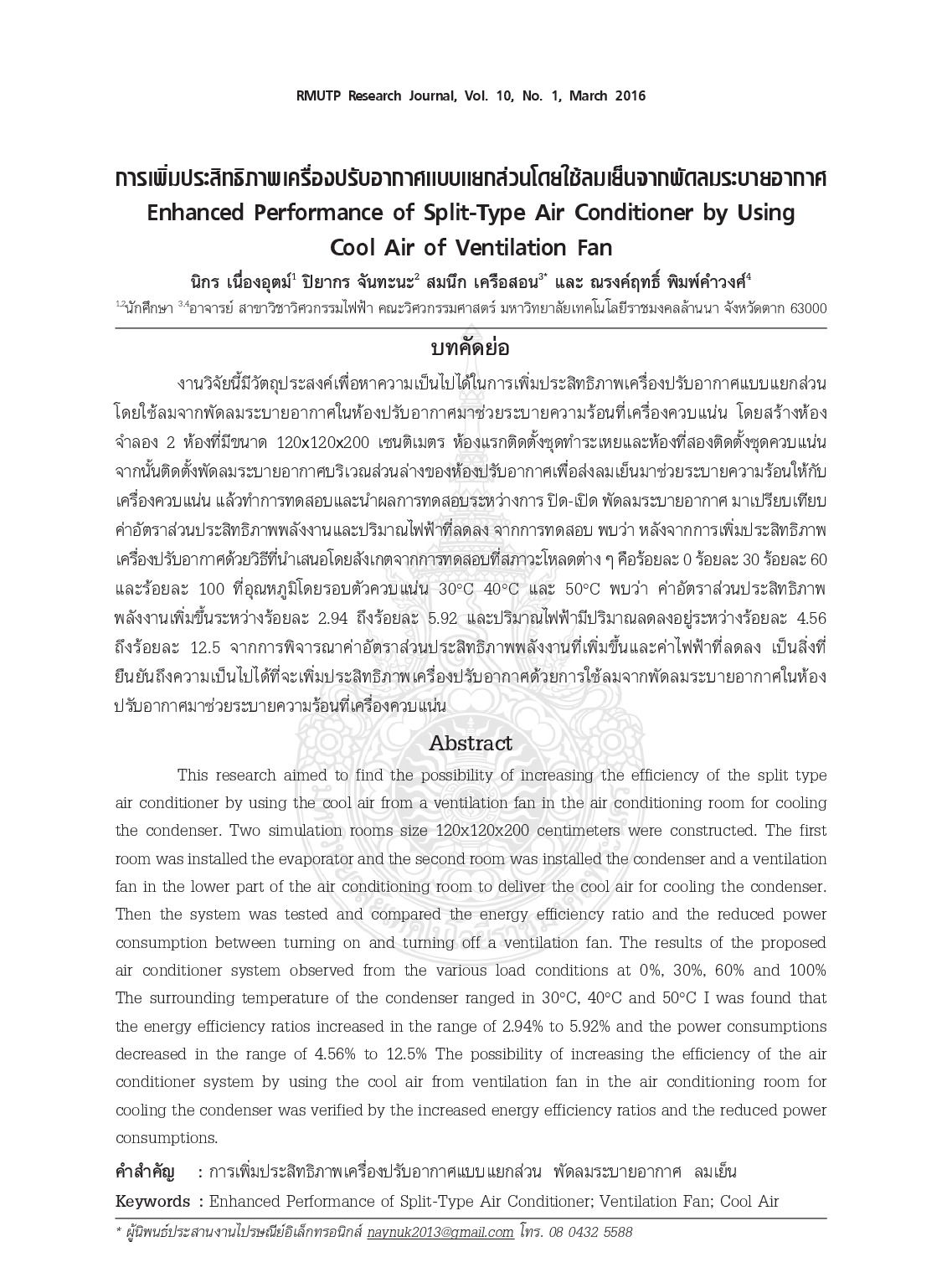
การเพิ่มประสิทธิภาพเครื่องปรับอากาศแบบแยกส่วนโดยใช้ลมเย็นจากพัดลมระบายอากาศ
This research aimed to find the possibility of increasing the efficiency of the split type air conditioner by using the cool air from a ventilation fan in the air conditioning room for cooling the condenser. Two simulation rooms size 120x120x200 centimeters were constructed. The first room was installed the evaporator and the second room was installed the condenser and a ventilation fan in the lower part of the air conditioning room to deliver the cool air for cooling the condenser. Then the system was tested and compared the energy efficiency ratio and the reduced power consumption between turning on and turning off a ventilation fan. The results of the proposed air conditioner system observed from the various load conditions at 0% 30% 60% and 100% The surrounding temperature of the condenser ranged in 30C 40C and 50C It was found that the energy efficiency ratios increased in the range of 2.94% to 5.92% and the power consumptions decreased in the range of 4.56% to 12.5% The possibility of increasing the efficiency of the air conditioner system by using the cool air from ventilation fan in the air conditioning room for cooling the condenser was verified by the increased energy efficiency ratios and the reduced power consumptions.