จำนวน Repository ( 580 )

The production of single cell protein from copra meal residue by saccharomyces cerevisiae and bacillus subtilis for development as animal feedstuff
This experiment was conducted to study on single cell protein production from copra meal residue by Saccharomyces cerevisiae and Bacillus subtilis as animal feedstuffs. The experimental design was 4x3 factorial in CRD experiment with two factors were design to experiment. The first factor was comprised of fermented period (0 15 30 and 45 days). While the second factor B was comprised of microorganism type (Saccharomyces cerevisiae Bacillus subtilis and Saccharomyces cerevisiae combined with Bacillus subtilis). The results showed that interaction between factor A and B on pH (4.00-4.53) and percentage yield (29.21-33.80) were highly significantly different (P<0.01). However Incubation temperature were not related between factor A and B. Additional both factor have no effect to incubation temperature (P?0.05). For nutrients composition the group was fermented Saccharomyces cerevisiae combined with Bacillus subtilis showed higher Crude Protein than other treatments (P<0.01). Optimum of period at days 45 showed that crude protein 14.77 percent was significantly (P<0.01) and pepsin digestibility 66.60 percent was significantly (p<0.01)
Rice production technology and cost benefit of smallholder farmer in rice community center : A Case Study Ban Phap, Phapayome District Phattalung Province
This research had objectives for the purpose of studied the rice production technology and cost benefit of farmer members in community rice seed centers (CRSC). The research case study was conducted in Phatthalung province by field surveys combining participatory rural appraisal and structured interview of 35 members during the research period from April 2012-August 2012. The CRSC received contribution grain from government service. The result showed that majority rice community center member were men and in one family had average 2 workers. Their ages between 51-60 years old. The Majority of education were primary school (grade 4). The cultivated area of rice between 11-20 rais. Rice production can generally be divided into the following 10 stages that is soil improvement land preparation crop establishment plantation water management nutrient management pet control weed control harvesting and post harvest. The results of the study found that almost all farmer using private land (69.72 %). The important expense was variable cost 80.25 % Ban-Phab is 3509 bath per rais. Average benefit per rais is 6985.04 bath per rais. The rice break- event point is 317.56 kg per rai. However return on investment explore CRSC Ban-Phab is 99.06 %
The design and development problem in wear house and decoration group for one Tumbon one product production group (OTOP), mini and medium SMEs in pathumthani province.
This research aimed to study and analyse conditions and problems in designing and developing household and decorative products of One Tambon One Product (OTOP) small and medium enterprises (SMEs) in Pathumthani province. The informants were 4 OTOP entrepreneurs and 205 OTOP SMEs. The research was conducted by means of interviews observations and questionnaires. The data was statistically analysed using frequency percentages mean and standard deviation. The results showed that conditions and problems in designing and developing household and decorative OTOP products ranged from home-based production site a lack of knowledge in product design and development transportation creativity artistic relations product specifications marketing to product design and development laws. Four entrepreneurs from these groups of products: lotus-fiber flowers silk flowers and bamboo lamps were found to have the problem of dyeing materials whilst those from the group of Thai/Japanese clay flowers had the problem of clay. The researcher had analysed piloted and concluded the problems and then passed on product development techniques to the entrepreneurs. It was found that they could use the given knowledge to make beautiful products and they satisfied with the reducing cost of production.
The plant growth and production from swine farm wastewater usage
The usage of wastewater from swine farm for agriculture have study on the production of three plants such as shallot (Allium ascalonicum L.) marigold (Tagetes erecta L.) and ruzi grass (Bachiaria ruziziensis). The experiment was focusing on the growth production and metals accumulation (Pb Cu Fe Zn) in plant. The results shown that swine farm wastewater were a lot of organic substant and nutrient. The biological oxygen demand and chemical oxygen demand were out of standard. The heavy metals lead zinc copper and iron were amount 0.106 0.218 0.082 และ 0.866 mg/kg respectively. The productivity of shallot and ruzi grass were high growing that treated by swine farm wastewater. The marigold production (flower size dry weight and fresh weight) treated by swine farm wastewater found that were not significant from the marigold production that treated by control water. The amount of lead in shallot ruzi grass and marigold flower were out of standard. The shallot and ruzi root found the amount of zinc out of standard. The amount of copper and iron were not out of standard all three plant.
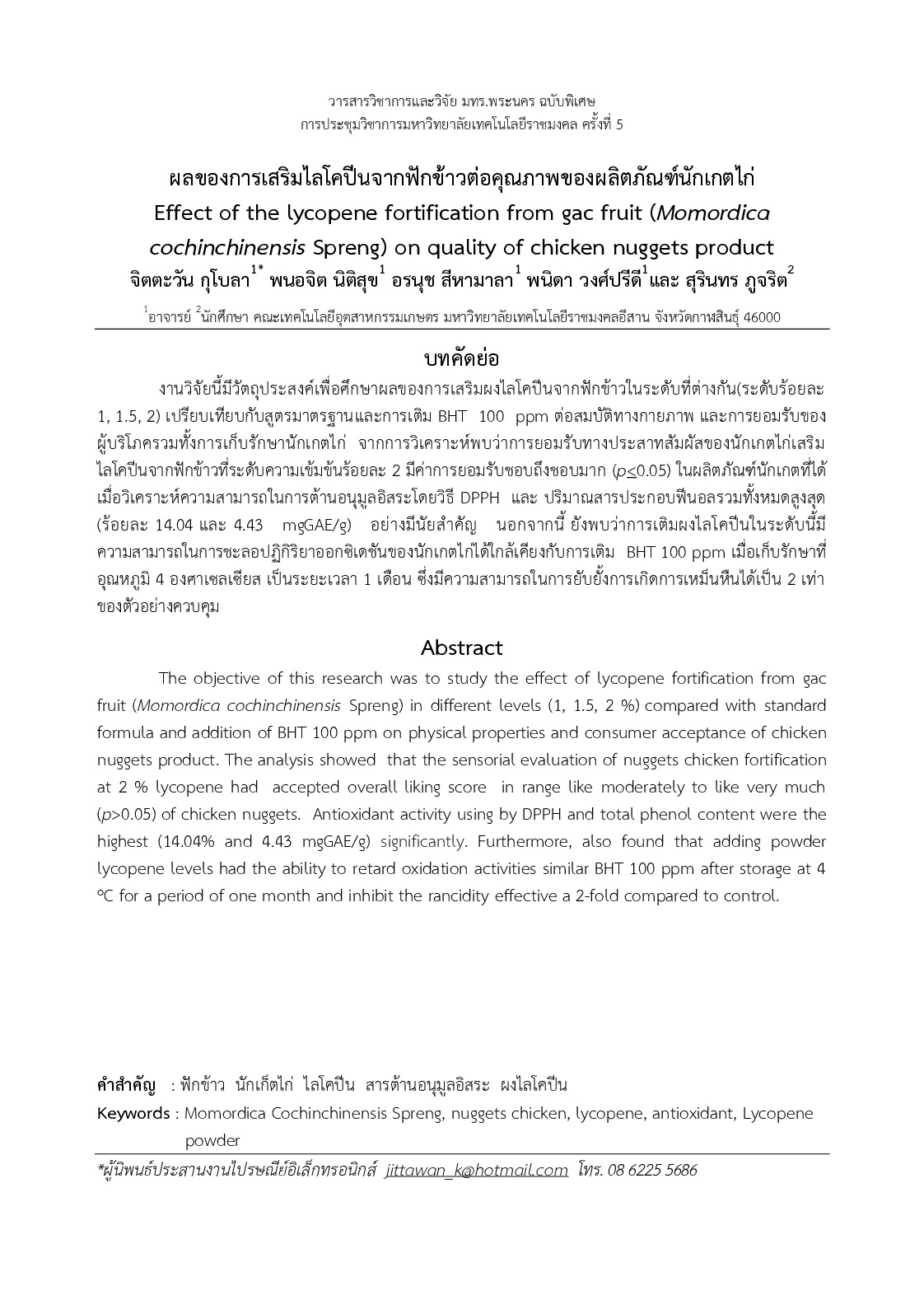
Effect of the lycopene fortification from gac fruit (momordica cochinchinensis spreng) on quality of chicken nuggets product
The objective of this research was to study the effect of lycopene fortification from gac fruit (Momordica cochinchinensis Spreng) in different levels (1 1.5 2 %) compared with standard formula and addition of BHT 100 ppm on physical properties and consumer acceptance of chicken nuggets product. The analysis showed that the sensorial evaluation of nuggets chicken fortification at 2 % lycopene had accepted overall liking score in range like moderately to like very much (p>0.05) of chicken nuggets. Antioxidant activity using by DPPH and total phenol content were the highest (14.04% and 4.43 mgGAE/g) significantly. Furthermore also found that adding powder lycopene levels had the ability to retard oxidation activities similar BHT 100 ppm after storage at 4 C for a period of one month and inhibit the rancidity effective a 2-fold compared to control.