จำนวน Repository ( 72 )
การผลิตก๊าซชีวภาพจากวัสดุเศษเหลือทางการเกษตร โดยระบบหมักไร้อากาศแบบแห้ง สำหรับครัวเรือนในชุมชนตำบลเกาะขันธ์ จังหวัดนครศรีธรรมราช
This research was studied and transferred the biogas production technology with the community participation using anaerobic dry fermentation system from agricultural residues. The production of renewable energy for replacing LPG in household cooking of Koh Khan Sub-district community Cha-Uat District Nakhon Si Thammarat Province was carried out. The efficiency of the biogas production from different co-digestion material with fresh cow manure was studied for 45 days. The experiment 1 bananas and papaya and the experiment 2 rice straw and coconut meal were used for fermented materials. It was found that the system using rice straw and coconut meal as a fermented material had a higher potential than using bananas and papaya. The system produced averaged biogas of 150 L/d and an average methane content of 67.68% respectively within just 15 days after start-up. While bananas and papaya as fermented materials took more time with more than 30 days after start-up the system. The system produced averaged biogas of 120 L/d and an average methane content of 64.64%. For usability test It was found that 150 L of biogas could continuously cook for 45-60 minutes. The 85% of the technology transfer recipients regarded that the knowledge gained as practical and reduced household expenditures. Additionally the system can produce biogas for a long time without adding new fermented materials. Therefore this biogas system could be applied to local agricultural waste for biogas production which can be expanded to other areas.
การเพาะเลี้ยงเยื่อเพื่อการขยายพันธุ์และการชักนำเหง้าขนาดเล็กจากว่านชักมดลูกตัวเมีย Curcuma comosa roxb
This study was conducted to determine the effects of plant growth regulators on in vitro propagated plantlets and microrhizome inductions of Curcuma comosa Roxb. for an efficient development of plant regeneration. In vitro sprouted shoots (2 cm length) of C. comosa were incised in longitudinal section and subcultured on MS media supplemented with 3 mg/L BA for shoot multiplication and plant regeneration. Subsequently the regenerated plants were transferred to MS medium with various concentrations of plant growth regulators; BA (1 3 5 mg/L) kinetin (1 3 5 mg/L) and TDZ (0.5 1 1.5 mg/L). The result showed that MS medium supplemented with 3 mg/L BA was the most effective in shoot induction with the significantly maximum average number of 2.11 shoot buds per responding explant. Moreover MS medium supplemented with 1 mg/L BA produced the longest average of shoot bud explants (12.99 cm) while the basal MS medium induced the longest average of root multiplication (6.63 cm). Furthermore microrhizome induction was produced under in vitro conditions derived young shoot buds upon transfer to MS medium containing various combinations of 1 3 and 5 mg/L BA and 30 60 and 90 g/L sucrose concentrations. The optimum combination in the induction of significantly highest average length of both stem (18.32 cm) and root (7.52 cm) multiplication was obtained on MS basal medium supplemented with 1 mg/L BA and 30 g/L sucrose for 4 weeks. Although microrhizome formation was not produced by the different amount of BA and sucrose in induction medium starch accumulation was found at the base of the stem explants cultured on MS medium containing 60 and 90 g/L sucrose concentrations. Additionally in vitro propagated C. comosa plantlets through microrhizome induction were grown under greenhouse conditions for 4 weeks and further developed into normal plants resulting in successfully high survival rates of 66 – 100% in the cultivated C. comosa.
ผลของสารสกัดหยาบด้วยเอทานอลจากสมุนไพร 7 ชนิดต่อการไล่มด
This research aims to study the ant repellent effects of the crude ethanolic extracts from 7 herbs; Piper nigrum Linn. Alpinia galanga (L.) Willd Ocimum basilicum L. Cymbopogon citratus Stapf Citrus aurantiifolia (Christm.) Swingle Citrus hystrix DC and Stemona collinsae Craib. Whatman filter paper was dipped with each concentration of the crude ethanolic extracts (0.625 1.25 2.5 and 5 % w/v) and placing the bait on a treated filter paper. The experiments were conducted in the natural. The numbers of weaver ants were recorded at 0 - 30 minutes. From the results the crude ethanolic extracts at 5% w/v of A. galanga was the most effective for repellent the ant (repellent rate; %R = 94.72 ± 2.39) followed with C. citratus (%R = 89.45 ± 3.85) S. collinsae (%R = 82.92 ± 4.47) and P.nigrum (%R = 81.20 ± 5.92). The repellent rates of those crude ethanolic extracts were significantly difference from distilled water which use for the negative control (P < 0.05). The crude ethanolic extract of A. galanga at concentration 5% w/v was prepared as spray cream chalk and powder. At 30 minutes of the observation the ethanolic extracts of A. galanga spray was the best ant repellent effect (%R = 100). The result from questionnaires reveals that a spray preparation was the more satisfaction for the using ant repellent products.
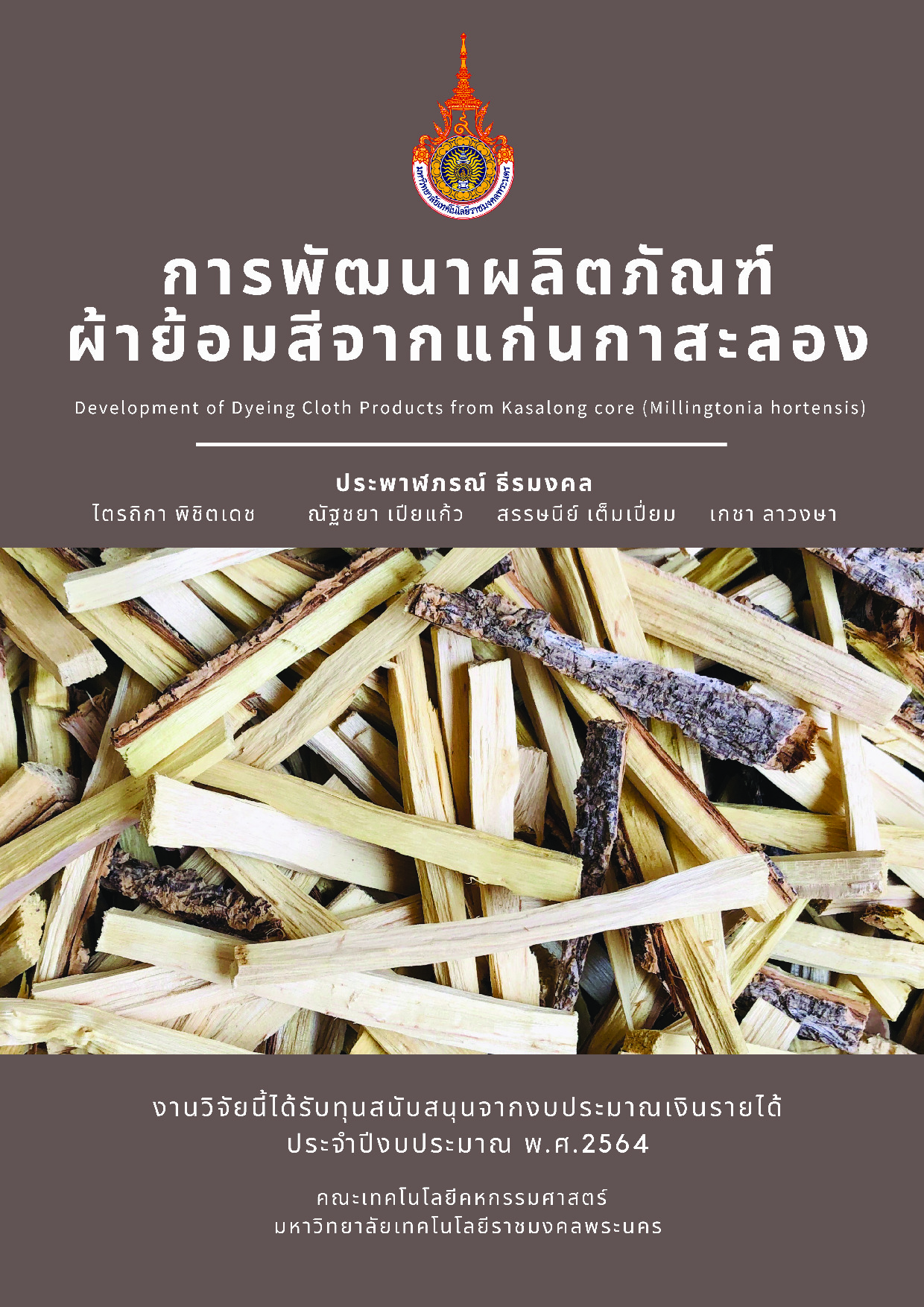
การพัฒนาผลิตภัณฑ์ผ้าย้อมสีจากแก่นกาสะลอง
Promotion of handicrafts in the field of natural dyes in the country. Increase the potential of the community and use the strengths of the cultural community. way of life and wisdom by finding ways to develop textile products by using creative textile innovations based on local wisdom in sustainable community areas To add added value to products in the ECO PRODUCT and ZERO WASTE product groups from the aforementioned concept To conserve plant genetics that exist throughout the country. The researcher therefore studied the process of dyeing fabrics by natural methods. By taking natural ingredients that are locally available and transforming them into environmentally friendly home products. This research is to study the natural dyeing of cotton fabric from Kasalong core. have a purpose Study on the effect of dyeing and the use of adjunctive agents in natural dyeing from Kasalong kernels. To develop dyed fabric products from Kasalong core and to pass on the knowledge and technology of developing dyed fabric products from Kasalong core for the general public. The result of dyeing cotton with natural dyes from Kasalong core. Four types of adhesives were used at a concentration of 20 percent as tamarind juice lime juice lime juice ash water and to test the washing fastness and sunlight resistance with the AATCC standard. The results can be summarized as follows. 1. The results of the study found that from the extraction of color from Kasalong kernels and then filtered with cloth. The color water extracted from Kasalong essence is brown. and when left for 24 hours the water color is dark brown and in this research using hot dyeing methods. 2. The result of dyeing cotton with natural dyes from Kasalong core without mordant using was found to yellow-brown but after washing the color intensity on the fabric fades slightly. 3. The result of dyeing cotton with natural color from Kasalong core. It was found that after washing the color intensity on the fabric was moderately fading. 4. The color measurement L* a* b* found that when the dye was measured in the CIELab system L* = 26.81 a* = 33.33 b* = 45.69 dL = 0.36 and dE*ab = 0.85 water. The resulting color from Kasalong will be reddish yellow. 5. Make the research prototypes as 10 of bag products. 6. Conducting technology transfer by organizing workshops dyeing course and sewing durating of the workshop for students and the general public was 1 day. Most of the participants had the highest level of satisfaction in all questions.
การตลาดออนไลน์ของสารสกัดจากไคร้น้ำ เพื่อส่งเสริมเศรษฐกิจยั่งยืนในชุมชนบ้านสวก จังหวัดน่าน
The research team aimed to develop a prototype and an online marketing concept of Homonoia riparia Lour. Extracts which is of interest to the Ban Suak community. Because of the needs of Bo Suak community who are cultivating organic fruit and medicinal plants. The Homonoia riparia Lour. were selected and extracted for cosmetic products. In the study Homonoia riparia Lour. extracts were extracted and tested for their bioactive compounds having antimicrobial properties and anti-oxidation. Initially dried Homonoia riparia Lour. leaves were extracted with 80% ethanol at a concentration of 5000 ppm had moderate antimicrobial properties for Pseudomonas sp. and Penicillium sp. For antioxidants activity it had antioxidants with DPPH method by performing free radical scavenging IC50 at 0.198 ppm. It was thus promoted for sale on the online market as introduction of Homonoia riparia Lour. extract and facial cream products with Homonoia riparia Lour. extracts. By managing the online market that already exists in the community an online market of Homonoia riparia Lour. extract for Ban Suak community Nan province via Facebook page was developed. The formation of online marketing by presentation of the extraction and the plant’s contents was including the events in many forms such as articles pictures videos questionnaires etc. Moreover the community could organize Facebook Events to invite interested people to join and learn watch demonstrations for the activity. They could try out test for and buy products. The outcome online marketing strategy of Homonoia riparia Lour. extract via Facebook Page can create success marketing that help consumers to gain knowledge and understand the benefits of the product as well. It also proposed guidelines for improving the process of creating an online marketing model based on the principles of Smart Goals SMART Goals for community people working in stores. The Smart Goals includes Specific Measurable Achievable Realistic and Timely. Based on the management principles and the acceptance of Ban Suak community in Nan province it should help create a way to reduce the cost of production guidelines to help reduce the problem of stocking herbs and offering fresh ingredients available all the time together with a verifiable tax invoice. It made it easy to understand the management approach to reach the target audience. As a result customers can come to find themselves and be able to conveniently access the products from anywhere. It thus introduces a performance review approach channels that customers can reach. Numbers of customers who visit the website or fan page will be able to present products and provides services easily.