จำนวน Repository ( 33 )

ผลของการฟังดนตรีตามความชอบ และดนตรีธรรมชาติต่อการลดความเครียดของนักศึกษา คณะศิลปศาสตร์มหาวิทยาลัยเทคโนโลยีราชมงคลพระนคร
The purpose ofthis research was to study the effect oflistening to preferred music and natural on stress of the faculty of hberal. Arts Rajamangala University students. These subject were 90 Rajamangala University students aged 18 -21 They were devided into 2 groups with 45 each. The first group listened to prefenred music and the second group listened to natural music. Pretest -Posttest Desigh was used and the data was analyzed by using t -test The results ofthis study showed that: 1) There was statistical significant difference at .01 level between pre-test and post -test on Suanprung Stress Scale scores of the group listened to preferred music and the group listened to natural music. 2) There was no statistical difference on Suanprung Stress Scale scores between the group listened to preferred music and the group listened to natural music.
การทำผลงานวิชาการเพื่อดำรงตำแหน่งวิชาการของอาจารย์คณะศิลปศาสตร์
This research is aimed to study the conditions and obstacles of academic work productivity the knowedge and understanding of rules and regulations to achieve academic position the opinions on the academic work productivity and the need to support the academic work productivity of the lecturers of the Faculty of Liberal Arts Rajamangala University of Technology Phra Nakhon. It is a descriptive research. The research instrument is questionaire. The population are 73 lecturers from the Faculty of Liberal Arts. The statistics used in this research were percentage average mean and t-test. The results were as follows: 1. LecturersBackground : most lecturers are female44.5 year of age in averagemarried having instructor status holding Masters degree and training on academic works for 1.9 times a year. As for the type of their works they are instructional documents which have been done by themselves. 2. In term of knowledge and understanding of rules and regulations in achieving academic position: most of the lecturers of the Faculty of Liberal Arts understand the rules and regulations at the point of 11-15. The average point is 11.72. 3. The attitude for the academic work: the reason for acadenic work productivity is the need to study by themselves. The reason why they do not want to make an academic work is lack of motivation. 4. The obstacles in making the academic work: they were engaged with other works. 5. As for the need to be supported in making the academic work the lecturers required the Faculty to provide them with various means of communications such as the announcement newsletter website Circular letter with x = 4.60. 6. T-test result was found that different sex has different obstaclest at .05 level. The obstacles which are statistically different at 0.05 are overloaded works and lack of facilities.
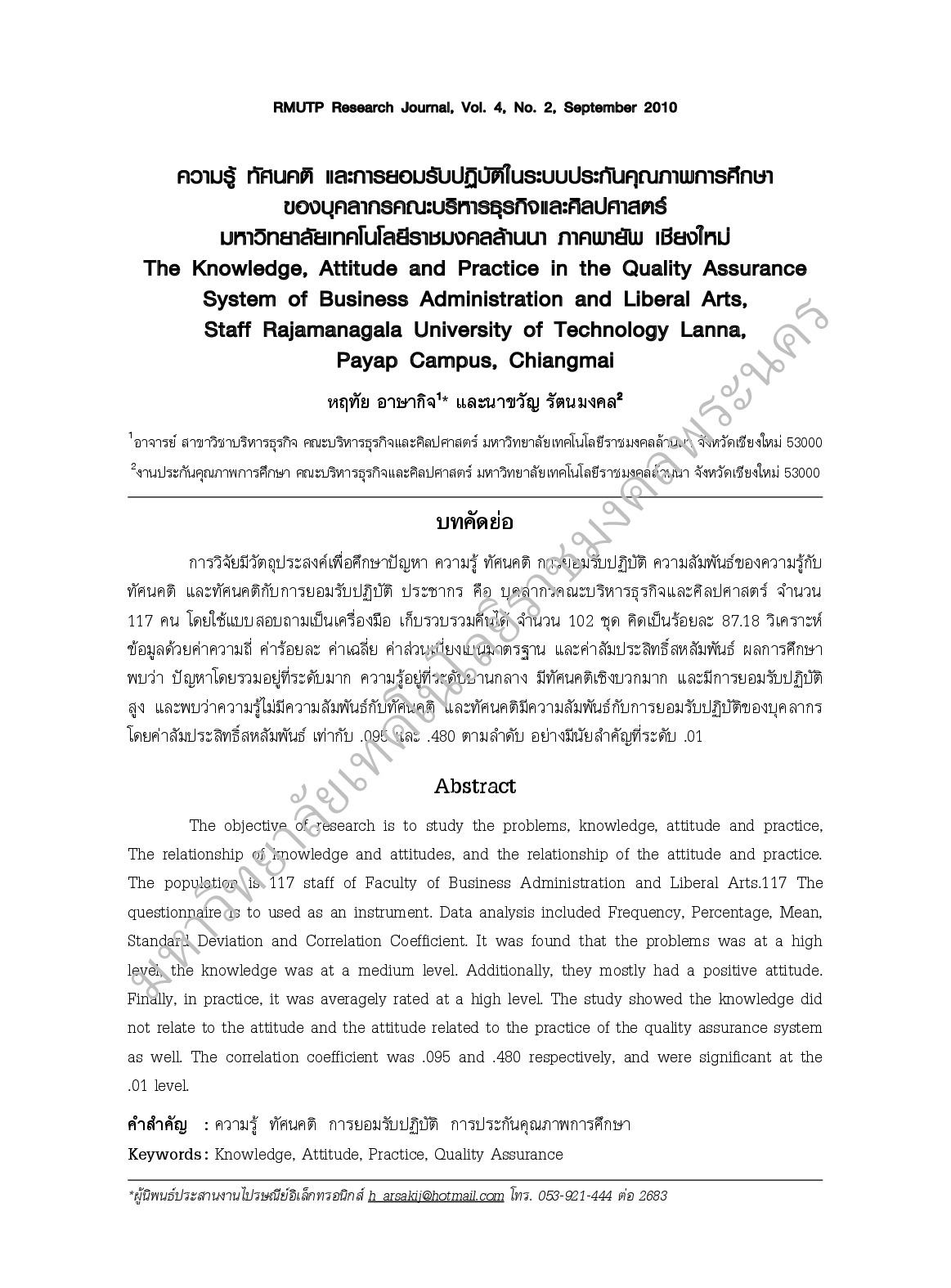
ความรู้ ทัศนคติ และการยอมรับปฏิบัติในระบบประกันคุณภาพการศึกษาของบุคลากรคณะบริหารธุรกิจและศิลปศาสตร์มหาวิทยาลัยเทคโนโลยีราชมงคลล้านนา ภาคพายัพ เชียงใหม่
The objective of research is to study the problems knowledge attitude and practice The relationship of knowledge and attitudes and the relationship of the attitude and practice. The population is 117 staff of Faculty of Business Administration and Liberal Arts.117 The questionnaire is to used as an instrument. Data analysis included Frequency Percentage Mean Standard Deviation and Correlation Coefficient. It was found that the problems was at a high level the knowledge was at a medium level. Additionally they mostly had a positive attitude. Finally in practice it was averagely rated at a high level. The study showed the knowledge did not relate to the attitude and the attitude related to the practice of the quality assurance system as well. The correlation coefficient was .095 and .480 respectively and were significant at the .01 level.