จำนวน Repository ( 39 )

การพัฒนาหลักสูตรสถานศึกษา ฐานสมรรถนะ สาขางานเทคโนโลยียานยนต์ของสาขาวิชาเครื่องกล วิทยาลัยเทคนิคเลย
การวิจัยนี้มีวัตถุประสงค์ 1) เพื่อพัฒนาหลักสูตรสถานศึกษา ฐานสมรรถนะ สาขางานเทคโนโลยียานยนต์ 4 อาชีพ ของสาขาวิชาเครื่องกล วิทยาลัยเทคนิคเลย 2) เพื่อประเมินความเหมาะสมในด้านบริบทและปัจจัยนำ เข้าของหลักสูตรสถานศึกษาที่พัฒนาขึ้นก่อนนำไปใช้ กลุ่มตัวอย่างที่ใช้ในการวิจัย จำนวน 4 กลุ่ม ได้แก่ เจ้าของ บริษัทรถยนต์ชั้นนำ จังหวัดเลย ที่ให้ความคิดเห็นด้านแรงงาน 8 คน ครูผู้ให้การสัมภาษณ์ด้านการจัดการเรียน การสอน 2 คน ผู้เข้าร่วมพัฒนาหลักสูตรสถานศึกษา 16 คน และผู้ประเมินหลักสูตรสถานศึกษา 13 คน รวม จำนวนทั้งหมด 39 คน วิธีรวบรวมข้อมูลใช้ข้อมูลเชิงปริมาณผสมผสานเชิงคุณภาพ สถิติที่ใช้ในการวิจัย ได้แก่ ค่า ร้อยละ เฉลี่ย และส่วนเบี่ยงเบนมาตรฐาน ผลการวิจัย พบว่า 1) ผลการพัฒนาหลักสูตรสถานศึกษาที่พัฒนาขึ้น โครงสร้างหลักสูตร รวม 4 อาชีพ ประกอบด้วย 31 หน่วยสมรรถนะ 213 สมรรถนะย่อย 2) ผลการประเมิน ความเหมาะสมของหลักสูตรสถานศึกษาที่พัฒนาขึ้น โดยรวมมีความเหมาะสม อยู่ในระดับมาก จำแนก วัตถุประสงค์ของหลักสูตร (x = 4.29 S.D. = 0.50) โครงสร้างหลักสูตร (x = 4.19 S.D. = 0.19) ข้อกำหนด โมดูลอาชีพและแบบมาตรฐานสมรรถนะ (x = 4.33 S.D. = 0.43) และการบริหารหลักสูตร (x = 4.10 S.D. = 0.47)
การศึกษาโครงสร้างกันแรงกระแทกของรถยนต์ที่ส่งผลต่อการดูดซับพลังงาน
Nowadays an automotive industry steadily has been growing and playing a major role on economy development for many years. The crash box is one of the most important parts for safety but it was found that the crash boxes manufactured domestically are not met international standard requirements. This is due to process and material limitation. This process for automotive safety test requires high budget and there is unclear approach for specific test. Therefore a study of crash boxes referred to energy absorption project was conducted as an alternative choice of testing. Regarding to the problems as addressed above this project was aimed to design and test crash boxes which come in various structures; simple type corrugated type and honeycomb type of crash box. In addition it was also emphasized in studying energy absorption behavior and physical deformation of crash boxes after dynamic and static energy being applied. Numeric simulation and static test methodology of front collision were applied for these tests in reference to USA NCAP standard for automobile collision test. Testing all types of crash boxes indicated that the corrugated type was able to absorb energy at 2.8% and 5.9% higher than honeycomb type and rectangular type respectively. This is capable to pickup stress and strain continually and effecting to more energy absorb than another type. Additionally this corrugated structure is feasible and suitable for crash box design in automotive manufacturing.
Combining ability test of gherkin (cucumis sativus l.)
Combining ability test of eight F5 gherkin lines from 5 generations in selected pedigree method 28 direct and 28 reciprocal crosses was performed. The objective of this study was to selected high general combining ability line and high specific combining ability hybrid for commercial variety. The experiment was designed in RCB with 2 blocks. The trial was planted during July to September 2012 at Lampang Agricultural Research and Training Centre Lampang province. Data were analyzed using Griffing method 1 with fixed treatment effect. The results were significant between varietal in all traits except yield and fruit per plant. General combining ability (GCA) was significant in all traits. Specific combining ability (SCA) was significant in all traits except yield and fruit per plant. Significance was also found in reciprocal effect in all traits except the width of fruit. For the yield of lines P1 P3 P2 P5 and P8 expressed high GCA and six hybrids were P5 / P3 P5 / P2 P1 / P5 P6 / P2 P3 / P2 and P6 / P8 had high SCA.
Analysis of needs and expert’s opinions on the competency required of computer Job category for work integrated learning (WiL) in higher education
The aim of this research is to analyze the needs and opinions of experts concerning competency required for computer related jobs in the present and the future. Its outcomes would be used in designing a Work-integrated learning (WiL) programs in undergraduate computer related programs (Computer Engineering Software Engineering Computer Science Information Technology and Information System) which meet quality standard specified by The Association for Computing Machinery (ACM) The Association for Information Systems (AIS) and The Institute of Electrical and Electronics Engineer - Computer Society (IEEE-CS). The forty educational institutions and industries in line with the development of hardware and software the installation of operating system the installation and maintenance of the network the application of information technology and the use of information system in management were invited to participate in this study. The instruments employed for data collection were questionnaires comprising six parts: 1) General Knowledge of Computer Personnel; 2) Knowledge of Computer Engineering Personnel; 3) Knowledge of Software Engineering Personnel. 4) Knowledge of Computer Science Personnel; 5) Knowledge of Information Technology Personnel and 6) Knowledge of Information System Personnel. Statistic devices used in analyzing the data were frequency percentage arithmetic mean and standard deviation. The results were also compared with the performance analysis of Competency of Computer Jobs Category in ASEAN countries Japan Europe and America. The results were also validated by 12 specialists using a purposive sampling from educational institutions enterprises and the professional associations. It was found that the Competency Required of Computer Job Category for educational management on WIL program were: 1) Computer Architect 2) Computer Support 3) Computer Specialist 4) Project Manager 5) Software Development 6) Applied Program Specialist 7) Computer Consultant 8) Sale and Marketing and 9) Computer Education Trainer. All job positions should be consistent with the empirical data which are statistically significant at p-value =0.05. The Competency Required of Computer Job Category overall fit are accepted.
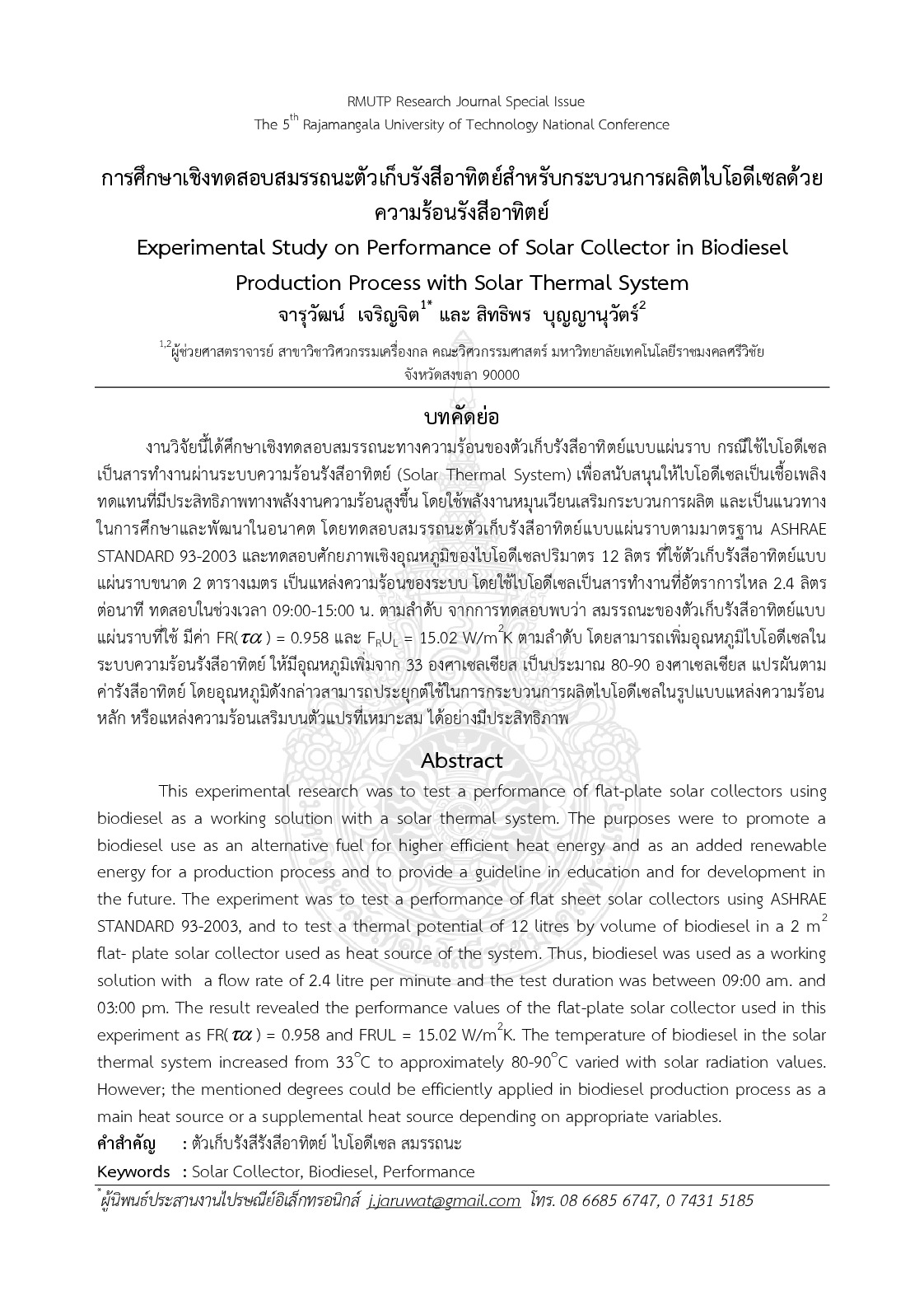
Experimental study on performance of solar collector in biodiesel production process with solar thermal system
This experimental research was to test a performance of flat-plate solar collectors using biodiesel as a working solution with a solar thermal system. The purposes were to promote a biodiesel use as an alternative fuel for higher efficient heat energy and as an added renewable energy for a production process and to provide a guideline in education and for development in the future. The experiment was to test a performance of flat sheet solar collectors using ASHRAE STANDARD 93-2003 and to test a thermal potential of 12 litres by volume of biodiesel in a 2 m2 flat- plate solar collector used as heat source of the system. Thus biodiesel was used as a working solution with a flow rate of 2.4 litre per minute and the test duration was between 09:00 am. and 03:00 pm. The result revealed the performance values of the flat-plate solar collector used in this experiment as FR( ) = 0.958 and FRUL = 15.02 W/m2K. The temperature of biodiesel in the solar thermal system increased from 33๐C to approximately 80-90๐C varied with solar radiation values. However; the mentioned degrees could be efficiently applied in biodiesel production process as a main heat source or a supplemental heat source depending on appropriate variables.