จำนวน Repository ( 270 )
การใช้บริการร้านอาหารพื้นถิ่นของผู้บริโภค จังหวัดภูเก็ต
The purposes of this research were: 1) to study the personal factors of consumers for choosing local restaurants in Phuket Province 2) to study the consumption factors of local restaurants in Phuket Province 3) to study the factors of marketing mix in the local restaurants in Phuket Province 4) to compare the level of importance of the marketing mix factors in the local restaurants in Phuket Province classified by personal factors of respondents 5)to compare the level of importance of the marketing mix factors in the consumers use of local restaurants in Phuket Province classified according to the use of local restaurants and 6) to present guidelines for local restaurant development in Phuket Province. A sample group of 400 people and local restaurant operators in Phuket has 16 cases. The research instruments are questionnaires and interviews. The statistical techniques used for data analysis were frequency percentage mean standard deviation one-way analysis of variance and analysis of descriptive data. The research found that: 1) most consumers were female aged 36-40 years with a bachelors degree being a private company employee with an estimated income of 10001–20000 baht and they resided in Phuket. 2) As for the reasons of choosing to use local restaurants it was found that most of the consumers chose to consume local food because of their unique identity and difference from conventional food. The most common food consumed was Hokkien fried noodles. The main course and side dishes commonly being consumed was Stir Fried Liang Bai with Shrimp Roe and a popular savory snack was Hu Shae sweet snacks were using Gosui and a popular dessert was Oh Aew. Most people consumed local food once a month and was paying approximately 901- 1300 baht for each meal. 3) Consumers valued the overall marketing mix at a high level. The determinants were in descending order local food price construction personnel and physical presentation and distribution service marketing promotion. 4) Comparing the level of importance of the marketing mix factors in consumers’ selection of local restaurants in Phuket Province found that gender age education level occupation monthly average income and different residences put importance on the factors of marketing mix with no difference except the gender was not different with statistical significance at the .05. 5) Comparing the level of importance of the marketing mix factors in consumers’ selection of local restaurants in Phuket Province found that the reasons for consuming local food popular types of local food popular local food items frequency of local food consumption and the cost of consumption per time were different. Paying attention to the factors of marketing mix there was no statistically significant difference at the .05 level. And 6) guidelines for local restaurant development in Phuket Province were to select raw materials directly from the producer sources in order to maintain freshness and quality. In addition a standard price threshold should be set and suitable for the quality of local food and so do distribution channels. There could be an online order and advertising through various media such as websites or other media in order to disseminate customers to know more about restaurants. In addition there should be a focus on training employees to recognize the importance of service and on educating employees about service skills. At the same time the restaurants should be designed to be unique easy to remember and technology should be adopted for example in the matter of receiving food orders to achieve accuracy speed and error prevention.

แนวทางการเพิ่มประสิทธิภาพในการจัดอาหารกลางวันของศูนย์การศึกษาพิเศษส่วนกลาง จังหวัดกรุงเทพมหานคร
This research aimed to study the personal factors operation and effectiveness of the lunch management project in Central Special Education Center Bangkok. The comparison of the effectiveness of the lunch was based on respondents’ individual factors this study proposed guidelines for optimizing the lunch arrangements. The research group consisted of 215 parents administrators and persons in charge of lunch management of which 164 samples were divided into 140 parents and 24 administrators and responsible persons for the lunch. The research instrument was a survey questionnaire. Data were analyzed statistically by using frequency percentage mean standard deviation and one-way analysis of variance. The results of the study indicated that this sample of parents was predominantly female aged between 31 to 40 years holding a lower bachelors’ degree and having a maximum income of 10000 baht. Overall the operations of the lunch project were performed at a high level. It appeared that the raw materials had the most average followed by administration management. The personnel aspect was the least. Moreover parents’ perception towards the effectiveness of the lunch project were high. Considering each aspect ordered from the highest to the least they respectively included quantity type quality of lunch safety and health administration and favorite luncheon menus. The comparison of the effectiveness of lunch project management and the perception of parents classified by their personal factors revealed that there was a significant difference at 0.05. The found guidelines for increasing the effectiveness of the lunch projects were to provide quality food ingredients the variety of tasty and nutritious dishes and five food groups. Moreover recruited dietitians were required to cook clean disease-free and healthy food by either frying steaming boiling or grilling the food. As a result of fully utilizing nutrients students would stay fit and healthy.
การศึกษา สํารวจ และวิเคราะห์องค์ประกอบของเสีย และแนวทางการใช้ของเสีย อาหารทะเล ตลาดทะเลไทย จ.สมุทรสาคร
This research is a survey study. And analyze the waste composition And guidelines for the use of seafood waste in the Thai seafood market Samut Sakhon Province According to the survey 96.27 percent of the waste comes from restaurants. This is because Most fresh seafood restaurants Will feed the seafood whole Therefore there is no garbage such as shrimp if it is a restaurant the customers will have left shrimps on the head. But the fresh restaurants give away the shrimp and crab so the garbage from the fresh restaurant only has fishbone which is very small. Because most customers accept the whole fish There were also some places where the vendors cut the fish and left their bones. But when analyzed by type of waste it found that shell waste was the highest. Which is up to 55.29 percent. Followed by shrimp shells fish bone and fish heads and crab shells the study found that seafood debris had material properties with low moisture content. It also contains calcium as the main component. For example shellfish contain calcium as the main component which is found in approximately 98.50 percent. Not only striped shells Fishbone shrimp and crab shells are also low humidity and high in calcium. The bizarre one was holding a sea bass head and a grouper head with a high amount of organic matter. And with low ash content food waste that should be analyzed for the possibility of recycling are striped shells cockle shells shrimp shells fishbone shells fishbone dumplings tuna and crab shells.
ผลของใยอาหารจากแกนสับปะรดต่อคุณภาพของขนมข้าวตู
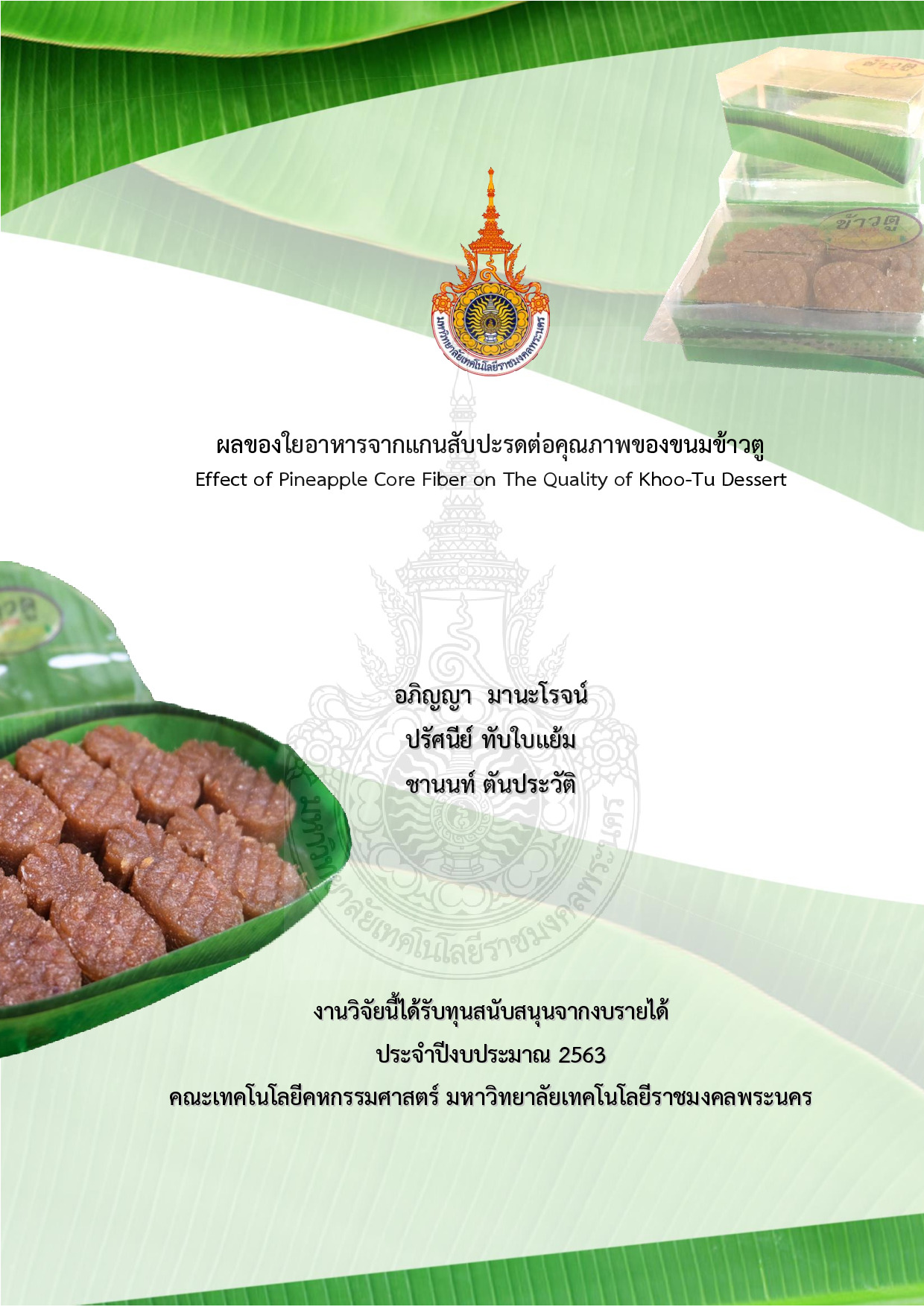
These research objectives are to study the basic formulas of Khoo-Tu dessert (dried rice balls made from rice and coconut) and to study the volume of pineapple cores instead of coconut in Khoo-Tu. The test of Khoo-Tu dessert basic formulas by 9 - point hedonic scale method of 50 examiner laboratory the results show acceptance rated on a moderate scale (7). After that substituting coconut with pineapple core the amount of 0 25 50 75 and 100 of the weight coconuts.It was found that at 75% of the substitution level the tasters evaluated the greatest acceptance (p> 0.05). The basic formulas had a pH of 6.24 the Pineapple core formulas 5.94 (p> 0.05). Water Activity (aw)of Khoo-Tu the basic formula was 0.85 and the pineapple core formula was 0.90 (p> 0.05). The color value of the pineapple core Khoo-Tu was L * (brightness value) (37.31) b * (yellowness value) (9.45) rather than the basic formula Khoo-Tu (p> 0.05). The nutritional value of the pineapple core Khoo-Tu was 316 Kcals protein 2.71 % fat 8.86 % ash 0.52 % carbohydrates 56.3 % dietary fiber 3.99 % insoluble fiber 3.60 % and 0.39% of water-soluble dietary fiber that was found in the pineapple core Khoo-Tu to provide lower nutritional value than basic formula Khoo-Tu. The microbiological quality of basic formula and pineapple core formula was found that the total variable count fungi and bacillus serous were less than 10 colonies / 1 g sample and staphylococcus aurias were not found in both samples. The shelf life of rice (Room temperature) found that the basic recipe was 12 days and the pineapple core recipe It has a shelf life of 6 days. At chilled temperature (4 degrees Celsius) it was found that the basic formula and pineapple core formula had a shelf life of 25 days with all microorganisms less than 1 x 10⁴ colonies/sample 1 gram fungus less than 100 colonies /1 gram sample and All microorganisms and fungi exceeded the standard on the 28th day.
ปัจจัยความสำเร็จของผู้ประกอบการร้านอาหารขนาดกลางที่มีสาขาเครือข่าย
The purpose of this research were to explore factors affecting success of medium size chain restaurant entrepreneurs and to present the keys success of medium size chain restaurant entrepreneurs. This research was mix methods research. The data of qualitative research were collected by In-depth Interview with two chain restaurant experts one president of the Thai Franchise & License Association three medium size chain restaurant entrepreneurs and six individual medium size chain restaurant customers. The data of quantitative research were collected by the questionnaire to 400 Thai medium size chain restaurant customers. Statistics for data analysis included frequency percentage average standard deviation and exploratory factor analysis (EFA). The results of this search showed that the factors affecting success of the medium size chain restaurant entrepreneurs were as follows 1) The factors affecting success of medium size chain restaurant entrepreneurs in management which included strategic planning good organization structure for chain restaurant clearly and defining the system well trained staff owned style of management and set share value. 2) The factors affecting success of medium size chain restaurant entrepreneurs in how to meet customer needs which included quality of service essential of social responsibility customer satisfaction in food quality right location and attractive promotion.