จำนวน Repository ( 160 )
สมบัติทางวิศวกรรมของบล็อคปูพื้นคอนกรีตพรุนจากผิวทางแอสฟัลต์เก่านำมาใช้ใหม่โดยการแทนที่มวลรวมหยาบ
This research aimed to study the use of coarse aggregate obtained from removing old recycled asphalt pavement (RAP) in the production of the porous concrete paving block. Crushing and size separation of the coarse aggregate by using standard sieve size by selected the gradation size of the coarse aggregate that passed to sieve size 1/2” and retained on sieve size 3/8” and other that passed to sieve size 3/8” and retained on sieve size No.4 by mixing ratio 50 : 50 of the mass as replaced natural coarse aggregate. Portland cement quantity about 18% and 20% by weight of the aggregate. The water to cement ratio was 0.30 and 0.35 respectively. Compressive strength flexural strength and water permeability were investigated. The results showed that the cement content and water to cement ratio was influenced the strength properties and water permeability rate of the porous concrete paving block. The porous concrete paving block mixed with higher cement content (20%) had the compressive strength at the age of 28 days increased by 16-24% when compared with lower cement content (18%). On the other hand the water permeability rate decreased by 5.1-8.1%.
ผลของอุณหภูมิที่มีต่อค่าความต้านทานและความจุไฟฟ้าของข้าวเปลือกที่มีความชื้นแตกต่างกัน
This research proposes an application of resistive and capacitive soil moisture sensors to investigate the influences of paddy temperature on the electrical signal received from sensors when tested with paddy moisture in the range 9.2 - 22.75%wb at 40 - 80ºC to determine the relationship between paddy moisture and electrical signals. It was found that the mean signal values between 20 - 40 seconds from both sensors were inversely linear correlation with the moisture content of the paddy. Temperature is the factors that influence the measured electrical signal. R2 Adjust R2 (95% confidence interval) and RMSEC showed that the model developed from the resistive sensor signals was accurate in calculating the moisture content of paddy between medium to high temperature in range 60 - 80ºC more than the low temperature range. While the capacitive sensor signals model is accurate in calculating paddy moisture between low to medium temperature in range 40 - 60 ºC. Therefore the resistive soil moisture sensor is possible and more suitable for applying as a paddy moisture sensor in the high temperature drying processes than a capacitor soil moisture sensor.
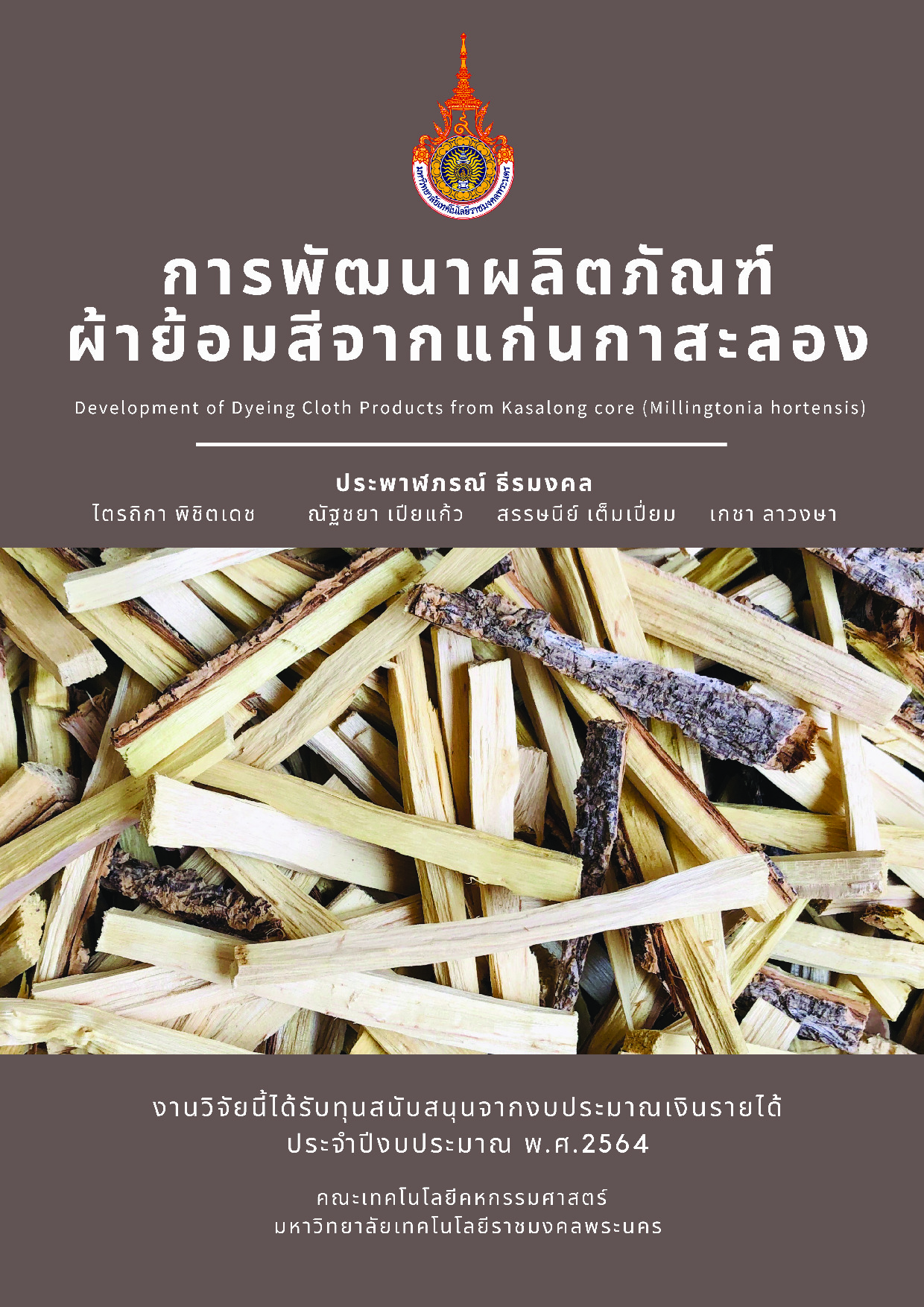
การพัฒนาผลิตภัณฑ์ผ้าย้อมสีจากแก่นกาสะลอง
Promotion of handicrafts in the field of natural dyes in the country. Increase the potential of the community and use the strengths of the cultural community. way of life and wisdom by finding ways to develop textile products by using creative textile innovations based on local wisdom in sustainable community areas To add added value to products in the ECO PRODUCT and ZERO WASTE product groups from the aforementioned concept To conserve plant genetics that exist throughout the country. The researcher therefore studied the process of dyeing fabrics by natural methods. By taking natural ingredients that are locally available and transforming them into environmentally friendly home products. This research is to study the natural dyeing of cotton fabric from Kasalong core. have a purpose Study on the effect of dyeing and the use of adjunctive agents in natural dyeing from Kasalong kernels. To develop dyed fabric products from Kasalong core and to pass on the knowledge and technology of developing dyed fabric products from Kasalong core for the general public. The result of dyeing cotton with natural dyes from Kasalong core. Four types of adhesives were used at a concentration of 20 percent as tamarind juice lime juice lime juice ash water and to test the washing fastness and sunlight resistance with the AATCC standard. The results can be summarized as follows. 1. The results of the study found that from the extraction of color from Kasalong kernels and then filtered with cloth. The color water extracted from Kasalong essence is brown. and when left for 24 hours the water color is dark brown and in this research using hot dyeing methods. 2. The result of dyeing cotton with natural dyes from Kasalong core without mordant using was found to yellow-brown but after washing the color intensity on the fabric fades slightly. 3. The result of dyeing cotton with natural color from Kasalong core. It was found that after washing the color intensity on the fabric was moderately fading. 4. The color measurement L* a* b* found that when the dye was measured in the CIELab system L* = 26.81 a* = 33.33 b* = 45.69 dL = 0.36 and dE*ab = 0.85 water. The resulting color from Kasalong will be reddish yellow. 5. Make the research prototypes as 10 of bag products. 6. Conducting technology transfer by organizing workshops dyeing course and sewing durating of the workshop for students and the general public was 1 day. Most of the participants had the highest level of satisfaction in all questions.
ภาพยนตร์สั้นอินเตอร์แรคทีฟเรื่อง ใครๆก็ทำกัน
The objectives of this study were to produce an interactive short film “Everyone does it” to assess the media suitability of an interactive short film “Everyone does it” and to assess the audiences satisfaction with the medium of the interactive short film “Everyone does it” using 2 groups of samples 1) a group of experts to assess the suitability of 3 people divided into experts. opus and editing; 2) a group of high school students Nawaminthrachinuthit Benchamarajalai Mathayomsuksa 6 Room 2 30 people were obtained by using a specific method. by using questionnaires to collect data The statistics used to analyze the data were mean and standard deviation. The results showed that Interactive short film “Everyone does it” was overall very appropriate (=4.20 SD=0.53) and viewers towards interactive short film medium. “Everyone does it” overall satisfaction was at a high level (=4.34 SD=0.65)
การแก้ไขปัญหาอุปสรรคของเครื่องจักรในอุตสาหกรรมแปรรูปน้ำผลไม้ของวิสาหกิจชุมชน กลุ่มแปรรูปผลิตเครื่องดื่มน้ำผลไม้ ต.คลองจินดา อ.สามพราน จ.นครปฐม
This research presents the processing of fresh guava into guava juice product. to be kept for consumption and distribution in the local area It is an alternative career path that helps rural farmers earn more. and create additional careers for the family But farmers still lack the correct technology tools and processing methods in each production process. Therefore there was a problem of insufficient cleanliness taking a lot of time resulting in unacceptable quality and the production is low the postharvest engineering research group has conducted research to find suitable guava juicer. This study is based on working principles of food processing equipment in general use. Come as a guideline to develop improve and create prototypes. The original guava juicer was a grater roller squeezer. There is a guava-sized subsystem consisting of a sub-chamber with grated rollers and the waste water barrier system consists of a juice sieve chamber a waste separation room a spiral conveyer and a sweeper set. various parts that come in contact with the guava juice is made of stainless steel The power source uses a 1-horsepower electric motor a single-phase electrical system a voltage of 220 volts. The machine has the ability to block water at a rate of 250 kg / hour. The juice obtained must be filtered out again with a centrifugal bag filter capable of filtering water at a rate of 50 liters/hour. The prototype guava juice machine costs 40000 baht and the centrifugal filter bag costs 5000 baht. With just one such machine each of these machines can produce 28000 liters of guava juice/year (112000 bottles a year) able to get a return in 0.08 years with an average processing cost of 4.48 baht/bottle which is appropriate in engineering economics. In investment use a ready-to-drink guava juice machine. Fresh guava ingredients are available throughout the year and have 200 business days/year.