จำนวน Repository ( 41 )
A study an optimum casting condition for manufacturing jewelry setting of low silver alloys 58.33 wt% AgCuSn
การวิจัยนี้เป็นการศึกษาวิเคราะห์หาสภาวะที่เหมาะสมสาหรับการหล่อขึ้นรูปตัวเรือนเครื่องประดับโลหะเงินเจือต่า 58.33 wt% AgCuSn โดยทาการเปรียบเทียบกับสมบัติของโลหะเงินสเตอร์ลิง 925 และโลหะเงินเจือต่า 58.33% เพื่อศึกษาสภาวะที่ดีที่สุดจากการปรับปรุงคุณสมบัติทางเคมีที่ส่งผลต่ออิทธิพลของคุณภาพระดับของโลหะเงินเจือต่าที่เป็นไปตามมาตราานผลิตเครื่องประดับ ผลจากการศึกษาโลหะเงินเจือต่า 58.33 % ที่อัตราส่วนผสม 58.33Ag + 41.16Cu + 0.51Sn จากการวิเคราะห์ค่าระดับสีและค่าความแตกต่างของสีและมีพฤติกรรมความต้านทานการหมองของโลหะเงินเจือต่ามากที่สุด จึงทาให้อัตราส่วนผสมนี้มีความเหมาะสมสาหรับการหล่อขึ้นรูปตัวเรือนเครื่องประดับโลหะเงินเจือต่า และพบปัญหารูพรุนจากงานหล่อของเครื่องประดับโลหะเงินเจือต่า 58.33Ag + 41.16Cu + 0.51Sn ไม่พบรูพรุนในการหล่อที่อุณหภูมิ 1000 ºC เป็นอุณหภูมิที่เหมาะสมในการหล่อได้งานที่มีคุณภาพดี โลหะมีสุดหลอมเดือดที่เหมาะสม ส่วนอุณหภูมิที่ 1040 ºC จะทาให้อุณหภูมิมีจุดหลอมละลายมาก ทาให้งานมีรอยแตกร้าวบางจุด ส่วนอุณหภูมิที่ 1080 ºC เป็นอุณหภูมิที่สูงมากเกินไป จึงทาให้ชิ้นงานมีรอยแตกมาก ส่วนปัญหาต่างๆ ที่เกิดขึ้นในกระบวนการหล่อสามารถทาการวิเคราะห์หาสาเหตุและกาหนดแนวทางการแก้ไขได้อย่างเหมาะสมเพื่อลดความสูญเสียที่อาจจะเกิดขึ้นในผลิตภัณฑ์เครื่องประดับโลหะเงินเจือต่า 58.33 wt% AgCuSn ผลจากการทดลองและวิเคราะห์หาค่าคุณสมบัติเชิงกายภาพและวิเคราะห์ปัญหาของชิ้นงานทดสอบที่ได้จากการทดลองในสภาวะที่ดีที่สุดมีค่าที่เป็นไปตามมาตราานของเครื่องประดับเงินตามมาตราานอุตสาหกรรมการผลิตเครื่องประดับทั้งของในประเทศและต่างประเทศ

Dry reforming of methane reaction for hydrogen and syngas production using cobalt catalysts and nickel-cobalt bimetallic catalysts
The cobalt catalysts (cobalt content by weight: 7% 10% and 15%) and cobalt-nickel bimetallic catalysts (cobalt-nickel content by weight: 3.5%-3.5% 5%-5% and 7%-7%) were studied in dry reforming of methane for hydrogen and syngas production. All catalysts were synthesized by the wetness impregnation method. The dry reforming of methane was carried out at 700oC atmosphere pressure using a mixture; CH4 and CO2 in ratio 1:1. The result showed that the good activity and stability depend on metal content in catalysts and the combined 2 metals as bimetallic catalysts. The optimum amounts of catalysts are 10wt% Co for mono-metallic catalysts 75%CH4 and 75%CO2 conversion and 7wt% Ni-7wt% Co for bimetallic catalysts 87%CH4 and 89%CO2 conversion.
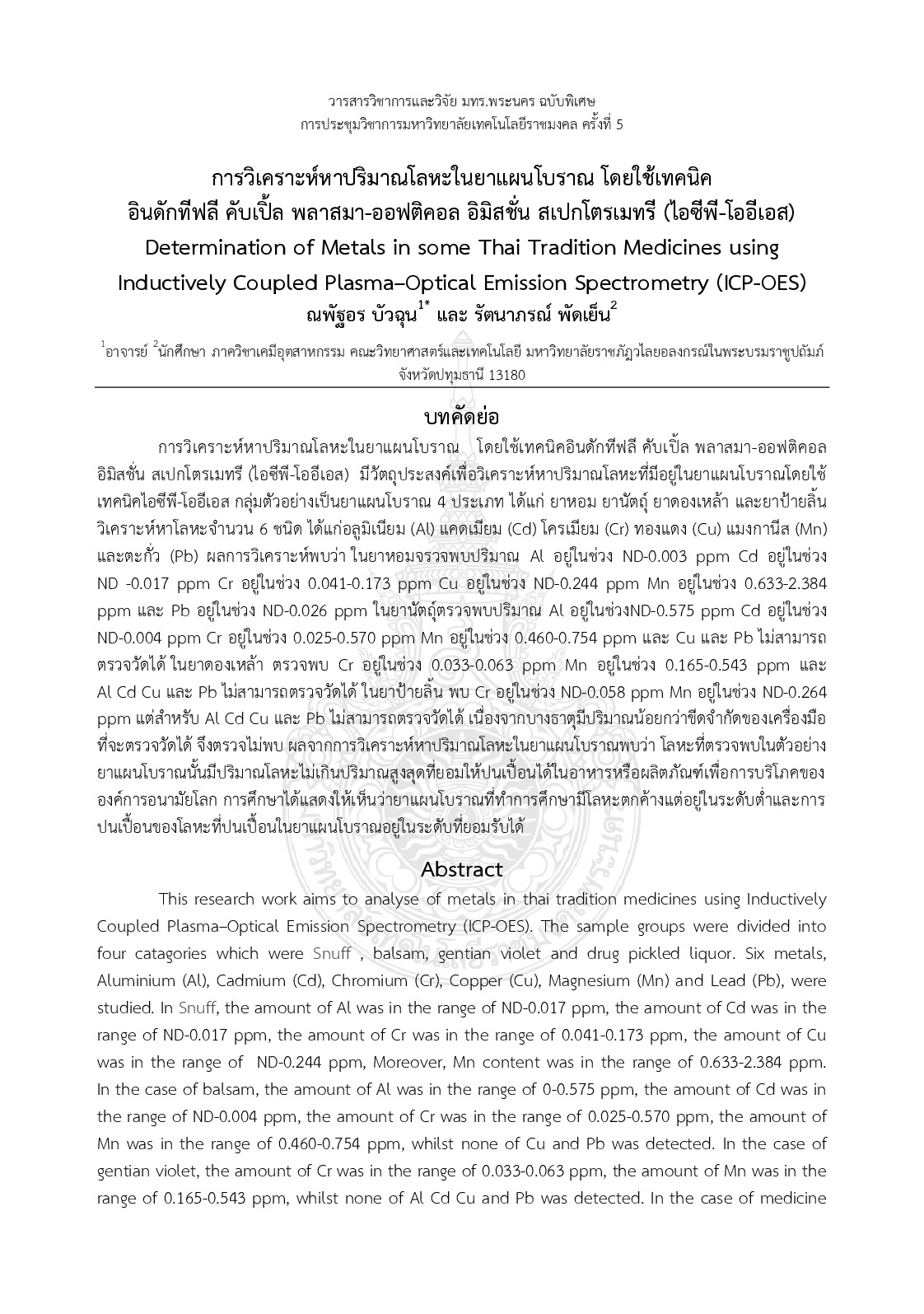
Determination of metals in some thai tradition medicines using inductively coupled plasma–optical emission spectrometry (ICP-OES)
This research work aims to analyse of metals in thai tradition medicines using Inductively Coupled Plasma–Optical Emission Spectrometry (ICP-OES). The sample groups were divided into four catagories which were Snuff balsam gentian violet and drug pickled liquor. Six metals Aluminium (Al) Cadmium (Cd) Chromium (Cr) Copper (Cu) Magnesium (Mn) and Lead (Pb) were studied. In Snuff the amount of Al was in the range of ND-0.017 ppm the amount of Cd was in the range of ND-0.017 ppm the amount of Cr was in the range of 0.041-0.173 ppm the amount of Cu was in the range of ND-0.244 ppm Moreover Mn content was in the range of 0.633-2.384 ppm. In the case of balsam the amount of Al was in the range of 0-0.575 ppm the amount of Cd was in the range of ND-0.004 ppm the amount of Cr was in the range of 0.025-0.570 ppm the amount of Mn was in the range of 0.460-0.754 ppm whilst none of Cu and Pb was detected. In the case of gentian violet the amount of Cr was in the range of 0.033-0.063 ppm the amount of Mn was in the range of 0.165-0.543 ppm whilst none of Al Cd Cu and Pb was detected. In the case of medicine pickled the amount of Cr was in the range of ND-0.058 ppm the amount of Mn was in the range of ND-0.264 ppm the amount of Ni was in the range of 0-0.034 ppm no metals Al Cd Cu and Pb was observed. The detected metals in thai tradition medicines have the contamination value under the optimization scale for consumable under WHO. It show that some metals were retained in thai tradition medicines and the contamination level of metals in were acceptable.
การศึกษาปัญหาในงานหล่อเพื่อการพัฒนาแนวทางแก้ไขปัญหาในงานหล่อเครื่องประดับสมัยใหม่
งานวิจัยนี้เป็นการศึกษาปัญหาในงานหล่อและพัฒนาแนวทางแก้ไขปัญหาในงานหล่อ เครื่องประดับสมัยใหม่ ที่มีการสร้างต้นแบบตัวเรือนเครื่องประดับจากกระบวนการผลิตด้วยเทคโนโลยีการ ขึ้นรูปด้วยเครื่องสร้างต้นแบบอย่างรวดเร็ว (Rapid Prototype Machine) ด้วยวัสดุแว็กซ์ wic100a โดย ทาการศึกษาอุณหภูมิการอบเบ้าปูน เพื่อกาจัดแว็กซ์ออกจากเบ้าปูนให้สมบูรณ์ แล้วทดลองนาไปหล่อเป็น ตัวเรือนโลหะ ผลจากการศึกษาการอบเบ้าปูนที่ใช้ต้นแบบตัวเรือนวัสดุ wic100a เมื่อนามาเปรียบเทียบกับ กราฟการอบเบ้าปูนที่มีต้นแบบตัวเรือนเป็นแว็กซ์เขียวทั่วไป จากการศึกษาพบว่าวัสดุแว็กซ์เขียวเมื่อได้รับ ความร้อนจะเริ่มหลอมละลายที่อุณหภูมิ 90 องศาเซลเซียส จนหลอมละลายจากก้อนเป็นของเหลว ทั้งหมดที่อุณหภูมิ 120 องศาเซลเซียส ซึ่งสามารถใช้อุณหภูมิและเวลาที่กาหนดไว้จากมาตรฐานทั่วไป นามาใช้ในการอบเบ้าปูนเพื่อกาจัดแว็กซ์ได้ โดยใช้อุณหภูมิสูงสุดเพื่อเผาไล่เศษขี้เถ้าแว็กซ์ที่ 750 องศา เซลเซียส แต่แว็กซ์ wic100a ไม่หลอมละลายในช่วงอุณหภูมิต่าว่า 270 องศาเซลเซียส แต่จะเกิดการเผา ไหม้แทนโดยใช้อุณหภูมิเผาให้ตั่งแต่ 270-450 องศาเซลเซียส ในสภาวะปกติ 350-500 องศาเซลเซียสใน เมื่ออยู่ในเบ้าปูน และต้องใช้อุณหภูมิในการเผาไล่ขี้เถ้าแว็กซ์ถึง 850 องศาเซลเซียส เพื่อเผาไล่เศษขี้เถ้า แว็กซ์ จึงจะสามารถทาให้โพรงแบบสะอาด เมื่อนาเบ้าปูนไปหล่อด้วยโลหะเงินสเตอร์ลิง 925 แล้วได้ ชิ้นงานที่มีความสมบูรณ์ดี
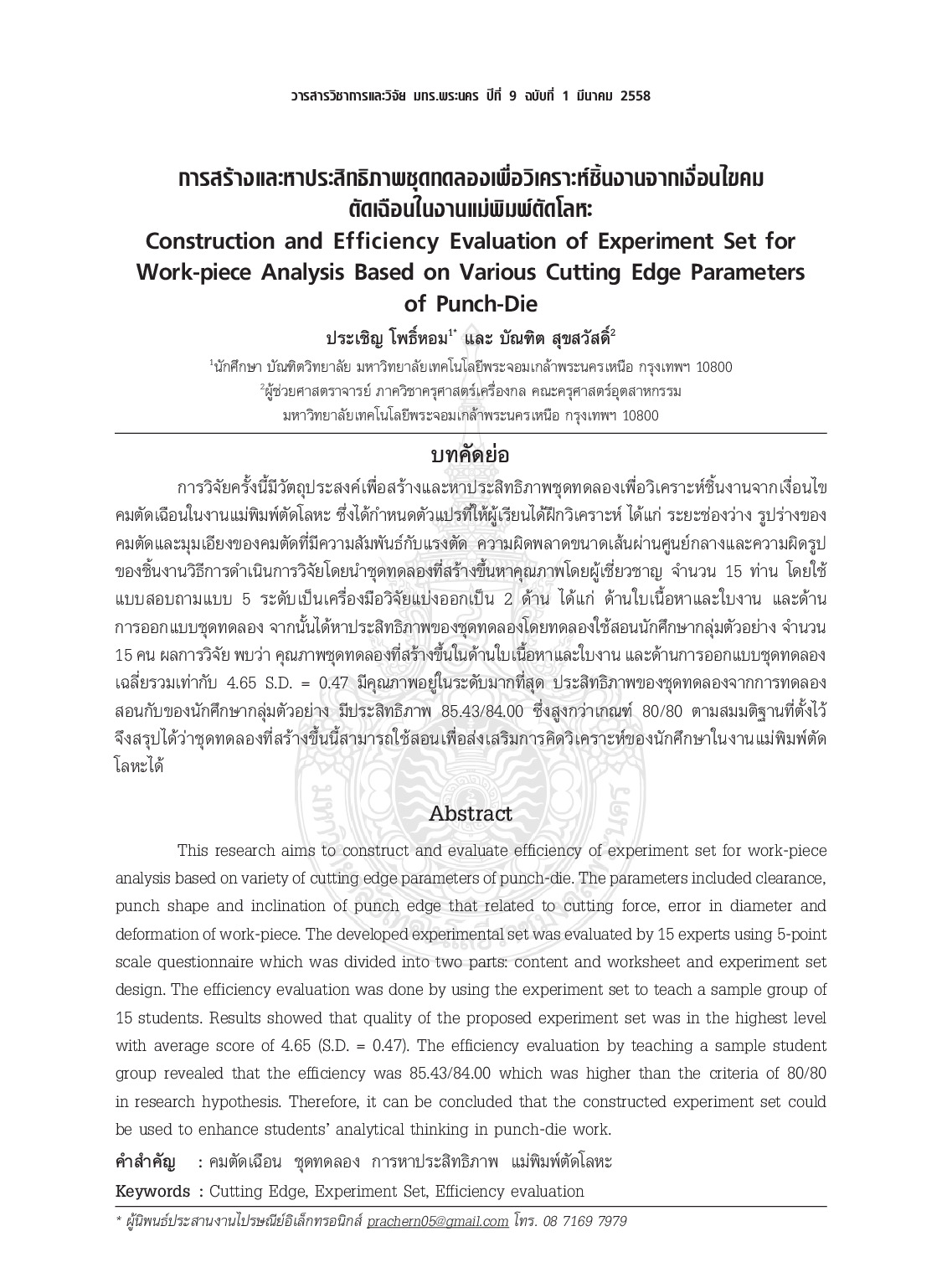
Construction and efficiency evaluation of experiment set for work-piece analysis based on various cutting edge parameters of punch-die
This research aims to construct and evaluate efficiency of experiment set for work-piece analysis based on variety of cutting edge parameters of punch-die. The parameters included clearance punch shape and inclination of punch edge that related to cutting force error in diameter and deformation of work-piece. The developed experimental set was evaluated by 15 experts using 5-point scale questionnaire which was divided into two parts: content and worksheet and experiment set design. The efficiency evaluation was done by using the experiment set to teach a sample group of 15 students. Results showed that quality of the proposed experiment set was in the highest level with average score of 4.65 (SD = 0.47). The efficiency evaluation by teaching a sample student group revealed that the efficiency was 85.43/84.00 which was higher than the criteria of 80/80 in research hypothesis. Therefore it can be concluded that the constructed experiment set could be used to enhance students’ analytical thinking in punch-die work.