จำนวน Repository ( 193 )
การใช้หลักปรัชญาเศรษฐกิจพอเพียงในการดำเนินชีวิตของผู้มีงานทำในกรุงเทพมหานคร
The purpose of this study is to study the 1) Demographic factors affecting the knowledge about the sufficiency economy philosophy of those employed persons in Bangkok. 2) Demographic factors affecting the use of sufficiency economy philosophy in the life of the person employed in Bangkok. 3) The relationship between knowledge about sufficiency economy philosophy and the use of sufficiency economy philosophy in the life of the employed persons in Bangkok. The samples in this research were 540 the employed persons in Bangkok selected by multistage random sampling. The research instrument was test with 10 items and questionnaires of rating scales with 30 items. The statistics used to analyze the data including the number and percentage mean standard deviation t - test for independent sample One-Way ANOVA Scheffe’s test analysis and simple correlation coefficients were statistical method to analyze data. The research found that: 1) Most of the respondents were female aged less than 35 years single status education level Bachelors degree career employees to a private company. The average monthly income of less than 35000 baht Hometown Central region. Have knowledge of the sufficiency economy philosophy at a moderate level. The sufficiency economy philosophy is applied to life at a high level. 2) Demographic factors affecting knowledge of the sufficiency economy philosophy include gender age education level occupation and average monthly income. Comparison results vary statistically significantly at a significant level of 0.05. 3) Demographic factors affecting the use of sufficiency economy philosophy in the life of those employed in Bangkok include gender age marital status education level occupation and average monthly income. Comparison results vary statistically significantly at a significant level of 0.05 4) The relationship between knowledge about sufficiency economy philosophy and the use of sufficiency economy philosophy in the life of the employed persons in Bangkok. There was a relationship that was not statistically significant. At a significance level 0.05
การเปิดรับข่าวสารการท่องเที่ยวเชิงวัฒนธรรมผ่านสื่อสังคมออนไลน์ที่มีผลต่อ ความรู้ ทัศนคติ และพฤติกรรมการท่องเที่ยวเชิงวัฒนธรรมของประชาชนในเขตกรุงเทพมหานคร
The Objectives of the study were to study the tourists social media exposure and their knowledge and attitudes towards cultural tourism in Bangkok Metropolitan. This research was quantitative methodology. The sample consisted of 400 tourists in Bangkok Metropolitan and used non-probability sampling by accidental random sampling. Data were collected through a questionnaire as the research instrument. The results of this study showed as follows: In terms of basic information the sample mostly travels with a family. The source of information were relatives friends acquaintances who have traveled to that location. In terms of exposure to social network the sample mostly exposed to social media via Facebook short messages via twitter online video via YouTube photo sharing via Instagram website via Wikipedia and Webboard via Pantip. The sample exposed to social media average of 1 hour during 1.00-6.59 pm. on a smartphone. The majority of the sample used social media at home searching for cultural tourism information at a high level. The highest mean is finding transportation. The sample receives cultural tourism information at a high level. The highest mean is exposure to information about arts crafts sculpture traditions and festivals. The most trustworthy social media is Youtube. The social media influence had a high level because fulfilling objectives such as tourist attraction accommodations restaurants travel etc. In terms of knowledge the sample had a high level of knowledge of cultural tourism. The area with the highest level of knowledge was increasing the diversity of cultural tourism such as heritage tourism art tourism urban culture tourism rural culture tourism creative tourism and Thai local wisdom. In terms of attitudes overall the sample gave the highest priority is security.
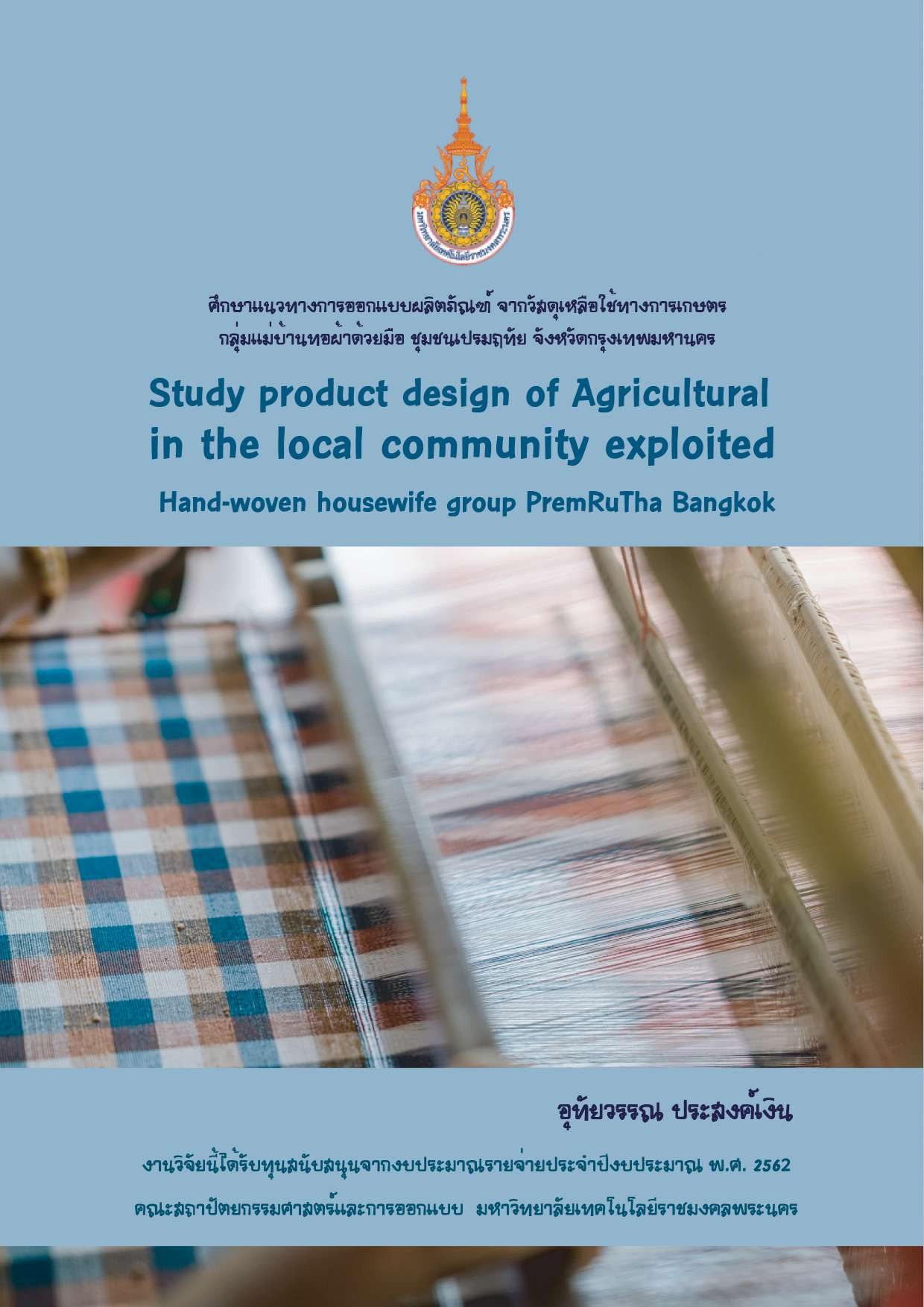
ศึกษาแนวทางการออกแบบผลิตภัณฑ์ จากวัสดุเหลือใช้ทางการเกษตร กลุ่มแม่บ้านทอผ้าด้วยมือชุมชนเปรมฤทัย จังหวัดกรุงเทพมหานคร
This research is Study the product design guidelines from agricultural waste materials. Weaving Housewife Group Premruethai Community Bangkok And in order to use waste materials to develop to add value With the following steps. (1) Surveying types amount of agricultural waste materials. (2) Study the physical structure and chemical properties of plant fibers. (3) Study the methods of preparing suitable fibers for textile materials. (4) Develop and study the suitable mixture ratio of blended fiber yarn. (5) Manufacture of hand-woven fabrics from agricultural waste materials. (6) Design and prototype of products from hand-woven fabrics from fibers agricultural waste And study from testing methods comparing the opinions of users / users and evaluators Assessed in the test Bring the results to analyze find conclusions analyze and suggest the research results to study. And analyze find conclusions study product design guidelines from agricultural waste materials Weaving Housewife Group Premruethai Community Bangkok Expect It was found that different methods of fiber content were obtained. And found that the amount of fiber varies according to the size of the material Analysis results of all chemical composition of fibers Found that the moisture content of 1.82% Water content 1.00% ashes 0.7 % and the fiber has the same amount of 0.97 mg kg at a normal level that can be found in general plants And meet the standard criteria Physical property test results of fibers The shape according to the cross-section of the fiber Looks like an oval almost round shape with a noticeable lumen. For the strength it was found that the fibers had an average elongation at break of 7.54% the toughness equal to 57.32% the fiber size was 16.45 deniers and the strength was 26.85 grams. Yarn production results The most suitable hand-woven (plant fiber and cotton) is 60% plant fiber mixed with 40% cotton. The yarn has an average toughness or strength of 4.86 newtons and the yarn is equal to 2.8 Ne and the result of Testing fabric peach mixed fiber fabric with handicraft pattern Found that the weaving of the fabric on the surface of the fabric and / or some grain on the fabric. And there is no hair and grain on the fabric medium Woven fabric has a lack of testing value from the number of abrasion cycles in the range of 1780 - 2100 and the color fastness to washing is in the level of 4-5 (the color has slightly changed And there is no color leakage) By the test streaking of yarn streaks (Plant fiber yarn) has the strength to withstand the pulling force in the range 577.30 - 610.22 newton the tear strength is in the range 37.26 - 53.89 newton and the size change after washing is in the range - 3.77 to - 6.59 should be developed into various home decoration products such as tableware sets curtains shoes bags etc. The assessor has the opinion that the use The beauty of various products Satisfied (1) Beauty pattern (2) color (3) Durability (4) Suitable proportion (5) Career promotion to local communities The assessors have the highest level of satisfaction respectively.
การพัฒนารูปแบบสำนักงานบริการด้านวิชาชีพบัญชีในไทย ด้วยแนวคิดทุนปัญญาสู่ประชาคมเศรษฐกิจอาเซียน : กรณีศึกษาสำนักงานบัญชีคุณภาพในเขตกรุงเทพมหานคร
The purpose of this research was to study the development of the office of accounting professional services in Thailand with the concept of intellectual capital towards the ASEAN Economic Community. The quality accounting offices were research samples which were representative of quality accounting offices in Thailand that can continue to perform professionally and successfully. Which found that quality accounting offices had applied the concept of intellectual capital It consists of 4 components namely human capital social capital structural capital and spiritual capital. They applied to the operation and management of the quality accounting office If the accounting firms in Thailand have applied the intellectual capital to their accounting firm they will be able to succeed in the accounting profession as well. Therefore based on this research the model for the development of the Office of Professional Accounting offices in Thailand is based on the idea of intellectual capital.
การตัดสินใจเลือกซื้อผ้าปักลายไทยประยุกต์จากธุรกิจผ้าไทยของสุภาพสตรีในเขตกรุงเทพมหานคร
The purposes of this research were 1) to study the individual factors of Thai women on making decisions about purchasing Thai-style embroidered textiles in the Bangkok area 2) to study the marketing mix factors which have an effect on their decision making 3) to study the decision making of the women 4) to study the relation between marketing mix factors and the women’s decision making and 5) to compare the level of decision making on purchasing of Thai-style embroidered textiles by considering the individual factors. The sample consisted of 400 women who purchased Thai-style embroidered textiles in Laksi Phra Nakorn Phaya Thai and Chatuchak districts. The employed research instruments were a questionnaire. The statistical methods used in analyzing the data were frequency percentage mean standard deviation Pearson Product Moment Correlation and One-Way ANOVA. The results showed that: 1) The main target group was women who were aged between 41 and 50 years single and have bachelor degrees. They were government or state enterprise officers who have an income from 25001 to 35000 baht per month. 2) The target group prioritized marketing mix factors at a high level; the product factor was at the highest average followed by the price factor. The lowest average was the staff factor. 3) The decision making considered several factors; the pattern of Thai-style embroidered textiles had the highest average followed by influencers. The lowest average was the buying frequency. 4) The marketing mix factors (product price channel promotion staff place of selling and service) were correlated with the decision making factor with a significance at the .05 level. And 5) the comparison of individual factors that affect decision making showed that status and average income per month were different while other factors were the same with significance at the .05