จำนวน Repository ( 36 )
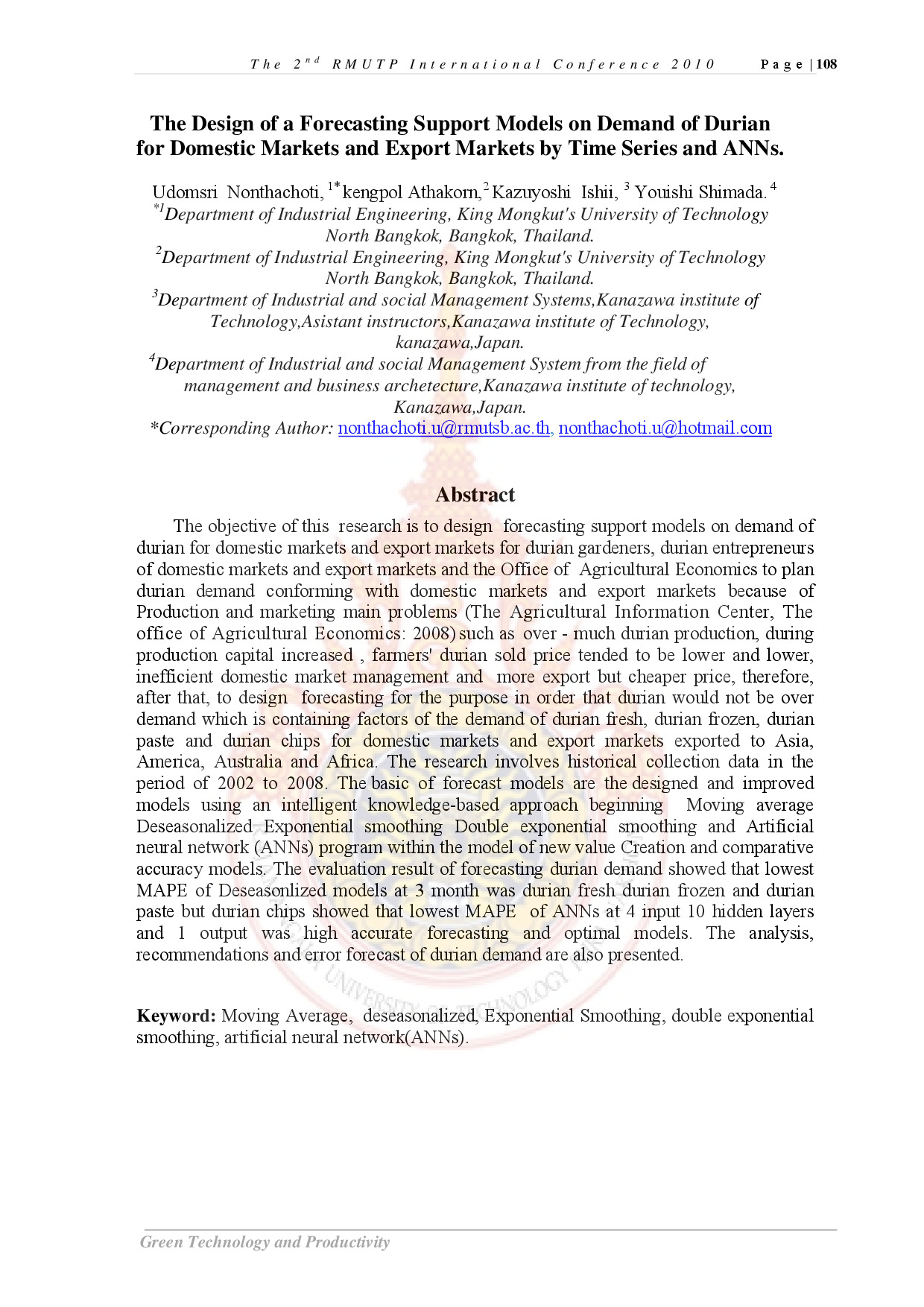
The Design of a Forecasting Support Models on Demand of Durian for Domestic Markets and Export Markets by Time Series and ANNs.
The objective of this research is to design forecasting support models on demand of durian for domestic markets and export markets for durian gardeners durian entrepreneurs of domestic markets and export markets and the Office of Agricultural Economics to plan durian demand conforming with domestic markets and export markets because of Production and marketing main problems (The Agricultural Information Center The office of Agricultural Economics: 2008) such as over - much durian production during production capital increased farmers durian sold price tended to be lower and lower inefficient domestic market management and more export but cheaper price therefore after that to design forecasting for the purpose in order that durian would not be over demand which is containing factors of the demand of durian fresh durian frozen durian paste and durian chips for domestic markets and export markets exported to Asia America Australia and Africa. The research involves historical collection data in the period of 2002 to 2008. The basic of forecast models are the designed and improved models using an intelligent knowledge-based approach beginning Moving average Deseasonalized Exponential smoothing Double exponential smoothing and Artificial neural network (ANNs) program within the model of new value Creation and comparative accuracy models. The evaluation result of forecasting durian demand showed that lowest MAPE of Deseasonlized models at 3 month was durian fresh durian frozen and durian paste but durian chips showed that lowest MAPE of ANNs at 4 input 10 hidden layers and 1 output was high accurate forecasting and optimal models. The analysis recommendations and error forecast of durian demand are also presented.
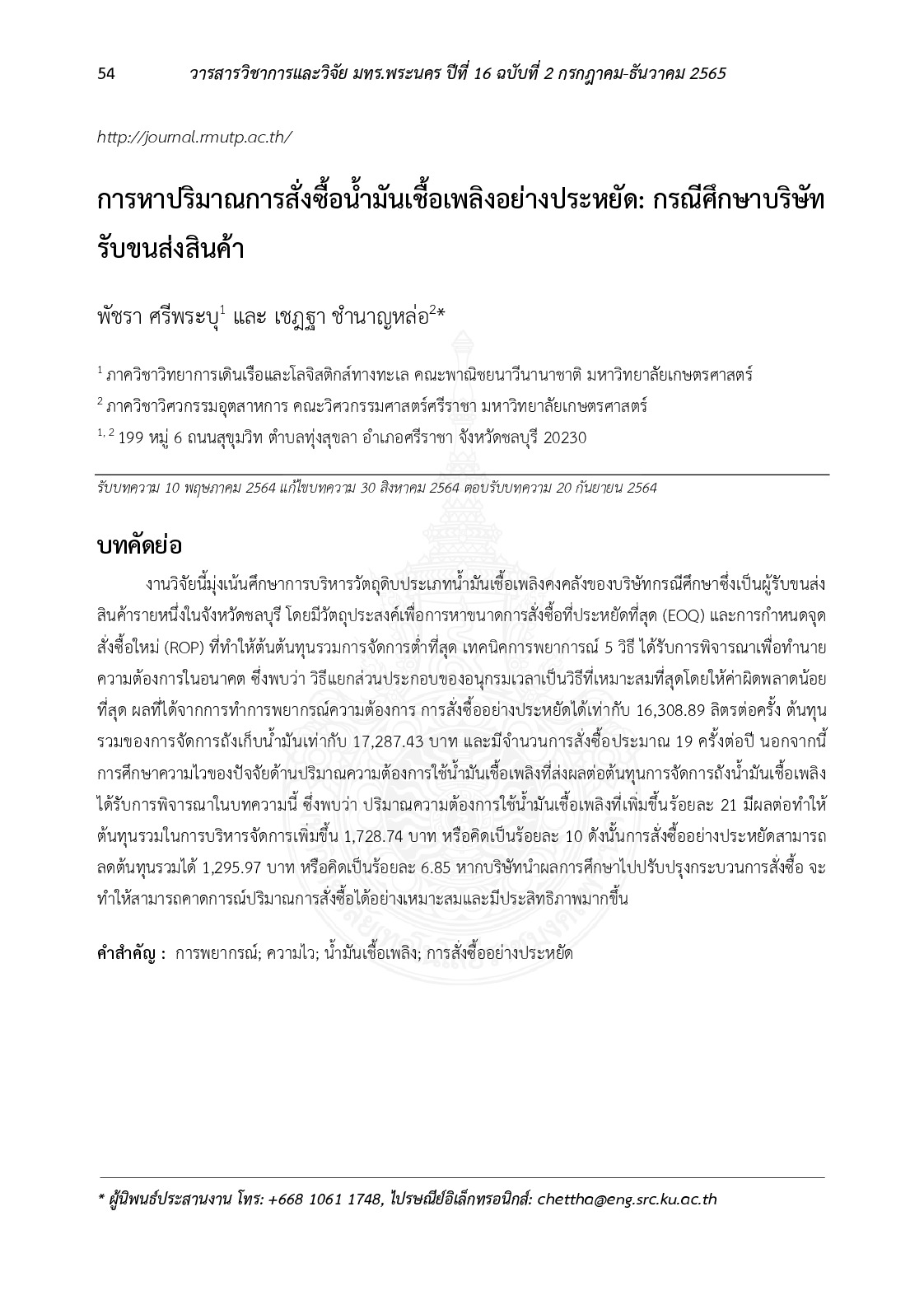
การหาปริมาณการสั่งซื้อน้ำมันเชื้อเพลิงอย่างประหยัด: กรณีศึกษาบริษัทรับขนส่งสินค้า
This research focuses on the raw-material management such as fuel of a case study company being a freight forwarder in Chonburi province. The objective is to determine the economic order quantity (EOQ) and the reorder point (ROP) that minimize the total cost of handling. Five forecasting techniques are investigated to predict the future demand and it was found that the time series decomposition was the most suitable method with the least error. At the result of demand forecasting the economic order quantity is 16308.89 liters per time the total cost of handling the fuel tank is 17287.43 baht and there are ordering around 19 times per year. In addition the sensitivity study on demand factors affecting the cost of fuel tank management are also considered in this paper. It was found that 21% of the increased fuel demand brings the total handling cost is 1728.74 baht or increasing 10%. Therefore ordering economically can reduce the total cost of 1295.97 baht or 6.85%. If the company brings the studied results to improve the ordering process it will be able to forecast the order quantity more appropriately and effectively.
การสร้างเงื่อนไขเริ่มต้นในการพยากรณ์อากาศ
Weather forecasts are very necessary to predict the future weather conditions. The important thing in forecasting is the model and variables. The model used in the forecasting must be accurate and effective. In addition the variables used in forecasting must be comprehensive and appropriate to be able to represent the forecast. The initial conditions for forecasting must be appropriate and reliable. There are many methods to generate the initial conditions in forecasting. To generate the initial conditions for winter monsoon prediction with Kalman Filtering method which is a method used to predict the status of various systems and able to create values of variables used in forecasting to have a variety of similarities can be used as a starting variable in forecasting very well. In this research the winter monsoon prediction by the Shallow Water Model and validating the initial conditions by Root Mean Square Error (RMSE). The result of weather prediction in the winter monsoon can be used the Kalman Filtering method for generate the initial conditions.
ตัวแบบผสมเชิงเส้นสาหรับข้อมูลอนุกรมเวลาเชิงพื้นที่ที่มีฤดูกาลรวมอยู่ด้วยประยุกต์ใช้กับผลผลิตยางพาราในจังหวัดภาคใต้ของประเทศไทย
The objectives of this research are to propose a linear mixed model (LMM) for spatial time series with a seasonal component to apply the proposed model to monthly rubber yields in southern provinces of Thailand to forecast rubber yields in southern provinces of Thailand and to compare the performance of the proposed model to the Holt-Winters Additive Exponential smoothing model (Holt-Winters ES) and the seasonal autoregressive integrated moving average model (SARIMA). The proposed model is a linear mixed model (LMM) with spatial effects following a conditional autoregressive model (CAR model). Seasonal dummy variables and Fourier terms are two methods used to account for the seasonal effects. A Bayesian method is used for parameter estimation. The estimated monthly yields are used to forecast the monthly rubber yields. The dependent variables are the monthly rubber yields in each province. The effects considered are spatial effects heterogeneity effects and seasonal effects. The data are secondary data at a provincial level. The results show that the effects influencing on the amount of rubber yields are spatial heterogeneity and seasonal effects. The proposed model with sesonal dummy variables is the most appropriate model copared to the LMM with Fourier sesonal effects Holt-Withers ES and SARIMA. The mean absolute errors (MAE) are smallest in both model fitting and model validating parts. The proposed model with sesaonal dummy variables should be the first consideration for forecasting spatial time series with a seasonal component.
ตัวแบบเบย์สำหรับข้อมูลอนุกรมเวลาเชิงพื้นที่ ประยุกต์ใช้กับผลผลิตยางพารา ในจังหวัดภาคใต้ของประเทศไทย
The objectives of this research are to propose a Bayesian model for spatial time series analysis to apply the proposed model to forecast a monthly rubber yield in Southern provinces of Thailand and to compare the performance of the proposed model with the classical Holt-Winters Additive Exponential smoothing. The proposed model is a linear mixed model (LMM) with spatial effects which follow a conditional autoregressive model (CAR). Dummy variables are used for seasonal effects. A Bayesian method is used for parameter estimation. The estimated monthly yields are used for the monthly rubber yield forecasting. The dependent variables are the rubber yield in each month of each province. The data are secondary data at a provincial level. The factors considered are spatial effects heterogeneity effects and seasonal effects. The results show that the factors influencing on the amount of rubber yields are spatial heterogeneity and seasonal effects. The proposed model is proper and forecast accurately. Using the mean absolute error (MAE) the proposed model has a better performance compared to the classical Holt-Winters Additive Exponential smoothing in both model fitting and model validating. The proposed model should be the first consideration for spatial time series forecasting.