จำนวน Repository ( 53 )

Rice production technology and cost benefit of smallholder farmer in rice community center : A Case Study Ban Phap, Phapayome District Phattalung Province
This research had objectives for the purpose of studied the rice production technology and cost benefit of farmer members in community rice seed centers (CRSC). The research case study was conducted in Phatthalung province by field surveys combining participatory rural appraisal and structured interview of 35 members during the research period from April 2012-August 2012. The CRSC received contribution grain from government service. The result showed that majority rice community center member were men and in one family had average 2 workers. Their ages between 51-60 years old. The Majority of education were primary school (grade 4). The cultivated area of rice between 11-20 rais. Rice production can generally be divided into the following 10 stages that is soil improvement land preparation crop establishment plantation water management nutrient management pet control weed control harvesting and post harvest. The results of the study found that almost all farmer using private land (69.72 %). The important expense was variable cost 80.25 % Ban-Phab is 3509 bath per rais. Average benefit per rais is 6985.04 bath per rais. The rice break- event point is 317.56 kg per rai. However return on investment explore CRSC Ban-Phab is 99.06 %
Development of a Low-Cost unmanned aerial vehicle for military affair
This paper proposes the study and development of a low-cost unmanned aerial vehicle (UAV) for survey with virtual pilot view that can be applied for both civilian and military purposes. Our prototype UAV is a fixed upper wing type with 1.6 m.-span 0.9 m.-length 0.2 m.-height and 2.6 kg.-payload. Its technical specification is as follows: 2500 m.-range 1000 m.-ceiling 60 km/hr-speed 1 hr-endurance 12 VDC/3000 mA/hr-power supply >90 azimuth-angle adjustable and >45 elevation-angle adjustable. The advantages of our prototype include low cost compactness and light weight. Furthermore it can be applied in several missions such as missing person search sky surveillance geo-informatics etc
นวัตกรรมคอนกรีตต้นทุนต่ำไหลเข้าแบบง่ายโดยการใช้เถ้าทิ่้ง
This research presents a study of the compressive strength porosity chloride penetration resistance to carbonation and corrosion of self-compacting concrete containing fly ash ground rice husk-bark ash and ground bottom ash. Portland cement (CT) is partially replaced with pozzolans 0-40% by weight of the cementitious materials. Fly ash ground rice husk-bark ash and ground bottom ash have a high potential to be used as a good cementitious material. The results show that the compressive strength and low porosity of self-compacting concrete improves substantially with partial replacement of Portland cement with fly ash. Self-compacting concrete mix cement containing 20-40% of pozzolans can be used to make cementitious materials. The use of fly ash ground rice husk-bark ash and ground bottom ash produces concrete mix with good strength and resistance to chloride and corrosion.
Cost of safety system in building construction
The goal of this study is to study the cost of safety system in building construction by studying multipurpose building with durable goods project. The cost of safety system in building construction is divided into two categories are the safety measure cost and the safety program cost in construction. From the study it is found out that the value of safety measure cost is approximately 1.85 % of a project cost and the value of safety program cost is approximately 0.98 % of a project cost. To sum up the cost of safety system in building construction is approximately 2.83 % of a project cost .Moreover the study found out that the safety measure cost is higher than the safety program cost about 1.88 as much. From the data of this study it can be used as the guideline in estimating the cost of safety system in building construction for the future project.
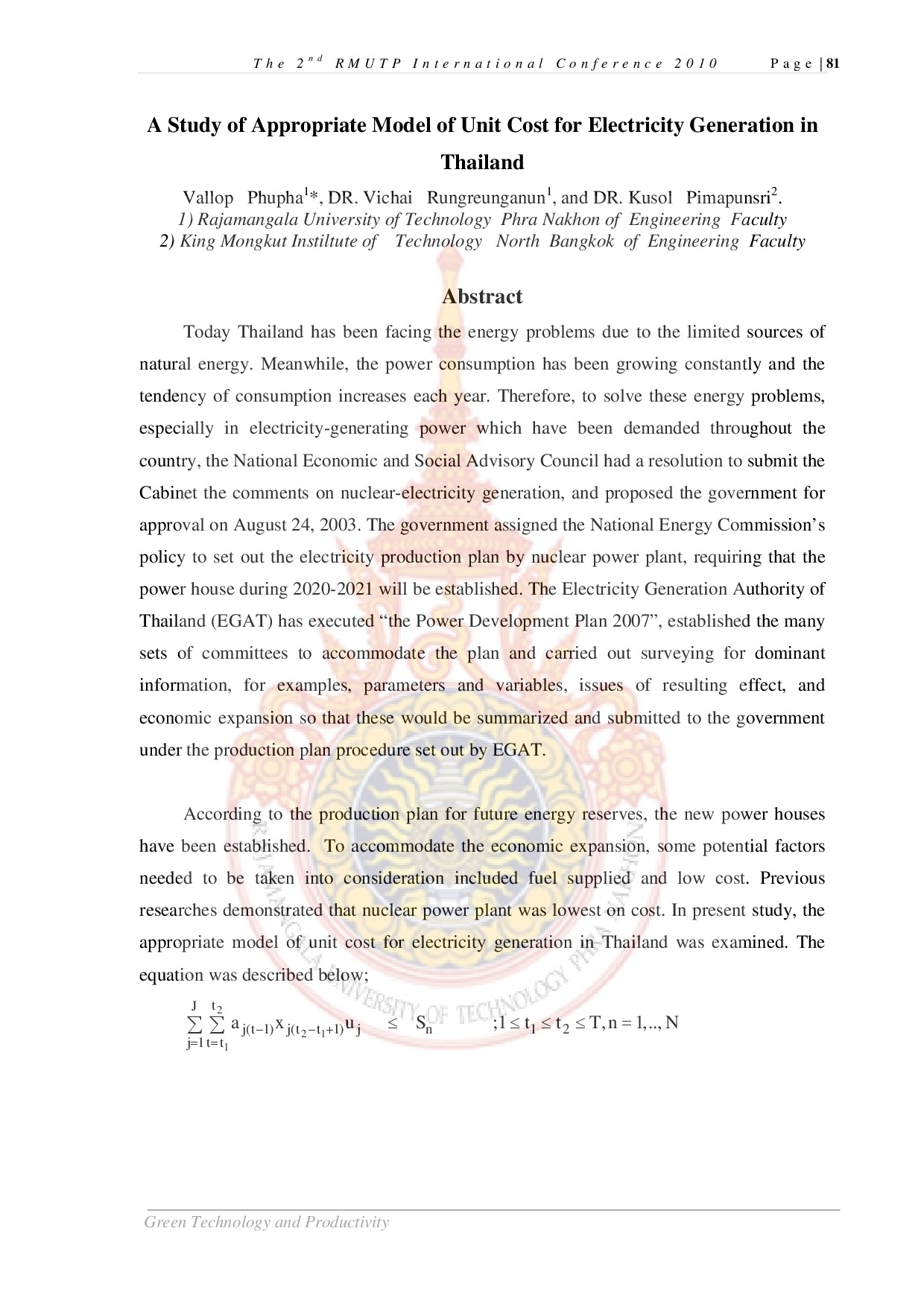
A Study of Appropriate Model of Unit Cost for Electricity Generation in Thailand
Today Thailand has been facing the energy problems due to the limited sources of natural energy. Meanwhile the power consumption has been growing constantly and the tendency of consumption increases each year. Therefore to solve these energy problems especially in electricity-generating power which have been demanded throughout the country the National Economic and Social Advisory Council had a resolution to submit the Cabinet the comments on nuclear-electricity generation and proposed the government for approval on August 24 2003. The government assigned the National Energy Commission’s policy to set out the electricity production plan by nuclear power plant requiring that the power house during 2020-2021 will be established. The Electricity Generation Authority of Thailand (EGAT) has executed “the Power Development Plan 2007” established the many sets of committees to accommodate the plan and carried out surveying for dominant information for examples parameters and variables issues of resulting effect and economic expansion so that these would be summarized and submitted to the government under the production plan procedure set out by EGAT. According to the production plan for future energy reserves the new power houses have been established. To accommodate the economic expansion some potential factors needed to be taken into consideration included fuel supplied and low cost. Previous researches demonstrated that nuclear power plant was lowest on cost. In present study the appropriate model of unit cost for electricity generation in Thailand was examined. The equation was described below;....