จำนวน Repository ( 37 )

ศึกษาสีผิวอิฐดินดิบลูกรังด้วยวัสดุธรรมชาติ
จากการทดลองวิจัยพบว่าอัตราส่วนผสมของดินลูกรังผสมสีธรรมชาติครั่งและสีครามในระยะเวลาการบ่ม 28 วัน ตามข้อกำหนดมาตรฐานของวิศวกรรมสถานแห่งประเทศไทยในพระบรมราชูปถัมภ์ สำหรับอิฐดินเผา (อิฐมอญ) ที่ว่าการต้านทานแรงอัดของอิฐจะต้องๆไม่น้อยกว่า 20 ksc ในทุกอัตราส่วนผสมไปถือว่าไปใช้งานต่อไปได้ การเปลี่ยนแปลงขนาดและปริมาตรในระยะเวลา 28 วัน จากการทดสอบและบันทึกการเปลี่ยนแปลงขนาดและปริมาตร จากดิน 3 แหล่ง ได้แก่ บ่อลุงวร จังหวัดสระบุรี อำเภอบ้านโป่ง จังหวัดราชบุรี และอำเภอท่ามะกา จังหวัดกาญจนบุรี พบว่ามีความสัมพันธ์กับกำลังของดินคือ ดินที่มีความสามารถในการรับกำลังสูงจะมีการเปลี่ยนแปลงปริมาตรน้อยตามไปด้วย การเปลี่ยนแปลงสีการาติดของสีธรรมชาติทั้ง 2 สีในระยะเวลา 28 วัน โดยการเปรียบเทียบกับตัวอย่างก้อนอิฐที่ผสมกับน้ำปะปา สีธรรมชาติในระดับที่1 ทั้ง 2 สี จะไม่แตกต่างกับสีของก้อนดินผสมน้ำปะปา เกิดการติดของน้อยมากไม่เหมาะสมจะนำมาใช้ในการเคลือบสีของสีธรรมชาติในระดับที่ 1และสีธรรมชาติในระดับที่ 2 ทั้ง 2 สี จะเกิดการติดของสีมากกว่าสีธรรมชาติในระดับที่ 1 ในอัตราส่วนผสม 10 % จะติดสีน้อยมาก อัตราส่วนผสม 15 % จะติดสีน้อย อัตารส่วนผสม 20 % จะติดสีปานกลาง อัตราส่วนผสม 25 % จะติดสีมาก ตามปริมาณสีที่เพิ่มขึ้น
ศึกษาความสามารถรับกำลังของดินดิบลูกรัง
จากการทดลองวิจัยพบว่าตัวอย่างดินที่ใช้ในงานวิจัยมีกำลังของดินเพิ่มขึ้นตามร้อยละปริมาณปูนที่เพิ่มขึ้นตามลำดับค่าอยู่ในช่วง 24.55-104.22 ksc. ตัวอย่างดินทุกแหล่งที่มีส่วนผสมของปริมาณปูนร้อยละ 0-1 ทุกความชื้นเมื่อนำไปแช่น้ำไม่สามารถก่อตัวขึ้นรูปอยู่ได้ ดินที่มีส่วนผสมของปริมาณปูนร้อยละ 5-10 ทุกความชื้อเมื่อนำไปแช่น้ำ มีร้อยละการเปลี่ยนแปลงปริมาตรอยู่ที่ 5.92-12.5 และดินที่มีส่วนผสมของปริมาณปูนร้อยละ 20 ของทุกความชื้นเมื่อนำไปแช่น้ำมีร้อยลการเปลี่ยนแปลงปริมาตรอยู่ที่ 0.01-6.96 และจากผลการทดสอบการดูดซึม น้ำพบว่าตัวอย่างดินทุกแห่งที่มีส่วนผสมของปูนปริมาณปูนร้อยละ 0-1 ทุกความชื้น เมื่อนำไปแช่น้ำไม่สามารถก่อตัวขึ้นรูปอยู่ได้ ดินที่มีส่วนผสมของปริมาณปูนร้อยละ 5-20 ทุกความชื้อ เมื่อนำไปแช่น้ำมีร้อยละการดูดซึมน้ำร้อยละ 10.25-19.95
การพัฒนาวัสดุจีโอโพลีเมอร์จากเถ้าแกลบและเถ้าชานอ้อย
This research studies the potential for using waste ash from industrial and agricultural by–products as a geopolymer material. This paper presents a study of the resistance to chloride penetration and resistance to sulfuric acid of geopolymer mortar containing ground rice husk ash (RA) and ground bagasse ash (BA). Geopolymer mortars with constant liquid to ash ratio and similar flow were used for the tests. Compressive strength porosity chloride penetration test Rapid migration test of chloride depth chloride ion diffusion coefficient immersion test of chloride depth and weight loss with impressed sulfuric acid were investigated. Test results show that the workable flow of geopolymer mortar was in the range of 110–115% and was dependent on the ratio by mass of sodium silicate to NaOH and the concentration of NaOH. Extra water was used to improve the workabililty. In case of rice husk ash geopolymer mortar the geopolymer mortars with high strengths were obtained with concentration of NaOH of 15M with the sodium silicate to NaOH ratio by weight of 2.5. However the bagasee ash geopolymer mortars with high strengths were obtained with concentration of NaOH of 10M with the sodium silicate to NaOH ratio by weight of 2.5. The use of rice husk ash and bagasse ash produces geopolymer mixes with good strength and resistance to acid and chloride penetration. The resistance to acid and chloride penetration is higher with an increase in the sodium silicate to NaOH ratio by weight of 2.5.

The factors of satisfaction in working of supporting for government officers and others staffs in the university.
This research is an exploring research to be connected with the main purpose of learning about the satisfactions in working as other sides for supporting personal consists of supporting for government officers supporting for government staffs university staffs permanent employees and temporary employees in total 635 people. There are only 360 people of samples from the total as mentioned to be analyzed the factors and other satisfactions the result of this research is the level of surrounding factors in working as showing the average rate for all over as the normal level. In comparing with the personal factor and satisfaction were found that Male are much more than Female about satisfaction in all factors mentioned. And also single government staff there is most of satisfying than married and divorced status. Additionally the level of satisfaction will be reduced respectively as referring with ages type of working opportunity colleague and facilities but the satisfaction of reward will be much more which is depended on ages. Moreover the experienced staff will be much satisfied as follows: Type of working Reward Opportunity and Facilities but another side to be less satisfied are Colleague. However the responsibility of members in their family will be less satisfied almost all sides. Another thing the position is the most of satisfying colleague & facilities are next and reward & opportunity to be promoted as the last one. Moreover chief executive position satisfies more than head of department and operation respectively. Noise temperature dust smell air flow and colleague are the surrounding factors to be reflected with the satisfactions.
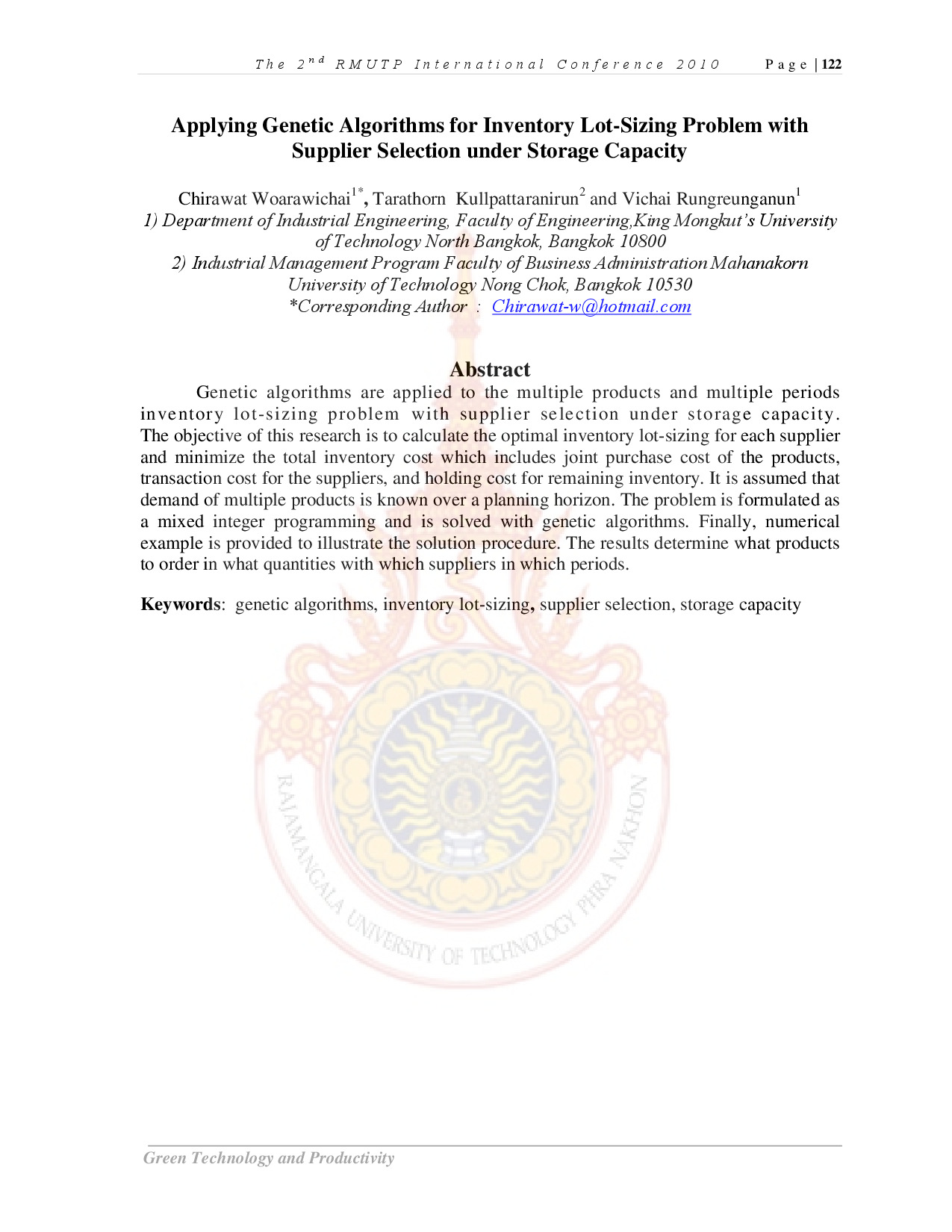
Applying Genetic Algorithms for Inventory Lot-Sizing Problem with Supplier Selection under Storage Capacity
Genetic algorithms are applied to the multiple products and multiple periods inventory lot-sizing problem with supplier selection under storage capacity. The objective of this research is to calculate the optimal inventory lot-sizing for each supplier and minimize the total inventory cost which includes joint purchase cost of the products transaction cost for the suppliers and holding cost for remaining inventory. It is assumed that demand of multiple products is known over a planning horizon. The problem is formulated as a mixed integer programming and is solved with genetic algorithms. Finally numerical example is provided to illustrate the solution procedure. The results determine what products to order in what quantities with which suppliers in which periods.