จำนวน Repository ( 70 )

Research and development on paddy washing machine for households rice milling machines
The objectives of this study were to develop the paddy washing machine for community rice milling machines to extend this technology to rural community and introduce to commercial production. The experiments were conducted at the Department of Agricultural Engineering and Technology Faculty of Agriculture and Natural Resource Rajamangala University of Technology Tawan-ok Bangpra Campus Sriracha Chonburi. The results showed that paddy washing machine was suitable for high moisture content paddy between 20-25 % and washing for 1-3 minutes demonstrated better milling quality than unwashed paddy. Performance test of this developed paddy washing machine using drum speed at 35 rpm drum slopes of 1 2 and 3 degree and 21.60 % MC KDML 105 paddy could reach capacity about 150-200 kg/hr. The milling quality was significantly different at 95% confidence level from unwashed paddy. Furthermore this machine provided 1% better in purity and 11% better head rice yield at the same milling degree. From the study it can be concluded that increasing drum slope gave higher capacity higher power efficiency and lower water usage. The best condition was working with drum slope of 3 degree. The paddy washing process gave higher purity of paddy head yield and power efficiency of washing process while the color property was not significantly different from unwashed paddy at the same milling degree.
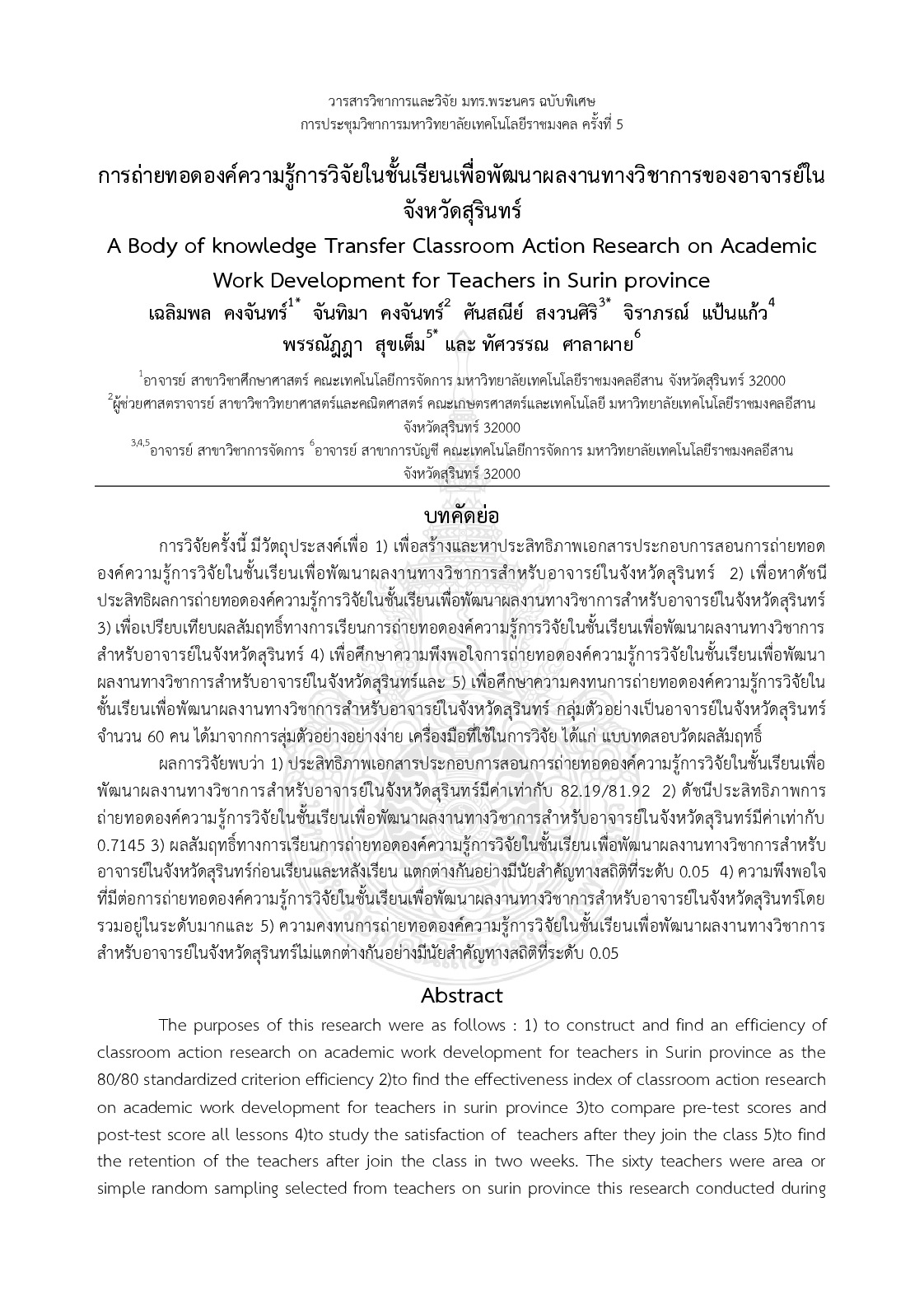
A body of knowledge transfer classroom action research on academic work development for teachers in surin province
The purposes of this research were as follows : 1) to construct and find an efficiency of classroom action research on academic work development for teachers in Surin province as the 80/80 standardized criterion efficiency 2)to find the effectiveness index of classroom action research on academic work development for teachers in surin province 3)to compare pre-test scores and post-test score all lessons 4)to study the satisfaction of teachers after they join the class 5)to find the retention of the teachers after join the class in two weeks. The sixty teachers were area or simple random sampling selected from teachers on surin province this research conducted duringthe first semester academic year 2011-2012. 1) An efficiency of classroom action research on academic work development for teachers is surin province was 82.19/81.92 which higher than the 80/80 standardized criterion efficiency.2) The effectiveness index of classroom action research on academic work development for teachers in surin province was 0.7145.3) The results of the comparisons of pre-test scores and post-test scores all lessons were significantly different at 0.05.4)The results of the satisfaction of teachers among a classroom action research on academic work development for teachers among a classroom action research on academic work development for teachers in surin province was found to be a high Level(x=4.27).5) The retention of the teachers after join the class in two week was no significantly different at 0.05.
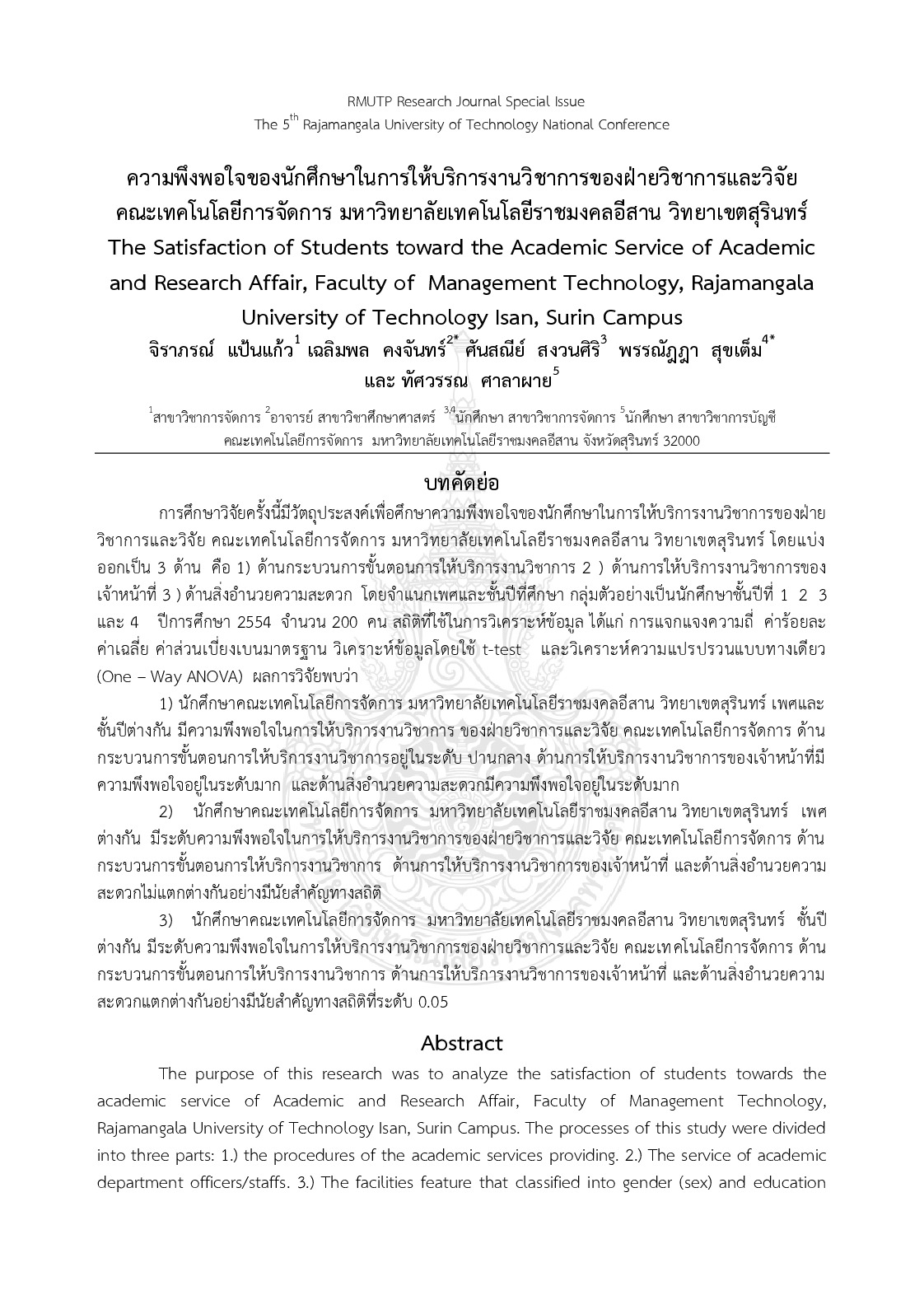
The satisfaction of students toward the academic service of academic and research affair, faculty of management Technology, Rajamangala University of Technology isan, surin campus
The purpose of this research was to analyze the satisfaction of students towards the academic service of Academic and Research Affair Faculty of Management Technology Rajamangala University of Technology Isan Surin Campus. The processes of this study were divided into three parts: 1.) the procedures of the academic services providing. 2.) The service of academic department officers/staffs. 3.) The facilities feature that classified into gender (sex) and education level (year) of the students. The populations used were 200 students among the first year to the fourth year students who studied in the academic year of 2011. The tool used consisted was the questionnaire and the statistic data were analyzed by frequency percentage average value mean standard deviation T-test and One-Way ANOVA. The findings were concluded as follows: 1.) The students of Management Technology Faculty Rajamangala University of Technology Isan Surin Campus who had the different in gender (sex) and education level (year) were satisfied the procedures of the academic services providing were in the moderate level. While the service of academic department officers/staffs were in high level and lastly the facilities features were also in high level. 2.) The students of Management Technology Faculty Rajamangala University of Technology Isan Surin Campus who had the different gender were satisfied the procedures of the academic services providing the service of academic department officers/staffs the facilities features in the level of indifferent significant. 3.) The students of Management Technology Faculty Rajamangala University of Technology Isan Surin Campus who had the different education level (year) were satisfied the procedures of the academic services providing the service of academic department officers/staffs the facilities features in the different statistical significant level at 0.05
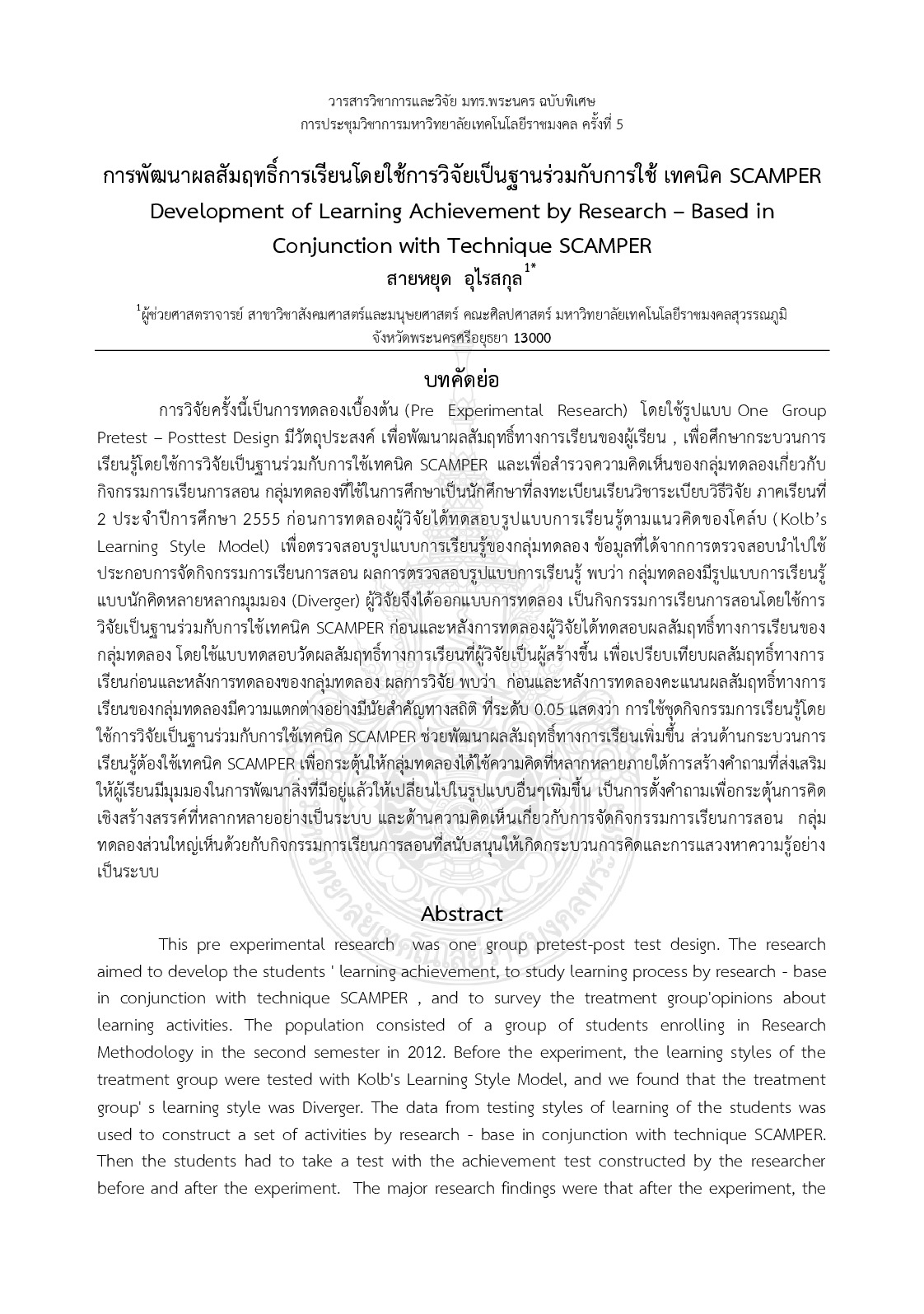
Development of learning achievement by research – based in conjunction with technique SCAMPER
This pre experimental research was one group pretest-post test design. The research aimed to develop the students learning achievement to study learning process by research - base in conjunction with technique SCAMPER and to survey the treatment groupopinions about learning activities. The population consisted of a group of students enrolling in Research Methodology in the second semester in 2012. Before the experiment the learning styles of the treatment group were tested with Kolbs Learning Style Model and we found that the treatment group s learning style was Diverger. The data from testing styles of learning of the students was used to construct a set of activities by research - base in conjunction with technique SCAMPER. Then the students had to take a test with the achievement test constructed by the researcher before and after the experiment. The major research findings were that after the experiment the scores of the treatment group were significantly different at level 0.05 therefore; we concluded that the qualified set of the learning activities by research - base in conjunction with SCAMPER was able to develop the students learning achievement. In the part of learning process the technique SCAMPER was used to promote the students different views and ideas by asking questions which encouraged students to create their thinking systematically. In the students opinions about learning activities most of them strongly agreed with this technique which contributed to the thinking process and the systematic pursuit of knowledge.
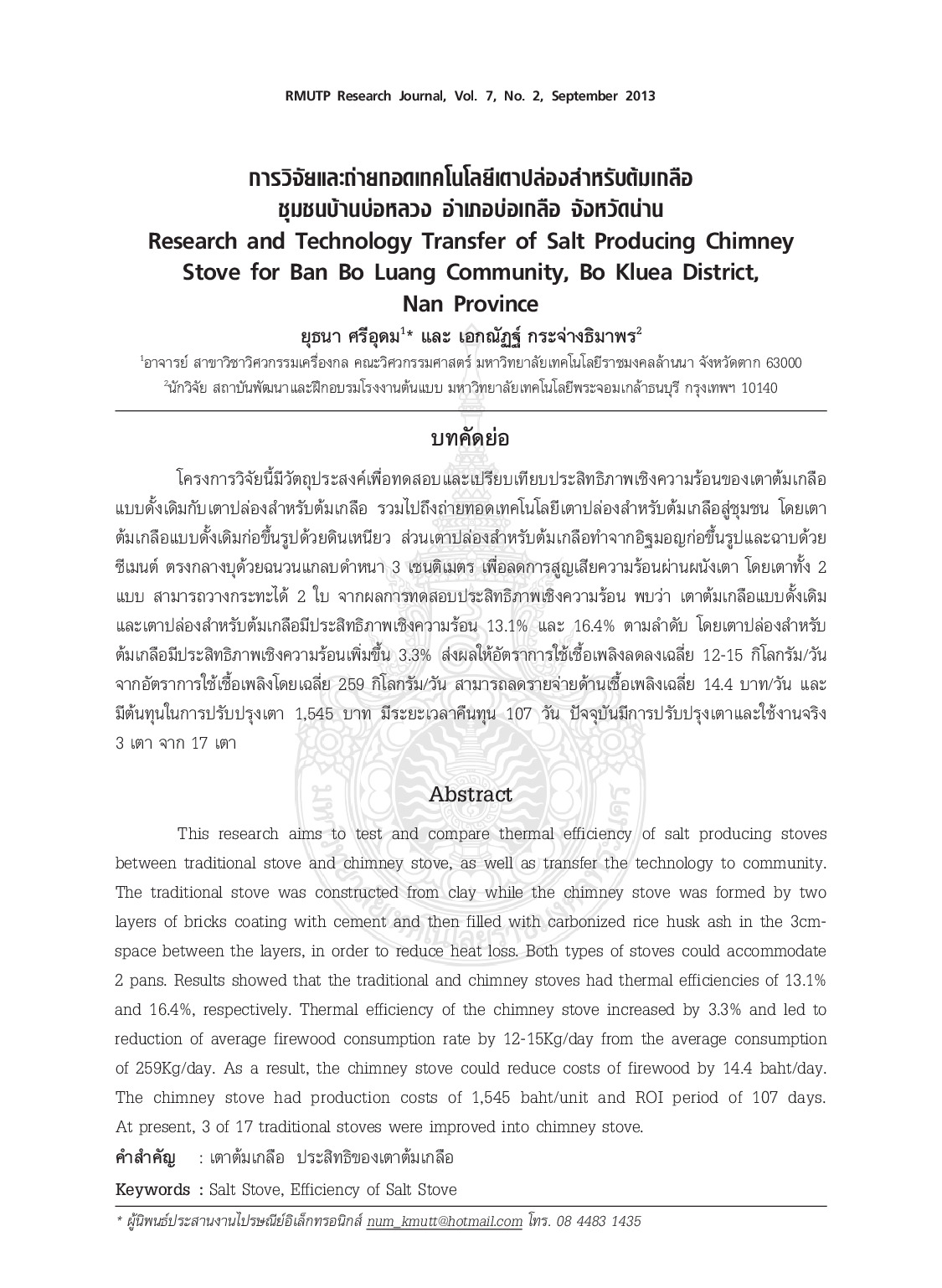
Research and technology transfer of salt producing chimney stove for ban bo luang community, bo kluea district, Nan Province
This research aims to test and compare thermal efficiency of salt producing stoves between traditional stove and chimney stove as well as transfer the technology to community. The traditional stove was constructed from clay while the chimney stove was formed by two layers of bricks coating with cement and then filled with carbonized rice husk ash in the 3cm-space between the layers in order to reduce heat loss. Both types of stoves could accommodate 2 pans. Results showed that the traditional and chimney stoves had thermal efficiencies of 13.1% and 16.4% respectively. Thermal efficiency of the chimney stove increased by 3.3% and led to reduction of average firewood consumption rate by 12–15Kg/day from the average consumption of 259Kg/day. As a result the chimney stove could reduce costs of firewood by 14.4 baht/day. The chimney stove had production costs of 1545 baht/unit and ROI period of 107 days. At present 3 of 17 traditional stoves were improved into chimney stove.