จำนวน Repository ( 45 )
การผลิตวัสดุดูดซับเสียงจากวัสดุผสม ยางโฟมธรรมชาติและเส้นใยธรรมชาติ
This research work was to study the effect of surface treatment of natural fiber and the effects of type and content of natural fiber on the development of acoustic material from natural rubber foam /natural fiber composites. The surface treatment used for this research work was sodium hydroxide (NaOH) treatment. NaOH Concentrations and treatment times were varied from 0 to 15 %wt. and 0 to 30 min respectively. Natural fibers used for this work were bagasse fiber (BF) and oil palm fiber (OPF). The suitable condition for surface treatment was estimated by fiber length and diameter (L/D) ratio and morphology of natural fiber. The result suggested that L/D ratios tended to increase when NaOH concentrations and/or treatment times increased except for NaOH concentration of 15 %wt. L/D ratios of OPF after surface treatment were changed more than those of BF. The suitable conditions of NaOH treatment for BF and OPF were NaOH concentration of 10 %wt. and surface treatment times of 30 and 10 min respectively. The effects of fiber type and content on sound absorption properties of natural rubber foam /natural fiber composites were investigated by cell characteristics sound absorption coefficient DMA analysis and bulk density. Both treated BF and OPF with suitable treatment condition were varied from content of 0.0 to 10.0 %wt. The result showed that the cell size of composites tended to decrease with addition of natural fiber whereas number of foam cell per unit volume increased. After adding natural fiber more than 2.5 %wt. cell size of composite foam and number of foam cell per unit volume tended to change the inverse direction. Natural fiber in composites enhanced the sound absorption efficiency. Sound absorption coefficient of composites adding BF was more than that of composite adding OPF. The addition of natural fiber enhanced the elasticity of composites and that increased sound absorption efficiency. NaOH treatment led to creation of strong interfacial bonding between natural fiber and natural rubber and enhanced the sound absorption efficiency. Density of NR composite foam increased with increasing natural fiber content.
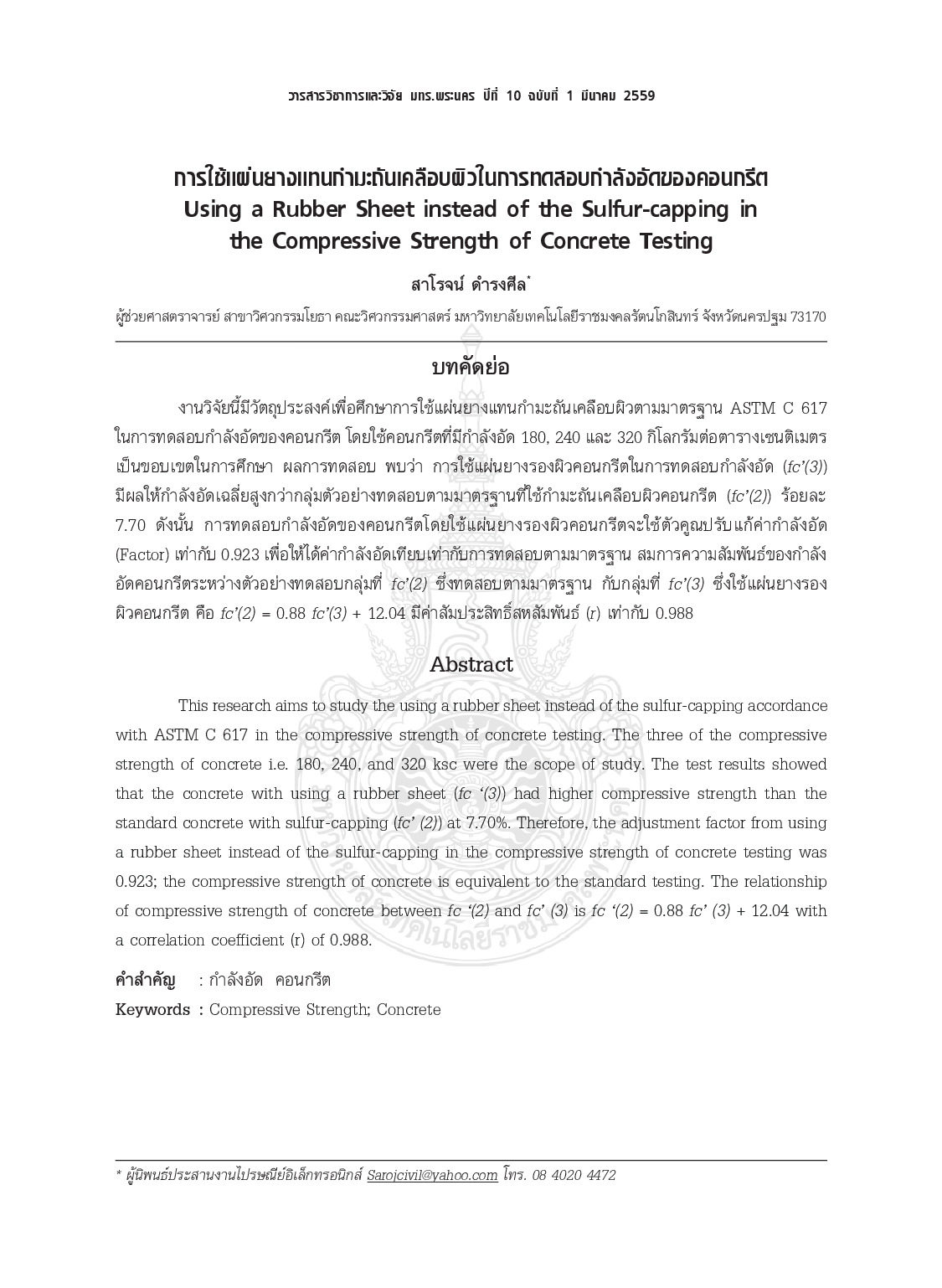
การใช้แผ่นยางแทนกำมะถันเคลือบผิวในการทดสอบกำลังอัดของคอนกรีต
This research aims to study the using a rubber sheet instead of the sulfur-capping accordance with ASTM C 617 in the compressive strength of concrete testing. The three of the compressive strength of concrete i.e. 180 240 and 320 ksc were the scope of study. The test results showed that the concrete with using a rubber sheet (fc (3)) had higher compressive strength than the standard concrete with sulfur-capping (fc (2)) at 7.7%. Therefore the adjustment factor from using a rubber sheet instead of the sulfur-capping in the compressive strength of concrete testing was 0.923; the compressive strength of concrete is equivalent to the standard testing. The relationship of compressive strength of concrete between fc (2) and fc (3) is fc (2) = 0.88 fc (3) + 12.04 with a correlation coefficient (r) of 0.988.
การใช้ขุยมะพร้าวเพื่อเสริมความต้านทานแรงดึงของผลิตภัณฑ์แผ่นยางธรรมชาติ
This research aims to study the properties of natural rubber STR 20 at 100 phr with various contents of coir (e.g. 0 5 10 20 40 and 80 phr) and then mixed with chemical substance at constant ratio. After that the samples are ground by two-roll mill and formed by compression molding at 150 degree Celsius. This leads into the coir reinforcement natural rubber plate of dimension 30x30x0.5 cm. The properties of the natural rubber plates are tested under ASTM standard. From the results it is found that increasing in coir then the properties of resilience and density are improved at every mix ratio. However the tensile strength tear strength and wearing are increased at some certain value of coir. The samples give no water absorption at every mix ratio. The results from this research indicate that it can develop into the rubber floor tiles and rubber wall tiles for furnishing the buildings in natural style.
ตัวแบบเบย์สำหรับข้อมูลอนุกรมเวลาเชิงพื้นที่ ประยุกต์ใช้กับผลผลิตยางพารา ในจังหวัดภาคใต้ของประเทศไทย
The objectives of this research are to propose a Bayesian model for spatial time series analysis to apply the proposed model to forecast a monthly rubber yield in Southern provinces of Thailand and to compare the performance of the proposed model with the classical Holt-Winters Additive Exponential smoothing. The proposed model is a linear mixed model (LMM) with spatial effects which follow a conditional autoregressive model (CAR). Dummy variables are used for seasonal effects. A Bayesian method is used for parameter estimation. The estimated monthly yields are used for the monthly rubber yield forecasting. The dependent variables are the rubber yield in each month of each province. The data are secondary data at a provincial level. The factors considered are spatial effects heterogeneity effects and seasonal effects. The results show that the factors influencing on the amount of rubber yields are spatial heterogeneity and seasonal effects. The proposed model is proper and forecast accurately. Using the mean absolute error (MAE) the proposed model has a better performance compared to the classical Holt-Winters Additive Exponential smoothing in both model fitting and model validating. The proposed model should be the first consideration for spatial time series forecasting.
ผลิตภัณฑ์กระเบื้องยางพาราผสมเศษขยะพลาสติกเหลือทิ้งจากโรงงานอุตสาหกรรม
This research aims to develop the Para-rubber floor tiles mixed with ethylene vinyl acetate plastic wastes (EVA plastics) from the factories. The study use Para-rubber STR 20 at 100 phr with various contents of EVA plastics (e.g. 0 5 10 20 40 and 80 phr) and then mixed with chemical substance at constant ratio include zinc oxide at 5 phr stearic acid at 2 phr sulfur at 3 phr mercaptobenzothiazole at 0.5 phr and diphenyl guanidine at 0.2 phr. The samples are ground by two-roll mill and formed by compression molding at 150 degree Celsius with 30x30x0.2 cm of dimension. The properties of the Para-rubber floor tiles are tested under ASTM standard. From the results it is found that the Para-rubber floor tiles mixed with 10 phr of EVA plastics is the suitable ratio for using as the rubber floor tiles and rubber wall tiles in building. This ratio can increase the hardness and wear resistant properties and decrease the density and thermal insulation properties when compare to the Para-rubber floor tiles without EVA plastic.