จำนวน Repository ( 127 )
การถ่ายทอดเทคโนโลยีการสร้างตราสินค้าและบรรจุภัณฑ์เพื่อเพิ่มมูลค่าผลิตภัณฑ์จากเศษวัสดุสิ่งทอเหลือทิ้ง
The research’s purpose is the knowledge transfer of the technology about branding and packaging to increase product’s value from waste textiles for the community groups and interested person. The assessment method for evaluation is studying the local product’s information the processing rag’s group in Ban Dongdang Tambon Dongdeang Jaturapakpiman Roy-ed. The researcher selected the brand and packaging prototypes and the product from the research about branding and packaging to increase product’s value from waste textiles (Fiscal year in 2013) which are appropriate to the product being sold. Because that research has the heart shape petal’s brand label for packaging the winner from 25 styles that selected from 5 experts. And has been applied to a prototype of 8 products. The 8 products are The packaging for bag The packaging for hat The packaging for lamp The packaging for shoe The packaging for textile’s box The packaging for bedspread The packaging for carpet The packaging for Cushions The packaging for Scatter cushion The packaging for tablecloth The packaging for fabric wall and frame. The goal of knowledge transfer are 30 persons. The survey of the participants’ satisfaction by the questionnaires data collection the data from the frequency statistic percentage and median. The result is the participants 25 persons (50 %) were mostly female 13 persons (43.34%) with secondary education 15 persons (50%) between the ages of 31- 40 years old 10 persons (33.33%) a farmer and seamstress 18 persons (60%) with monthly income less than 5000 bath. Satisfaction is divided into 3 topics the purpose of project the structure of the course the content of the course.The purpose of project is the most satisfied (4.68%). The structure of the course is satisfactory (3.97%). The content of the course is satisfactory (4.45%). And the satisfaction to the reproductive technology about branding and packaging to increase product’s value from waste textiles project in the service processes is satisfactory (4.50%) Lecturer team is the most satisfied (4.68%) The facilities is the most satisfied (4.68%). Ban Dong deang’s rag and processing group has a satisfaction’s average of the project is the most satisfied (4.48%).
การเพิ่มมูลค่าเศษวัสดุสิ่งทอเหลือทิ้งเป็นผลิตภัณฑ์เครื่องใช้ในบ้านและของที่ระลึก
The objectives of the research were : firstly to increase value of textile waste for household products : one set made from rags and the other from rag’s thread and to make the first model of the household products and souvenirs secondly to survey the satisfaction of the target group towards those products. To launch the research 5 styles of 11 products of each set were designed and made .The products were lamps cushions seats tablecloths mats wall-hangings bed sheets multi -purpose boxes shoes hats and handbags. Afterwards all of those products 110 pieces were brought to 5 experts for their 3 styles optimal selections of each set. Therefore 66 pieces of the selected products from the experts was brought to ask for the satisfaction from 100 persons of the target group that obtained by accidental sampling of statistically method. And the data was analyzed by frequency percentage mean and standard deviation. And the results of the study found that the target group satisfied all of the products in the utility of textile waste increasing value at the highest level. And their contentment were at high level to very high level in products from rags were handbags multi -purpose boxes bed sheets hats mats and seats and the other from rag’s thread were cushions handbags lamps bed sheets hats mats and seats.

การทอผ้าขีดลายไทยเพื่อออกแบบและพัฒนารูปแบบผลิตภัณฑ์สิ่งทอ
The objective of this study was to khet design by using Thai pattem created on cotton clothes using Thai Khet creation: warp yarn in thousand comb with tightly strengthened cloth while welf yam with hardness together Thai Khet on Thai cotton pattern Traditional Thai Khet waving machine to be adapted by adding front floating hardness pattern hardness wood stepping new pattern weaving plan plotting Thai pattern and making color signals on graph prior khet pattern creation which one graphs column replaces one warp yarn when khet designing have been finished then the following step is desinged plane weaving. The results of the study showed that: there is suitable continuing Thai pattern on cotton cloth: Kanook pattern follows Krajang Ta Ooy pattern and Prajamyam pattern to be combined as graceful delicacy pattern and innovation transferred into Danchang District Supanburi Province.
Preparation of polymer blends fiber between poly (lactic acid) and poly (butylene succinate) for textile applications
Biodegradable polymer blend fibers were prepared by melt spinning technique. Poly(lactic acid) (PLA) and poly(butylene succinate) (PBS) were blended in a twin screw extruder at various contents of PBS at 0-50 wt%. PLA/PBS blends were melt spun using a single screw extruder equipped with multifilaments spinnerette. The effect of PBS contents on morphology thermal properties and mechanical performance of PLA/PBS blend fiber was investigated. SEM micrographs indicated that the addition of PBS at 10 wt% showed miscibility of PLA/PBS blends while the other contents of PBS exhibited phase separation of the blends. The incorporation of PBS affected on the declination of crystallinity in the blends. It can be noted that the addition of PBS could enhance the elasticity of PLA/PBS blend fibers.
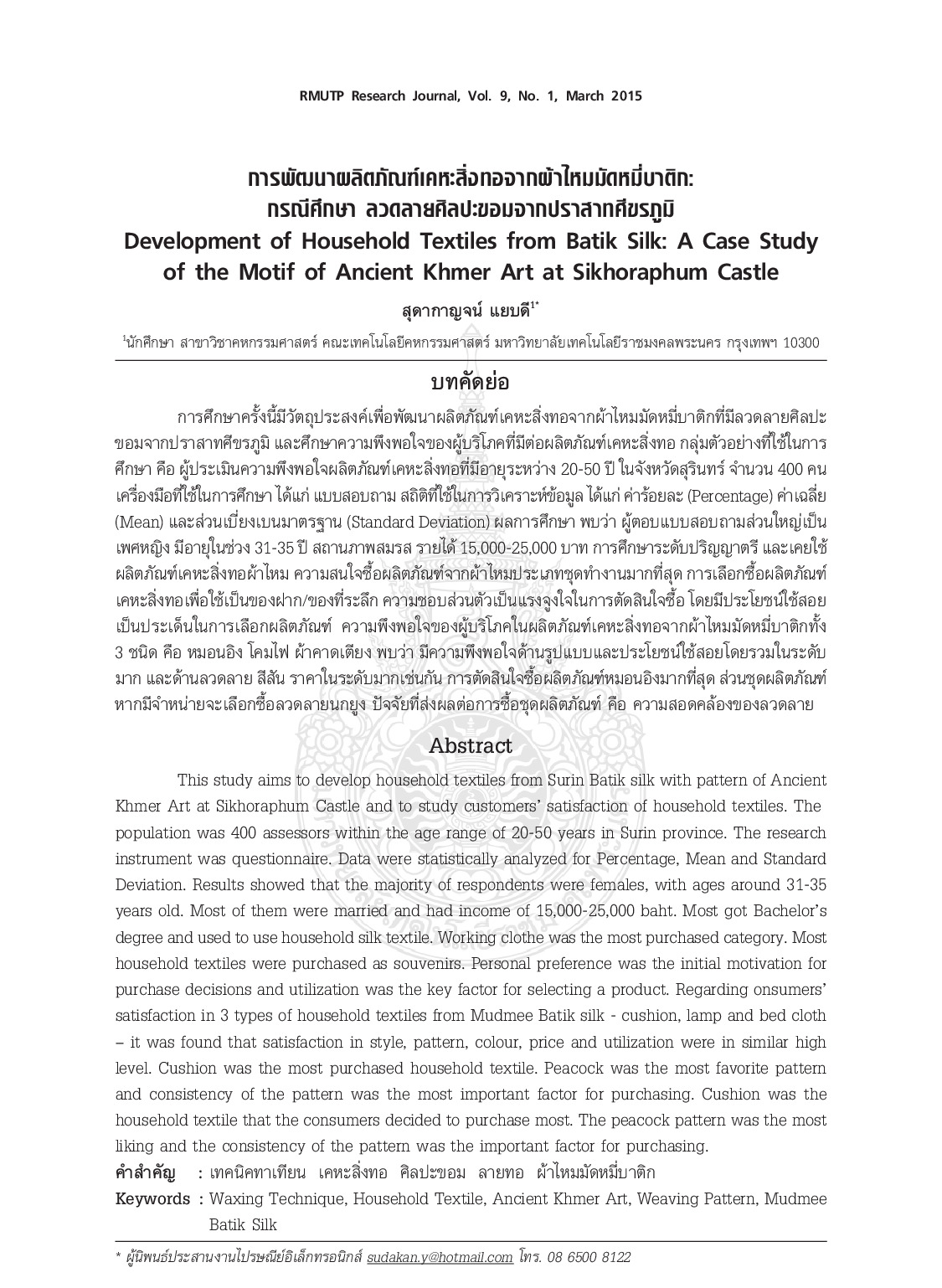
Development of household textiles from batik silk: a case study of the motif of ancient khmer art at sikhoraphum castle
This study aims to develop household textiles from Surin Batik silk with pattern of Ancient Khmer Art at Sikhoraphum Castle and to study customers’ satisfaction of household textiles. The population was 400 assessors within the age range of 20 - 50 years in Surin province. The research instrument was questionnaire. Data were statistically analyzed for Percentage Mean and Standard Deviation. Results showed that the majority of respondents were females with ages around 31 - 35 years old. Most of them were married and had income of 15000 – 25000 baht. Most got Bachelor’s degree and used to use household silk textile. Working clothe was the most purchased category. Most household textiles were purchased as souvenirs. Personal preference was the initial motivation for purchase decisions and utilization was the key factor for selecting a product. Regarding onsumers’ satisfaction in 3 types of household textiles from Mudmee Batik silk - cushion lamp and bed cloth – it was found that satisfaction in style pattern colour price and utilization were in similar high level. Cushion was the most purchased household textile. Peacock was the most favorite pattern and consistency of the pattern was the most important factor for purchasing.