จำนวน Repository ( 131 )
การศึกษาความเป็นไปได้ในการผลิตฝากระโปรงรถยนต์จากแกลบและผักตบชวาเพื่อรองรับการชนคนเดินเท้า
Recently the Thai industry has continually grown up and also plays a role to economic growth in the country which affects the many of automotive components to be in the market. While the degeneration and waste of automotive components had increased as well. Therefore a car hood is one of the automotive parts which damage from the accident. Consequently the researchers have created a prototype material to develop into the car hood which made from the husk and water hyacinth. The random mixture of water hyacinth and husk was attempted to more than 3 ingredients. By forming a flat plate with thickness between 1 to 3 millimeters was used as prototype of the car hood material in this research. Thus the mechanical properties such as compressing and bending test were attempted to by the universal testing machine. The results showed that using resin as a binder material (Reinforced resin by water hyacinth and husk) will have the less ability of energy absorption. While using polymers as a binder (Polymer resin by water hyacinth and husk) will have the better ability of energy absorption. The properly mixture between water hyacinth and husk referred to the energy absorbing properties is 50:50 because the least linear stiffness is 1.087 N/mm. Besides the ability of energy absorption is 1612444 J/m3 which is property of this ingredient can reduce the severity of the impact in the event of pedestrians collision in the best.
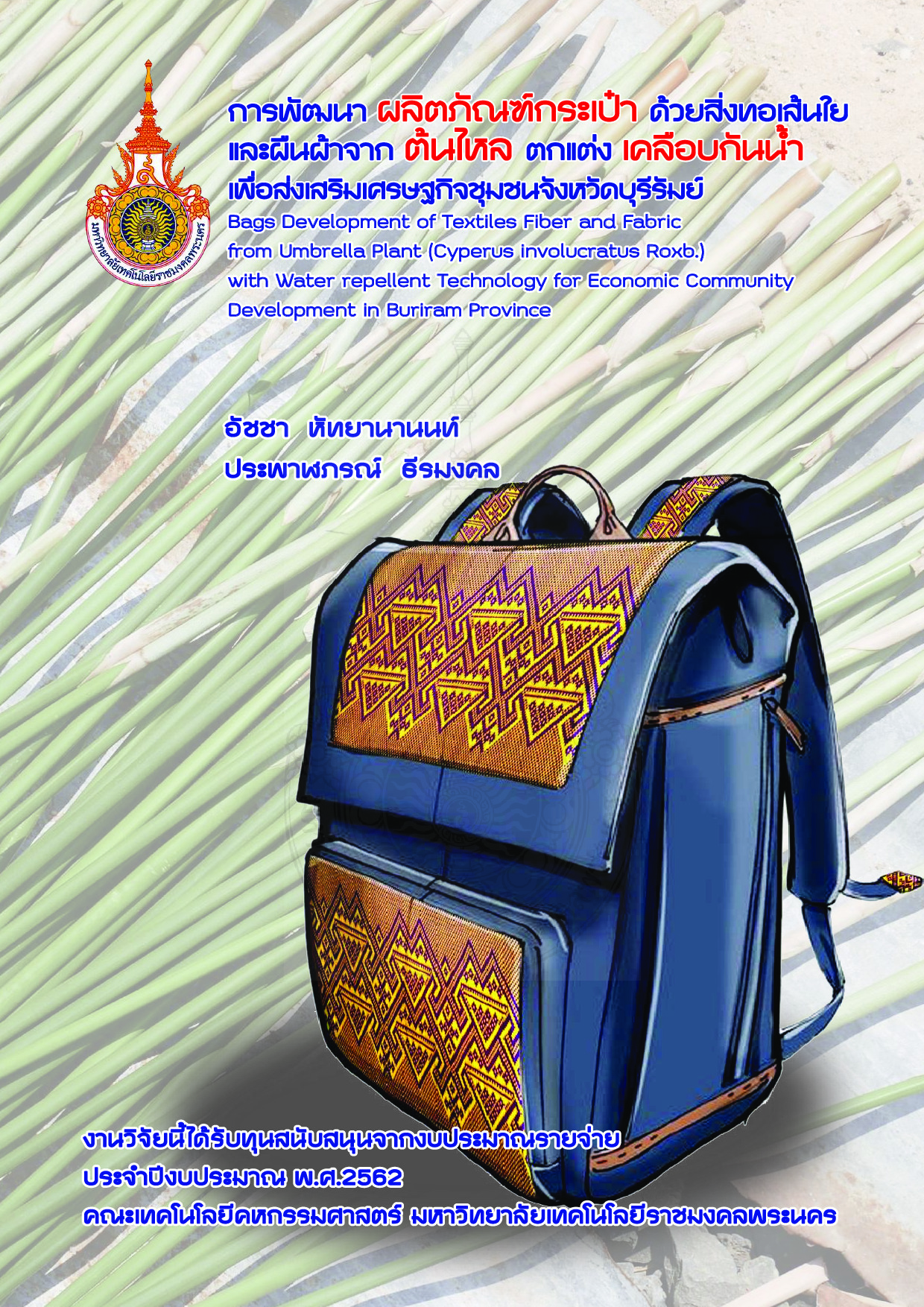
การพัฒนาผลิตภัณฑ์กระเป๋าด้วยสิ่งทอเส้นใยและผืนผ้า จากต้นไหลตกแต่งเคลือบกันน้ำ เพื่อส่งเสริมเศรษฐกิจชุมชนจังหวัดบุรีรัมย์
The proposes of this research were to study the development of bag products with textiles fibers and fabrics from decorative flowing water-resistant coating to promote community economy in Buri Ram Province. With the objective To study the process of producing yarn from fibers from the flow source To design and develop textile and bag products from yarn from the Lai Ton To study the effect of coating with waterproofing on bag products using textiles fibers and fabric from the flow. And to transfer knowledge and technology for utilization to community groups and interested people in next fiscal year This research can be summarized as follows: 1. The study of Ton Lai found that most villagers grow Lai Ton and make products as a supplementary career. In using this flow source in this research the researcher used a large flow source with a diameter of about 1 hour and can be separated into 4 small strands for research and production. The dyes used are synthetic because they will get fresh colors save time and be consistent. 2. The researcher designed 2 designs of weaving designs with the idea of using the original pattern to add edit and then create the pattern that the community groups like and can actually produce it as a product. After getting the fabric pattern then design into 10 bags of women and men bags using leather as an ingredient Decorate the bag to look interesting increase the price and increase the target audience. Which will be different from the original. That uses colored fabric and striped fabric as decorative items. 3. Coating with waterproofing on the bag products with textiles fibers and fabrics from the flow found that the fabric that has been coated with water repellent. When pouring water on the water surface there is a clumping together. No water penetration through fibers. When wiping clean the fibers are still dry not wet. Which is different from fabric that has not been coated namely water is able to penetrate immediately and create moisture on the fabric surface. If stored for a long time it can cause mold. 4. Schedule of technology transfer with the plan to transfer the research in the budget year 2020. For 3 day knowledge transfer and workshop was 30 participants. The group consisted of weaving mats from Ban Bu community Chorakhe Mak Subdistrict Prakhon Chai District. Buriram province
การใช้น้ำเฉาก๊วยทดแทนน้ำในขนมขี้หนู
The objectives of this special project were to investigate three basic formulas of Using black cincau water in Kanom Kee Noo and to study the content of black cincau water as partial substitute for water in Kanom Kee Noo with different four proportions of black cincau water at 0% 20% 40% and 80%. Randomized Complete Block Design (RCBD) was used as the research design. Sensory evaluation was conducted to assess appearance (rise crumbling) color flavor taste texture (softness) and overallikng preference with 9-Point Hedonic Scale. 80 tasters were instructors and students in Foods and Nutrition Faculty of Home Economics Technology Rajamangala University of Technology Phra Nakhon. Data collected were analyzed to determine mean (x̅) and Analysis of Variance (ANOVA). The statistical comparison was conducted by using Least Significant Difference (LSD) and Duncans New Multiple Range Test (DMRT). Data were analyzed through statistical software packages. The results of studying three basic formulas of Kanom Kee Noo indicated that tasters preferred the first formula over the second and the third formulas in terms of appearance (rise and crumbling) color taste and overall preference at a moderate level of preference with mean scores of 7.85 8.17 7.85 7.75 and 7.87 respectively. For the second formula over the first and the third formulas in terms of flavor at a moderate level of preference with mean scores of 7.45 respectively. The tasters had a moderate level of preference. When ANOVA and statistical comparison were considered there were the differences in appearance (rise crumbling) color flavor taste texture (softness) and overallikng preference with a statistical significance level of 0.05 The results of studying the content of black cincau water as partial substitute for water in Kanom Kee Noo with different four proportions of black cincau water showed that tasters preferred the 40% black cincau water formula over 0% 20% and 80% formulas in terms of color flavor taste texture (softness) and overallikng preference with mean scores of 7.60 7.51 7.69 7.58 and 7.63 respectively. The tasters had a moderate level of preference. The tasters preferred 20% black cincau water formula in terms of appearance (rise crumbling) over 0% 40% and 80% formulas with mean score of 7.67. The tasters had a moderate level of preference. When ANOVA and statistical comparison were considered there were statistically insignificant differences in appearance (rise crumbling) flavor taste texture (softness) and overallikng preference with a level of 0.05. There were the differences in color with a statistical significance level of 0.05.
คุณสมบัติด้านกำลังอัดและการดูดกลืนน้ำของคอนกรีตบล็อกที่ผสมเปลือกหอยนางรมบดไม่ผ่านกระบวนการเผา
The research aims to investigate the possibilities of crushed oyster shell (OS) not have to go through the process of burning as a substitution cement for concrete blocks. The cement was replaced with crushed oyster shell not process burning (OS) at 0% 10203040 and 50% by the weight of the binder. After that the concrete blocks were tested to determine the compressive strength and moisture absorbed of the concrete blocks cured for 7 142856 and 90 days The result showed that the compressive strength of the concrete blocks which replaced cement with OS (at the proportion of 10% by the weight of the binder) at 28 days had the compressive strength and water absorbed accordance with the TIS 58-2533 on non-load bearing concrete blocks.Moreover the concrete blocks which replaced cement with OS at the proportion of 20 % and 30 % had the compressive strength equivalent to 28 days compressive strength of TIS 58-2533 standard at 56 and 90 days respectively and decreased when the percentage in addition to OS in concrete blocks of 40 and 50 %. Tested results also showed that the water absorbed of concrete blocks increased when the percentage of replacement of OS in binder increased at 10 20 30 40 and 50%. The economical of concrete blocks it has manufactured unit cost is 2.60 baht. Whereas the concrete block containing crushed oyster shell at 10-30% it has manufactured unit cost at 2.12-2.44 baht respectively.
การออกแบบรูปทรงแม่แบบเครื่องจักสานผักตบชวาสู่ผลิตภัณฑ์สร้างสรรค์แนวคิดเอกลักษณ์ท้องถิ่น
The objective of this study 1) To study the shape of the template from the process of making basketry 2) To design a template hyacinth wicker products creative products 3) To test the woven pattern of water hyacinth wicker 4) To create a unique product that is more valuable to the local wisdom and value. Consumerism toward the development of water hyacinth wicker patterns. By specifying a sample group of 57 people. The tools used in the research consisted of the satisfaction questionnaire on the template pattern water hyacinth weave basketry to local creative concept product. The results of the design of the water hyacinth wicker pattern design to the product of local identity concept found that the design shape can be a shape that has a concept as a creative product. Form 1 wicker-shaped pattern template from water hyacinth leaves The product is a chair with an average of 4.58 Form 2 template oval shaped wicker basket shape. The product was a basket of legs with an average of 4.48 Form 3 basket shaped shape from the bowl shape the product received the basket has a value of 4.22. All 3 forms that can be developed in the form of products that can satisfy level most satisfactory shape is the molds for Basketry 1. The product is a chair that is beautiful the proportion of products is suitable for use and strong products are local and creative in the process of water hyacinth wicker requires a template for forming. The original material used to make the wicker template is plywood or foam material. During the study phase the researcher invented the material for making water hyacinth woven basket template using rubber water mixed with plastic watercolor foamed foam templates are used for easy handling and longer durability.