จำนวน Repository ( 3447 )
การศึกษาสมบัติทางกลของโพลิเอทิลีนน้ำหนักโมเลกุลสูงยิ่งยวดเชิงประกอบสำหรับล้อ Run-flat
This research project aimed to test the mechanical properties and the capability in wear resistance of ultra-high molecular weight polyethylene composite as well as determine the optimal formulation of UHMWPE-based composites which had a main component of aluminum oxide. The developed formula was used in the manufacture of run-flat wheels and thus applied to build run-flat wheels with an understanding of the proper molding conditions under the run-flat wheel forming process. Two materials used in the research consisted of super-high molecular weight polyethylene (UHMWPE) as the base material and the additive of aluminum oxide (Al2O3). The parameters employed in the hot compression process to obtain the specimen for the experiment consisted of compressive force temperature time and the ratio between super-high molecular weight polyethylene and aluminum oxide. The test for mechanical properties consisted of an impact test a hardness test according to the ASTM D2240 standard a tensile test according to the ASTM D638 standard type I and a wear test according to the ASTM G77 standard. The results indicated that a hot compression condition under a pressure of 5 MPa a temperature of 210°C for 90 min and using 5% Al2O3 HTM 30 material caused mixed uneven powder particle sizes between 2 to 5 µm. The tensile test results inferred the yield strength of 20.52 MPa ultimate tensile strength at 29.96 MPa breaking strength at 22.83 MPa elongation at break at 265.8% and modulus of elasticity at 784.46 MPa. The highest hardness was 62 shore D the high impact strength was 586.8 J/m and it was displayed for the wear rate of hot compression specimens made of UHMWPE mixed with 5% HTM-30. Moreover it introduced a coefficient of friction the wear rate and the density of 0.12 8.66E-11 mm3/N.m and 1.2446958 g/cm3 respectively.
การศึกษาพารามิเตอร์ในการขึ้นรูปแผ่นเกราะเซรามิกส์รูปร่างหกเหลี่ยมกันกระสุน
This research had two objectives that were to study parameters for forming bulletproof ceramic armor plates and to create a model of a bulletproof ceramic armor plate for small armored regular trucks. The parameters used to form a ceramic armor plate contain the thickness of the armor plate and the compressive strength which affects the density distribution of the green compact. A ballistic ceramic armor plate with a hexagonal shaped material was created as a concave bulletproof plate. Extrusion results displayed that the hexagonal material was formed at a very high density on the side surface of the armor plate but with uneven capacity distributed across the overall plate due to the friction occurring on the wall of the mold. The finite element method particularly at the Ansys/Explicit Dynamic tools were applied to analyse the damage of bulletproof plates. The model of a concave-shaped bulletproof plate was set for the SKD11material influencing the changes in the direction of the bullet firing when the bullet hit the bulletproof plate at a velocity of 880 m/s in accordance with the NIJ 4 standard. The bullet was made of tungsten carbide and the ceramic armor plate was built with a size of 300×300 mm and thicknesses of 14 16 18 and 20 mm. The bullet was fired into the center part and onto the curved surface of the ceramic plate. The result shows that the armor plate could not resistant to penetration. In this situation the direction of the bullets movement against the armor plate especially at a curved surface as a slope could result the deflection of the bullet direction as well as reduction of penetration capability.
หลักฆราวาสธรรม 4 ในพระบรมราโชวาทพระบาทสมเด็จพระบรมชนกาธิเบศรมหาภูมิพลอดุลยเดชมหาราช บรมนาถบพิตร
This research article aimed to investigate the Gharavasa-dhamma IV which appeared in the royal guidance of His Majesty King Bhumibol Adulyadej the Great. The sample was The Royal Guidance of His Majesty King Bhumibol Adulyadej the Great about religion and morality book of the Department of Religious Affairs (Ministry of Culture 2009). Gharavasa-dhamma IV principle in Buddhism which was defined in Dictionary of Buddhism by Phra Bhramagunabhorn (P.A. Payutto) (2015) was the conceptual analysis framework. The study is based on the documentary research and presented through analytical description. The study found that the royal guidance of His Majesty King Bhumibol Adulyadej the Great can be classified into 3 groups: civil servant youth and Buddhist association with the young Buddhists association. according to the royal guidance literally conformed Gharavasa-dhamma IV was found a total of 21 words of Sacca [truth and honest] 22 words of Dama [taming and training oneself] 15 words of Khanti [tolerance ; forbearance] and 21 words of Caga [generosity]. However in some Royal Guidance there were more than one characteristic as well of Gharavasa-dhamma IV. The royal Guidance therefore has aimed on people to know how to be a good citizen in society for the benefit of People in nation and for their happiness.
พฤติกรรมที่ส่งผลต่อการตัดสินใจเลือกซื้ออาหารออนไลน์ของผู้เรียนในสังกัดอาชีวศึกษา จังหวัดพิษณุโลก
The objectives of this research were 1) to study the behavior and decision to buy online food of vocational students in Phitsanulok Province 2) to compare of personal factors with behavior and decision to buy online food of vocational students in Phitsanulok Province and 3) to study online food shopping behavior affecting to buy online food decisions of students vocational in Phitsanulok Province. The research was a quantitative research using questionnaires from 400 vocational students in Phitsanulok Province. Data was systematically analyzed by percentage mean standard deviation (S.D.) t-Test One-way ANOVA and multiple regression analysis. The result showed that the behavior of buying online food was at moderate level. The decision to buy online food was at moderate level. Difference Personal factors including gender year of study type of subject housing type and monthly income had different of behavior of online food shopping with no statistical significance. Difference Personal factors including type of subject and monthly income had different of decision to buy food online with statistical significance at .05. Online food purchasing behavior effecting decision to buy food online with statistical significance at .05.
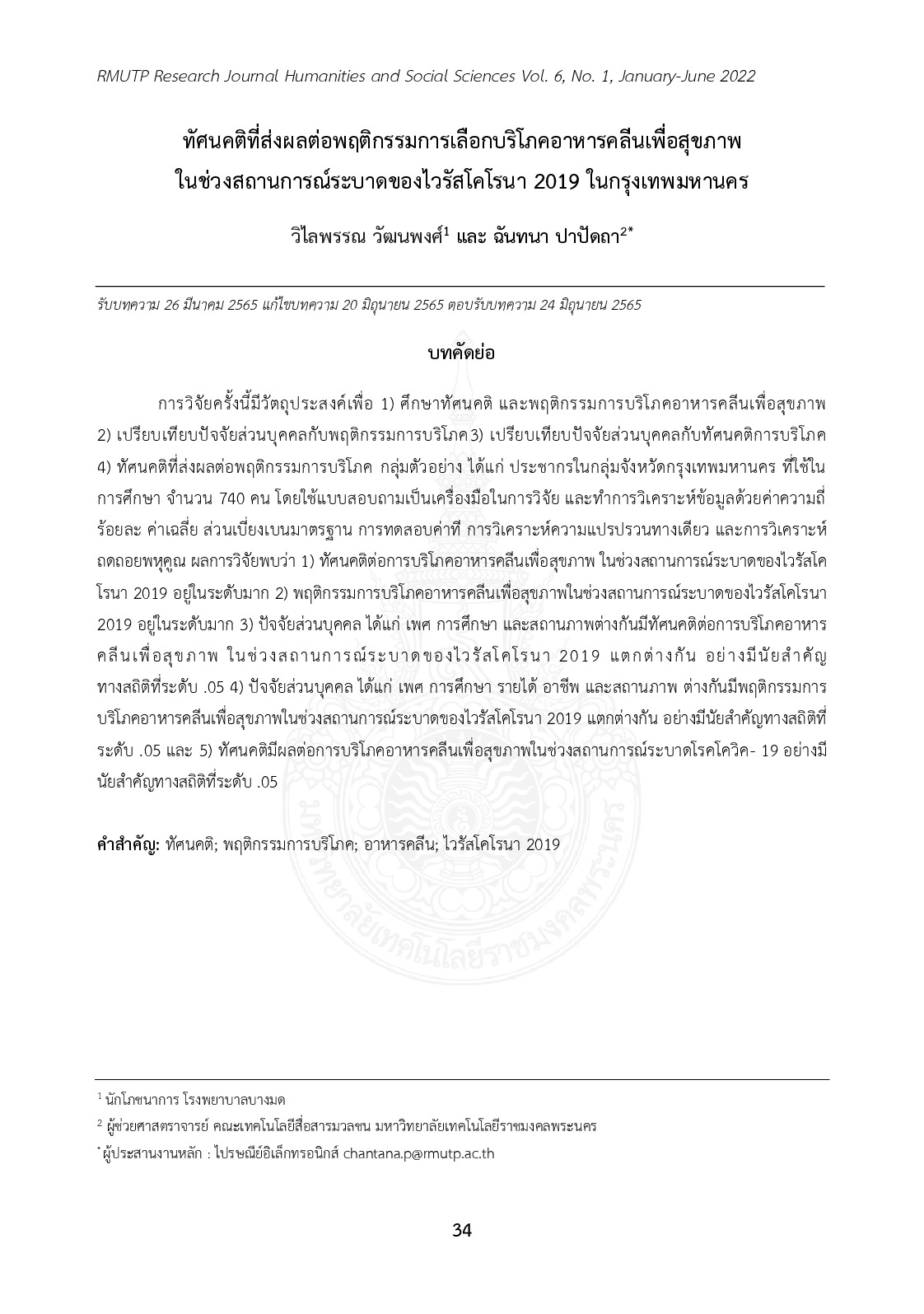
ทัศนคติที่ส่งผลต่อพฤติกรรมการเลือกบริโภคอาหารคลีนเพื่อสุขภาพในช่วงสถานการณ์ระบาดของไวรัสโคโรนา 2019 ในกรุงเทพมหานคร
The objectives of this research were to 1) study attitudes and consumption behavior of clean food for health 2) compare personal factors with consumption behavior 3) compare personal factors with consumption attitudes and 4) study attitudes affecting consumption behavior. The sample group was the population of Bangkok Province. Used in the study: 740 people. The questionnaire was used as a research tool. The data were analyzed by frequency percentage mean standard deviation. T-value test Analysis of one-way ANOVA and multiple regression analysis. The research results were found that: attitudes towards the consumption of clean food for health during the Covid-19 epidemic situation was at a high level. Clean food for health consumption behavior during the Covid-19 epidemic situation was at a high level.Individual factors including gender education and status had different attitudes towards healthy food consumption. During the Covid-19 epidemic situation the difference was statistically significant at the .05 level Individual factors including gender education income occupation and status had different healthy clean food consumption behaviors during the Covid-19 epidemic with statistical significance at the .05 level. Attitudes had a statistically significant effect on healthy food consumption during the Covid-19 epidemic at .05 level.