จำนวน Repository ( 85 )

ความรู้และพฤติกรรมการบริโภคอาหารฟาสต์ฟู้ดแบบตะวันตก ของหญิงวัยรุ่นตั้งครรภ์ กรณี ศึกษาโรงพยาบาลระยอง
Objectives of this research were to study the consumption knowledge level and consumption behavior towards Western fast food among pregnant teenagers. The case study was conducted at Rayong Hospital. This is a survey research and questionnaires were applied for compiling data from 143 pregnant teens who received prenatal care at the Rayong Hospital in Rayong Province between October and December 2014. Efficiency test results on questionairs about 12 items of knowledge the reliability (r) was 0.715. The percentage and frequency were employed for data analysis. The findings indicated that : 1) 54.55 % of samples had knowledge of Western fast food consumption at very good level and 40.56 % at the good level. Two items with most correct answers were questions about the suitable amount of fat and suitable amount of carbohydrate taken from rice grains and bread per meal accounting for 96.50 and 95.10 percent respectively. Meanwhile two items with incorrect answers were questions about Western fast food can be consumed unlimited during period of gestation and Western fast food consumption will cause pregnant teens risky to Pre-eclampsia accounting for 50.35 and 32.87 percent respectively. 2) Western fast food consumption behavior of samples it was found that hamburgers were the most popular food accounting for 27.97 percent. Frequency of consumption was 4-5 times per week. Expenses paid for each meal ranged from 101-200 Bahts. Swensen’s ice-cream shop was the most favorite place and the taste of the food was the top reason.
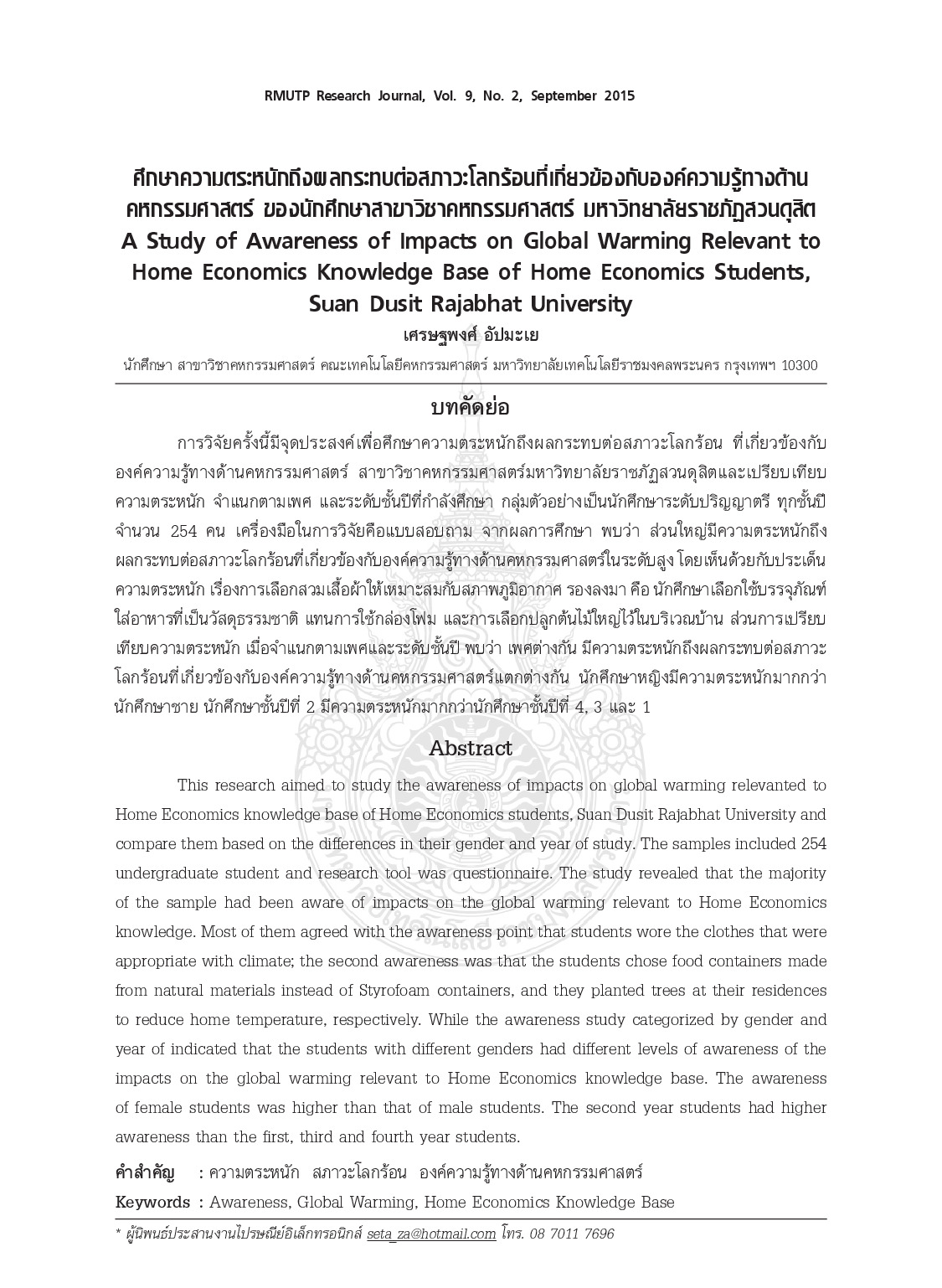
ศึกษาความตระหนักถึงผลกระทบต่อสภาวะโลกร้อนที่เกี่ยวข้องกับองค์ความรู้ทางด้านคหกรรมศาสตร์ ของนักศึกษาสาขาวิชาคหกรรมศาสตร์ มหาวิทยาลัยราชภัฏสวนดุสิต
This research aimed to study the awareness of impacts on global warming that is relevant to Home Economics knowledge base of Home Economics students Suan Dusit Rajabhat University and compare their awareness of impacts on global warming relevant to the Home Economics knowledge base considering their gender and year of study. The sample was 254 undergraduate students from Home Economics of Suan Dusit Rajabhat University. The research tool was questionnaire. The study revealed that the majority of the sample had been aware of impacts on the global warming relevant to Home Economics knowledge base in a high level. Most of them agreed with the awareness point that students wore the clothes that were appropriate with climate; for example they chose to wear light and thin clothes to reduce workload of air conditioners the students chose food containers made from natural materials instead of Styrofoam containers to reduce waste that took long time to decompose and they planted trees at their residences to reduce home temperature respectively. Comparing the awareness categorized by gender and year of study it was found that the students of Suan Dusit Rajabhat University of different genders had different levels of awareness of the impacts on the global warming relevant to Home Economics knowledge base. The awareness of female students was higher than that of male students and as for year of study the students of Suan Dusit Rajabhat University had different levels of the awareness of the impacts on the global warming relevant to Home Economics knowledge base. The second year students had higher awareness than the first third and fourth year students.
การผลิตคู่มือให้ความรู้เรื่องอาหารแก่ผู้ป่วยไตวายเรื้อรัง
The purpose of study had the following objectives 1) to produce food handbook for chronic kidney disease patients. 2) to test effectiveness of the food knowledge handbook. 3) to compare knowledge before and after learning the handbook on food for chronic kidney disease patients. The population of this research were 100 chronic kidney disease patients who were tested at the kidney center of Galyani Vadhana Siriraj hospital age between 40 – 59 years. The population were randomize age sample through purposive sampling. The tools were food knowledge handbook and knowledge measurement form participant were tested for nutrition knowledge before learning the handbook. The knowledge was analyzed using mean and standard deviation. Difference between the averages was measured by the standard deviation (t-test) The study showed that the handbook contains knowledge of diet therapy for chronic kidney disease. The handbook was 80.00/83.40 effective comparing to the standard 80/80 specified. Result of the knowledge after learning the handbook was higher than the result before learning significantly different statistically at 0.05
The potential development of Ficus hispida Linn use to traditional herbs and cancer prevention for generate knowledge and heritage of local wisdom
The study used the bark leaves and fruit of Ficus hispida Linn to separation by Maceration and sequential extraction method with hexane ethyl acetate and methanol to crude extracts. Crude extracts were assessed for their antioxidant activities tested using DPPH radical scavenging assay total phenolic contents tested using the Folin–Ciocalteu method cytotoxic activity against oral cavity cancer (KB) human small cell lung cancer (NCI-H187) and breast cancer (MCF-7) cancer cell lines tested using the resazurin microplate assay (REMA). The results showed that 1. Crude methanol extracts from the fruit exhibited free radical scavenging effect on the DPPH assay with IC50 value of 27 g/ml with the total phenolic contents value of 102.39 mg GAE/g dw of standard BHT. 2. Crude hexane extracts from the bark showed highest inhibited the growth of Vibrio paraheamolyticus crude ethyl acetate extracts from the bark showed highest inhibited the growth of Streptococcus mutans ATCC 27175 and crude methanol extracts from the leaves showed highest inhibited the growth of Vibrio cholerae most with MIC value of 7.80 g/ml. 3. Crude ethyl acetate and methanol extracts from F. Hispida exhibited inhibitory effect against oral cavity cancer (KB) human small cell lung cancer (NCI-H187) and breast cancer (MCF-7) cancer cell lines. These data support traditional uses of F. Hispida in folk medicine