จำนวน Repository ( 80 )

แผ่นมุงหลังคาจากวัสดุรีไซเคิล
The purpose of this project is to study the mechanical and physical properties of recycled roofing materials. The pulp extracted from the UHT beverage boxes to get aluminum foil mixed with low density polyethylene. This can be used engineering and is an option to reduce the amount of UHT boxes left over to roofing sheets. In experiment 3 aluminum foil medium size and fine then hot and extruded with 68 and 10 bar compression then cut into test pieces. To test mechanical and physical properties in accordance with the test standards: Torsion Testing Tensile strength Impact resistance Heat resistance water absorption and density testing. Compare the mechanical and physical properties of the material; different sizes of aluminum foil and compressive strength. To bring the best materials to the product. From the tests it was found that the properties of recycled composite materials From the box UHT beetroot This is made of coarse aluminum foil. 18.23 MPa bending strength 10.66 MPa tensile strength 110.987 J / m2 impact resistance 52.40 Shore-D Hardness 0.62 % Water Absorption 0.70 % Thickness Swelling 1.086 g/m3 Density 0.031 m2.K/W Thermal Resistance and 0.291 W/mK Thermal Conductivity is the best mechanical properties. Due to the large aluminum foil it can be used for high strength. Which is higher than the aluminum foil of a smaller size.
การศึกษามาตรฐานกระบวนการการเคลื่อนย้ายวัตถุดิบการผลิตและความปลอดภัยของอุตสาหกรรมเนื้อสัตว์แปรรูปในประเทศไทยเพื่อรองรับการเปิดประชาคมเศรษฐกิจอาเชียน
The research investigated the process of transporting raw materials for production and the safety of the meat processing industry to support the ASEAN Economic Community. The study objectives were (1) to study factors that influenced the process of transporting raw materials for production and the safety of the meat processing industry to support the ASEAN Economic Community and (2) to determine the consistency of a causal model influencing the process of transporting raw materials for production and the safety of the meat processing industry to support the ASEAN Economic Community. The variables used in this study were the independent variables the organization environment and the organization resources. The mediator variables were the supply chain cooperation equipment strength food quality and Halal sign. The dependent variable was the process standard of transporting raw materials for production and the safety of the meat processing industry to support the ASEAN Economic Community. The researchers used a mixed method of qualitative and quantitative study. Questionnaires were used to collect empirical data from 510 meat operator samples. The statistical methods used to analyze data were the frequency percentage mean standard deviation and the analysis on the structural equation model. The results revealed that the model was well consistent with the empirical data. The Chi – Square (2) value was 122.231 at the degrees of freedom (df) of 150. The chi - square relative (2/df) was 1.815 with the probability p-value equal to 0.953. The index of harmony (GFI) was equal to 0.980 and the modified harmony index measuring (AGFI) was equal to 0.938. The index measuring the comparative (CFI) was equal to 1.000 and the index root mean square of the section standard (SRMR) was 0.020 and the index error in estimation parameters (RMSEA) was equal to 0.000. Additionally the research results also showed that the organization environment organization resources the mediator variables; the supply chain cooperation equipment strength food quality and Halal sign positively influenced the process standard of transporting raw materials for production and the safety of the meat processing industry to support the ASEAN Economic Community.
การผลิตวัสดุดูดซับเสียงจากวัสดุผสม ยางโฟมธรรมชาติและเส้นใยธรรมชาติ
This research work was to study the effect of surface treatment of natural fiber and the effects of type and content of natural fiber on the development of acoustic material from natural rubber foam /natural fiber composites. The surface treatment used for this research work was sodium hydroxide (NaOH) treatment. NaOH Concentrations and treatment times were varied from 0 to 15 %wt. and 0 to 30 min respectively. Natural fibers used for this work were bagasse fiber (BF) and oil palm fiber (OPF). The suitable condition for surface treatment was estimated by fiber length and diameter (L/D) ratio and morphology of natural fiber. The result suggested that L/D ratios tended to increase when NaOH concentrations and/or treatment times increased except for NaOH concentration of 15 %wt. L/D ratios of OPF after surface treatment were changed more than those of BF. The suitable conditions of NaOH treatment for BF and OPF were NaOH concentration of 10 %wt. and surface treatment times of 30 and 10 min respectively. The effects of fiber type and content on sound absorption properties of natural rubber foam /natural fiber composites were investigated by cell characteristics sound absorption coefficient DMA analysis and bulk density. Both treated BF and OPF with suitable treatment condition were varied from content of 0.0 to 10.0 %wt. The result showed that the cell size of composites tended to decrease with addition of natural fiber whereas number of foam cell per unit volume increased. After adding natural fiber more than 2.5 %wt. cell size of composite foam and number of foam cell per unit volume tended to change the inverse direction. Natural fiber in composites enhanced the sound absorption efficiency. Sound absorption coefficient of composites adding BF was more than that of composite adding OPF. The addition of natural fiber enhanced the elasticity of composites and that increased sound absorption efficiency. NaOH treatment led to creation of strong interfacial bonding between natural fiber and natural rubber and enhanced the sound absorption efficiency. Density of NR composite foam increased with increasing natural fiber content.
นวัตกรรมคอนกรีตมวลเบาแบบเซลลูล่าด้วยการใช้วัสดุเหลือทิ้ง
This research presents a study of the compressive strength tensile strength flexural strength and water absorption of Cellular Lightweight Concrete containing fine fly ash and ground bagasse ash. Portland cement (CT) is partially replaced with pozzolans 20 30 and 40% by weight of the cementitious materials. The results show that the compressive strength tensile strength flexural strength and low water absorption of Cellular Lightweight Concrete improves substantially with partial replacement of Portland cement with fly ash and bagasse ash. Cellular Lightweight Concrete mix cement containing 20 and 30% of pozzolans can be used to make cementitious materials. In addition the use of fly ash and ground bagasse ash produces Cellular Lightweight Concrete mix with good compressive strength tensile strength flexural strength and water absorption.
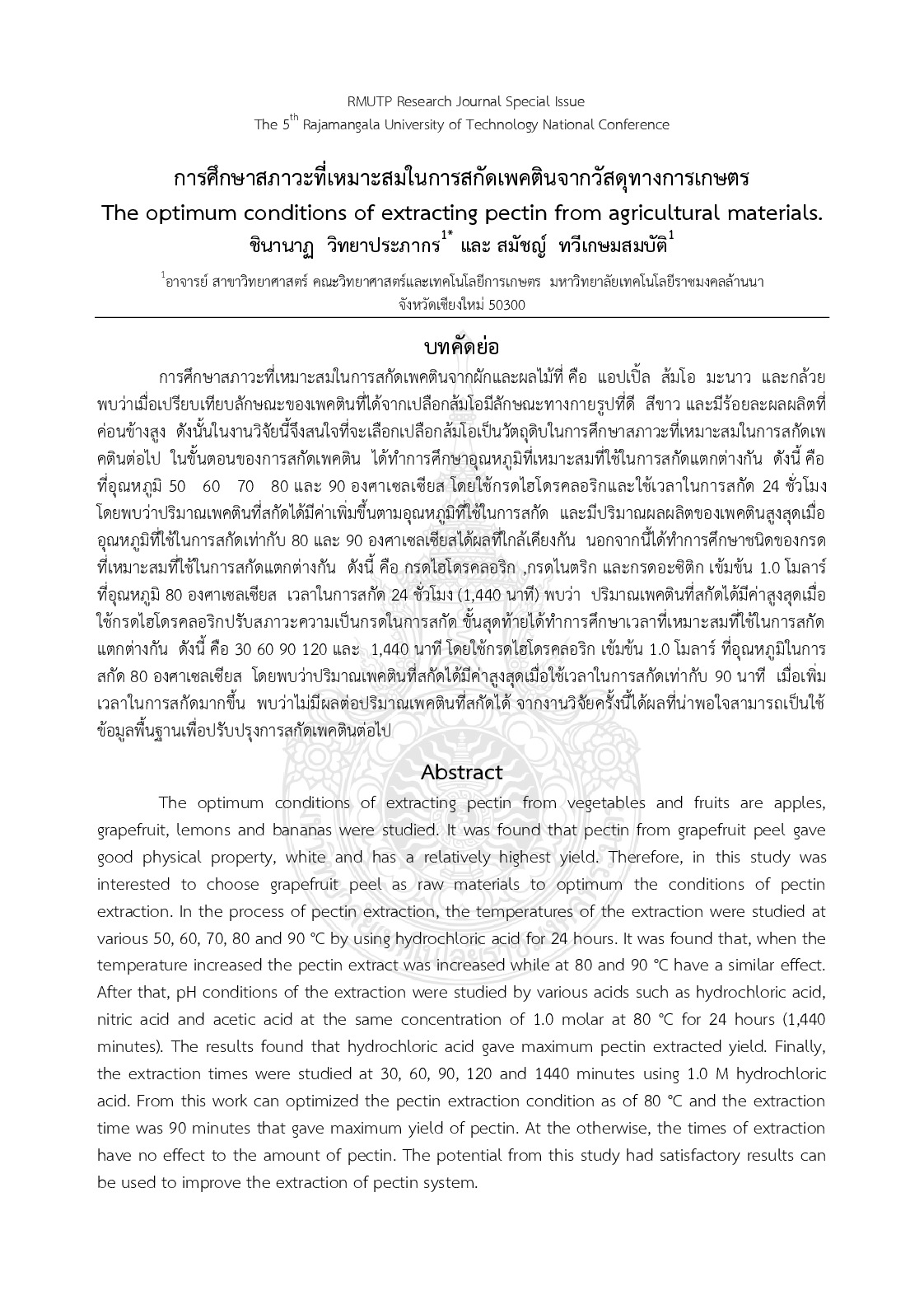
The optimum conditions of extracting pectin from agricultural materials.
The optimum conditions of extracting pectin from vegetables and fruits are apples grapefruit lemons and bananas were studied. It was found that pectin from grapefruit peel gave good physical property white and has a relatively highest yield. Therefore in this study was interested to choose grapefruit peel as raw materials to optimum the conditions of pectin extraction. In the process of pectin extraction the temperatures of the extraction were studied at various 50 60 70 80 and 90 ?C by using hydrochloric acid for 24 hours. It was found that when the temperature increased the pectin extract was increased while at 80 and 90 ?C have a similar effect. After that pH conditions of the extraction were studied by various acids such as hydrochloric acid nitric acid and acetic acid at the same concentration of 1.0 molar at 80 C for 24 hours (1440 minutes). The results found that hydrochloric acid gave maximum pectin extracted yield. Finally the extraction times were studied at 30 60 90 120 and 1440 minutes using 1.0 M hydrochloric acid. From this work can optimized the pectin extraction condition as of 80 C and the extraction time was 90 minutes that gave maximum yield of pectin. At the otherwise the times of extraction have no effect to the amount of pectin. The potential from this study had satisfactory results can be used to improve the extraction of pectin system.