จำนวน Repository ( 126 )
การศึกษาแนวดำเนินการหลักในการจัดการศึกษาของคณะวิศวกรรมศาสตร์ ที่บูรณาการการเรียนรู้กับการทำงานสำหรับการผลิตบัณฑิตมืออาชีพ
Nowadays it is rapid technology advancement. The faculty of engineering Rajamangala University of Technology Phra Nakhon needs to update the bachelor degree programs and produces graduates that meet the requirements of the target markets. Work integrated learning education is one of the most effective education that is suitable for this situation and the future. This research is a study of faculty of engineering’s strategy base on work integrated learning for professional graduate production. The research results acknowledge the work integrated learning education type that is implemented in the faculty of engineering Rajamangala University of Technology Phra Nakhon. In addition the results can be applied to the modification of the engineering curriculum or the new engineering curriculum design.
การผลิตกระดาษทำมือจากหญ้าชันกาด
Panicum repens is a species of grass. The paper has been made from non-wood materials for long times. This research was used Panicum repens for made grass pulp as non-wood fiber. The influence of alkaline concentrations on properties of pulp from Panicum repens was investigated under room temperature. Alkaline concentration levels were varied at 0% 5% 10% 15% and 20% respectively. Moreover Paper pulp from Panicum repens was observed by scanning electron microscope (SEM). This research has controlled the length of fiber approximately 0.5- 2.5 cm before soaked with alkaline concentration at 1 hour and soak with water for controlled pH value at 7-8. Paper pulp was formed on a sieve. The result showed that color of paper pulp made from Panicum repens was light brown and green. SEM showed that alkaline concentration affects the physical properties of paper pulp. Moreover true density of paper pulp was also investigated in this research.
การพัฒนาผลิตภัณฑ์เบเกอรี่จากหยวกกล้วยและส่วนเหลือทิ้งใน การผลิตกล้วยตากของกลุ่มวิสาหกิจชุมชนแม่บ้านบางตาโฉม จังหวัดสิงห์บุรีสู่เชิงพาณิชย์อย่างยั่งยืน
Bakery Products Development from the Banana Pseudo-stems and Waste from Dried Banana Production at Ban Bang Ta Chom Community Enterprise Sing Buri Province for Sustainable Commerce. Research on bakery product development from paprika and bananas in Production of Dried Banana of Bang Ta Chom Housewife Community Enterprise Group Sing Buri province for sustainable commercialization in order to: 1. Develop bakery products from 4 types of Banana Pseudo-stems and Waste 2. study the formulas and production processes of bakery products from Banana Pseudo-stems and Waste 3. study the consumer test of bakery products from 4 types of Banana Pseudo-stems and Waste and 4. To transfer technology Little Bakery products from Banana Pseudo-stems and Waste then bring the shelf life in conditions ranging from 0-10 days and compare the physical properties. Chemical and microorganisms such as pH value color measurement and total number of microorganisms found that Khanom Jeen noodles stored in modified atmosphere conditions have longer shelf life than those stored. At normal atmospheric conditions and vacuum conditions. Chemical analysis results showed that the bakery products decreased their pH over time. With values between 4.31 ± 0.00 and 2.99 ± 0.01 and bakery products Stored at 100% carbon dioxide (CO2) modified atmosphere packed in a sealed nylon / PET vacuum plastic bag. Store at room temperature. Can be stored for up to 10 days and found that the total number of microbes increased when the storage life is longer But not over the standard of community products so the products are safe and not harmful to consumers. Consumer test results show that consumers like and are interested in buying bakery products that use 100 percent carbon dioxide (CO2) at 75 percent.
การพัฒนาหลักสูตรระยะสั้นด้านการผลิตเคมีภัณฑ์ในครัวเรือน
The purpose of this research was to develop a short vocational training course on household chemical products and to develop a training course for shortterm vocational training in the production of household chemicals. Population groups Is a general public in Bangkok and metropolitan area by using the voluntary selection as follows. Trial of a short course on the production of household chemicals 10 participants. Evaluation of short courses in household chemical production 10 participants. Technology transfer the short-term training course on household chemical production 20 participants and five speakers. The tools used in the research are as follows: 1. Demand questionnaire 2. Short-term vocational training course 3. Satisfaction assessment. Data analysis using statistical software packages. The statistics used were mean ( X ) standard deviation (SD) and t-test. The research found that 1. Study and development of short courses in the production of household chemicals 1.1 selection of household chemicals that will lead to the creation of training courses based on components Where to buy Price per set Properties of components Safety and hazard Materials and equipment used for production storage use and distribution opportunities 1.2 Creating training courses training course components and training documents to have a sequence of steps that are easy and convenient for the learning of the general public 2. Trial of a short course on the production of household chemicals 2.1 Most trainees are satisfied with the short-term training program model as follows: Training procedures Training hours 1.30 hours per 1 course Short-term courses can be implemented and the curriculum can be used as a guideline for occupation at the highest level. As for the number of trainees four people per group per 1 course is at a high level. 2.2 Most of the trainees were satisfied with the speakers and short-term training. In explaining the various components of Household chemicals Explanation of the mixing process Household chemicals Integration of household chemical mixing techniques Explanation of caution In the mixing of household chemicals And explaining how to pack household chemicals at the highest level 3.Short-term evaluation of household chemical production 3.1 Most trainees are satisfied with the short-term training program model. The training process Training hours 1.30 hours per 1 course Short-term courses can be implemented and courses can be used as guidelines for their career at the highest level. As for the number of trainees four people per group per 1 course is at a high level. 3.2 Most of the trainees were satisfied with the speakers and short-term training. Explain the various components of household chemicals Explanation of the mixing process Household chemicals Integration of household chemical mixing techniques. Explanation of caution In the mixing of household chemicals And explaining how to pack household chemicals at the highest level 4.Technology transfer the short-term training course on household chemicalproduction 4.1 Most of the trainees were satisfied with the trainers for short-term training. Explain the various components of household chemicals Explanation of the mixing process Household chemicals Integration of household chemical mixing techniques Explanation of caution in the mixing of household chemicals and explaining how to pack household chemicals at the highest level 4.2 Most trainees were satisfied with the short-term training program model. Regarding the number of trainees four people per group Training procedures The number of training hours is 1.30 hours per course the highest level. Furthermore short courses can be implemented. As for the curriculum it can be used as a guideline for a career at a high level.
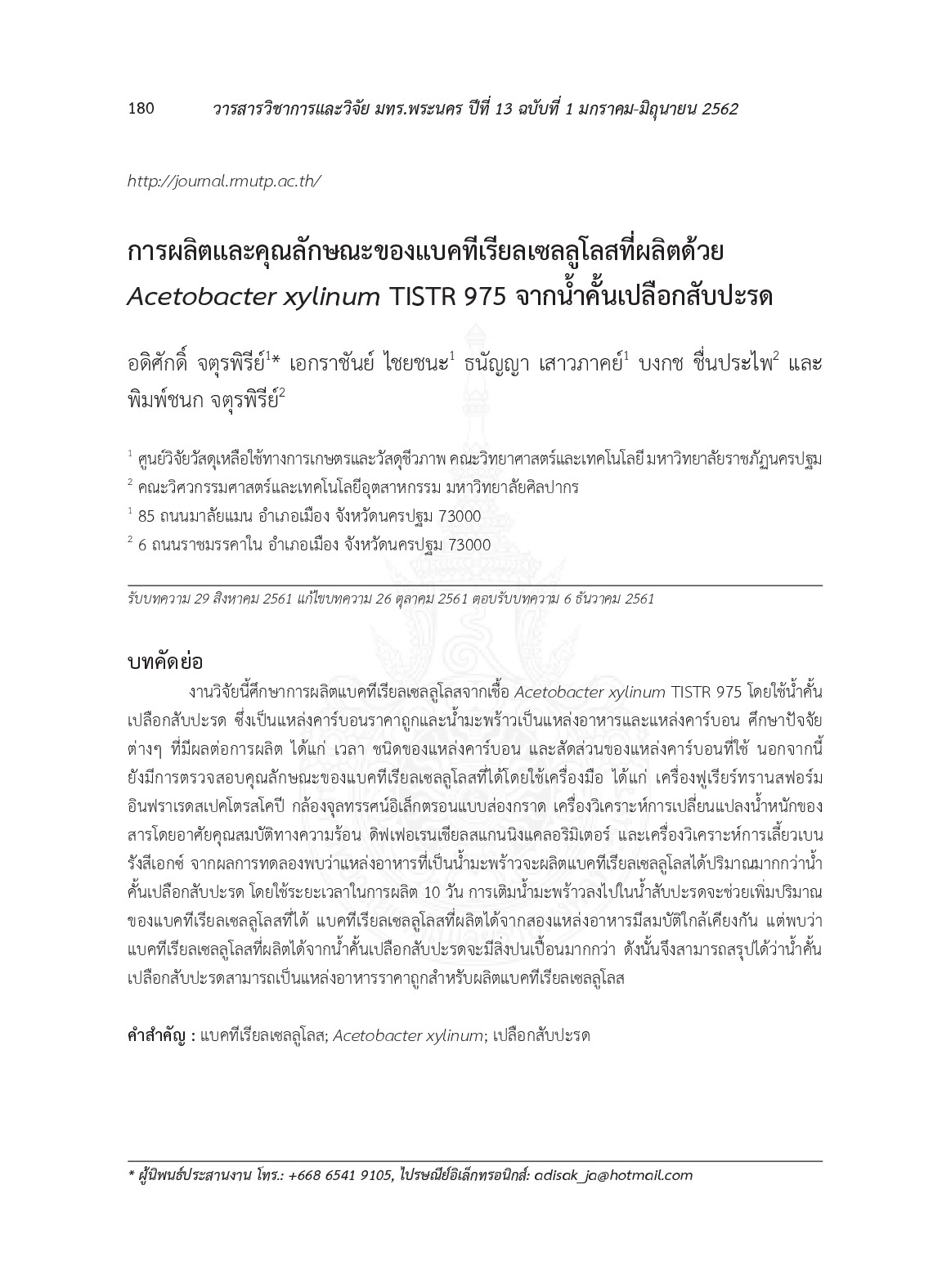
การผลิตและคุณลักษณะของแบคทีเรียลเซลลูโลสที่ผลิตด้วย Acetobacter xylinum TISTR 978 จากน้ำคั้นเปลือกสับปะรด
This research studies the production of bacterial cellulose from Acetobacter xylinum TISTR 975 with pineapple peel juice a low cost carbon source and coconut water as nutrient and carbon source. The factors influencing the production were studied including incubation time type of carbon sources and ratio of mixed carbon sources. In addition the characteristics of the produced bacterial cellulose were investigated using Fourier Transform Infrared Spectrophotometer (FTIR) Scanning Electron Microscope (SEM) Thermogravimetric Analyzer (TGA) Differential Scanning Colorimeter (DSC) and x-ray Diffractometer (xRD). It was found that the coconut water produced the amount of bacterial cellulose higher than the pineapple peel juice with 10 days of production. An addition of the coconut water into the pineapple peel juice increased the amount of bacterial cellulose. The characteristics of two bacterial celluloses from two different sources were nearly similar but the one from the pineapple peel juice had higher impurities. It can be concluded that the pineapple shell extract could be used as low cost carbon source for bacterial cellulose production.