จำนวน Repository ( 580 )
Needs assessment for human resources development employees of rubber products industry in thailand
The objectives of this study were to determine the need to develop human resources for employees in the rubber industrial in Thailand and to compare the difference of need for human resource development of employees in the rubber industrial who have differences of personal status.The study was conducted as a survey research by using a questionnaire to collect data. The samples of this research were employees who work in the rubber industry of Thailand. result was 400. The statistics treatments included frequency percentage mean standard deviation and one-way analysis of variance. Research findings: The need to develop human resources for employees in the rubber industrial in Thailand was overall at high level. Considering in specific aspects found that the need of employee to develop the most is their work environment which had the highest mean followed by the need to develop self development training and education respectively. And Employees with difference in personal status such sex age and marriage status and income level have no different in the need of human resources development. While employees with difference in educational level work experience and working position have a difference of need in human resources development.
Experimental study on performance of solar collector in biodiesel production process with solar thermal system
This experimental research was to test a performance of flat-plate solar collectors using biodiesel as a working solution with a solar thermal system. The purposes were to promote a biodiesel use as an alternative fuel for higher efficient heat energy and as an added renewable energy for a production process and to provide a guideline in education and for development in the future. The experiment was to test a performance of flat sheet solar collectors using ASHRAE STANDARD 93-2003 and to test a thermal potential of 12 litres by volume of biodiesel in a 2 m2 flat- plate solar collector used as heat source of the system. Thus biodiesel was used as a working solution with a flow rate of 2.4 litre per minute and the test duration was between 09:00 am. and 03:00 pm. The result revealed the performance values of the flat-plate solar collector used in this experiment as FR( ) = 0.958 and FRUL = 15.02 W/m2K. The temperature of biodiesel in the solar thermal system increased from 33๐C to approximately 80-90๐C varied with solar radiation values. However; the mentioned degrees could be efficiently applied in biodiesel production process as a main heat source or a supplemental heat source depending on appropriate variables.
The biogas production and the application of lunch project for student at suksasongkhro tak school tak province
This research aims to transfer biogas digester construction technology and application of biogas in household to teachers and students of Suksasongkhro Tak school. They were instructed and trained about biogas digester construction and application of biogas produced from animal manure on household cooking in order to reduce LPG use. A total number of 330 teachers and students participated in the training. Results from 5-point scale questionnaire for project evaluation showed that the highest rank was location duration and food ( = 4.37 SD = 0.67). The second was knowledge utilization ( = 4.33 SD = 0.66). The third was trainers ( = 4.26 SD = 0.65) and the lowest was knowledge and understanding ( = 4.13 SD = 0.72). Regarding level of average post-training satisfaction the highest was 4.44 for knowledge and understanding while the lowest was 4.16 for question and answer. For success of the project it was found that every biogas digester done by participants could produce biogas used in place of LPG and could reduce monthly expense by about 1400 – 1500 baht. The total construction cost of biogas production system was 58000 baht with a payback period of 4 years. For students there were 3 science projects about biogas; including 1) comparison of biogas produced from food remains and animal manure; 2) comparison of biogas produced from pigs and cows manure; and 3) comparison of biogas produced from dry and fresh pigs manure.
Effects of environmental management in evaporative cooling system (EVAP) house on productive performance of layer pullets
The research was conducted to study on effects of environmental management in evaporative cooling system (EVAP) house on productive performance of layer pullets. This study divided into 2 experiments. Experiment 1 was conducted to study on temperature and air velocity in evaporative cooling system (EVAP) house on productive performance of layer pullets. Four thousand and eight hundred layer pullets were raised on battery cage with 5 birds per cage and assigned in a Randomized Completely Block Design (RCBD) experiment with three treatments. Each treatment consisted of four blocks (four houses) and followed different temperature and air velocity in raising area of evaporative cooling system (EVAP) house as front area central area and back area. Results showed that temperature and air velocity in front area was grater body weight gain (BWG) average daily gain (ADG) and feed conversion ratio (FCR) of layer pullets than layer pullets were raised in back area of evaporative cooling system (EVAP) house (P<0.01) Experiment 2 was conducted to study on light color and number of H-Flame battery cage row in evaporative cooling system (EVAP) house on light intensity and productive performance of layer pullets. Nine thousand and six hundred layer pullets were raised on H-Flame battery cage with 5 birds per cage and assigned in a 2x4 factorial in Randomized Completely Block Design (RCBD) experiment with two factors. Factor A was light color comprised of range and blue). While Factor B was number of battery cage row comprised (first row second row third row and fourth row). Each treatment consisted of four blocks (four houses). Results showed that interaction between factor A and B on light intensity and uniformity of layer pullets with highly significantly different (P<0.01). However interaction between factor A and B and main effect (factor A and B) were investigated on body weight gain (BWG) average daily gain (ADG) and feed conversion ratio (FCR) (P>0.05). The data from this research was suggests the important for implicate to improve the egg production industry in further success.
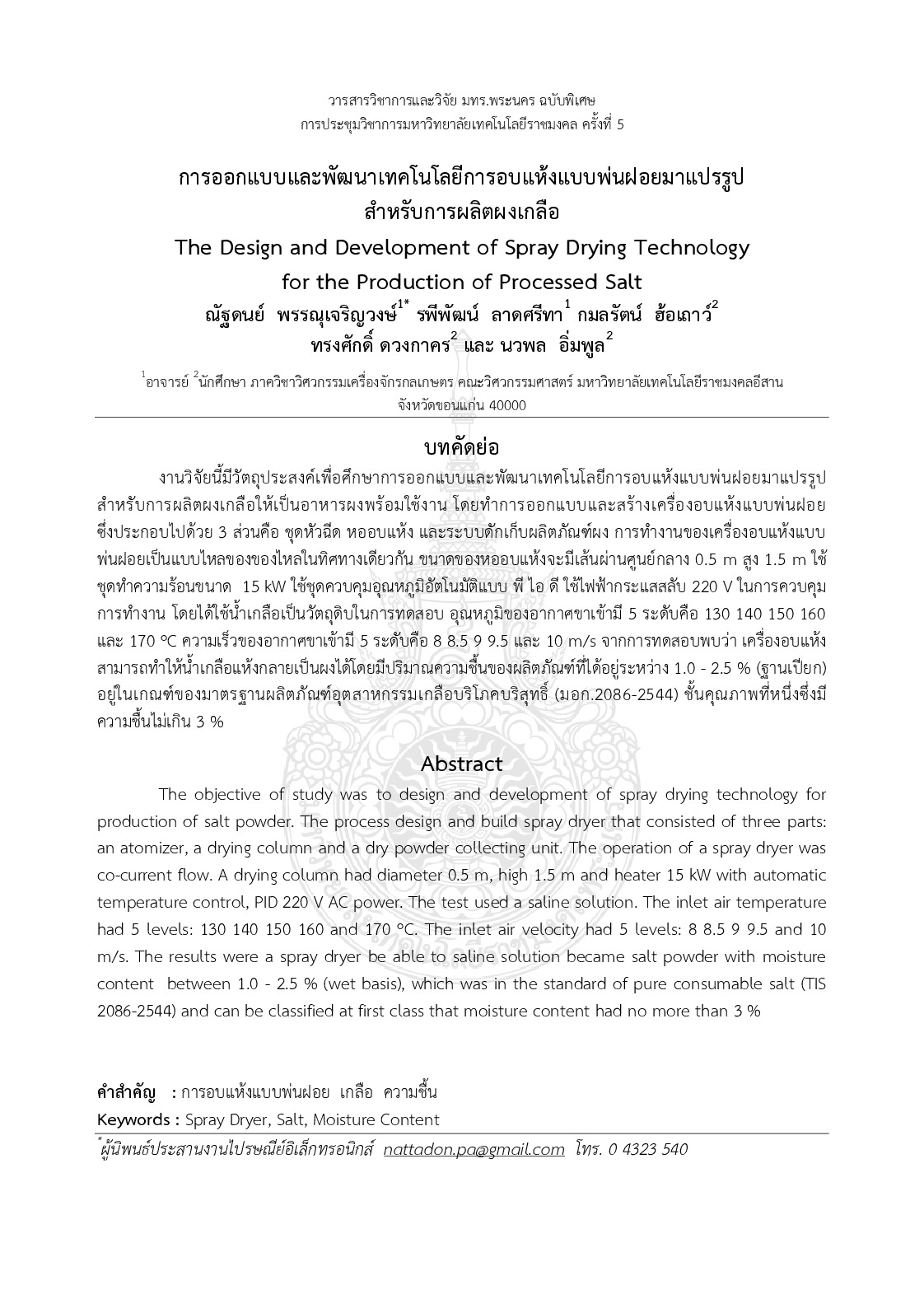
The design and development of spray drying technology for the production of processed salt
The objective of study was to design and development of spray drying technology for production of salt powder. The process design and build spray dryer that consisted of three parts: an atomizer a drying column and a dry powder collecting unit. The operation of a spray dryer was co-current flow. A drying column had diameter 0.5 m high 1.5 m and heater 15 kW with automatic temperature control PID 220 V AC power. The test used a saline solution. The inlet air temperature had 5 levels: 130 140 150 160 and 170 ?C. The inlet air velocity had 5 levels: 8 8.5 9 9.5 and 10 m/s. The results were a spray dryer be able to saline solution became salt powder with moisture content between 1.0 - 2.5 % (wet basis) which was in the standard of pure consumable salt (TIS 2086-2544) and can be classified at first class that moisture content had no more than 3 %