จำนวน Repository ( 580 )
การเสริมใยอาหารในผลิตภัณฑ์มาการองด้วยรำข้าวสังข์หยด
The objective of this research to study the three formula basic of macarons amount of Sangyod Rice Bran usage in macarons product and nutritional composition of macarons product. The sensory evaluate of three formula of macarons the second and the third formula basic macarons non-significant in odor liking ( P< ) . However the three formulas are significant in appearance color liking odor liking taste liking texture liking a nd overall liking ( P> ). When consideration in average score 3rd formula of macarons acceptable that the most one formula. Therefore the third formula used to determine the proper amount of Sangyod Rice Bran to add on macarons in the next step. For the Enhancing of Sangyod Rice Bran in macarons. The three levels as follow; added Sangyod Rice Bran for % % and % of all total weight. The taster remains to accept all sample of Sangyod Rice Bran in macarons. Especially at the % of Sangyod Rice Bran to added in macarons to the highest acceptance . However the resulted of added Sangyod Rice Bran at % to decrease in the appearance and overall liking of macarons .Therefore supplementation of fiber in macarons product with Sangy od Rice Bran is not affectin macarons. Furturemore spicies and amount of other bran for macarons production should be intensive studied.
การเสริมใยอาหารในผลิตภัณฑ์มาการองด้วยรำข้าวสังข์หยด
The objective of this research to study the three formula basic of macarons amount of Sangyod Rice Bran usage in macarons product and nutritional composition of macarons product. The sensory evaluate of three formula of macarons the second and the third formula basic macarons non-significant in odor liking (P<). However the three formulas are significant in appearance color liking odor liking taste liking texture liking and overall liking (P>). When consideration in average score 3rd formula of macarons acceptable that the most one formula. Therefore the third formula used to determine the proper amount of Sangyod Rice Bran to add on macarons in the next step. For the Enhancing of Sangyod Rice Bran in macarons. The three levels as follow; added Sangyod Rice Bran for % % and % of all total weight. The taster remains to accept all sample of Sangyod Rice Bran in macarons. Especially at the % of Sangyod Rice Bran to added in macarons to the highest acceptance. However the resulted of added Sangyod Rice Bran at % to decrease in the appearance and overall liking of macarons. Therefore supplementation of fiber in macarons product with Sangyod Rice Bran is not affect in macarons. Furturemore spicies and amount of other bran for macarons production should be intensive studied.
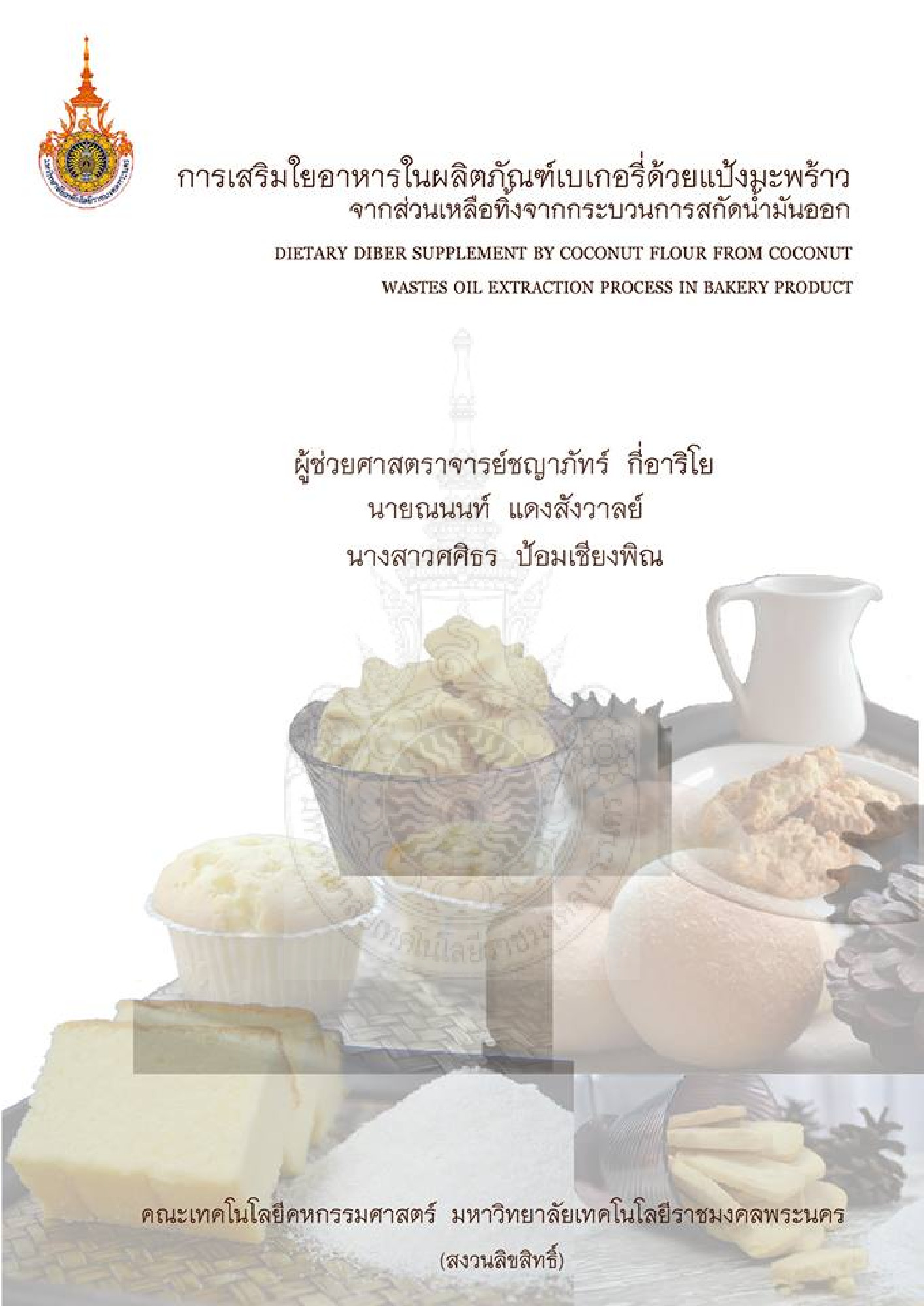
การเสริมใยอาหารในผลิตภัณฑ์เบเกอรี่ด้วยแป้งมะพร้าวจากส่วนเหลือทิ้งจากกระบวนการสกัดน้ำมันออก
The studies of Dietary Fiber Supplement by coconut flour from coconut Wastes Oil Extraction process in Bakery Product was investigated Production of coconut flour from coconut wastes oil extraction drying at 55 ° C for 12 hours and then grinding to powder gave the off-white fine powder. The chemical compositions of coconut flour were 57.70 % carbohydrate 29.4 % fat 6.23 % moisture 5.20 % protein and 1.48 % ash by dye weigh. Butter cake making experiment by substitution of wheat flour with coconut flour at 5 % of wheat flour weigh which has the highest sensory scores comparing butter cake with the control found that increase dietary fiber 1.34 g. /100 g. The majority of the tested consumers (92%) accepted butter cake with 5 % of coconut flour substitution. Muffin making experiment by substitution of wheat flour with coconut flour at 15 % of wheat flour weigh which has the highest sensory scores comparing muffin with the control found that increase dietary fiber 2.34 g /100 g. The majority of the tested consumers (81%) accepted muffin with 15 % of coconut flour substitution. Cornflake cookie making experiment by substitution of wheat flour with coconut flour at 20 % of wheat flour weigh which has the highest sensory scores comparing cornflake cookie with the control found that increase dietary fiber 3.54 g. /100 g. The majority of the tested consumers (94 %) accepted cornflake cookie with 20 % of coconut flour substitution. Butter cookie making experiment by substitution of wheat flour with coconut flour at 10 % of wheat flour weigh which has the highest sensory scorescomparing butter cookie with the control found that increase dietary fiber 3.04 g. /100 g. The majority of the tested consumers (94 %) accepted Butter cookie with 10 % of coconut flour substitution. Frozen cookie making experiment by substitution of wheat flour with coconut flour at 20 % of wheat flour weigh which has the highest sensory scores comparing cookie with the control found that increase dietary fiber 4.02g. /100 g. The majority of the tested consumers (93 %) accepted 20 % of coconut flour substitution. Butter bread making experiment by substitution of wheat flour with coconut flour at 15 % of wheat flour weigh which has the highest sensory scores comparing butter bread with the control found that increase dietary fiber 2.22 g. /100 g. The majority of the tested consumers (75 %) accepted 15% of coconut flour substitution. Whole wheat bread making experiment by substitution of wheat flour with coconut flour at 15 % of wheat flour weigh which has the highest sensory scores comparing whole wheat bread with the control found that increase dietary fiber 2.09 g. /100 g. The majority of the tested consumers (79 %) accepted 15 % of coconut flour substitution. Pie crust making experiment by substitution of wheat flour with coconut flour at 15 % of wheat flour weigh which has the highest sensory scores comparing pie crust with the control found that increase dietary fiber 2.91 g. /100 g. The majority of the tested consumers (82 %) accepted 15 % of coconut flour substitution.

การสร้างตราสินค้าและบรรจุภัณฑ์เพื่อเพิ่มมูลค่าเศษวัสดุสิ่งทอเหลือทิ้ง
The purposes of this research are : to transfer knowledge and brand creation technology being able to create increased value to products from textile waste; to promote profession and to increase income for community; to transfer technology and knowledge of creating of brand and packaging product promote utilization from textile waste from factory create new concept and develop profession to community for commercial manufacture creation of brand knowledge and packaging product development being beneficial to educational and research circle. The research was conducted by the study and data collection related to brand design. Data analysis was performed by 5 specialists to select 25 appropriate brands for packaging from textile waste cutting down to one brand for using with packaging product from textile waste. The most selected one was the first brand. The design of packaging product from textile waste was analyzed by 5 specialists to select 8 packaging products from textile waste. The groups of products 4 prototypes of each type was cut down to one prototype of each type to use in packaging product from textile waste. The results of data analysis found that the basic data of 100 respondents were mostly female total : 63 people (57.27%); 46 people (41.82%) aged 21-30 years; 58 people (52.73%) having Bachelor’s degree; 29 people (26.36%) being government officers and 58 people (52.73%) having monthly income of 10001-20000 Baht. The satisfaction of consumers towards packaging product divided into 7 lists in each type of packaging product having 8 types : type 1 : packaging product for bag having total mean at 4.22 satisfaction level at high level; type 2 : packaging product for hat having total mean at 4.21 satisfaction level at high level; type 3 : packaging product for lamp having total mean at 3.93 satisfaction level at high level; type 4 : packaging product for shoe having total mean at 4.21 satisfaction level at high level; type 5 : packaging product for cloth box having total mean at 4.27 satisfaction level at high level; type 6 : packaging product for bedspread having total mean at 4.17 satisfaction level at high level; type 7 : packaging product for carpet pad cushion backrest pillow tablet cloth having total mean at 4.31 satisfaction level at high level; type 8 : packaging product for wall drapery with wooden frame having total mean at 4.04 satisfaction level at high level and 8 types of packaging product having total mean at 4.17 satisfaction level at high level.
การผลิตแผ่นฝ้าเพดาน T-Bar ทำจากส่วนโคนของลำต้นสบู่ดำ
The objective of this research is to produce the T- BAR plate from the agriculture process’s waste. The researcher brought physic nut plant to produce T- BAR plate forint prior building. It was tested based on Thailand industrial standard (TIS 876-2547)which are Determination of moisture content density absorption and expansion when soak in water .For cohesion and perpendicular surface tension and tested for flexural resistance and modulus of elasticity The results show that suitable size material should not thicker than 2 centimeters. The experiment of ratio between physic nut plant and phenol cyanide resin at 90:10 and 92:8. The researcher found that suitable proportion are 92%physic nut pant with 8%phenol cyanide resin. The temperature used for compression was 120 C. The appropriate density to the compression plate was 0.80 g/cm.3 The moisture content of materials before compression was at 8.89% average. The suitable compression was 150 lb/in². The moisture content was at 7.65% The density is at 0.818 g/cm.3expansion value when soaked in water for 2 hours was at 8.02% water absorption retain 2 hour is at 14.23% Inner bond is at 0.56 MPa. Flexibility is at 21.45 MPa. mordulus 2116MPa.Which the result of tested with the Thailand industrial standard (TIS 876-2547).The experiment concluded that we can used physic nut plant as material to make T- BAR plate for interior building.