จำนวน Repository ( 558 )

Study on the correlation between the degree of milling on quality of rice
The objectives of this research were to find the correlation between the milling degree and the milling quality of rice which was the basic data to investigate the milling degree equipment. Chainat 1 and KDML 105 rice varieties were milled at difference degree of milling (DOM) which calculated from bran removed. The study revealed that as the DOM increase the milled rice and head rice decreases. Therefore the whiteness transparency and milling degree of milled rice which was measured from Milling Meter also increased. When the DOM increased the whiteness transparency and milling degree also increased. The DOM had highly correlation not only to milled rice and bran but also to milling degree from Milling Meter at R2=0.99 and R2=0.97. So these correlations could be used to investigate the milling degree equipment.
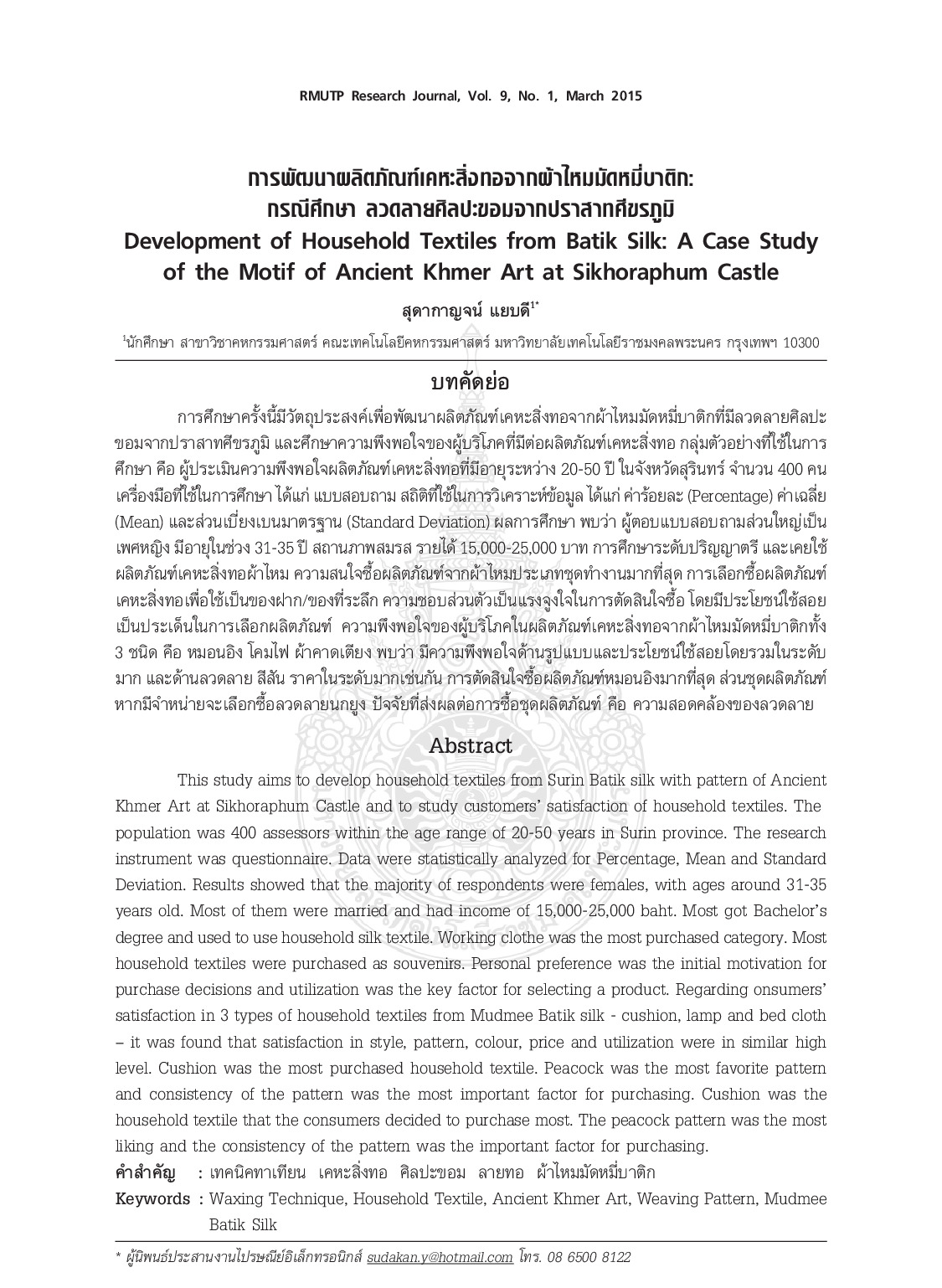
Development of household textiles from batik silk: a case study of the motif of ancient khmer art at sikhoraphum castle
This study aims to develop household textiles from Surin Batik silk with pattern of Ancient Khmer Art at Sikhoraphum Castle and to study customers’ satisfaction of household textiles. The population was 400 assessors within the age range of 20 - 50 years in Surin province. The research instrument was questionnaire. Data were statistically analyzed for Percentage Mean and Standard Deviation. Results showed that the majority of respondents were females with ages around 31 - 35 years old. Most of them were married and had income of 15000 – 25000 baht. Most got Bachelor’s degree and used to use household silk textile. Working clothe was the most purchased category. Most household textiles were purchased as souvenirs. Personal preference was the initial motivation for purchase decisions and utilization was the key factor for selecting a product. Regarding onsumers’ satisfaction in 3 types of household textiles from Mudmee Batik silk - cushion lamp and bed cloth – it was found that satisfaction in style pattern colour price and utilization were in similar high level. Cushion was the most purchased household textile. Peacock was the most favorite pattern and consistency of the pattern was the most important factor for purchasing.
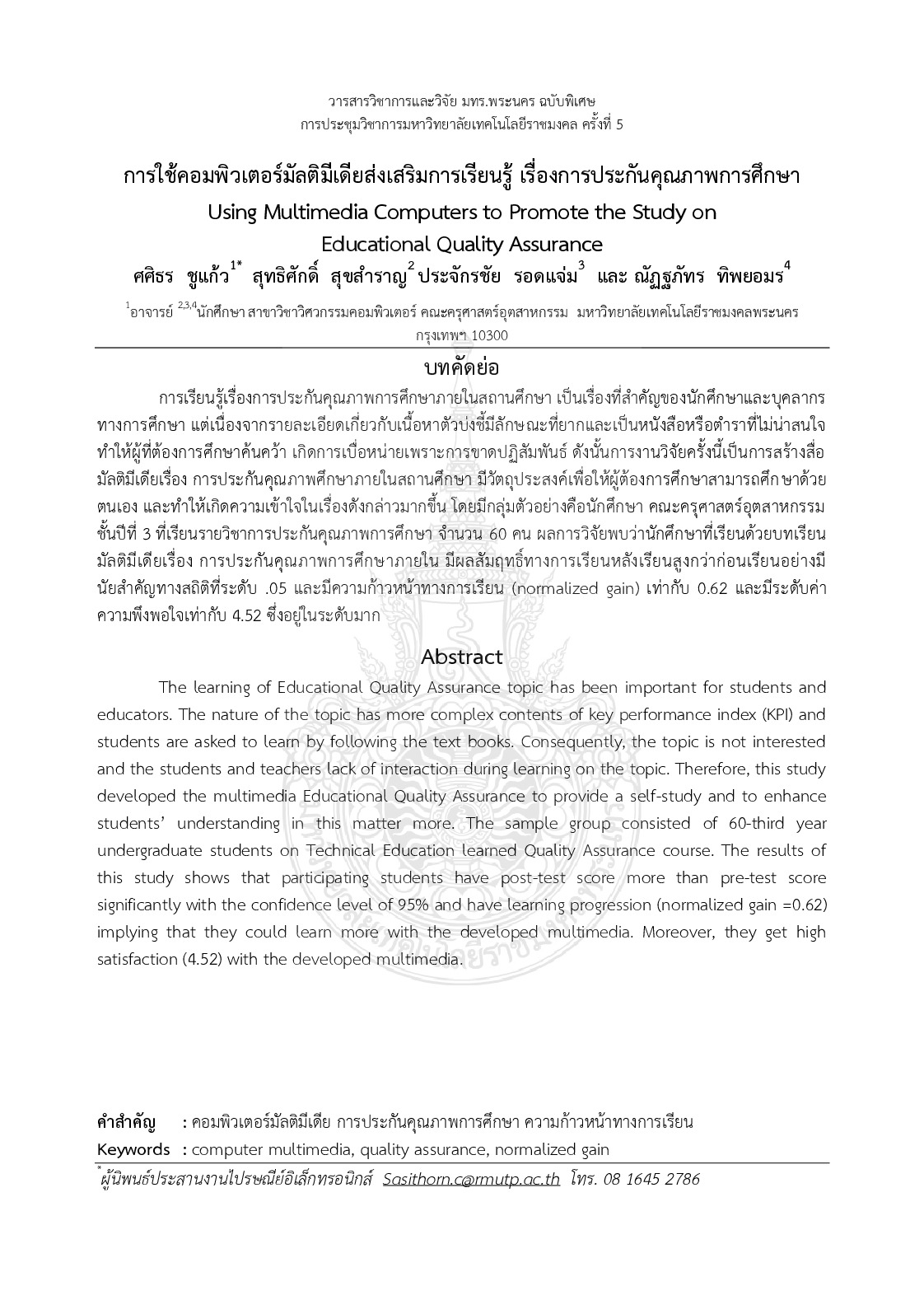
Using multimedia computers to promote the study on educational quality assurance
The learning of Educational Quality Assurance topic has been important for students and educators. The nature of the topic has more complex contents of key performance index (KPI) and students are asked to learn by following the text books. Consequently the topic is not interested and the students and teachers lack of interaction during learning on the topic. Therefore this study developed the multimedia Educational Quality Assurance to provide a self-study and to enhance students’ understanding in this matter more. The sample group consisted of 60-third year undergraduate students on Technical Education learned Quality Assurance course. The results of this study shows that participating students have post-test score more than pre-test score significantly with the confidence level of 95% and have learning progression (normalized gain =0.62) implying that they could learn more with the developed multimedia. Moreover they get high satisfaction (4.52) with the developed multimedia.
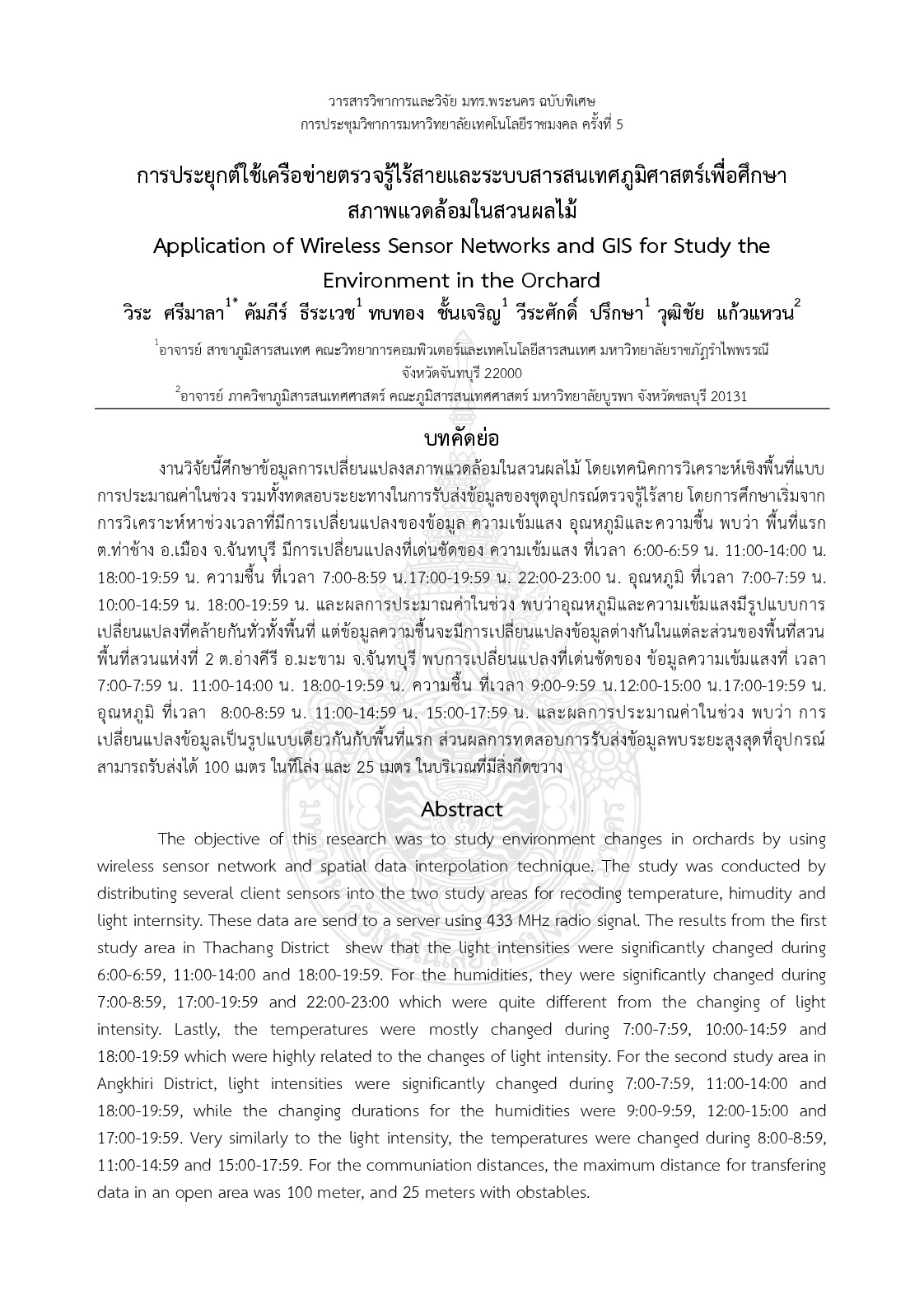
Application of wireless sensor networks and gis for study the environment in the orchard
The objective of this research was to study environment changes in orchards by using wireless sensor network and spatial data interpolation technique. The study was conducted by distributing several client sensors into the two study areas for recoding temperature himudity and light internsity. These data are send to a server using 433 MHz radio signal. The results from the first study area in Thachang District shew that the light intensities were significantly changed during 6:00-6:59 11:00-14:00 and 18:00-19:59. For the humidities they were significantly changed during 7:00-8:59 17:00-19:59 and 22:00-23:00 which were quite different from the changing of light intensity. Lastly the temperatures were mostly changed during 7:00-7:59 10:00-14:59 and 18:00-19:59 which were highly related to the changes of light intensity. For the second study area in Angkhiri District light intensities were significantly changed during 7:00-7:59 11:00-14:00 and 18:00-19:59 while the changing durations for the humidities were 9:00-9:59 12:00-15:00 and 17:00-19:59. Very similarly to the light intensity the temperatures were changed during 8:00-8:59 11:00-14:59 and 15:00-17:59. For the communiation distances the maximum distance for transfering data in an open area was 100 meter and 25 meters with obstables.
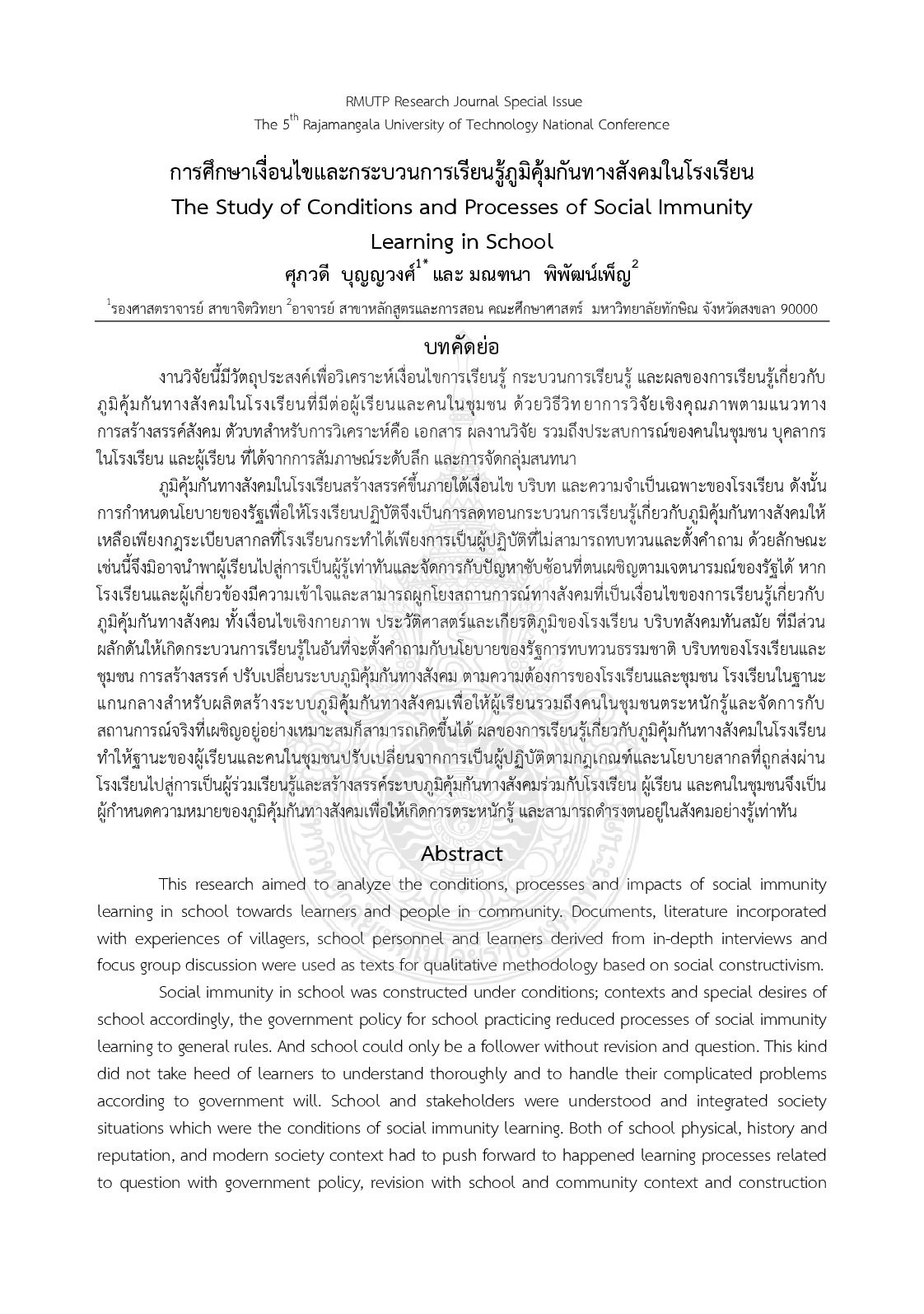
The study of conditions and processes of social immunity learning in school
This research aimed to analyze the conditions processes and impacts of social immunity learning in school towards learners and people in community. Documents literature incorporated with experiences of villagers school personnel and learners derived from in-depth interviews and focus group discussion were used as texts for qualitative methodology based on social constructivism. Social immunity in school was constructed under conditions; contexts and special desires of school accordingly the government policy for school practicing reduced processes of social immunity learning to general rules. And school could only be a follower without revision and question. This kind did not take heed of learners to understand thoroughly and to handle their complicated problems according to government will. School and stakeholders were understood and integrated society situations which were the conditions of social immunity learning. Both of school physical history and reputation and modern society context had to push forward to happened learning processes related to question with government policy revision with school and community context and construction social immunity. Therefore school as a core to construct social immunity for awareness and coping with real situations of learners and people in community was able to occur. The impact of this learning replaced the learners and villagers whom were the followers of passed general rules and policy to the participants of cooperative learning and constructing social immunity processes. Hence learners and villagers determined meaning of social immunity for awareness and having abilities to exist in society with understanding thoroughly.