จำนวน Repository ( 558 )
Community-based tourism management case study “palm paddy sea” community cultural way. sa-ting phra district, songkhla province
The purpose of this research was to study community-based tourism management case study “Palm Paddy Sea” cultural way community Sa-Ting Phra district Songkhla province. The study was conducted by data collection interview people who involved in tourism management and tourists who traveled to the communities using questionnaire with 5 rating scales estimation. The data was analyzed according to the content and presented by descriptive analysis and tables. The study found that “Palm Paddy Sea” cultural way community has the potential to support eco-tourism. The tourism development of both natural and cultural resources within the communities encourage for being learning sources about community way and folk wisdom The community has participated in the development and wants to join in tourism management meetings with the Sub-district Administrative Organization. In addition the community requires that a community representative must have a chance to present ideas in a meeting in order to be developed in the same way. The guidelines for tourism development need to have cooperation from involved organizations in order to develop tourist attractions tourism facilities and promotions.
Study on effectiveness of aquatic plants for wastewater treatment
The objective of this research was to compare the effectiveness of water hyacinth and cootail for wastewater treatment by taking water sample from Klong Bangkhen-mai near King Mongkut’s University of Technology North Bangkok. The results showed that there was no diifference on water temperature changes in tanks between two plants. pH of water in coontail tanks was between pH 8.69 to pH 8.91 and pH of water in water hyacinth tanks was slightly increasing between pH 7.71 to pH 8.26. The more amount of coontail added the higher DO would be between 9.18 mg/L to 10.02 mg/L. Moreover COD of water was decreasing according to the amount of cootail addition and more effective than that in water hyacinth tank especially in 150 grams coontail tanks but TS in water hyacinth tanks was much more decreasing than that in coontail tanks. TS was between 21.73 mg/L to 25.91 mg/L. COD was between 45.30 mg/L to 48.34 mg/L.
A study of solar absorber shape effect in the solar Air heater
This purpose of the research was to study of Solar Absorber Shape Effect in the Solar Air Heater. These has designed and constructed the solar air heater for drying agricultural products of two different types. Comparison of First thing used square type one glass layer used centrifugal fans to feed air and installed solar absorber which each made of sinusoidal corrugate galvanized steel sheet coated with dull black paint and each other made of trapezoidal corrugate galvanized steel sheet coated with dull black paint. The results of research showed that the solar absorber which each made of trapezoidal corrugate galvanized steel sheet coated with dull black paint is most suitable. Which has overall thermal efficiency 66% and can generate maximum temperature 96.13 degree of Celsius
Community-based tourism management case study buddhist way klong dan community ra – nod district songkhla province
The purposes of this research were to 1) explore and collect a problem and an obstacle of tourism management by Klong Dan community 2) analyse a problem and an obstacle in tourism management by the community and 3) the study guidliness to develop tourism by the community. The population of the study are government and private organizations community leaders technocrats researchers who used to study in the area OTOP group and tourists The sampling technique for the sample is Simple Random Sampling. The data were collected by interviewing people who involved in tourism management and using questionnaire with the tourists. The data were analyzed according to the content and presented by descriptive analysis and tables. The study found that people in the community are involved in conservation plan and tourism management as well as tourism activities. There are community rules according to covenant community and want to have support from the outside. Beside there are development plans to develop the area as a cultural destination which recognizing the unique art and culture and vernacular architecture of the community. Facility constructing must consider to aesthetic social and culture. The used materials must be able to preserve the unique of local architecture. Furthermore there must be the promotion of the tourism destination to connect with other communities.
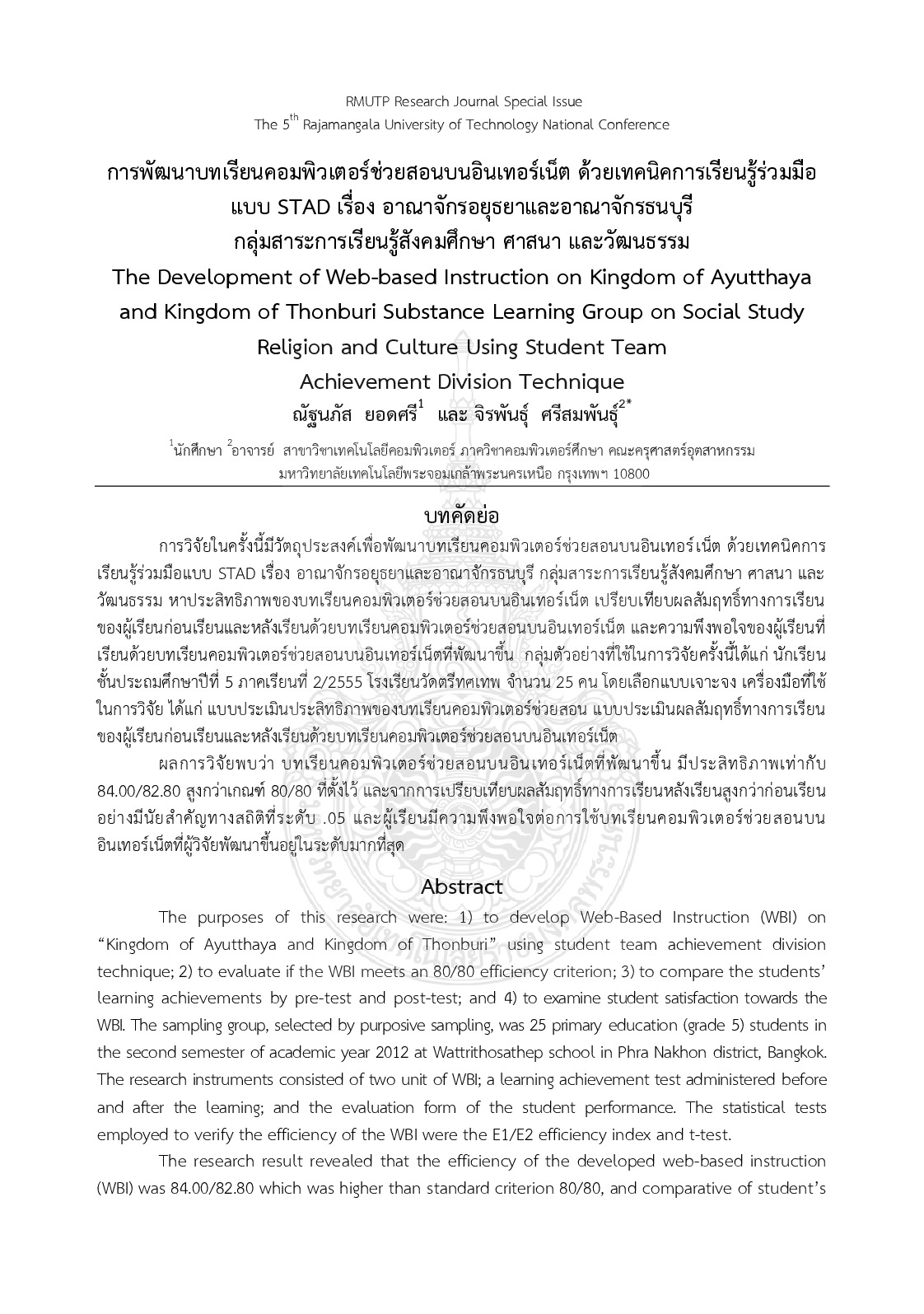
The development of web-based instruction on kingdom of ayutthaya and kingdom of thonburi substance learning group on social study religion and culture using student team achievement division technique
The purposes of this research were: 1) to develop Web-Based Instruction (WBI) on “Kingdom of Ayutthaya and Kingdom of Thonburi”กusing student team achievement division technique; 2) to evaluate if the WBI meets an 80/80 efficiency criterion; 3) to compare the students’ learning achievements by pre-test and post-test; and 4) to examine student satisfaction towards the WBI. The sampling group selected by purposive sampling was 25 primary education (grade 5) students in the second semester of academic year 2012 at Wattrithosathep school in Phra Nakhon district Bangkok. The research instruments consisted of two unit of WBI; a learning achievement test administered before and after the learning; and the evaluation form of the student performance. The statistical tests employed to verify the efficiency of the WBI were the E1/E2 efficiency index and t-test. The research result revealed that the efficiency of the developed web-based instruction (WBI) was 84.00/82.80 which was higher than standard criterion 80/80 and comparative of student’s achievement it was found that the student achieved learning progress significantly level of .05. Finally it was found that the learners opinion after using the developed web-based instruction (WBI) was very satisfactory.