จำนวน Repository ( 558 )
Feasibility study of copper indium gallium (di)selenide (CIGS) for condominium in thailand
This research was to study the feasibility of CIGS for condominiums in Thailand by studying the energy consumption of building which divide by behavior of users which interested in day time users and night time users. Then study approach and feasibility to apply CIGS for condominiums by consider energy consumption and economic efficiency of installation CIGS for energy conservation. The result showed that when installed 110 watts/m2 of CIGSs on windows in a room type can be provide electricity 2.51 kWh per day 2.81 kWh per day and 3.75 kWh per day which can be represented 40 percent of the total energy consumption. In other word can be reduce energy supply from grid per month 75.30 kWh 84.3 kWh and 112.50 kWh. While investment cost per square meter of CIGS is about 23000 - 35000 baht which equivalent to 3 percent of total condominium price that mean payback period is about 8 years. Although CIGS is not able to provide all of electric consumption in building but from the assessment of economics found that there is a very interesting to investment it should be interested policy for the government to enforce condominium to install CIGS for sustainable development.
The study of shrinkage percentage HDPE based on the ASTM D955 Standard test method
The shrinkage depended on the product shape and the type of plastic used in injection melting temperature injection speed holding pressure and mold cooling. Different surroundings during the injection resulted in differences shrinkage so the exact shrinkage value hadn’t been known. This was the cause of Try out and error work that produced Injection products that were not in correct size. This research aims to find the shrinkage percentage based on the ASTM D955 standard test method from high density polyethylene (HDPE) which has partial crystalline structure and high shrinkage. The results were as follows: The specimen size 60x60 mm shrinkage was at 2.57 percentage and with 2 mm thickness the shrinkage was 3.60 percentage. The specimen size 12.7x127 mm shrinkage was between 2.76 percentage and 2.91 percentage with 3.20 mm thickness the shrinkage was 2.48 percentage. For the 100 mm circular specimen the shrinkage was from 4.35 to 4.39 percentage and with 3.20 mm thickness the shrinkage was 2.56 percentage
Study of a small vacuum coating system for thermal evaporation
In this research we studied and fabricated a small vacuum coating system which is suitable for small pieces of the samples. It can help us to save in both cost and time for coating materials in each run. The home-built system consists of (1) a two-stage rotary pump used as a roughing and backing pump for a vacuum chamber and (2) a diffusion pump. The ultimate pressure of this diffusion pump is about 10-7 torr. From the result of testing the fabricated vacuum system it is found that the chamber pressure under the atmosphere can get down to 2.2 x 10⁻² torr in 6 minutes by the rotary pump. The pressure inside the chamber is continuously lower to achieve 4.5 x 10⁻⁵torr in 30 minutes by the diffusion pump. Moreover we did further testing the system by coating pure aluminum (99.999%) on a Si (100) substrate using a resistive heater source made of tungsten with applied voltage and current of about 2.19 V and 110 A respectively. The aluminum surface has been investigated by SEM and AFM.
Study on rice straw to be bio-fuel pellets
FAO reported in year 2008 world paddy production more than 40 countries and about 60 million tones of rice straw were produced in Thailand. For most farmers use an easy method for land clearing by straw burning in open area. Greenhouse gases such as carbon dioxide(CO2) emissions from paddy field burning to atmosphere is causes of global warming problem. This project aimed to utilize agricultural waste from rice field to be cheap biomass energy was started in 2009 at Nhongjork area. The waste was mixed with molasses and kaolin in ratio of rice straw : molasses : kaolin as 80:10:10 by weights. A size of rice straw fuel pellet was 1.54 cm. diameter and 2 cm. height. The calorific value of the rice straw pellet was tested by using Gallekamp Autobomb instrument by ASTM(American Society of Testing and Materials) standard. The results of testing found : CO2 emission from rice straw fuel pellets as half of burning in open area (by weight). Cost of energy for cooking by using Bio-fuel pellets only 7 Baht( 0.25 US $) and half price by comparing with LPG. The useful of rice straw Bio-fuel pellet is one of a cheap biomass energy for household and small manufacturers.
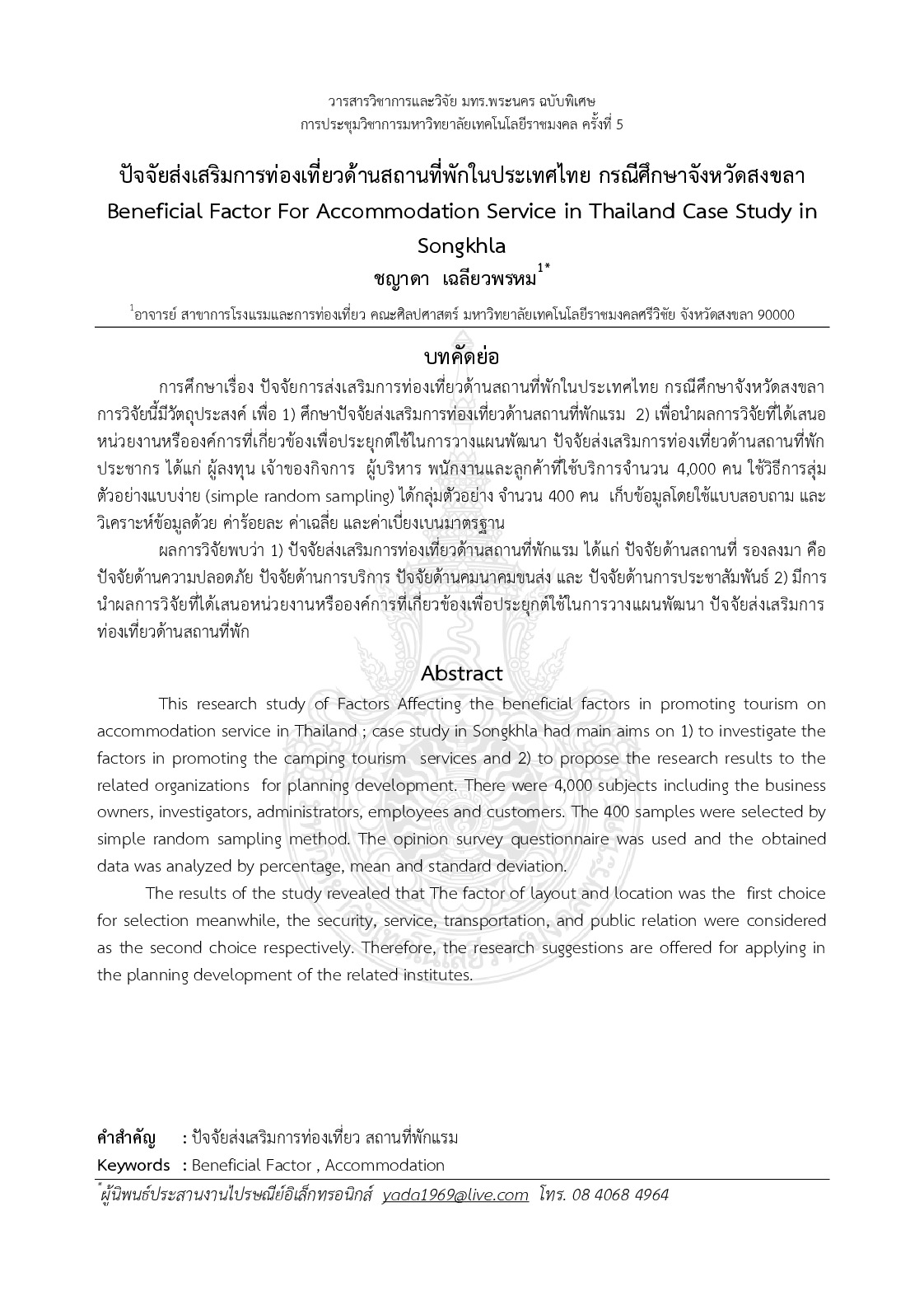
Beneficial factor for accommodation service in thailand case study in songkhla
This research study of Factors Affecting the beneficial factors in promoting tourism on accommodation service in Thailand ; case study in Songkhla had main aims on 1) to investigate the factors in promoting the camping tourism services and 2) to propose the research results to the related organizations for planning development. There were 4000 subjects including the business owners investigators administrators employees and customers. The 400 samples were selected by simple random sampling method. The opinion survey questionnaire was used and the obtained data was analyzed by percentage mean and standard deviation. The results of the study revealed that The factor of layout and location was the first choice for selection meanwhile the security service transportation and public relation were considered as the second choice respectively. Therefore the research suggestions are offered for applying in the planning development of the related institutes.