จำนวน Repository ( 59 )
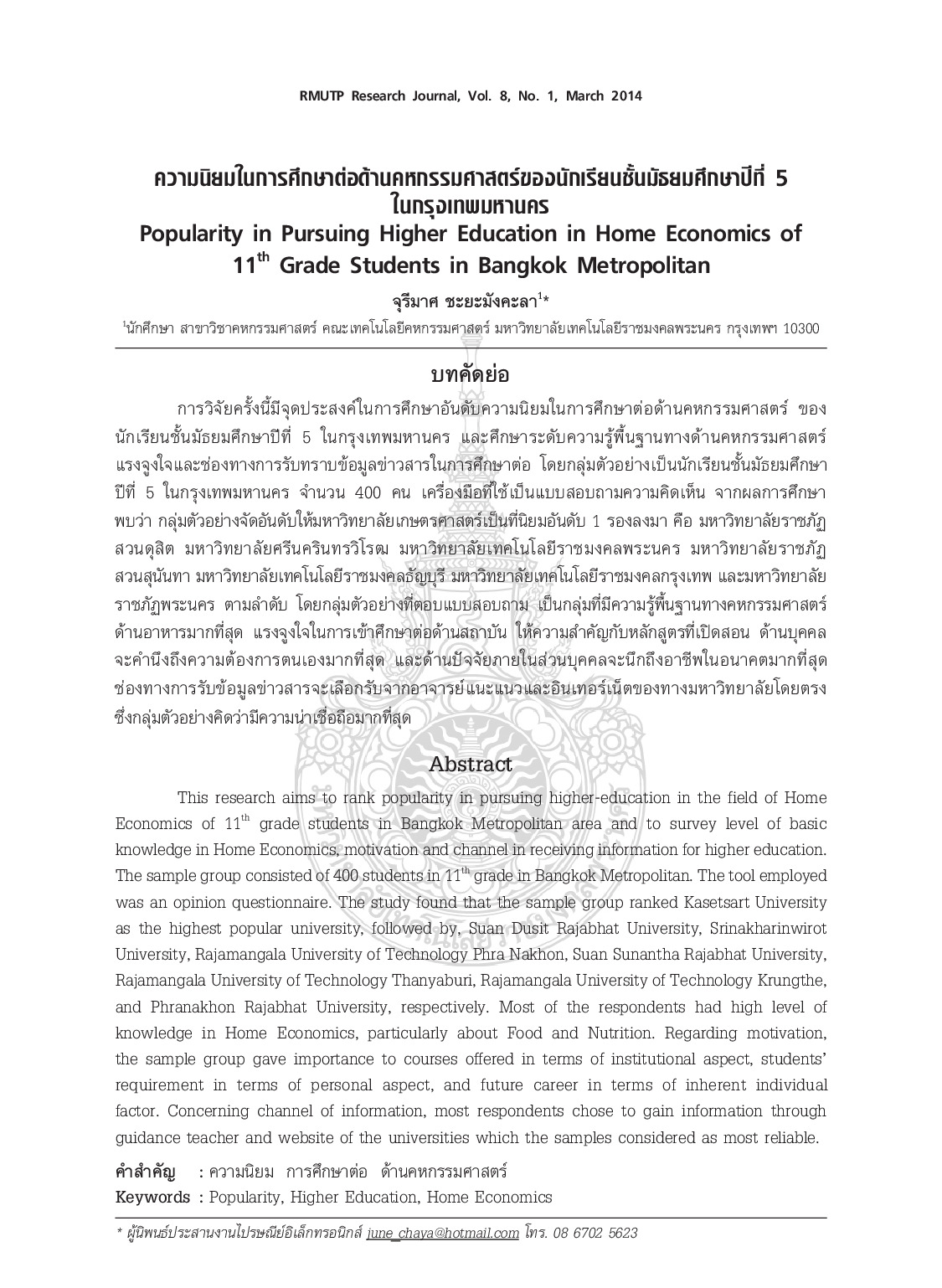
ความนิยมในการศึกษาต่อด้านคหกรรมศาสตร์ของนักเรียนชั้นมัธยมศึกษาปีที่ 5 ในกรุงเทพมหานคร
This research aims to rank popularity in pursuing higher-education in the field of Home Economics of 11th grade students in Bangkok Metropolitan area and to survey level of basic knowledge in Home Economics motivation and channel in receiving information for higher education. The sample group consisted of 400 students in 11th grade in Bangkok Metropolitan. The tool employed was an opinion questionnaire. The study found that the sample group ranked Kasetsart University as the highest popular university followed by Suan Dusit Rajabhat University Srinakharinwirot University Rajamangala University of Technology Phra Nakhon Suan Sunantha Rajabhat University Rajamangala University of Technology Thanyaburi Rajamangala University of Technology Krungthe and Phranakhon Rajabhat University respectively. Most of the respondents had high level of knowledge in Home Economics particularly about Food and Nutrition. Regarding motivation the sample group gave importance to courses offered in terms of institutional aspect students’ requirement in terms of personal aspect and future career in terms of inherent individual factor. Concerning channel of information most respondents chose to gain information through guidance teacher and website of the universities which the samples considered as most reliable.
ปัจจัยที่ส่งผลต่อเจตคติต่อการทำงานในโรงงานอุตสาหกรรมเสื้อผ้าของนักศึกษา คณะเทคโนโลยีคหกรรมศาสตร์ มหาวิทยาลัยเทคโนโลยีราชมงคลพระนคร
This research aims to study the factors affecting the attitude of students in faculty of home economics technology towards work in factory of garment industry. Contain factor of personal characteristics of students the family background of students and the learning environment of students. Population is divisions of fashion merchandising technology and fashion clothing & textile design class 1-4 of Year 2555 total 210 people. Tool used was the questionnaire. Statistics used were percentage mean standard deviation correlation coefficient of Pearson and multiple regression analysis. The results showed factors affecting attitude towards work in factory of garment industry of students in faculty of home economics technology statistically significant at the .01 level has 3 factors. Sort by factors affecting most to the least 1) learning environment of students 2) Number of subjects for textile cutting and sewing learned ever 3) Personal characteristics of students and could explain the variability of attitude towards work in factory of garment industry at 77.1 percent of this population.
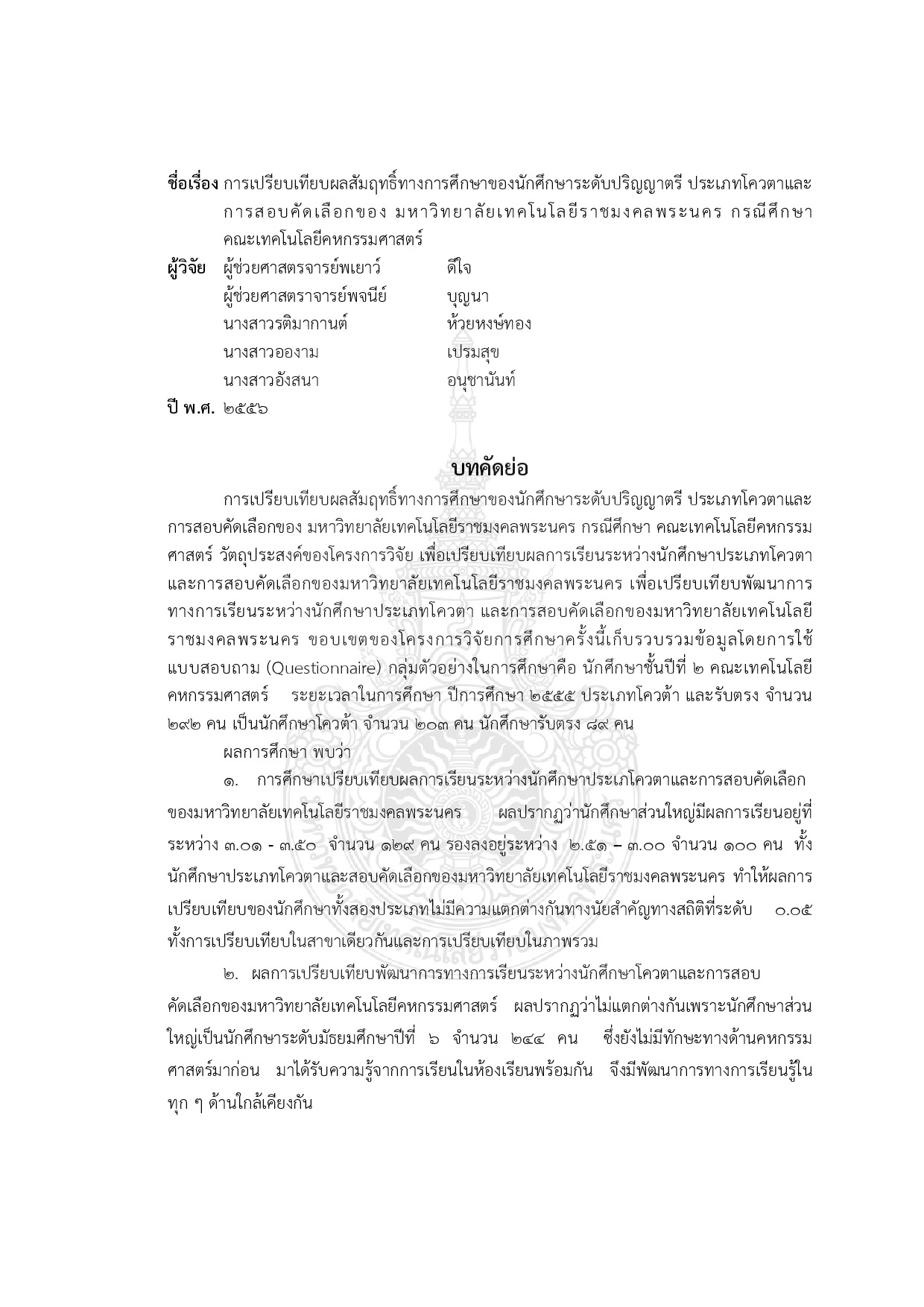
การเปรียบเทียบผลสัมฤทธิ์ทางการศึกษาของนักศึกษาระดับปริญญาตรี ประเภทโควตาและ การสอบคัดเลือกของ มหาวิทยาลัยเทคโนโลยีราชมงคลพระนคร กรณีศึกษาคณะเทคโนโลยีคหกรรมศาสตร์
การเปรียบเทียบผลสัมฤทธิ์ทางการศึกษาของนักศึกษาระดับปริญญาตรี ประเภทโควตาและ การสอบคัดเลือกของ มหาวิทยาลัยเทคโนโลยีราชมงคลพระนคร กรณีศึกษา คณะเทคโนโลยีคหกรรม ศาสตร์ วัตถุประสงค์ของโครงการวิจัย เพื่อเปรียบเทียบผลการเรียนระหว่างนักศึกษาประเภทโควตา และการสอบคัดเลือกของมหาวิทยาลัยเทคโนโลยีราชมงคลพระนคร เพื่อเปรียบเทียบพัฒนาการ ทางการเรียนระหว่างนักศึกษาประเภทโควตา และการสอบคัดเลือกของมหาวิทยาลัยเทคโนโลยี ราชมงคลพระนคร ขอบเขตของโครงการวิจัยการศึกษาครั้งนี้เก็บรวบรวมข้อมูลโดยการใช้ แบบสอบถาม (Questionnaire) กลุ่มตัวอย่างในการศึกษาคือ นักศึกษาชั้นปีที่ 2 คณะเทคโนโลยี คหกรรมศาสตร์ ระยะเวลาในการศึกษา ปีการศึกษา 2555 ประเภทโควต้า และรับตรง จำนวน 292 คน เป็นนักศึกษาโควต้า จำนวน 203 คน นักศึกษารับตรง 89 คน ผลการศึกษา พบว่า ๑. การศึกษาเปรียบเทียบผลการเรียนระหว่างนักศึกษาประเภโควตาและการสอบคัดเลือก ของมหาวิทยาลัยเทคโนโลยีราชมงคลพระนคร ผลปรากฏว่านักศึกษาส่วนใหญ่มีผลการเรียนอยู่ที่ ระหว่าง ๓.๐๑ - ๓.๕๐ จำนวน ๑๒๙ คน รองลงอยู่ระหว่าง ๒.๕๑ – ๓.๐๐ จำนวน ๑๐๐ คน ทั้ง นักศึกษาประเภทโควตาและสอบคัดเลือกของมหาวิทยาลัยเทคโนโลยีราชมงคลพระนคร ทำให้ผลการ เปรียบเทียบของนักศึกษาทั้งสองประเภทไม่มีความแตกต่างกันทางนัยสำคัญทางสถิติที่ระดับ ๐.๐๕ ทั้งการเปรียบเทียบในสาขาเดียวกันและการเปรียบเทียบในภาพรวม ๒. ผลการเปรียบเทียบพัฒนาการทางการเรียนระหว่างนักศึกษาโควตาและการสอบ คัดเลือกของมหาวิทยาลัยเทคโนโลยีคหกรรมศาสตร์ ผลปรากฏว่าไม่แตกต่างกันเพราะนักศึกษาส่วน ใหญ่เป็นนักศึกษาระดับมัธยมศึกษาปีที่ ๖ จำนวน ๒๔๔ คน ซึ่งยังไม่มีทักษะทางด้านคหกรรม ศาสตร์มาก่อน มาได้รับความรู้จากการเรียนในห้องเรียนพร้อมกัน จึงมีพัฒนาการทางการเรียนรู้ใน ทุก ๆ ด้านใกล้เคียงกัน
ผลการจัดการเรียนรู้แบบร่วมมือเชิงบูรณาการ วิชาเทคนิคการจัดดอกไม้ ของนักศึกษา ระดับปริญญาตรี สาขาวิชาการบริหารธุรกิจคหกรรมศาสตร์ มทร.พระนคร
The research studied results of integrated learning management in flower arrangement techniques subject of students from the bachelor’s degree in Home Economics Business Administration program Rajamangala University of Technology Phra Nakhon. The researchers provided the cooperative learning and selected three units of flower arrangement techniques subject consisting of materials and tools for arranging flowers creative flower arrangement and international flower arrangement. The research samples were the second year students of Home Economics Business Administration program. The research methods used in this study were a learning achievement form a satisfaction form and a participant observation form. Results of the study found were: 1. The effects of cooperative learning on students flower arrangement techniques subject achievement was found that there was a statistically significant difference between students pretest and post-test scores at the level .05. 2. The satisfaction of students toward flower arrangement techniques subject was at the highest level ( x = 4.00). It showed that students’ attitudes toward cooperative learning were at good level.
พฤติกรรมการใช้น้ำ และไฟฟ้า ของนักศึกษาคณะเทคโนโลยีคหกรรมศาสตร์ มหาวิทยาลัยเทคโนโลยีราชมงคลพระนคร
The purposes of this research are to study water and electricity consumption behavior of the students to study understanding of water and electricity saving and to compare the difference of water and electricity consumption behavior classified as personal characteristic of the students Faculty of Home Economics Technology Rajamangala University of Technology Phra Nakhon. This research was descriptive research. The sample group used in the research was the students Faculty of Home Economics Technology Rajamangala University of Technology Phra Nakhon. Size of the sample group was specified to be 325 people by stratified sampling. The tool used in data analysis was questionnaire divided into 3 parts including part 1: questions regarding general details of a respondent part 2: questions regarding knowledge of water and electricity saving consumption the students of Faculty of Home Economics Technology Rajamangala University of Technology Phra Nakhon and part 3: questions regarding water and electricity consumption behavior of the students Faculty of Home Economics Technology Rajamangala University of Technology Phra Nakhon. The statistics used in data analysis consisted of frequency percentage mean standard deviation and hypothesis testing using t-test and ANOVA (Analysis of Variance) for testing parallel difference by LSD method. The research result found that: 1. The level of water and electricity consumption behavior of the students Faculty of Home Economics Technology Rajamangala University of Technology Phra Nakhon was overall in the moderate level. 2. The level of understanding and knowledge regarding water and electricity saving of the students Faculty of Home Economics Technology Rajamangala University of Technology Phra Nakhon was overall in the moderate level. 3. The comparison of different behavior of water and electricity consumption specified according to personal characteristics could be summarized that the students having different gender class and major had identical water consumption behavior and the students having different gender class and major had identical electricity consumption behavior. On the other hand the students having different major had statistical significance in electricity consumption behavior at 0.05