จำนวน Repository ( 59 )

A study of obtained knowledge using from physics I for engineers for daily life application of undergraduate student at Rajamangala University of Technology Phra Nakhon
The purpose of this study was to investigate obtained knowledge using from Physics I for Engineers for daily life application of undergraduate student from faculty of engineering Rajamangala University of Technology Phra Nakorn. Sample was 316 students which taken from four engineering majors; computer electrical industrial and mechanical engineering. A questionnaire a four point scale was used as testing tool. The statistical analyses were performed in mean standard deviation and one way analysis of variance. The results revealed that students used their obtained knowledge in moderate level (3.10). Students in each programs showed significantly different used their obtained knowledge at 0.05 level. Electrical engineering students (3.27) showed highest number of the course content using follow by mechanical engineering (3.09) computer engineering (3.07) and industrial engineering (2.75) respectively.
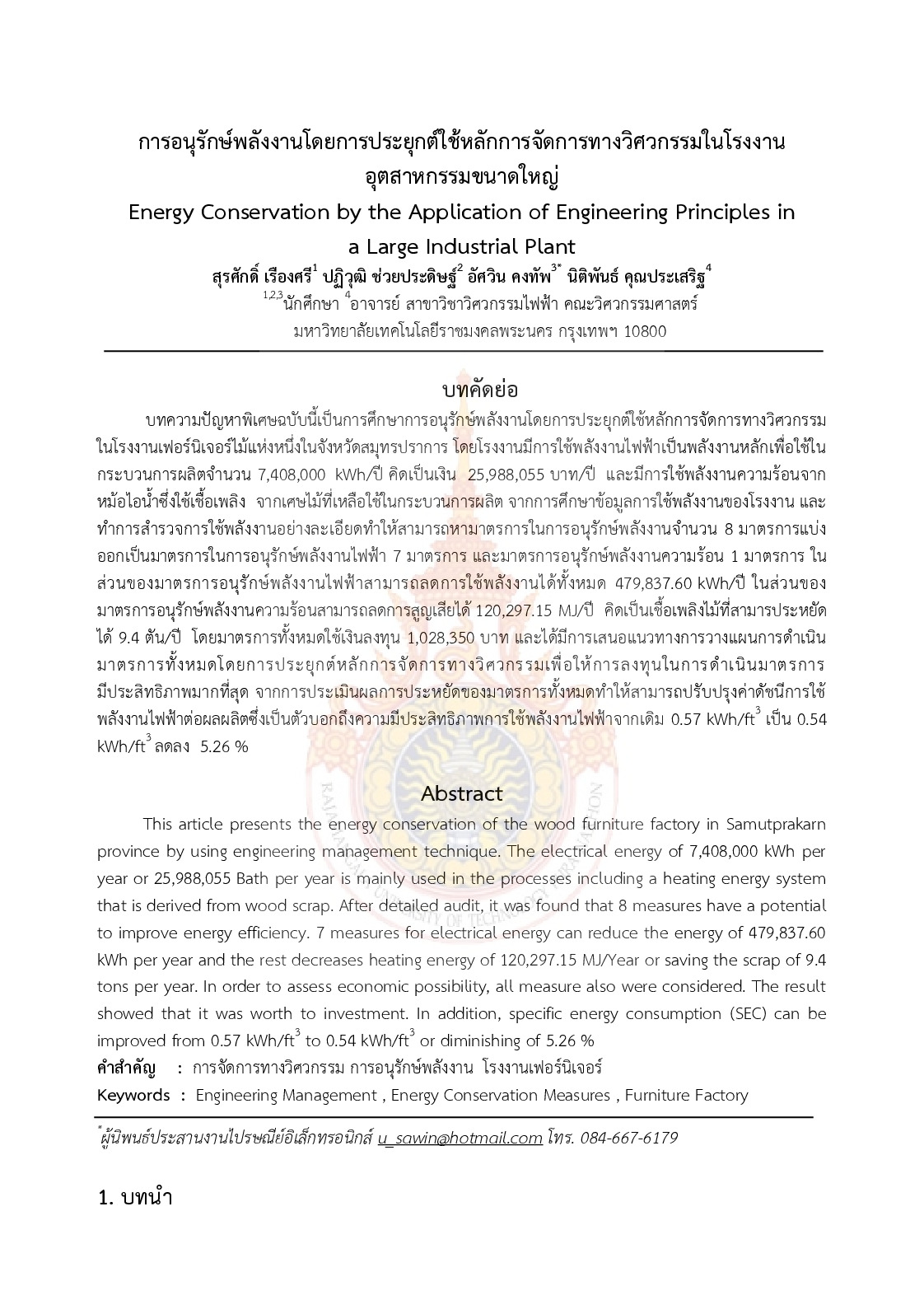
Energy Conservation by the Application of Engineering Principles in a Large Industrial Plant
This article presents the energy conservation of the wood furniture factory in Samutprakarn province by using engineering management technique. The electrical energy of 7408000 kWh per year or 25988055 Bath per year is mainly used in the processes including a heating energy system that is derived from wood scrap. After detailed audit it was found that 8 measures have a potential to improve energy efficiency. 7 measures for electrical energy can reduce the energy of 479837.60 kWh per year and the rest decreases heating energy of 120297.15 MJ/Year or saving the scrap of 9.4 tons per year. In order to assess economic possibility all measure also were considered. The result showed that it was worth to investment. In addition specific energy consumption (SEC) can be improved from 0.57 kWh/ft3 to 0.54 kWh/ft3 or diminishing of 5.26 %
Creating and Evaluating the Effectiveness of Computer Assisted Instruction Program Subject Engineering Materials Chapter 3-6.
The purposes of the research were to create and efficiency validation of computer Assisted for the courses of practiced to reading Creating and Evaluating the Effectiveness of Computer Assisted Instruction Program Subject Engineering Materials Chapter 3-6 based standard and analyses the leaning achievement of the student after by using computer assisted instruction . The subjects in the study were 20. Diploma students enrolled in Rajamangala University of Technology Phra Nakhon. The Researcher using the experiment by let the students do until test before class And then study by using computer assisted instruction focused on practiced to basic turning . After that let students do the unit test again at the class and calculate to find out the efficiency of the computer assisted instruction. And analyzed the learning achievement of students after study. The research result revealed that the efficiency of the computer assisted Instruction was efficient in standard Moreover after learning achievement at significant level of 0.05.
An application of Bayesian Models for risk of withdrawal from calculus 2 for engineers of students at Faculty of Engineering, Rajamangala University of Technology Pra Nakorn, North Bangkok Campus
The objectives of this research are: to study the characteristics of students in the Faculty of Engineering at Rajamangala University of Technology Pra Nakorn North Bangkok Campus that influence to the risk of withdrawal from Calculus 2 for Engineers; to predict the risk of withdrawal from Calculus 2 for Engineers; and to use the results of the study for planning and solving the problems of withdrawal from Calculus 2 for Engineers. The sample is 226 students in the Faculty of Engineering at Rajamangala University of Technology who enrolled the Calculus 2 for engineers in the second semester of the academic year 2009. The data are from the questionnaire. The factors considered are grad point average the number of enrollments for the Calculus 1 for engineers Calculus 1 for Engineers grade the number of courses that emphasize on calculation that were enrolled in the second semester of the academic year 2009 the sacrifices of students for the Calculus 2 for Engineers course and the need to withdraw from Calculus 2 for Engineers course before other courses. The logistic regression model in which the parameters are estimated by using Bayesian methods is used for analyzing the data. The study shows that the factors that influence to the risk of withdrawal from the Calculus 2 for Engineers are grade point average Calculus 1 for Engineers grade the number of courses that emphasize on calculation that were enrolled in the second semester of the academic year 2009 and the sacrifices of students for the Calculus 2 for Engineers and the need to withdraw from Calculus 2 for Engineers before other courses. The factor that does not influence to the risk of withdrawal from the Calculus 2 for Engineers is the number of enrollments for the Calculus 1 for Engineers.