จำนวน Repository ( 38 )

แนวทางการพัฒนาศักยภาพการดำเนินงานของวิสาหกิจชุมชนแปรรูปผลิตภัณฑ์อาหารในจังหวัดสมุทรปราการ
The objectives of this study were :1) to evaluate the basic information :2) to determine the operational status and problems and :3) to study the potential development guidelines for the operation of community enterprises of food processing groups in Samut Prakran Province. Samples selected by stratified random sampling technique were 112 members of community enterprises in Samut Prakran Province. These samples was drawn from the presidents of community enterprises of food processing in Samut Prakran Province which were assessed as the good level in potential operation. Data collection were done by using questionnaire technique while the data were analyzed with frequency percentage mean and standard deviation. The results revealed that the assessment of potential operation of the community enterprises of food processing groups 268 in Samut Prakran Province were at the good level of 114 the average level of 117 and the improvement level of 20. The community enterprises had strong intention to the strengthening of communities and the supportive system from the partite participation consisted of knowledge and developing budget. The overall of operational status was at a high level while the overall of operational problem was at a low level. The potential development guidelines for the operation of community enterprises of food processing groups in Samut Prakran Province were ;1) planning approach: making master plan for all sub-district ;2) organization structure approach: overall operation review with all of members ;3) personnel management approach: creating morale for work performance of personnel together ;4) marketing approach: producing products to meet market needs ;5) production approach: supporting the production knowledge by government sectors and ;6) accounting/ financial approach: making real income and expense accounts.
การพัฒนากลยุทธ์ทางการตลาดของธุรกิจอาหารคลีนสำเร็จรูปในเขตกรุงเทพมหานคร
This research was aimed to identify personal factors and consumers’ needs of the marketing mix as well as to study of the strategy development of instant clean foods business in Bangkok Metro Metropolis. To obtain the data a questionnaire was designed to gather the information from the 400 samples in the study selected by convenience sampling in five out of 50 districts from 50 districts. In-depth interviews were also arranged among five respondents. The statistical analysis was completed by percentage mean and SD. The hypothesis was tested by the t-test F-test and Oneway ANOVA. To test differences in pairs LSD was applied at the level of statistical significance at the 0.05. This research employed mixed research method: the quantitative research looked into the quantitative data obtained from the respondents who consumed instant clean foods. Qualitative research relied on the data from the indepth interviews of the clean food business operators. Concerning the marketing mix the targets groups and marketing strategies the research revealed most respondents were single female who aged 21-30 years old with bachelor’s degrees. The average incomes were 10000 - 20000 baht. Their needs related to the marketing mix were the importance of products relevant with freshness and cleanness. They highly focused on food prices and made a wide variety of payments (cash credit card online etc.) The consumers also paid attention to distribution channels at a high level (store sale convenience stores various online channels etc.) and convenient to buy from various reasons such as stores that were close to work schools and shopping malls. The consumers also paid high focus on the clean food promotion.
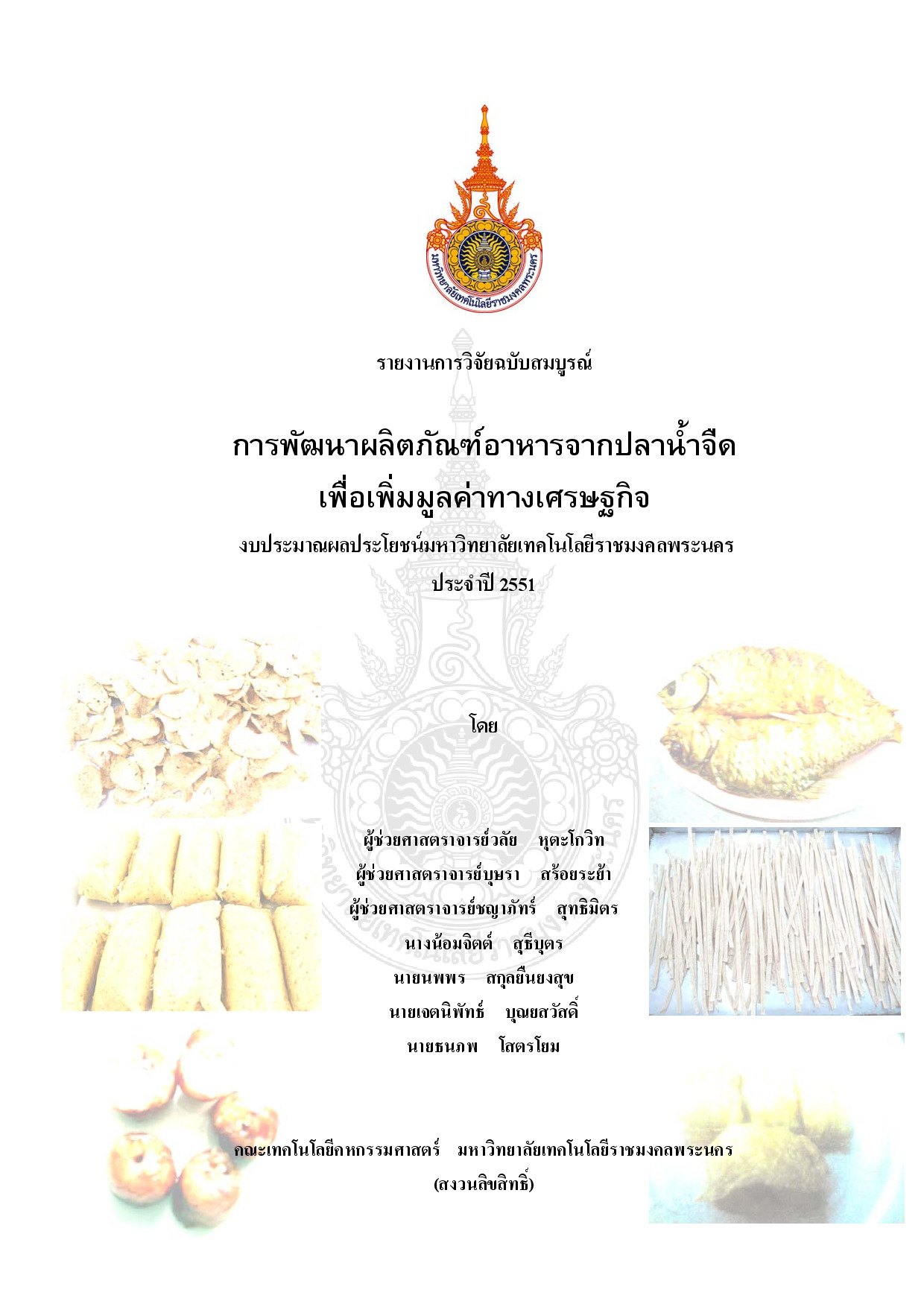
การพัฒนาผลิตภัณฑ์อาหารจากปลาน้ำจืดเพื่อเพิ่มมูลค่าทางเศรษฐกิจ
โครงการวิจัยเรื่อง การพัฒนาผลิตภัณฑ์อาหารจากปลาน้ำจืดเพื่อเพิ่มมูลค่าทางเศรษฐกิจ ได้ดำเนินการสำรวจและคัดเลือกแหล่งจัดซื้อวัตถุดิบที่เหมาะสม ความต้องการของตลาดผลิตภัณฑ์ปลาแปรรูป ผลิตภัณฑ์ที่เหมาะสมกับปลาแต่ละชนิดและน่าสนใจเพื่อนำมาพัฒนาเป็นผลิตภัณฑ์อาหารแปรรูปจากปลาน้ำจืด พบว่าการพัฒนาสูตรและกรรมวิธีการแปรรูปปลาน้ำจืด 6 ผลิตภัณฑ์ ได้แก่ ไส้กรอกปลารสต้มยำ ไส้กรอกอีสานปลานิล ปลายอสมุนไพร ปลาจ๊อ ปลาตะเพียนแผ่นปรุงรสสำเร็จ และน้ำพริกปลาตะเพียน ผลการพัฒนาผลิตภัณฑ์ พบว่า ไส้กรอกปลารสต้มยำ สูตรที่ยอมรับมากที่สุดเป็นสูตรที่ใช้ปลายี่สกทดแทนปลากราย 50 % และ เครื่องต้มยำกึ่งสำเร็จรูป (ชนิด C) 75 กรัม ไส้กรอกอีสานปลานิล ใช้สูตรพื้นฐานที่ได้จากกรมปศุสัตว์ ฝ่ายถ่ายทอดเทคโนโลยีผลิตภัณฑ์เนื้อสัตว์ และใช้ข้าวจ้าวหุงสุก ผลิตภัณฑ์ปลายอสมุนไพร ใช้เนื้อปลานิล แป้งมัน เกลือป่น พริกไทย ไข่ไก่ มันหมู ปริมาณน้ำพริกแกงเผ็ดสมุนไพรที่เหมาะสมในสูตรร้อยละ 3.5 การพัฒนาผลิตภัณฑ์ปลาจ๊อ สูตรที่ใช้เนื้อปลานิลบด มันหมู รากผักชี กระเทียม พริกไทย เกลือ แป้งสาลี น้ำตาลทราย ซีอิ้วขาว ไข่เป็ด ต้นหอม และผักชี ได้รับการยอมรับมากที่สุด การปรับปรุงลักษณะเนื้อสัมผัสโดยใช้ผสมมันหมูที่ใช้วิธีการบดผสม มีคะแนนความชอบมากกว่าการสับละเอียดและหั่นเป็นชิ้นเล็กๆ การศึกษาระยะเวลาการละลายน้ำแข็งจากการเก็บปลาจ๊อเข้าตู้แช่แข็งเป็นเวลา 2 สัปดาห์ เมื่อนำไปละลายน้ำแข็งที่กำลังความร้อน 70% เป็นเวลา1 นาที ผู้ทดสอบชิมให้การยอมรับมากที่สุด ผลิตภัณฑ์ปลาตะเพียนแผ่นปรุงรสสำเร็จรูป โดยการนำปลาตะเพียนขาวมาพัฒนาเป็นปลาแผ่นปรุงรสสำเร็จรูป พบว่าสูตรที่ให้การยอมรับมากที่สุด ประกอบด้วยเนื้อปลาบด ซีอิ๊วขาว น้ำตาลทราย เกลือไนไตรท์ ยี่หร่า พริกไทย ลูกผักชี และน้ำแข็ง กรรมวิธีการขึ้นรูปให้เป็นแผ่นโดยการอัดเป็นแท่งแล้วใช้เครื่องสไลด์ตัดมีคะแนนความชอบจากการทดสอบทางประสาทสัมผัสมากกว่าการคลึง การอัดเป็นแท่งแล้วใช้มีดตัด ผลิตภัณฑ์น้ำพริกปลาตะเพียนสูตรน้ำพริกปลาย่าง ใช้ปริมาณเนื้อปลาตะเพียน 70% วิธีการทำแห้งที่เหมาะสม คือ อบที่อุณหภูมิ 73 องศาเซลเซียส เป็นเวลา 1 ชั่วโมง This research aimed to survey and screen the appropriate resource study the need of fish processed product and investigate the suitable product that fit for each freshwater fish. The findings of this study demonstrated that the most suitable products were 6 ones such as Fish sausage with Tom Yam flavour added Fermented Thai Fish Sausage from Nile Tilapia fish Pla – Yor with Herbs Pla – Jor Fish Flake from Silver Barb Fish and Sauce of grilled silver barb fish paste and chili . The results of product development were : Fish Sausage with Tom Yam Flavour Added was developed by using Seven-Stripped Carp fish partial substituted with Spotted Featherback fish at level 50 % and 75 grams instant Tom Yum flavour (type C). Fermented Thai Fish Sausage from Nile Tilapia fish was developed by using dry-cooked rice. Pla – Yor with Herbs was developed by using Nile Tilapia and 3.5 % curry paste. Pla – Jor was developed by using minced lard and thawing 2-week frozen Pla – Jor by microwave at heat level 70 % for 1 minute. Fish Flake from Silver Barb Fish was developed by crushing to roll and sliding to sheet. Sauce of grilled Silver Barb fish paste and chili was developed by using Silver Barb fish partial substituted with shrimp at level 70 % and the appropriate drying method was using tray dryer at 73OC for 1 hour.