จำนวน Repository ( 71 )
การพัฒนาแผ่นซีเมนต์บอร์ดด้วยกากกาแฟเพื่อการอนุรักษ์สิ่งแวดล้อม
The using of ground coffee wastes from industries to develop the cement board is an objective of this research that can solve the air pollution problems from smell and spreading of ground coffee wastes. The ratio of Portland cement type1: fine sand: tap water is equal to 1: 0.5: 0.416 by weight and the ratios of Portland cement type1: ground coffee wastes include 1: 0.05 1: 0.06 1: 0.07 1: 0.08 1:0.09 and 1: 0.10 by weight (6 ratios). The production of cement board uses the pressure casting in temperature 30 – 35 degree of Celsius and controls 0.75 g/cm3 of density. The testing of cement-bonded fiberboard properties follow the TIS 878-2537 standard (cement bonded particle board: high density). From the results 1: 0.05 is the most suitable quantity of cement: ground coffee wastes which mixed in cement board. This cement boards can reduce the ground coffee wastes by using as aggregate to produce the construction materials.
การพัฒนาแผ่นซีเมนต์บอร์ดจากเถ้ากะลามะพร้าว สำหรับการอนุรักษ์พลังงานและสิ่งแวดล้อม
This research aims to develop the cement board from coconut shell ash. The Portland cement type1: fine sand: tap water ratio is equal to 1: 0.4: 0.33 by weight. The 5 ratios of Portland cement type1: coconut shell ash include 1: 0.12 1: 0.13 1: 0.14 1: 0.15 and 1: 0.16 by weight. The cement board production uses the pressure casting in normal temperature (30 – 35 degree of Celsius) and controls the 0.75 g/cm3 of density then test the properties of cement-bonded fiberboard follow TIS 878-2537 standard (cement bonded particle board: high density). From the results 1: 0.12 is the most suitable ratio of cement board from coconut shell ash. This developed cement boards can reduce the quantity of coconut shell ash waste and have the good thermal insulation.
Effects of environmental management in evaporative cooling system (EVAP) house on productive performance of layer pullets
The research was conducted to study on effects of environmental management in evaporative cooling system (EVAP) house on productive performance of layer pullets. This study divided into 2 experiments. Experiment 1 was conducted to study on temperature and air velocity in evaporative cooling system (EVAP) house on productive performance of layer pullets. Four thousand and eight hundred layer pullets were raised on battery cage with 5 birds per cage and assigned in a Randomized Completely Block Design (RCBD) experiment with three treatments. Each treatment consisted of four blocks (four houses) and followed different temperature and air velocity in raising area of evaporative cooling system (EVAP) house as front area central area and back area. Results showed that temperature and air velocity in front area was grater body weight gain (BWG) average daily gain (ADG) and feed conversion ratio (FCR) of layer pullets than layer pullets were raised in back area of evaporative cooling system (EVAP) house (P<0.01) Experiment 2 was conducted to study on light color and number of H-Flame battery cage row in evaporative cooling system (EVAP) house on light intensity and productive performance of layer pullets. Nine thousand and six hundred layer pullets were raised on H-Flame battery cage with 5 birds per cage and assigned in a 2x4 factorial in Randomized Completely Block Design (RCBD) experiment with two factors. Factor A was light color comprised of range and blue). While Factor B was number of battery cage row comprised (first row second row third row and fourth row). Each treatment consisted of four blocks (four houses). Results showed that interaction between factor A and B on light intensity and uniformity of layer pullets with highly significantly different (P<0.01). However interaction between factor A and B and main effect (factor A and B) were investigated on body weight gain (BWG) average daily gain (ADG) and feed conversion ratio (FCR) (P>0.05). The data from this research was suggests the important for implicate to improve the egg production industry in further success.
Application of wireless sensor networks and gis for study the environment in the orchard
The objective of this research was to study environment changes in orchards by using wireless sensor network and spatial data interpolation technique. The study was conducted by distributing several client sensors into the two study areas for recoding temperature himudity and light internsity. These data are send to a server using 433 MHz radio signal. The results from the first study area in Thachang District shew that the light intensities were significantly changed during 6:00-6:59 11:00-14:00 and 18:00-19:59. For the humidities they were significantly changed during 7:00-8:59 17:00-19:59 and 22:00-23:00 which were quite different from the changing of light intensity. Lastly the temperatures were mostly changed during 7:00-7:59 10:00-14:59 and 18:00-19:59 which were highly related to the changes of light intensity. For the second study area in Angkhiri District light intensities were significantly changed during 7:00-7:59 11:00-14:00 and 18:00-19:59 while the changing durations for the humidities were 9:00-9:59 12:00-15:00 and 17:00-19:59. Very similarly to the light intensity the temperatures were changed during 8:00-8:59 11:00-14:59 and 15:00-17:59. For the communiation distances the maximum distance for transfering data in an open area was 100 meter and 25 meters with obstables.
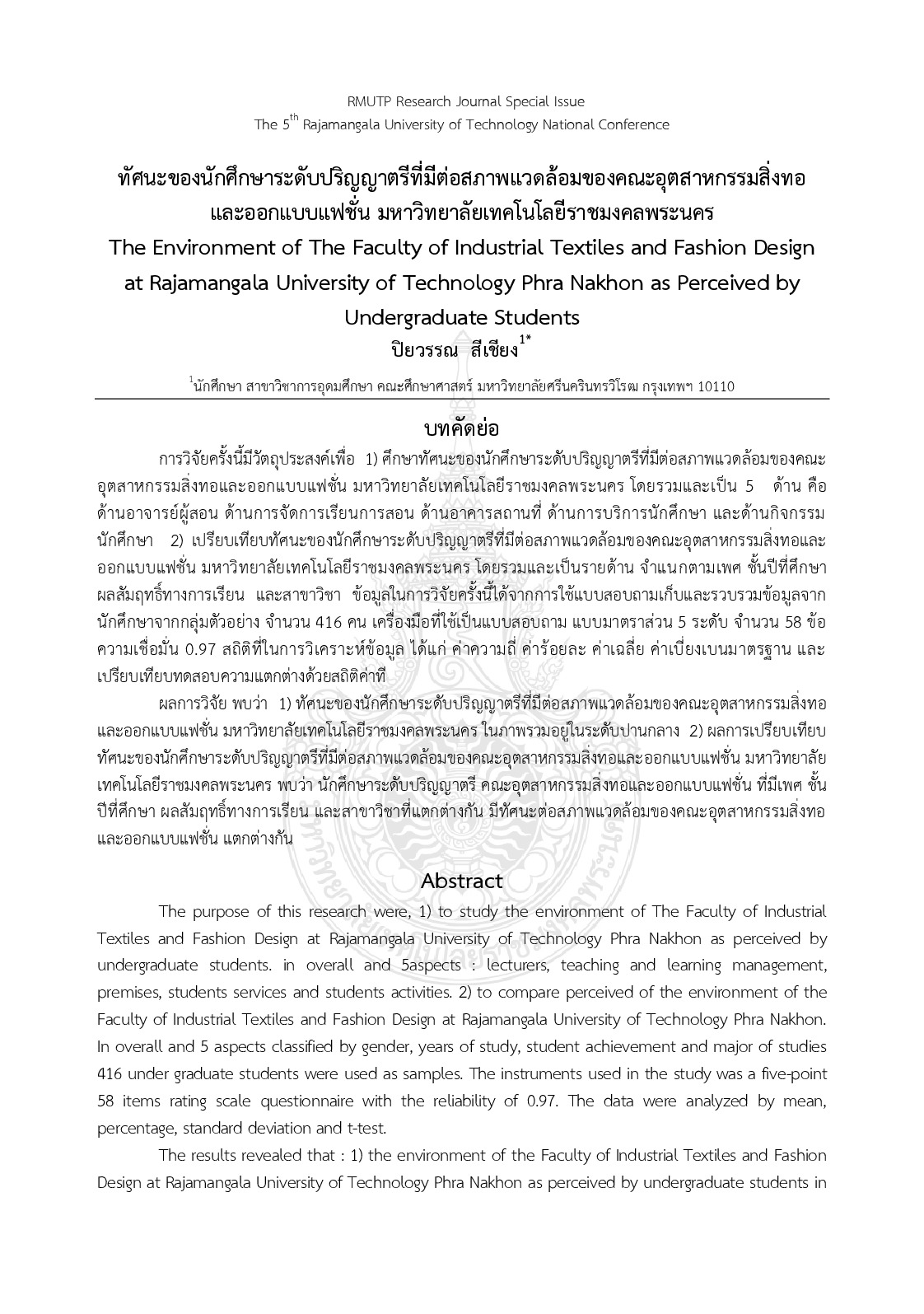
The environment of the faculty of industrial textiles and fashion design at Rajamangala University of Technology Phra Nakhon as Perceived by Undergraduate students
The purpose of this research were 1) to study the environment of The Faculty of Industrial Textiles and Fashion Design at Rajamangala University of Technology Phra Nakhon as perceived by undergraduate students. in overall and 5aspects : lecturers teaching and learning management premises students services and students activities. 2) to compare perceived of the environment of the Faculty of Industrial Textiles and Fashion Design at Rajamangala University of Technology Phra Nakhon. In overall and 5 aspects classified by gender years of study student achievement and major of studies 416 under graduate students were used as samples. The instruments used in the study was a five-point 58 items rating scale questionnaire with the reliability of 0.97. The data were analyzed by mean percentage standard deviation and t-test. The results revealed that : 1) the environment of the Faculty of Industrial Textiles and Fashion Design at Rajamangala University of Technology Phra Nakhon as perceived by undergraduate students in overall and 5 aspects were at moderate level. 2) the environment of The Faculty of Industrial Textiles and Fashion Design at Rajamangala University of Technology Phra Nakhon as perceived by undergraduate students classified by gender years of study student achievement and faculties were significant different.