จำนวน Repository ( 816 )
การพัฒนาต้นแบบเครื่องยนต์ที่ใช้น้ำมันดีเซลและแอลพีจีเป็นเชื้อเพลิงสำหรับการเกษตร
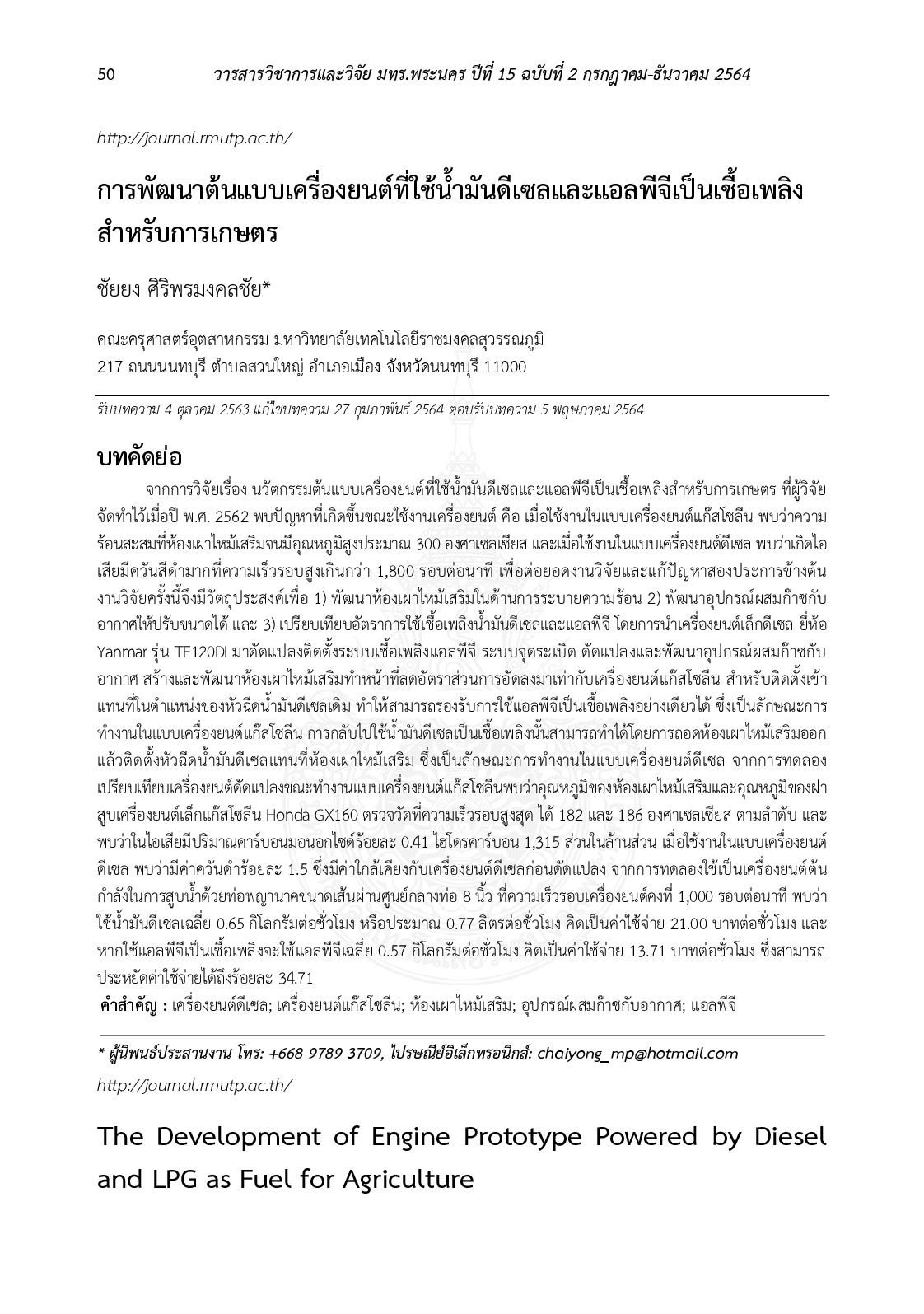
According to the research entitled “the innovative engine prototype powered by diesel and LPG as fuel for agricultural” in 2019 the problems found while using the engine were as follows: the accumulated heat in the auxiliary combustion chamber reached 300 C in case of gasoline engine use and a lot of black smoke in the exhaust was found at the speed higher than 1800 rpm in case of a diesel engine use. In order to extend the research and solve two foresaid problems the objectives of this study were 1) to develop an auxiliary combustion chamber for cooling 2) to develop a scalable gas-air mixing device and 3) to compare diesel and LPG consumption rates by modifying a small diesel engine Yanmar version TF120DI to install LPG fuel systems and ignition system. In addition a gas-air mixing device was modified while an auxiliary combustion chamber was developed to reduce the compression ratio to the same level as the gasoline engine for replacing the position of the original diesel fuel injector. This method could support LPG fueling only whose function was characterized by the function of a gasoline engine. The auxiliary combustion chamber could be removed and then installed a diesel injector to return using diesel fuel. From an experiment to compare the modified engine operating as a gasoline engine it was found that the temperature of the auxiliary combustion chamber and the temperature of the engine cylinder head of Honda GX160 were measured at the maximum speed of 182 C and 186 C respectively. It was found that carbon monoxide content was 0.41 % and 1315 ppm hydrocarbons. When used as a diesel engine it was found that the black smoke was exhausted at 1.5 % which was similar to the diesel engine before the modification. From the experiment of using the power engine for pumping water with an Irrigation propeller pump with the diameter of 8 inch at a constant engine speed of 1000 rpm it was found that the average diesel usage was 0.65 kg/hr or about 0.77 L/hr with the cost of 21.00 Baht/hr and if using LPG as fuel the average LPG consumption was 0.57 kg/hr with the cost of 13.71 Baht/hr which could save up to 34.71 % of costs.
การตรึงอะโซโตแบคเตอร์แบคทีเรียตรึงไนโตรเจนในอากาศด้วยวัสดุธรรมชาติและผลต่อการเจริญเติบโตของผักกวางตุ้งในดิน
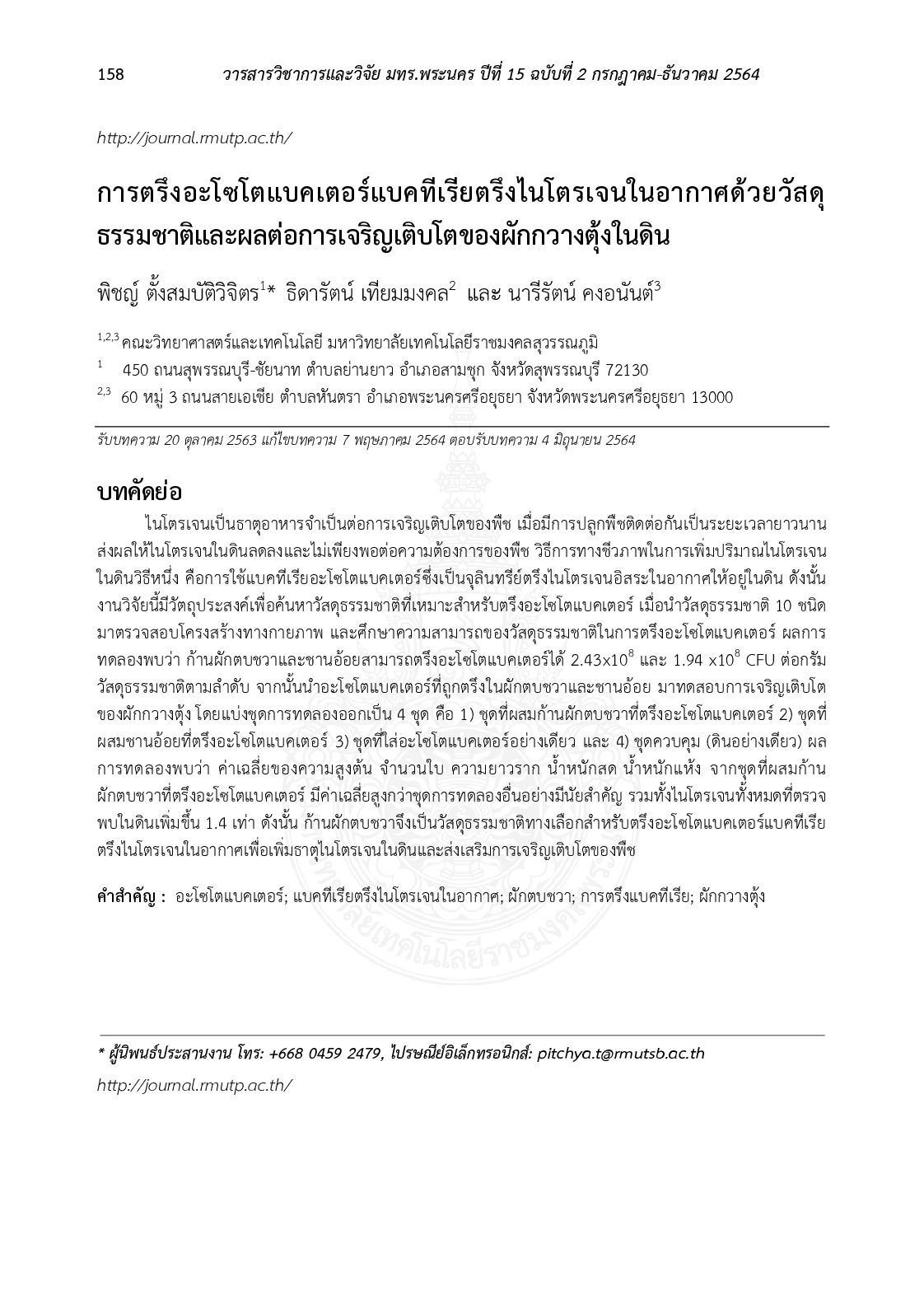
Nitrogen is an essential nutrient for plant growth. When the plants have been grown for a long-term effect to decreased nitrogen in soil and insufficiency of the plant growth. One biological method for increasing the nitrogen content in soil is utilize of free nitrogen-fixing bacteria Azotobacter. Therefore the objective of this research was to search natural material suitable for Azotobacter fixation. The 10 natural materials were observed physical structure and investigated the ability of natural materials for Azotobacter fixation. The results showed that water hyacinth and bagasse stalks were fixed the Azotobacter of 2.43x10⁸ and 1.94 x10⁸ CFU per gram of each natural material respectively. After that the selected fixed Azotobacter of water hyacinth and bagasse stalks were studied the growth of Brassica Chinensis. This experiment was designed to 4 treatments. The first treatment was mixed of water hyacinth stalks and the Azotobacter. Second treatment was mixed of bagasse stalks and the Azotobacter. The third treatment was the Azotobacter only. The last treatment was soil only. The results indicated that the average of plant growth include height leaf number root length fresh weight and dry weight of the mixed of water hyacinth stalks and the Azotobacter had significantly higher growth rates than other treatments. The total nitrogen was also increased 1.4 fold in the soil. All results suggest that the water hyacinth stalk is alternative for the fixation of the free nitrogen-fixing bacteria Azotobacter as induce nitrogen in the soil and plant growth promotion.
การจำลองทางคณิตศาสตร์เปรียบเทียบกับการปฏิบัติการโรงไฟฟ้าพลังงานแสงอาทิตย์ขนาดเล็กแบบกระจายตัวในระบบจำหน่าย
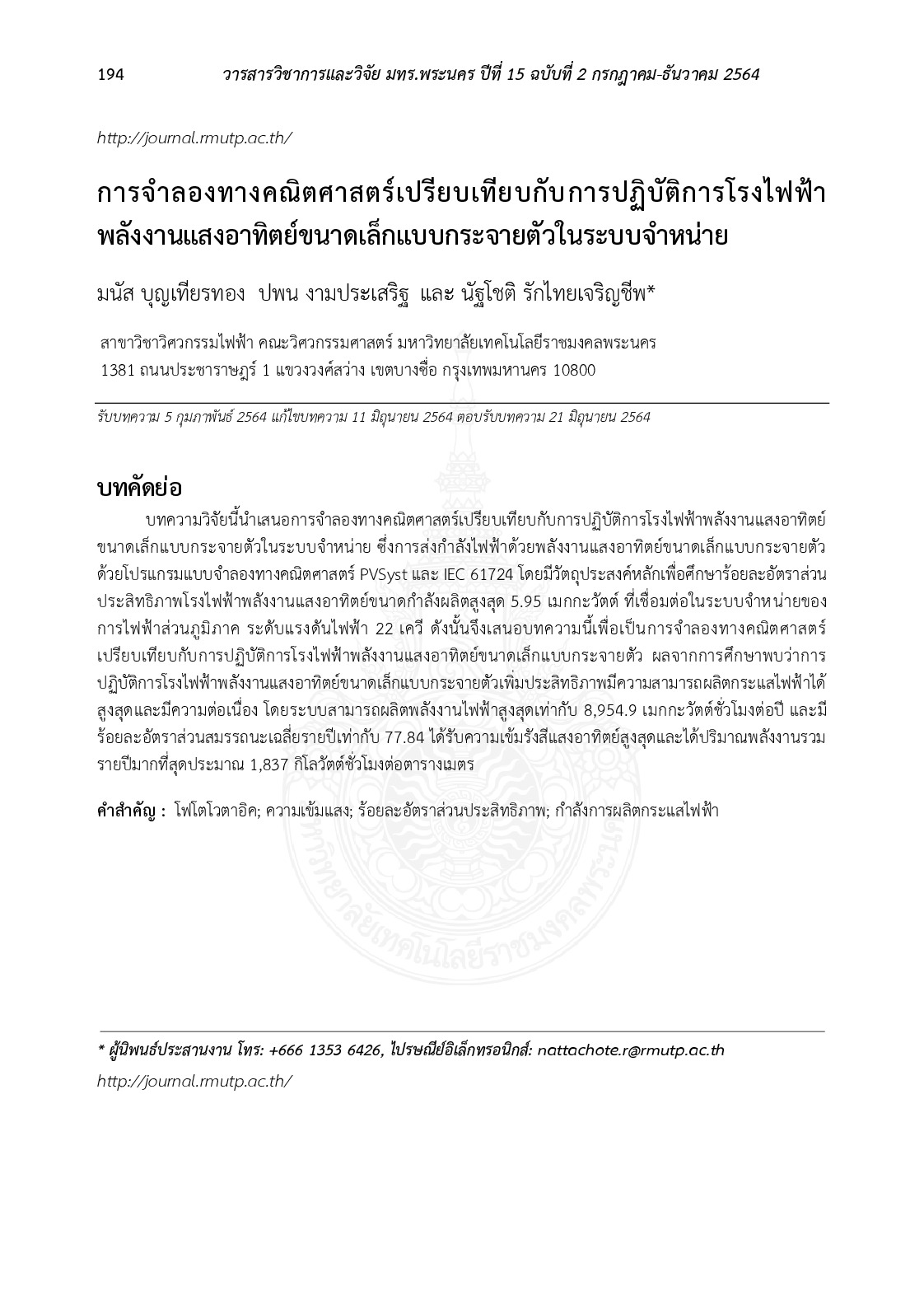
This paper presents a mathematical simulation to compared to operations a small distributed photovoltaic power plant in the distribution system. Practices transmission of electric power by small distributed solar energy With the PVSyst and IEC 61724 mathematical modeling programs the main objective was to study the % performance ratio photovoltaic power plants 5.95 MWp connected in the distribution system of the Provincial Electricity Authority voltage level 22 kV. Therefore this paper is presented as a mathematical simulation compared to operations a small distributed photovoltaic power plant in a distribution system. The results of the study show that the operation of small distributed solar power plants increases the efficiency to be able to produce the maximum electricity and continuously. The system was able to produce the highest power of 8954.9 MWh/year and had an average annual efficiency ratio of 77.84% receiving the highest solar radiation intensity and the highest annual total energy output of approximately 1837 kWh/m2
Real-time travel time prediction algorithm using spatiotemporal speed interval patterns matching
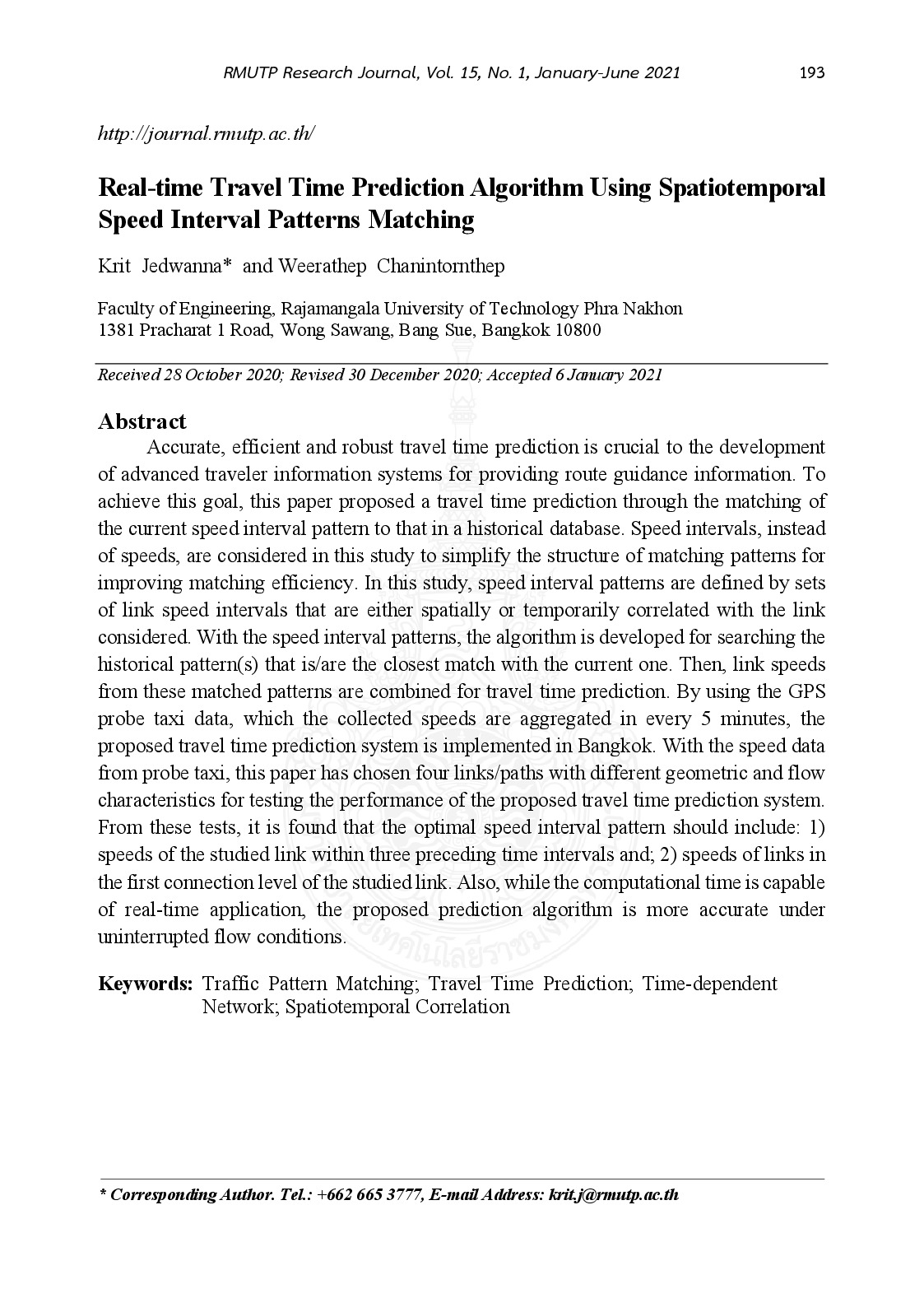
Accurate efficient and robust travel time prediction is crucial to the development of advanced traveler information systems for providing route guidance information. To achieve this goal this paper proposed a travel time prediction through the matching of the current speed interval pattern to that in a historical database. Speed intervals instead of speeds are considered in this study to simplify the structure of matching patterns for improving matching efficiency. In this study speed interval patterns are defined by sets of link speed intervals that are either spatially or temporarily correlated with the link considered. With the speed interval patterns the algorithm is developed for searching the historical pattern(s) that is/are the closest match with the current one. Then link speeds from these matched patterns are combined for travel time prediction. By using the GPS probe taxi data which the collected speeds are aggregated in every 5 minutes the proposed travel time prediction system is implemented in Bangkok. With the speed data from probe taxi this paper has chosen four links/paths with different geometric and flow characteristics for testing the performance of the proposed travel time prediction system. From these tests it is found that the optimal speed interval pattern should include: 1) speeds of the studied link within three preceding time intervals and; 2) speeds of links in the first connection level of the studied link. Also while the computational time is capable of real-time application the proposed prediction algorithm is more accurate under uninterrupted flow conditions.
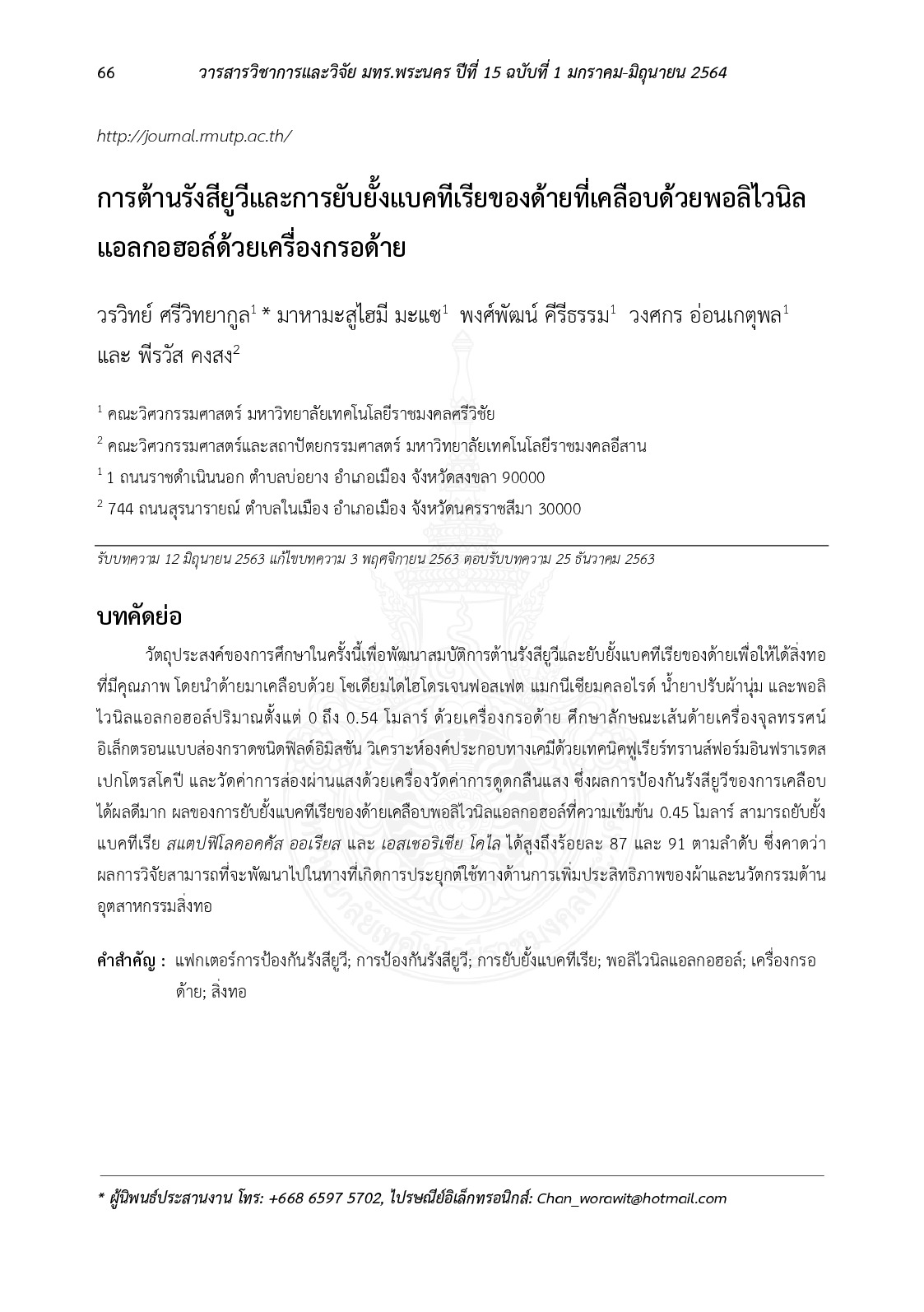
การต้านรังสียูวีและการยับยั้งแบคทีเรียของด้ายที่เคลือบด้วยพอลิไวนิลแอลกอฮอล์ด้วยเครื่องกรอด้าย
The objective of this study is to explore a method to improve UV protection and antibacterial properties of the cotton yarn surface to produce high-quality textile products. Cotton yarns were coated with sodium hydrogen phosphate magnesium chloride softener solution and 0 to 0.54 M of polyvinyl alcohol to hold surface yarns to the yarn body using the winding machine. The coated yarns were analyzed using Field emission scanning electron microscope Fourier transform infrared spectroscopy and UV-Vis spectrophotometer. Optimal results were achieved when coating with 0.45 M PVA exhibited UV protection was excellent protection. The cotton yarn coated 0.45 M polyvinyl alcohol displayed the antibacterial activity in the presence of Staphylococcus aureus and Escherichia coli was 87 and 91% respectively. The expected overall properties may open the way towards new applications of high performance fabrics leading to an innovative product development in the textile industry