จำนวน Repository ( 126 )
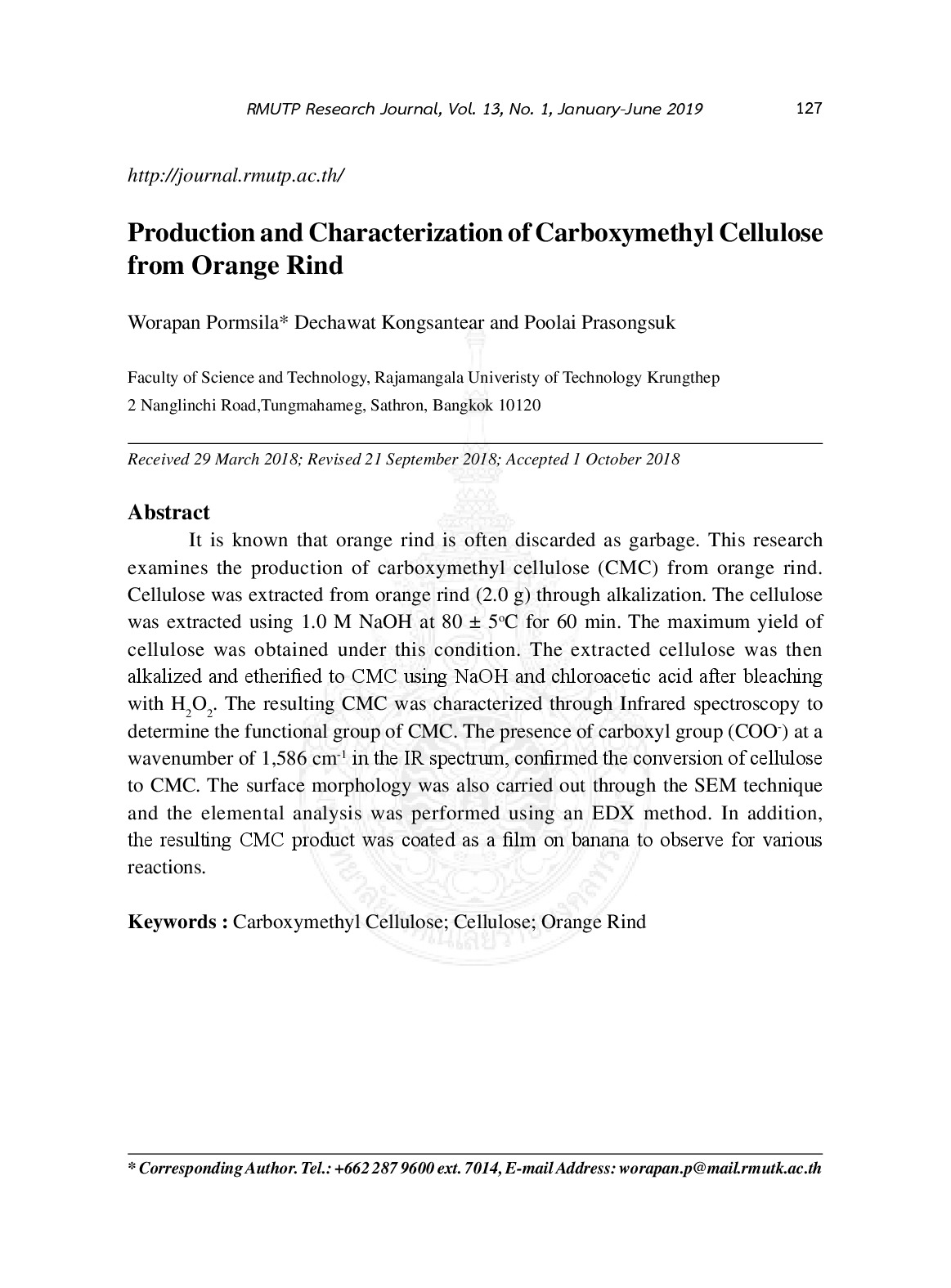
Production and characterization of carboxymethyl cellulose from orange rind
It is known that orange rind is often discarded as garbage. This research examines the production of carboxymethyl cellulose (CMC) from orange rind. Cellulose was extracted from orange rind (2.0 g) through alkalization. The cellulose was extracted using 1.0 M NaOH at 80 ± 5oC for 60 min. The maximum yield of cellulose was obtained under this condition. The extracted cellulose was then alkalized and etherified to CMC using NaOH and chloroacetic acid after bleaching with H2O2. The resulting CMC was characterized through Infrared spectroscopy to determine the functional group of CMC. The presence of carboxyl group (COO-) at a wavenumber of 1586 cm-1 in the IR spectrum confirmed the conversion of cellulose to CMC. The surface morphology was also carried out through the SEM technique and the elemental analysis was performed using an EDX method. In addition the resulting CMC product was coated as a film on banana to observe for various reactions.
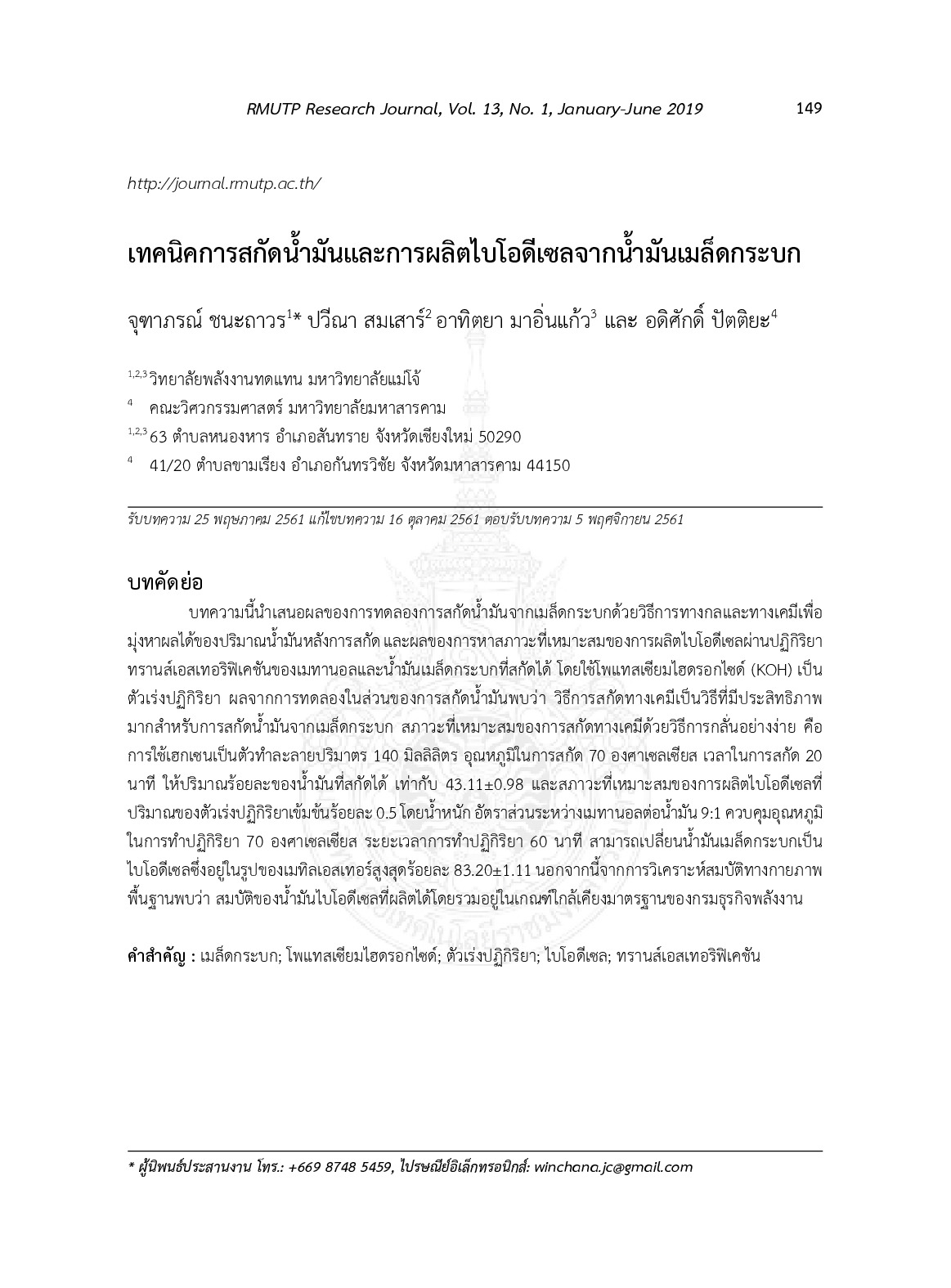
เทคนิคการสกัดน้ำมันและการผลิตไบโอดีเซลจากน้ำมันเมล็ดกระบก
This paper presents the experimental results of the oil extraction process from wild almond seeds by mechanical and chemical methods. The optimum conditions for the biodiesel production from the extracted oil via transesterification reaction using methanol and potassium hydroxide (KOH) are reported. Chemical extraction was found to be an effective technique for wild almond oil extraction. Simple distillation was used as oil extraction unit applying 140 ml of n-hexane as solvent at 70ºC for 20 min. The oil yield was 43.11±0.98%. This extracted oil was used as raw material for biodiesel production with the maximum yield of 83.20±1.11%. The optimum conditions for biodiesel production were the catalyst loading of 0.5 wt% and 9:1 molar ratio of methanol to oil in a controlled reaction temperature of 70ºC for 60 min. Finally the properties of biodiesel were analyzed and most properties met the requirements of the department of energy business standard.
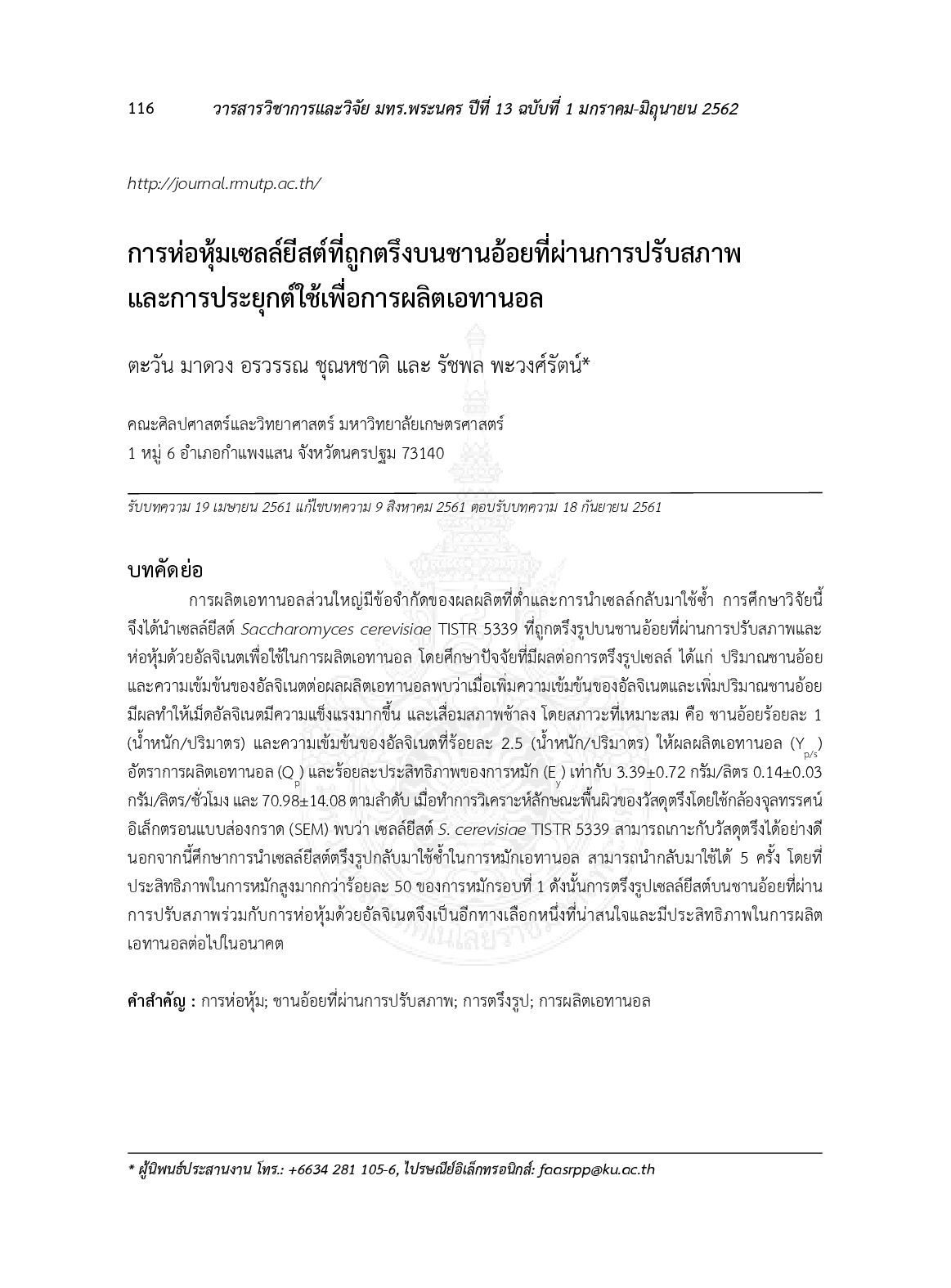
การห่อหุ้มเซลล์ยีสต์ที่ถูกตรึงบนชานอ้อยที่ผ่านการปรับสภาพและการประยุกต์ใช้เพื่อการผลิตเอทานอล
Most of ethanol production processes are limited by low ethanol production rate and recyclable problem of ethanologenic organisms. In the present study Saccharomyces cerevisiae TISTR 5339 entrapped in an aqueous mixture of alginate and pretreated-bagasse was used for ethanol production of immobilization parameter of yeast cells consisting of amount of bagasse and alginate concentration on ethanol production were investigated. The results showed that increase in alginate concentration and the amount of bagasse can increase structural strength and reduce deterioration of bead. The optimal condition of immobilization was 1.0% (w/v) bagasse and 2.5% alginate. Ethanol yield (Yp/s) ethanol production rate (Qp) and efficiency of fermentation (Ey) obtained from the bagasse-alginate immobilized yeast cell was 3.39±0.72 g/l0.14±0.03 g/l/h and 70.98±14.08% respectively. The ultrastructure obtained from SEM illustrated that S. cerevisiae TISTR 5339 was well incorporated within the bagasse-alginate matrix. Moreover the bagasse-alginate immobilized yeast cells were reusable at least 5 times with Ey higher than 50% of 1st round of fermentation. Therefore the pretreated bagasse-alginate immobilized yeast cells is an alternatively interesting techniques with effiiciency for ethanol production in the future.
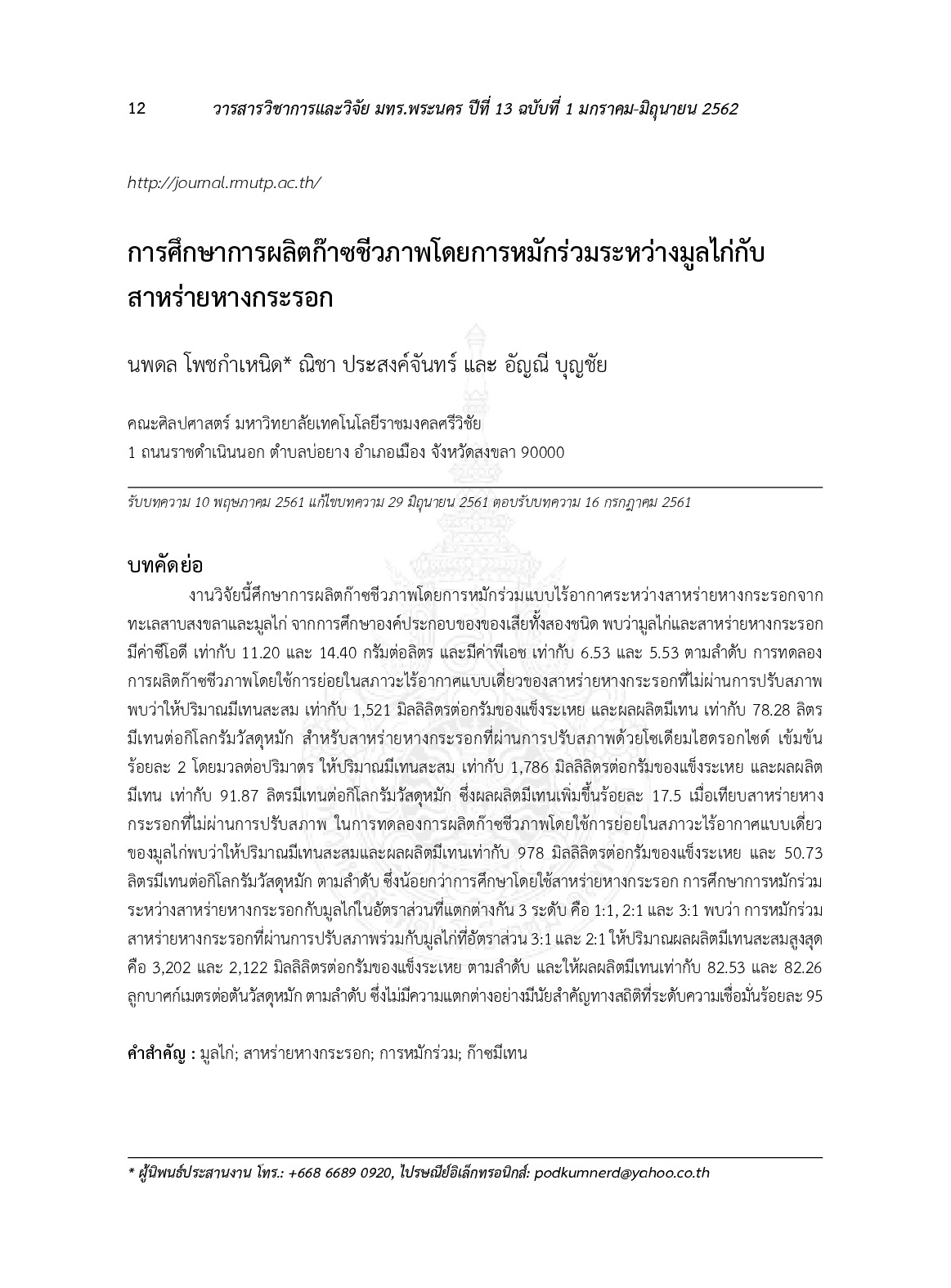
การศึกษาการผลิตก๊าซชีวภาพโดยการหมักร่วมระหว่างมูลไก่กับสาหร่ายหางกระรอก
This work presented the production of biogas using anaerobic co-digestion between hydrilla verticillata (HV) from Songkhla Lake Basin and chicken manure (CM). From the study of compositions of both wastes it was found that the COD of CM and HV were 11200 and 14400 mg/l and pH were 6.5 and 5.5 respectively. The biogas production using anaerobic single-digestion of untreated hydrilla verticillata (UHV) gave accumulative methane of 1251 ml-CH4/g-VS and methane production of 78.28 L-CH4/kg-substrate was obtained. For hydrilla treated with 2% w/v NaOH (THV) the accumulative methane was 1786 ml-CH4/g-VS and the obtained methane production was 91.87 L- CH4/kg-substrate which was 17.5 % increase when compared to the UHV. For the biogas production using anaerobic single-digestion of CM it was found that the accumulative methane and methane production were 978 ml-CH4/g-VS and 78.28 L- CH4/kgsubstrate respectively. These were lower than the studies using HV. The study of anaerobic co-digestion of HV and CM at three different ratios; 1:1 2:1 and 3:1 was studied. It was found that the anaerobic co-digestion using THV and CM at ratio 3:1 and 2:1 gave the highest potential for biogas production. The accumulate methane of 3202.20 and 2079.19 ml- CH4/g-VS were obtained respectively. The methane productions were 2.53 and 82.26 L-CH4/ton-substrate for ratio 3:1 and 2:1 respectively which is no significant different at 95 % confidence interval.
การสร้างเม็ดสีเมาลานินและฤทธิ์ยับยั้งแบคทีเรียโดยเมลานินที่ผลิตโดยแอคติโนมัยซีทีสสายพันธ์ PNSR-10 และสายพันธ์ PRBS-12
The objectives of this research were to characterize growth and melanin production on different culture media effect of copper ion and cobalt ion on growth and melanin production including antibacterial activity of crude melanin. The results revealed that actinomycetes strain PNST-01 have good growth on ISP-7 medium synthetic medium while strain PRBS-12 grow very well on ISP-3 medium complex medium. Both strains produced high amount of melanin showing brownish colony on ISP-7 medium but there is no melanin pigment production on ISP-1 medium and ISP-6 medium. Moreover the growth rate was reduced and both strains could not produce melanin pigment on ISP-7 medium without supplement with copper chloride and cobalt chloride. Crude melanin extract of strain PNST-01 showed antimicrobial activity against Bacillus cereus ATCC 11778 Bacillus subtilis ATCC 6633 and Staphylococcus aureus ATCC 25923 but could not inhibit Escherichia coli Shigella dysenteriae Salmonella typhi Klebsiella pneumoniae Serratia marcescens Pseudomonas aeruginosa and Streptococcus pyogenes . While crude melanin extract of strain PRBS-12 gave antimicrobial activity only on B. cereus ATCC 11778 and B. subtilis ATCC 6633. Based on the study the results can be used as key information for further development of melanin production and application in various industries.