จำนวน Repository ( 484 )

การศึกษาเปรียบเทียบเทคนิควิธีการมัดย้อมเพื่อพัฒนาลวดลายผลิตภัณฑ์ผ้ามัดย้อม
The purposes of this research were 1) the comparison of tie-dye methods; Binding technique folding technique and stitching technique and 2) three kinds of fabric dyed; cotton linen and rayon comparison and 2 pattern design groups; geometrics and naturalistic patterns. There are 8 motifs were used; quadrangle trianglecircle heart form flower leaf butterfly and worm. The research tools were used; The assessment for 15 connoisseurs (connoisseurship model). Data were analyzed by the statistical package for the social science program and using mean percentage standard deviation one-way ANOVA and chi-square.The result of the study were that binding technique had mean 4.20the second was stitching technique had mean 4.10 and the last was folding technique had 3.69. The result of the tie-dye technique suitability comparative ranking for massproduct that the best technique is binding. The second was stitching technique and the last was folding technique. In this study there were comparative in 5 parts as follows 1.tie-dye method 2. pattern design 3. colour of fabric dyed 4. overall image of fabric dyed 5. capability of techniques.Binding technique folding technique and stitching technique on Cotton were much points in tie-dye method and capability of techniques. Binding technique and stitching technique on Cotton were much points in pattern design and overall image of fabric dyed. Binding technique and stitching technique on Linen were much points in 5 parts. Folding technique on Linen were much points especially in tiedye method and capability of techniques. Binding technique and stitching technique on Rayon were much suitable in 5 parts. Folding technique on Rayon were much especial points in 5 parts except overall image of fabric dyed. Comparison of three kinds of fabric and two pattern groups were that cotton linen and rayon fabrics in geometrics and naturalistic patterns had average the best in binding technique. To compare tie-dye techniques and fabrics and pattern groups had different for some parts statistically significant at level of .05
โครงการวิจัยและพัฒนาผลิตภัณฑ์และบรรจุภัณฑ์กล้วยไม้เชิงอนุรักษ์และเรือโบราณจากกระดาษสา
The objective of this research project is to transfer the knowledge and skills of making extirpative orchids from mulberry -pulp paper for decorating home or souvenir to the housewives of Department of Veterinary and the third agricultural division Department of Veterinary Thai Army and the interested people at Amphoe Mae Rim in Changwat Chaing MaL This project processes these activities as follow: 1. Studying basic data of designing and making orchids for many kinds of ornaments 2. Surveying the need to train from target population 3. Making the training course 4. Making prototypes for the training course 5. Preparing media and documents for this course 6. To train the target group and 7. To evaluate the training course and methodology. The sampled population of this process transferring the knowledge and skills of making extirpative orchids from mulberry -pulp paper includes the housewives of Department of Veterinary and the third agricultural division Department of Veterinary Thai Army and the interested people at Amphoe Mae Rim in Changwat Chaing Mai (88 adult persons sampling by completely random sampling method). Research instruments are the training course the questionnaire for evaluating the training course and the training procedures. Descriptive analyses (percentage and mean) are conducted to this work.The results of this work show that all of trainees are women (100%) age between 40 49 years (31.82%) and most of trainees were housewives (73.87%). Evaluation of the training course and methodology finds that objectives structures contents and activities of this course are more suitable level. The opinions about materials and documents using for this course and the training room are more and the most suitable level. The training procedures are the most suitable level. The assessment of expert (preparing to lecture the knowledge about contents of the course the skillful making of products. and ability to transfer the knowledge to answer the questions and to give advice) are the most suitable level. The comment from trainees is they continuously want to train courses that could actually bring back the knowledge and skills to do the occupation.
การพัฒนาผลิตภัณฑ์อาหารจากกล้วยเพื่อธุรกิจอาหารเจ
This research aims to 1) develop pork roll product from cultivated banana flesh and banana flour for vegetarian food business; 2) develop suitable and unique packaging for food product using cultivated banana flesh and banana flour instead of meat; and 3) transfer technology in developing food product using cultivated banana flesh and banana flour instead of meat for vegetarian food business. Regarding suitable amount of banana flour used in place of isolated soy protein in pre-emulsion preparation from 4 levels of banana flour used at 0 10 15 and 20 percent it was found that increasing amount of banana flour used in place of isolated soy protein caused significant increase of L* value in the product (p<0.05). Moreover hardness and flexibility in texture profile of the product were not significantly different from the control product (p>0.05). In terms of sensory evaluation tasters gave the highest score for meat-emulated reducedemulsion product that used banana flour in place of isolated soy protein at 15 percent. For packaging of pork roll product it was found that Model-A package was the most suitable with recommendations to add tight-closed material to prevent contamination from outside and to print expiry date as well as food safety certified sign. Furthermore consumers’ overall satisfactory in packaging model was found to be highest at the mean of 4.31. Finally transferring of technology in a form of training workshop in developing food product from banana flour for vegetarian food business for Ban Lak Khon Bakery Housewife Community Enterprise and entrepreneurs in Nonthaburi province showed that post-training test scores were significantly higher than pre-training scores at .05 level. This indicated that technological transfer in a form of real-practice workshop provided increasing knowledge in developing food product from banana flour for vegetarian food business. Moreover it was also found that trainees were highly satisfied in both overall service (mean of 4.85) and by-aspect: servicing staff (4.93) procedure/steps (4.87) trainers (4.83) and usefulness of service (4.75) respectively.
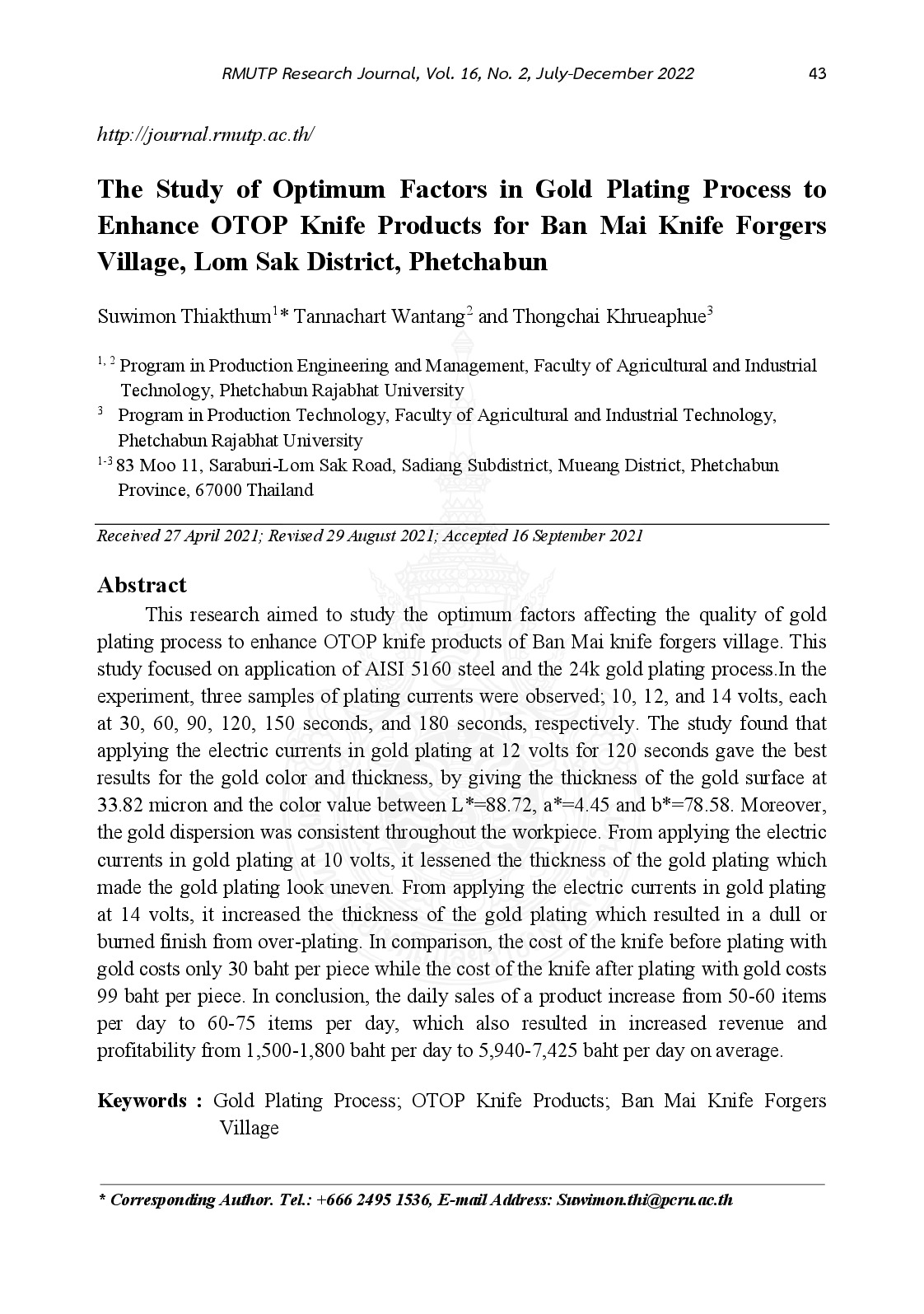
The study of optimum factors in gold plating process to enhance OTOP knife products for ban mai knife forgers village, Lom Sak district, Phetchabun
This research aimed to study the optimum factors affecting the quality of gold plating process to enhance OTOP knife products of Ban Mai knife forgers village. This study focused on application of AISI 5160 steel and the 24k gold plating process.In the experiment three samples of plating currents were observed; 10 12 and 14 volts each at 30 60 90 120 150 seconds and 180 seconds respectively. The study found that applying the electric currents in gold plating at 12 volts for 120 seconds gave the best results for the gold color and thickness by giving the thickness of the gold surface at 33.82 micron and the color value between L*=88.72 a*=4.45 and b*=78.58. Moreover the gold dispersion was consistent throughout the workpiece. From applying the electric currents in gold plating at 10 volts it lessened the thickness of the gold plating which made the gold plating look uneven. From applying the electric currents in gold plating at 14 volts it increased the thickness of the gold plating which resulted in a dull or burned finish from over-plating. In comparison the cost of the knife before plating with gold costs only 30 baht per piece while the cost of the knife after plating with gold costs 99 baht per piece. In conclusion the daily sales of a product increase from 50-60 items per day to 60-75 items per day which also resulted in increased revenue and profitability from 1500-1800 baht per day to 5940-7425 baht per day on average.