จำนวน Repository ( 1139 )
Community-based tourism management case study “palm paddy sea” community cultural way. sa-ting phra district, songkhla province
The purpose of this research was to study community-based tourism management case study “Palm Paddy Sea” cultural way community Sa-Ting Phra district Songkhla province. The study was conducted by data collection interview people who involved in tourism management and tourists who traveled to the communities using questionnaire with 5 rating scales estimation. The data was analyzed according to the content and presented by descriptive analysis and tables. The study found that “Palm Paddy Sea” cultural way community has the potential to support eco-tourism. The tourism development of both natural and cultural resources within the communities encourage for being learning sources about community way and folk wisdom The community has participated in the development and wants to join in tourism management meetings with the Sub-district Administrative Organization. In addition the community requires that a community representative must have a chance to present ideas in a meeting in order to be developed in the same way. The guidelines for tourism development need to have cooperation from involved organizations in order to develop tourist attractions tourism facilities and promotions.
Management of waste from the laboratory faculty of pharmacy mahidol university
The purpose of this research was to develope the laboratory waste management and provide this knowledge to the students and the research assistants of Faculty of Pharmacy Mahidol University by using the methodology of participatory action research (PAR). This project was performed by training course and releasing the method of waste management by different medias. After the training the 80 participants have been assessed the knowledge using the Scoring Rubrics as a criterion for the evaluation. The result showed that the participants understood about the wastes storage systems the wastes categories the wastes labelling types the wastes containers drop points of wastes the useful of waste storaging the officers who responsible for the storage of waste in the laboratory in the percentage of 97 94 87 97 97 100 and 98 respectively which all passed the specified criteria. The summary of comments and suggestions were that the containers to collect the waste were not enough due to there were many varieties of solvents. This research enables the users to know how to dispose the wastes by differentiating the chemicals types and perform accurately which leading to the reduction of the amount of hazardous waste reduction the unknown waste the waste management from the laboratory become more systematic which will reduce the budgets and decreasing the risk to the health.
Dispersion of copper oxide in water by pH value and ultrasonic method
The objective of this research is to study the dispersion of copper oxide particles in water using as a coolant in heat exchangers. Copper oxide particles were prepared by precipitate method. The parameters affected to dispersion of copper oxide were pH of solution and ultrasonic time. The results showed that an average crystalline size of copper oxide was in nano scale (< 22 nm). At pH value of 13 copper oxide was well dispersion in the water. Appropriate ultrasonic time of dispersion is dependent on particle sizes of copper oxide. The small particle sizes of copper oxide led to decreasing of ultrasonic time. On the other hand an increasing in particles sizes required longer ultrasonic time. Stability of suspension of CuO in the water decreased with an increasing of time. Moreover it was found that CuO particles were well dispersed in the water at pH value of 13 and ultrasonic time of 15 minutes
Effect of different colchicine concentrations on the morphology of physic nut (jatropha curcas l.)
Physic Nut (Jatropha curcas L.) was a narrow genetic based plant resulting in low productivity. Colchicine application was a mutation technique that could induce genetic variability for plant improvement. In this study the 24 hour soaked physic nut seeds and the 3 – day physic nut seedlings were treated with 0 0.05 0.15 and 0.20% of colchicine for 48 hours and there were soaked for 24 hours to induce polyploidy. The results showed that the survival rates were 67.15 and 93.93 % at the 0.05% of colchicine. DNA content in the survived seedlings was detected by flow cytometry. The number of tetraploid and mixoploid were increased in the 3-day seedlings treated with 0.05% of colchicine. The morphology characteristics at the first flowering stage were follows; the diploid had average height branch numbers spikelets per head ratio of male and female flowes leaf size (W x L) and stomata size (W x H) were 249.50 cm. 15.7 214.7 24.8 :1 14.8 x 13.2 cms and 7.88 x 50.25 micrometers respectively while the mutant had the average of 180.6 - 21.54 cm. 9.8 - 13.0 37.9 - 17.53 19.3 : 1 42.8 : 1 17.0 - 14.4 cms and 61.0 - 70.5 x 103.33 - 116.1 micrometers respectively. so The mutant had better characteristics but their fruits could not mature.
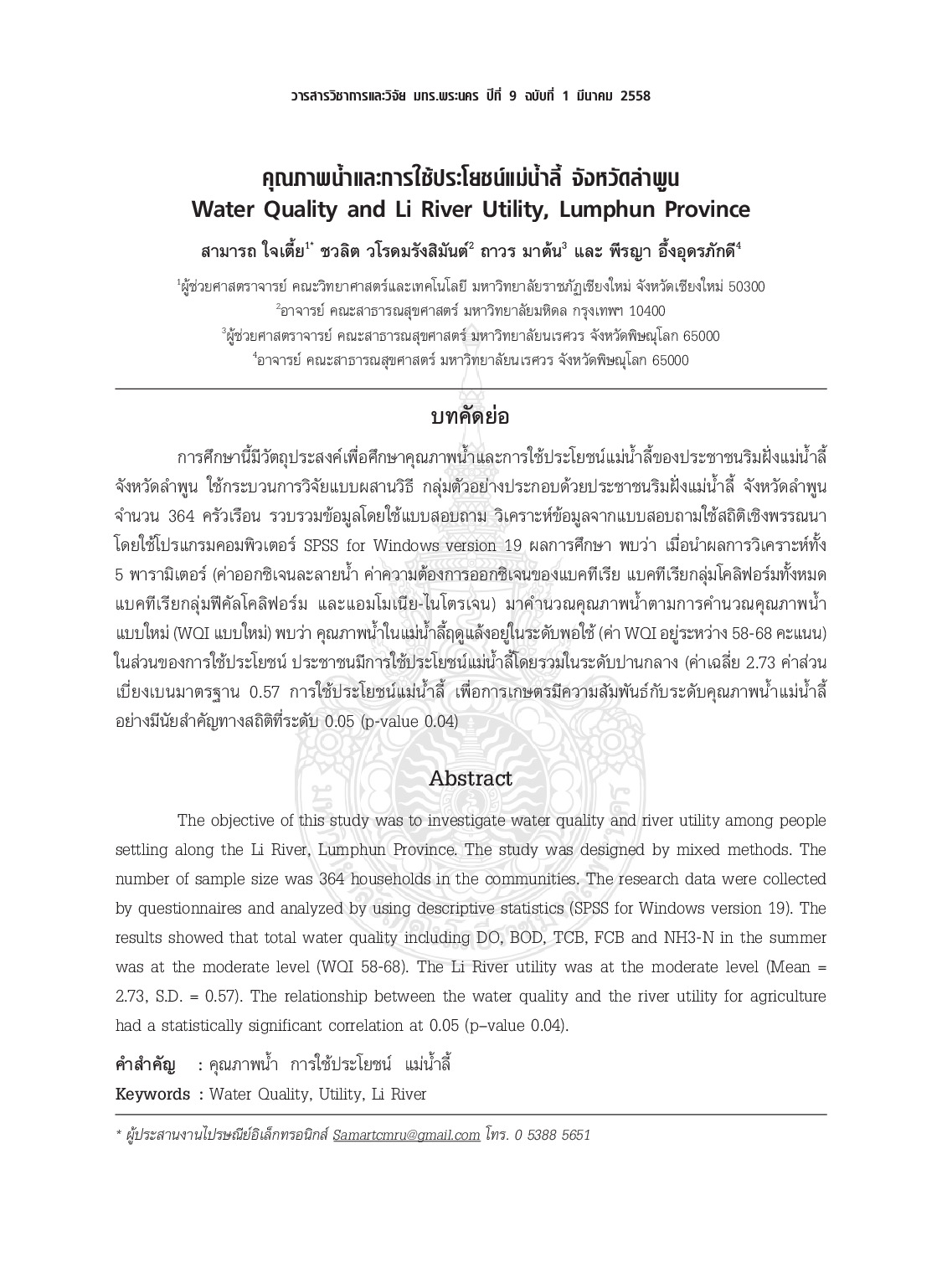
Water quality and li river utility, lumphun province
The objective of this study was to investigate water quality and river utility among people settling along the Li River Lumphun Province. The study was designed by mixed methods. The number of sample size was 364 households in the communities. The research data were collected by questionnaires and analyzed by using descriptive statistics (SPSS for Windows version 19 ).The results showed that total water quality including DO BOD TCB FCB and NH3-N in the summer was at the moderate level (WQI 58 - 68). The Li River utility was at the moderate level (Mean = 2.73 S.D. = 0.57). The relationship between the water quality and the river utility for agriculture had a statistically significant correlation at 0.05 (p –value 0.04).