จำนวน Repository ( 592 )
การยืดอายุการเก็บรักษาขนมจีนในภาชนะบรรจุร่วมกับสภาพบรรยากาศดัดแปลงเพื่อเพิ่มขีดความสามารถการแข่งขันสู่เชิงพาณิชย์เพื่อวิสากิจชุมชน ในจังหวัดภาคกลางตอนล่าง
The Research Shelf Life Extension of Kanom Jeen by Using Modified Atmosphere Packaging for Increasing the Competitiveness for Commercial: Case Study of Thap Luang Company. Study the use of modified conditions for extending the life of fermented rice noodle By using filling techniques under atmospheric conditions Divided into 7 levels which are normal conditions vacuum (vacuum) nitrogen gas (N2) 100 percent carbon dioxide (CO2) 100 percent nitrogen gas per carbon dioxide (N2: CO2) all 3 levels which are 60 percent. : 40 70:30 and 80:20 then to study the storage life of each condition from 0-15 and compare the physical properties Chemical and microorganisms such as pH value color measurement and total number of microorganisms found that Khanom Jeen noodles stored in modified atmosphere conditions have longer shelf life than those stored. At normal atmospheric conditions and vacuum conditions. Chemical analysis results show that ready-to-consume fermented rice noodle flour in all atmospheric modification conditions decreases pH over time. With values between 4.31 ± 0.00 to 2.99 ± 0.01 and fermented rice noodle flour stored at atmosphere modified with 100% carbon dioxide (CO2) gas packed in a sealed nylon / PET vacuum plastic bag. Store at room temperature. Can be stored for up to 12 days and found that the total number of microbes increased when the shelf life is longer but not exceeding the standard of community products (PhorChor. 500/2547 Knmhin) so the products are safe and not harmful to consumers. Consumer test results show that consumers like and are interested in buying Khanom Jeen products that use 100 percent carbon dioxide (CO2) at 75 percent.
การพัฒนาคุณภาพเส้นใยไหมด้วยนาโนเทคโนโลยี เพื่อกลุ่มธุรกิจเกษตรกรเลี้ยงหนอนไหมจังหวัดสุรินทร์
This research is to study the quality development of silk fibers by nanotechnology for the Silkworm farmer business groups of Surin Province. The research purposes are to study the efficiency and process of silkworm rearing using nanotechnology. To test the quality of silk fibers obtained from raising silkworms using nanotechnology. To compare of silkworm rearing results using nanotechnology and to transfer technology to improve silk quality with nanotechnology for silkworm farming business group in Surin Province. The results are as follows 1. The researchers designed the recording schedule which the party can record the changes easily of silk worm development during each day. This research allows the researchers to collect data from the farmer is more easily and finely into 4 groups of experiments with 3 nanotechnology formulas: 1. ZINC OXIDE 2. SILVER NANO and 3. ZINC OXIDE and SILVER NANO with 50:50 percentages each. The silk used in the experiment was “Nang Noi” which is popularly silkworm variety in every household in Surin province.When experimenting must clean the house and rinsing the container with DI WATER for aperiod of 7 months 2. This research is divided into 4 groups. Group 1: Silkworm feed normal methods without the use of nanotechnology. Group 2 silkworms feed with Nano substances such as ZINC OXIDE SILVER NANO ZINC OXIDE and SILVER NANO in 15 percentage concentration. Group 3 silkworms feed with Nano substances are ZINC OXIDE SILVER NANO ZINC OXIDE and SILVER NANO with 30 percentage concentration. Group 4 silkworms feed with Nano substances are ZINC OXIDE SILVER NANO ZINC OXIDE and SILVER NANO with 45 percentage concentration 3. The Results and comparison of silkworm rearing using nanotechnology the best formula feed is formula 1. When feeding Nano-sprayed on mulberry leaves using 3% 15% zinc silver and silver zinc it is found that the growth of worms in each age was good growth and not being a disease. Moreover Silkworms are slightly better and more alert than normal farming. The length in ages 3 - 4 - 5 is going in a better direction. Amount of eating mulberry leaves in each age. As usually eating more in ages 2 and 3 after passing the silk production process and testing the quality of silk fibers in the laboratory were found that the silk fibers are smooth not lacking toughness: Tenacity at 3.06 4.60 and 4.60 respectively and also result in fiber amount increase and also the color of the silk fibers is golden quite clear beautiful and consistent color. 4. When technology transfer to the Silkworm farmer business groups of Surin Province as workshop for 3 days. Most participants are satisfied with the highest levels in all questions.
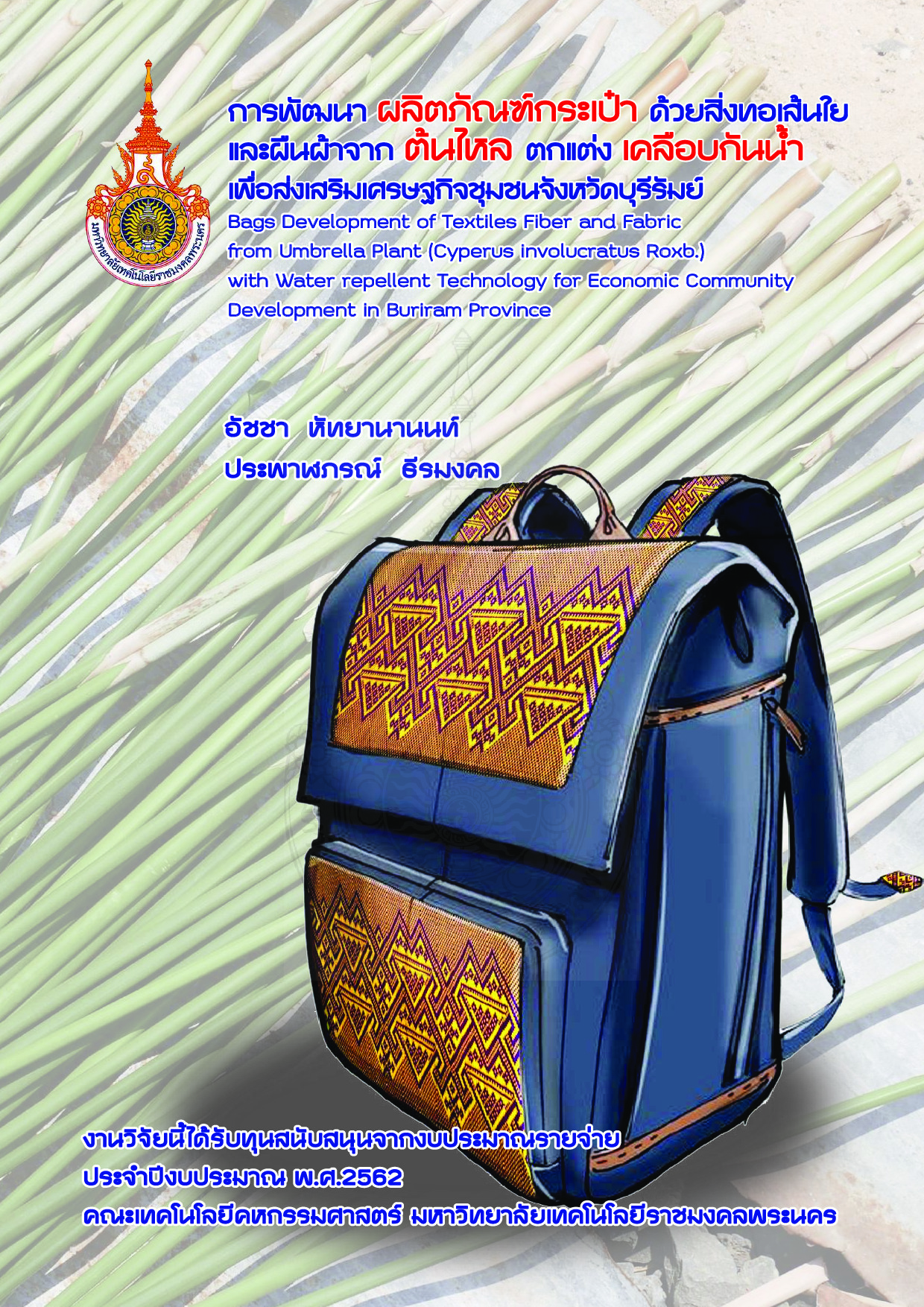
การพัฒนาผลิตภัณฑ์กระเป๋าด้วยสิ่งทอเส้นใยและผืนผ้า จากต้นไหลตกแต่งเคลือบกันน้ำ เพื่อส่งเสริมเศรษฐกิจชุมชนจังหวัดบุรีรัมย์
The proposes of this research were to study the development of bag products with textiles fibers and fabrics from decorative flowing water-resistant coating to promote community economy in Buri Ram Province. With the objective To study the process of producing yarn from fibers from the flow source To design and develop textile and bag products from yarn from the Lai Ton To study the effect of coating with waterproofing on bag products using textiles fibers and fabric from the flow. And to transfer knowledge and technology for utilization to community groups and interested people in next fiscal year This research can be summarized as follows: 1. The study of Ton Lai found that most villagers grow Lai Ton and make products as a supplementary career. In using this flow source in this research the researcher used a large flow source with a diameter of about 1 hour and can be separated into 4 small strands for research and production. The dyes used are synthetic because they will get fresh colors save time and be consistent. 2. The researcher designed 2 designs of weaving designs with the idea of using the original pattern to add edit and then create the pattern that the community groups like and can actually produce it as a product. After getting the fabric pattern then design into 10 bags of women and men bags using leather as an ingredient Decorate the bag to look interesting increase the price and increase the target audience. Which will be different from the original. That uses colored fabric and striped fabric as decorative items. 3. Coating with waterproofing on the bag products with textiles fibers and fabrics from the flow found that the fabric that has been coated with water repellent. When pouring water on the water surface there is a clumping together. No water penetration through fibers. When wiping clean the fibers are still dry not wet. Which is different from fabric that has not been coated namely water is able to penetrate immediately and create moisture on the fabric surface. If stored for a long time it can cause mold. 4. Schedule of technology transfer with the plan to transfer the research in the budget year 2020. For 3 day knowledge transfer and workshop was 30 participants. The group consisted of weaving mats from Ban Bu community Chorakhe Mak Subdistrict Prakhon Chai District. Buriram province
การพัฒนาผลิตภัณฑ์กระดาษและบรรจุภัณฑ์จากแกลบ และส่วนเหลือทิ้งในการแปรรูปข้าว เพื่ออนุรักษ์ศิลปไทย
This research is a study on the Development of Paper and Packaging from Rice Husk and Rice Processing Wastes for producing for Thai Art Conservation. This research purpose to develop products and packaging from the rice husk in rice processing to study the processes of paper production and forming products to design and develop products and packaging and to transfer technology products and packaging from the leftovers in rice processing to conserve Thai arts to the community and to study the satisfaction of the product and packaging development program from the leftovers in rice processing in order to conserve Thai arts to the community. The research findings can be summarized as follows: 1. In this research the research team produced paper and molded products experimenting with the ratio of RICE HUSK and paper SA fibers and find the best ratio of rice husk 50: paper SA fibers 50 so that rice husk can better adhere to paper and creates a beautiful texture for making products. Moreover this research uses the waste from the rice processing process it able to develop products according to objectives. At the same time can be produced at the household level. As well as finding marketing methods for new products to be able to sell which generates income for the community. 2. The results of the physical characteristics of paper produced from rice husk paper with the ratio of rice husk 50 to 50 has a moderate weight. The paper can be folded. The tensile strength of the paper is moderate. The surface is good. The characteristics of the paper after coated with waterproofing it was coated with natural extracts and environmentally friendly. When testing the water color paint on paper the water color slowly absorbed but does not spread along the paper fibers and also slightly absorbed in the backside paper. 3. In this research the development of products and packaging from the leftovers in rice processing for preserving Thai art into 2 categories 1. Develop paper from rice husk for processing into products and developing molded products from rice husk consisting of 3 sets of ornaments consisting of necklaces bracelets earrings 4 sets of home decor consisting of pans wall paintings and 3 sets of household items consisting of 4 multipurpose boxes fruit trays altar table 4. The knowledge transfer by organizing a workshop for theoretical and practical work the duration of knowledge transfer was 2 days 50 participants between 11 - 12 august 2019 at Bang Tachong Community Enterprise Village No.8 Tha Ngam Subdistrict and District in Buri Sing Buri province. Most participants are satisfied with the highest levels in all questions.
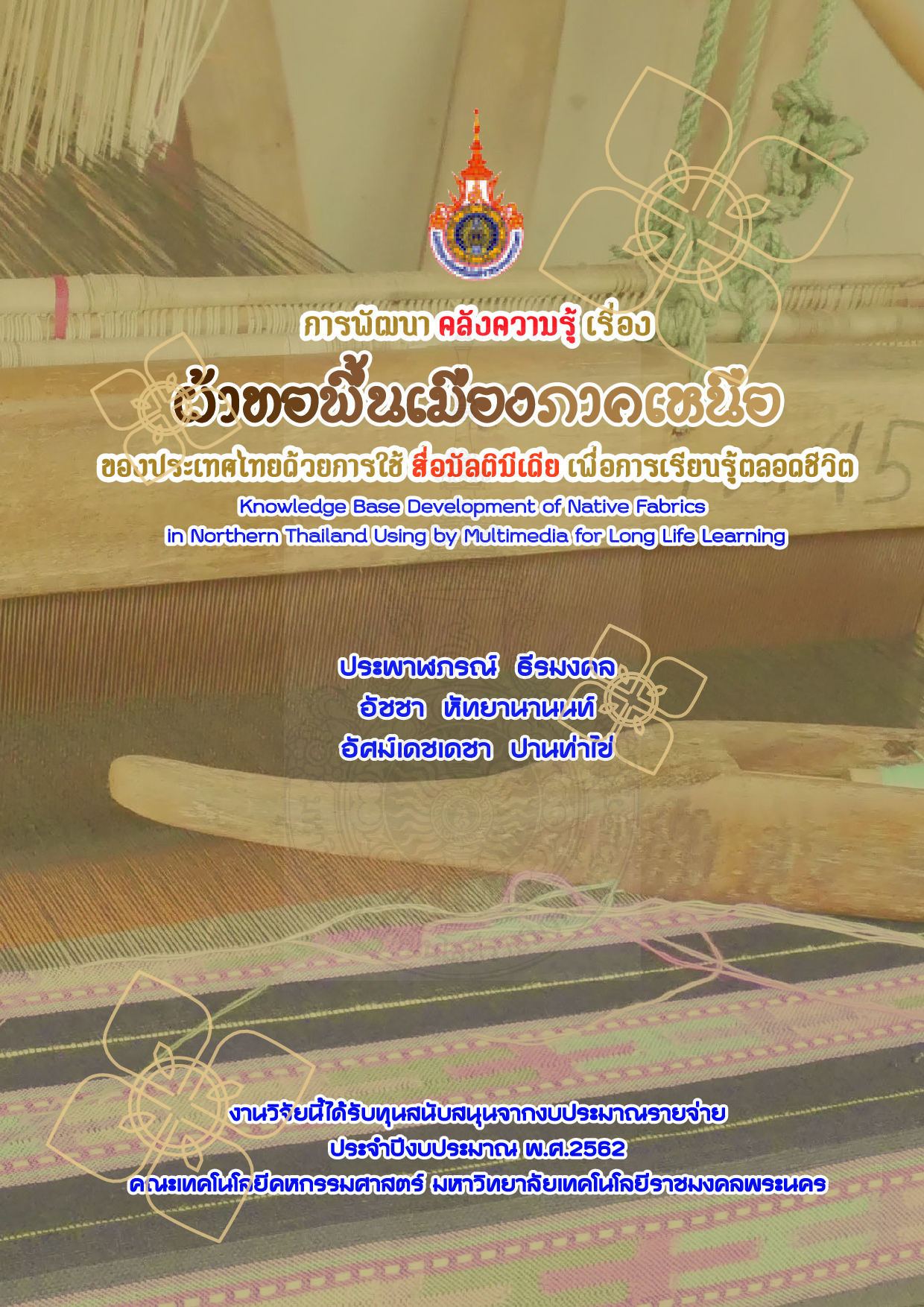
การพัฒนาคลังความรู้เรื่องผ้าทอพื้นเมืองภาคเหนือของ ประเทศไทยด้วย การใช้สื่อมัลติมีเดียเพื่อการเรียนรู้ตลอดชีวิต
This research is the development of the knowledge base on local textiles of northern Thailand by using multimedia for lifelong learning. The aim is to study compile and gather information of local cloths in northern Thailand. Develop a knowledge base by using multimedia on the local textiles of northern Thailand for lifelong learning and transferring knowledge and disseminating the knowledge base on northern Thai fabric by using multimedia for lifelong learning to the community. The research team proceeded to gather primary knowledge from the roots of the researchers who are interested in the local woven fabric. Therefore proceeding further knowledge in the upper reaches from literature reviews Including from field trips for data collection through in-depth interviews with important people Interviewing people who have knowledge about social context community local weaving characteristics weaving characteristics name of pattern type of fabric weaving technique of local textiles in northern Thailand in 9 provinces as well as studying primary data from textbooks textbooks and technical documents and in the internet. Thus the research shown that into 3 parts which are 1. Ethnic groups of Northern Thailand 2. Local woven fabric in northern Thailand and 3. Woven process and pattern. After that the knowledge library was developed by using multimedia on the local textiles of Northern Thailand for lifelong learning. This research can summarize the results in the form of a written description showing that the northern region of Thailand in the past was the Lanna Kingdom area. In the area of Xishuangbanna Before moving to the north of Thailand including the Tai Lue Tai Kheen Thai people Tai Yai people Meng (Mon) Lua people villages scattered throughout the highlands of the Lanna region such as Karen (Pak Kahen M) Mien (Yao) Hmong (Meo) Akha (Akha) Lahu (Mso) Lisu. In addition there are some groups in the Lanna fringe such as Khmu Labri (Tong Lueang). Each ethnic group has its own unique style especially Common skirt Has the same basis with the resin head the resin body and the resin tip but each part is not woven differently Have different colors Some ethnicities have a section called Lep which is the part that the weaver often weaves to keep the thread as for knowledge transfer. The research created a book Local woven cloth consists of videos from local knowledge sources and digital documents and to make the transfer of knowledge more complete Therefore held a forum and exhibition on the topic primary fabric of Lanna Kingdom as a medium for those interested in Local woven fabrics in the Lanna Kingdom of Thailand attended. Exchange ideas from various sources of knowledge from the research. While also receiving multimedia for lifelong learning from the inquiry regarding the satisfaction of the participants. The Keynote speakers are interesting and event condition caused the interest in the knowledge content that used to organize the exhibition. Overall the work is most satisfied.