จำนวน Repository ( 644 )
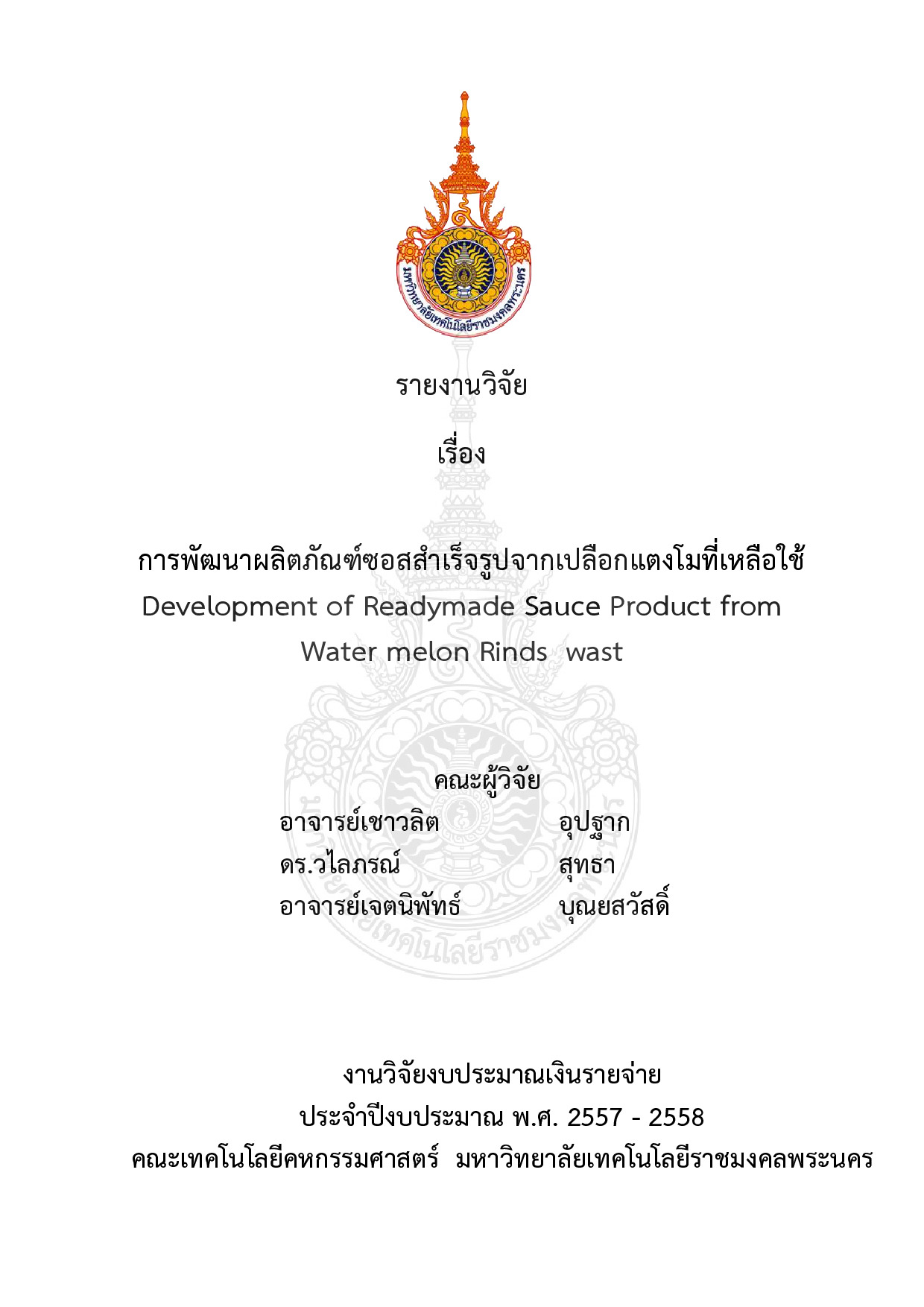
การพัฒนาผลิตภัณฑ์ซอสสำเร็จรูปจากเปลือกแตงโมที่เหลือใช้
This research had objectives to study the proper amount of adding of unused water melon peel in products of tomato sauce chili sauce pizza sauce and seafood sauce. This research studied the nutritional value of sauce products and studied the acceptance of consumers towards sauce products. The test found about the study about proper amount of unused water melon peel in four kinds of sauce products. The researcher tested about acceptance of forty examinees who are instructors in field of Food and Nutrition majoring Food and Nutritional science and majoring Food Service Industry by using 9-point hedonic scale by adding water melon peel into tomato sauce at levels of 5 10 and 15 per cent of all ingredients It is found that the examinees accepted chili sauce at level of 15 per cent that is in the much favor level (8). The chili sauce has been added with water melon peel at levels of 3 6 and 9 per cent of total ingredients. It was found that the examinees accepted it at level of 9 per cent that was from the level of moderate favor to much favor (7-8). The examinees accepted pizza sauce which has been added with water melon peel at level of 10 20 and 30 per cent of all ingredients. It was found that examinees accepted at level of 30 per cent which was in the level of much favor (8). The examinees accepted seafood sauce which has been added with water melon peel at level of 10 20 and 30 per cent of all ingredients. It was found that examinees accepted at level of 20 per cent which was in the level from moderate to very much favor (7-8). When the researcher studied the physical features of sauce product it was found that pH value at which was 25 degrees Celsius was in range of 3.90 3.49 3.83 and 2.73. The viscosity value was 4650cp 32639cp 37760cp and 612cp or centipoints respectively. Nutritional value of sauce product it was found that tomato sauce which has been added with water melon peel for 15 per cent has total calory for 70 per cent protein for less than 1.25 per cent fat for 0 per cent ash for 1.43 per cent carbohydrate for 17.5 per cent and moisture amount of 81.1 per cent. Chili sauce which is added with water melon peel for 9 per cent has total energy for 71.2 per cent; protein is less than 1.25 per cent fat is 0 per cent ash is 3.85 per cent; carbohydrate is 17.8 per cent and it has moisture amount of 78.4 per cent. Pizza sauce which is addedwith water melon peel for 30 per cent has total energy for 145 per cent; protein is less than 1.25 per cent fat is 3.49 per cent ash is 3.18 per cent; carbohydrate is 28.5 per cent and it has moisture amount of 64.8 per cent. Seafood sauce which is added with water melon peel for 20 per cent hashas total energy for 91.8 per cent; protein is 1.59 per cent fat is 0.20 per cent ash is 4.19 per cent; carbohydrate is 20.9 per cent and it has moisture amount of 73.1 per cent. However adding of water melon peel into four kinds of sauce products can be done but it should be realized about chemical components of starting components for example moisture amount and carbohydrate. These components may affect physical features for example smell flavor and texture. These features affect acceptance of products. From technology transfer of sauce products from water melon rind at 157/16 moo 9 Kao San housewife Group agricultural enterprise Bang Plee Bang Pla Samut Prakarn. 50 housewife Group agricultural there the level of satisfaction in every aspect.
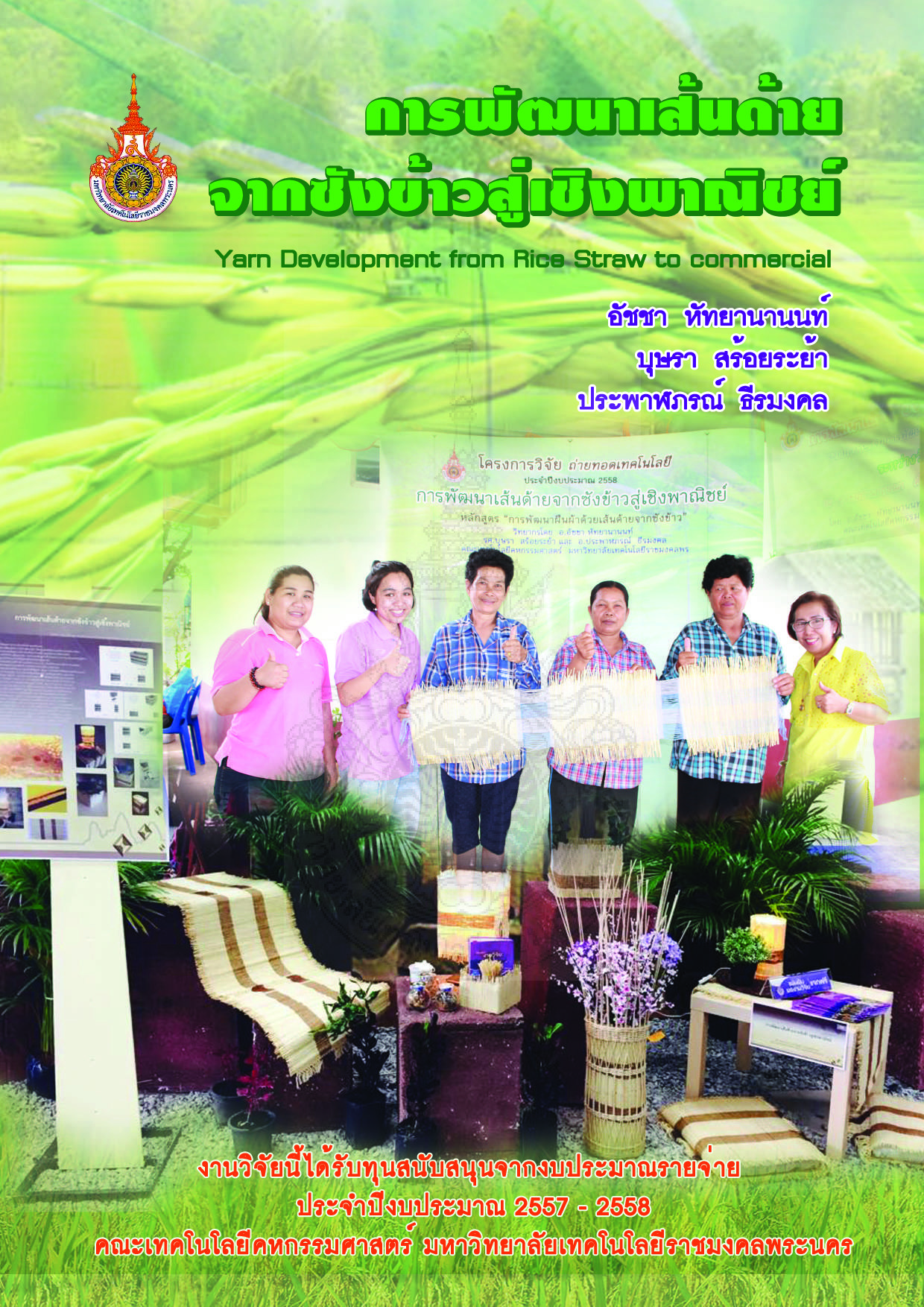
การพัฒนาเส้นด้ายจากซังข้าวสู่เชิงพาณิชย์
This research is Yarn Development from Rice straw to commercial. It aims to study the process of seperating fibers from rice straw. To study the physical properties of fibers from rice straw and to study the process of manufacturing yarn from rice straw fibers. The research material is rice straw fibers after that data was analyzed byphysical textile testing laboratory. The result of the first year’s research was the rice straw yarn has been developed as woven and develop into commercial products to promote. The process of separating fibers from rice straw which dried the sun for a few days. Selecting the rice straw fiber length at least 30 cm. to subtract the joints of the lower end of the stem by hand. peel off the rice straw fiber and place flat on a horizontal line. Then Rice straw fiber were tested in the physical laboratory was found that it is cellulose fibers tensile strength (Newton) at 28.18 elongation (percent) is at 2.01. The amounts of metals has plenty of CADMIUM at 0.1 mg/kg CHROMIUM (TOTAL) / (VI) at 0.5 mg/kg COPPER at 0.5 mg/kg and LEAD at 0.1 mg/kg which was not found to be risk for using. The fiber cross-section of rice straw fiber were found to be oval the middle is clearly. The fiber length is smooth and transparent when viewed from the side to see the clarity of the fiber. Rice straw fiber was weave in plain structure. Warp yarn uses a special brown cream and brown flat yarns. We use rice straw fiber with the same type of yarn. There are 2 warp yarn and using natural color without blench. Rice straw fabric was dyeing with dried hibiscus flowers (Kaa-Jeab herb) and mordant as ashes. The result is red light because of rice straw fiber surface is smooth and lustrous. Therefrom When woven as a fabric to develop be 4 products prototype : table lamps tablecloths in Japanese style potted plants and Accessories Box The result of the second year’s research there are focus group inquire for people it is interesting in this research and Date for transfer knowledge as: Ban-Krit-Sa- Na community Krit-Sa-Na sub-district bang-pra-ma district in Supanburi province. To plan the schedule and set the date place amount of participate and lectures 34 people The range of time to transfer as 3 days on 3 – 5 May 2015 and asking for consumer satisfaction of the curriculum and lecture for “transfer knowledge Yarn Development from Rice straw to commercial” by Questionnaire of participate satisfaction. Last the evaluation data was analyzed by using SPSS program in mean and percentage. The second year found that mostly participates were female aged under 21 years old finished the secondary school and also there are farmer. The participates are their income under 5000 baht and no income. For the participates questions relation to technology transfer of “Yarn Development from Rice straw to commercial” about course divided into 3 parts: The purpose The curriculum and The knowledge. The satisfaction of participates about project divided into 3 parts: Service process Lecturer and Facilities found that have been satisfied at maximum average and highest level of satisfaction in every parts of both satisfied participates questions. The participants are mainly used to provide benefits to themselves for one month to apply the gained after the training. Satisfaction with the benefits of technology transfer and utilization. Satisfaction at the highest level the participants used knowledge to apply with local and waste material. Moreover the participates make product as soon as finish course and they are planning to produce the table Hand Woven for weaving the Rice straw yarn fabric and push it to be OTOP products. The comments and suggestions of the participants found that they need for re-training again. They would like to have a longer period of training in order to gain more knowledge. All lecturer can transfer knowledge during the training as well.
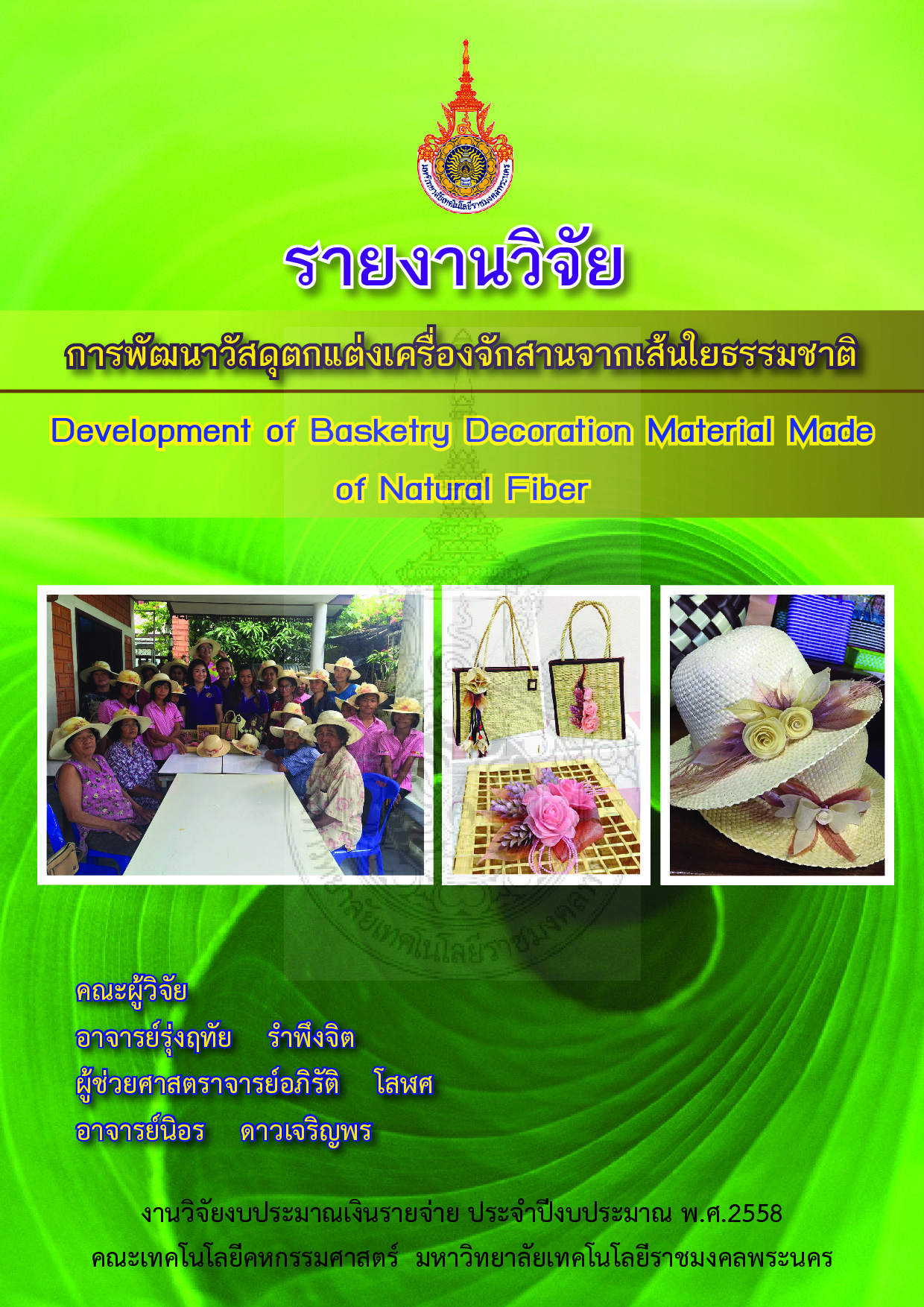
การพัฒนาวัสดุตกแต่งเครื่องจักสานจากเส้นใยธรรมชาติ
The study was aimed to investigate the production of banana fiber that was suitable for decorating handicraft basketry examine its effectiveness develop decorative handicraft materials for basketry from fibrous layer on the trunk of the banana tree and promote the obtained knowledge in the community of Plasticseeroong Baanmor Promburi District Singburi Province. The research result could be summarized that the most appropriate production process of dry fibrous layer on the trunk of the banana tree mixed with fibrous layer of paper mulberry was done through mechanical process. After bleaching the mixed fibrous layer was stirred by Hollander beater with the proportion of wet fibrous layer and water at 1:40; 10% of dry of paper mulberry was boiled for three hours in sodium hydroxide at 100 degree Celsius then bleached with 1.5% of hydrogen peroxide with 4% of the dry fibrous layer weight at 90 to 95 degree Celsius for two hours. The mixture of wet fibrous layer on the trunk of the banana tree with wet fibrous layer of paper mulberry was 70:30 which was considered appropriate for decorating handicraft basketry. Concerning the examination of mechanical properties of banana tree fibrous layer according to the standard of TAPPI T it was found that the folding endurance of paper value was 144 (N. m/g); the tensile strength value was 32.16 (N. m/g); the tear resistance value was 26.56 (mN.m2/g); and the bursting strength value was at 1.94 (KPa.m2/g). The fibrous layer obtained from on the trunk of the banana tree was fabricated into decorative basketry materials for example flowers palm leave hats flower key chains bags and paraffin coated flowers for bamboo boxed. The attendants’ satisfaction on the training of the production of decorative handicraft materials of basketry from fibrous layer on the trunk of the banana tree to 30 members of the community of Plasticseeroong Baanmor Promburi District Singburi Province concerning the training service speakers training procedures facilities and training benefits was at high level (90.67%) and at average level (9.33%).
การพัฒนารูปแบบของการสร้างหลักสูตรฝึกอบรมวิชาชีพระยะสั้น ด้านคหกรรมศาสตร์ กลุ่มอาชีพสหกรณ์ศิลปะประดิษฐ์ ตำบลเกาะเกร็ด จังหวัดนนทบุรี
This research aimed to study 1) the demand for short-term vocational training courses in home economics 2) create a training curriculum of home economics profession short of demand. Handicrafts Cooperative Occupational Groups Ko Kret Nonthaburi and her 3) the effects of short-term vocational training courses in home economics created The population in this study were selected purposively is a group of professional arts cooperative. Koh Kret Nonthaburi number 30 was used in the questionnaire and short-term training courses in home economics. Data analysis and statistics used were percentage average and standard deviation. The results were as follows: The population with an interest in the course of the invention include most academic inventor gift followed by molding the dough flowers Thailand. And the flowers The average score of 4.57 4.30 and 4.20 respectively Thus the curriculum invention gift. Style stuffed owl The concept of Taba comprises seven stages: 1) analysis of problems and needs for 2) define the aims of the course 3) selection of content 4) held a substantive 5) selection of a learning experience 6) experience. Learning and 7) evaluation of the course created consisting of five plans include 1) a basic knowledge about the inventor of the gift 2) materials and fabrication techniques stuffed owl onion 3) Knowledge of design creation. 4) the invention onions stuffed owl 5) costing and pricing onion stuffed owl. The six-hour period The results of the program found that participants with a performance favorably (83.33 percent) and a rating of the portfolio is in good shape (90.00 percent) from the satisfaction of the participants are. the most satisfied are averaging 4.58
การพัฒนาผลิตภัณฑ์วุ้นกรอบจากน้ำตาลสด
Fresh coconut syrup is a product from coconut spadix which has unique sweet taste and odor. Due to its short storage life it is usually processed into palm sugar. Development of new product from fresh coconut syrup would add more value by using it to produce crispy jelly. A suitable formula selected as a basic formula used 42.11 percent of refined sugar 56.14 percent of water and 1.75 percent of jelly powder. The basic formula was adjusted by calculating amount of water and soluble solids. Then a study was conducted to determine suitable amount of refined sugar heating period and drying temperature. It was found that a higher ratio of refined sugar and heating period led to increased concentration level of the mixture. As a result the crispy jelly had higher amount of sugar chips on the jellys surface and higher level of hardness. The highest score given by testers was for crispy jelly which used a ratio of fresh coconut syrup and refined sugar at 1:0.6 and 1:0.8 heating period of 5 minutes. Drying crispy jelly at higher temperature resulted in decreased drying period and higher degree of hardness. Drying at 70 degree Celcius produced crispy jelly with good quality which received the highest likeness score from testers. A study that kept crispy jelly in plastic box for at least 8 weeks showed that the tested condition could effectively maintain good quality of the crispy jelly.