จำนวน Repository ( 455 )
Promoting students' creation of innovation and technology
One of major missions of Rajamangala University of Technology Phra Nakorn is to promote studentscreation of research invention and innovation in order to add values to production sector and national academic service. The Promotion of Inventions and Innovations by Young Generation Project has been since 2008 initiated to provide necessary support development of undergraduate students works. The project aims to promote and improve students invention and innovation as well as to encourage national publication. This project has enhanced students professional expertise which would develop into Hands-on graduates. Results of the project were presented at national level and severaltools devices and products had been produced and evidently utilized to improve production process of communities and industrial sector. The 1st Rajamangala University of Technology Phra Nakhon Innovation and Technology Exhibition is another activity that has presented results of the project to public. The activities included an exhibition of students innovations ana technology a forum on Hands-on graduate development and a contest of students works. This initiation clearly corresponds with the mission to promote students creation of innovation in oder to produce hands-on graduates who have curiosity persistence technological expertise and morality in accordance with the university identity.
The biogas production and the application of lunch project for student at suksasongkhro tak school tak province
This research aims to transfer biogas digester construction technology and application of biogas in household to teachers and students of Suksasongkhro Tak school. They were instructed and trained about biogas digester construction and application of biogas produced from animal manure on household cooking in order to reduce LPG use. A total number of 330 teachers and students participated in the training. Results from 5-point scale questionnaire for project evaluation showed that the highest rank was location duration and food ( = 4.37 SD = 0.67). The second was knowledge utilization ( = 4.33 SD = 0.66). The third was trainers ( = 4.26 SD = 0.65) and the lowest was knowledge and understanding ( = 4.13 SD = 0.72). Regarding level of average post-training satisfaction the highest was 4.44 for knowledge and understanding while the lowest was 4.16 for question and answer. For success of the project it was found that every biogas digester done by participants could produce biogas used in place of LPG and could reduce monthly expense by about 1400 – 1500 baht. The total construction cost of biogas production system was 58000 baht with a payback period of 4 years. For students there were 3 science projects about biogas; including 1) comparison of biogas produced from food remains and animal manure; 2) comparison of biogas produced from pigs and cows manure; and 3) comparison of biogas produced from dry and fresh pigs manure.
Comparison the efficiency of internet services by 3G technology in thailand
Currently the internet services with 3G technology by mobile phone operators in Thailand are different in the performance. The mobile phone operators have already launched 3G technology with 2G frequency ranges which are limited in the efficiency. This paper aims to compare the efficiency of the internet service with 3G technology by three mobile phone operators (AIS DTAC and Truemove H) in Thailand. There are three type of testing as follows: Ping to both domestic and international website Bandwidth speed test and FTP Test (upload and download) are used to evaluate the performance of these mobile phone operators. There were five places in Bangkok where are the top of the network congestion list for such testing the three mobile phone operators. The result showed that AIS gives the best performance in the ping test. Truemove H introduces the best performance in both FTP and Bandwidth speed test. The DTAC performances are moderated level for every tests.
Usage behavior and satisfaction towards information technology of personnel in the ministry of culture.
The objectives of this research are 1) to study usage behavior and satisfaction in the information technology of personnel in the Ministry of Culture. 2) To study the relationship of usage behavior and satisfaction of personnel in the Ministry of Culture towards the information technology. 3) To compare behavior of personnel in the Ministry of Culture in using information technology which different in demographic characteristics. 4) To compare the satisfaction towards information technology of personnel in the Ministry of Culture which different in demographic characteristics. The representative sample of this research is 250 personnel in the Ministry of Culture. In addition for this research questionnaire has been used as a statistical methodology. The result of this research implies that most of the personnel in the Ministry of Culture are female 74.4 % of them use and exposure into the information technology by using desktop computer and most of these people are greatly satisfied in the information technology. Moreover regarding the effective and fast intercommunication it has been found from the statistical hypothesis testing that the demographic characteristics differences such as gender age marital status education and average income per month have the differences in the usage behavior and satisfaction of the information technology and the usage behavior of the information technology has a relationship with satisfaction in using information technology of personnel in the Ministry of Culture.
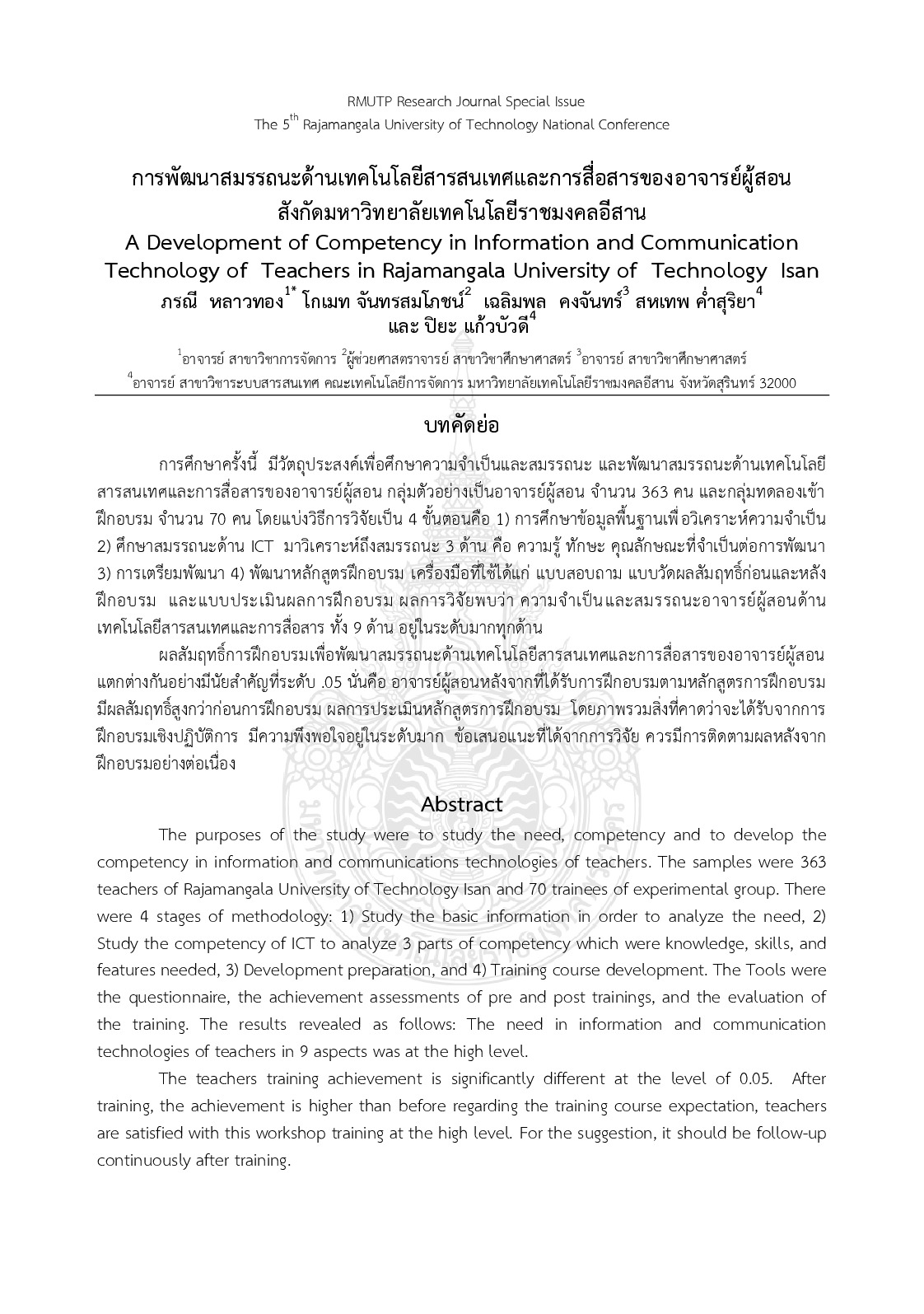
A development of competency in information and communication technology of teachers in Rajamangala University of Technology isan
The purposes of the study were to study the need competency and to develop the competency in information and communications technologies of teachers. The samples were 363 teachers of Rajamangala University of Technology Isan and 70 trainees of experimental group. There were 4 stages of methodology: 1) Study the basic information in order to analyze the need 2) Study the competency of ICT to analyze 3 parts of competency which were knowledge skills and features needed 3) Development preparation and 4) Training course development. The Tools were the questionnaire the achievement assessments of pre and post trainings and the evaluation of the training. The results revealed as follows: The need in information and communication technologies of teachers in 9 aspects was at the high level. The teachers training achievement is significantly different at the level of 0.05. After training the achievement is higher than before regarding the training course expectation teachers are satisfied with this workshop training at the high level. For the suggestion it should be follow-up continuously after training.