จำนวน Repository ( 720 )
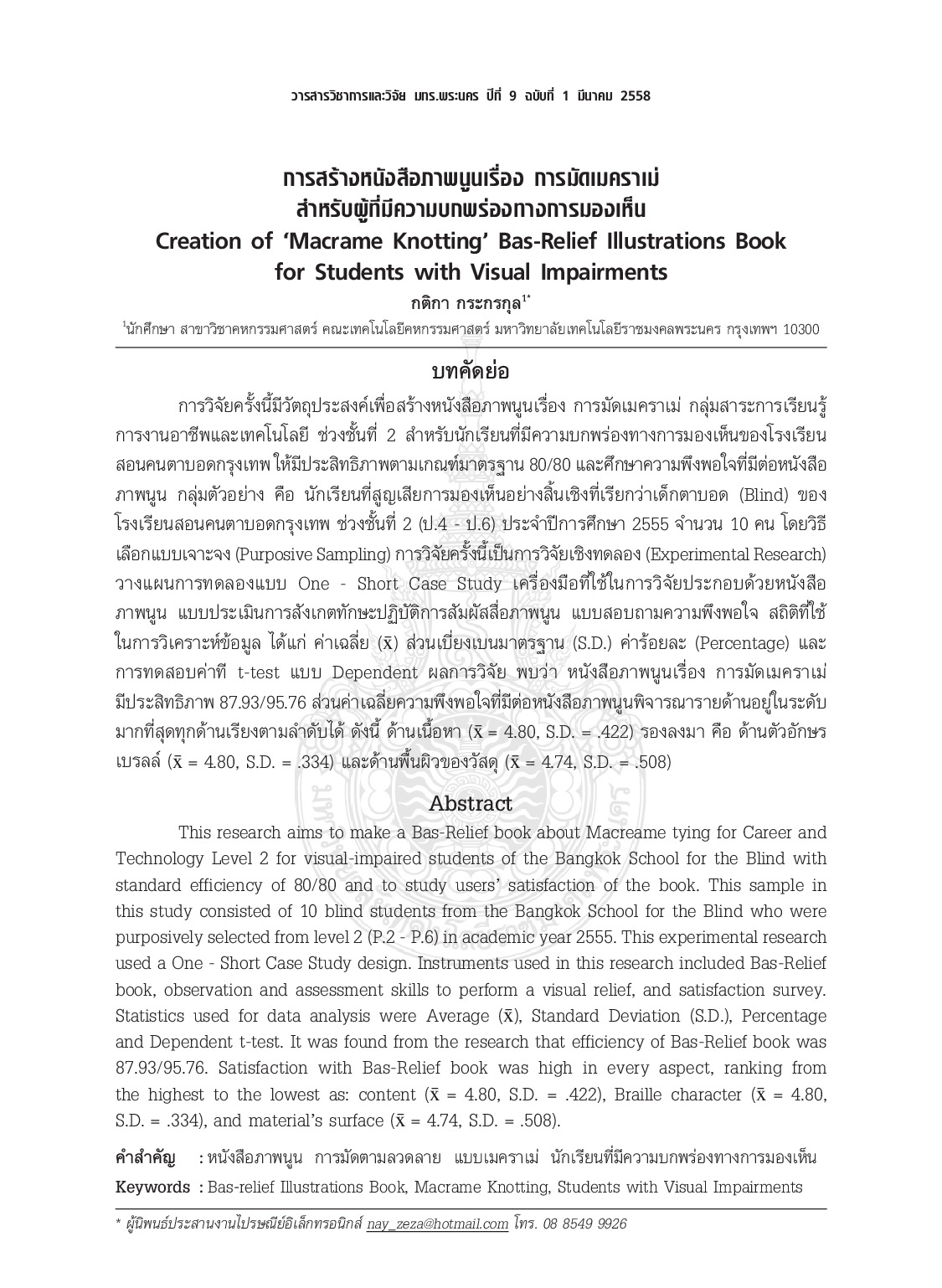
Creation of ‘macrame knotting’ bas-relief Illustrations book for students with visual impairments
This research aims to make a Bas-Relief book about Macreame tying for Career and Technology Level 2 for visual-impaired students of the Bangkok School for the Blind with standard efficiency of 80/80 and to study users’ satisfaction of the book. This sample in this study consisted of 10 blind students from the Bangkok School for the Blind who were purposively selected from level 2 (P.2 - P.6) in academic year 2555. This experimental research used a One - Short Case Study design. Instruments used in this research included Bas-Relief book observation and assessment skills to perform a visual relief and satisfaction survey. Statistics used for data analysis were Average ( ) Standard Deviation (S.D.) Percentage and Dependent t-test. It was found from the research that efficiency of Bas-Relief book was 87.93/95.76. Satisfaction with Bas-Relief book was high in every aspect ranking from the highest to the lowest as: content ( = 4.80 S.D. = .422) Braille character ( = 4.80 S.D. = .334) and material’s surface ( = 4.74 S.D. = .508).
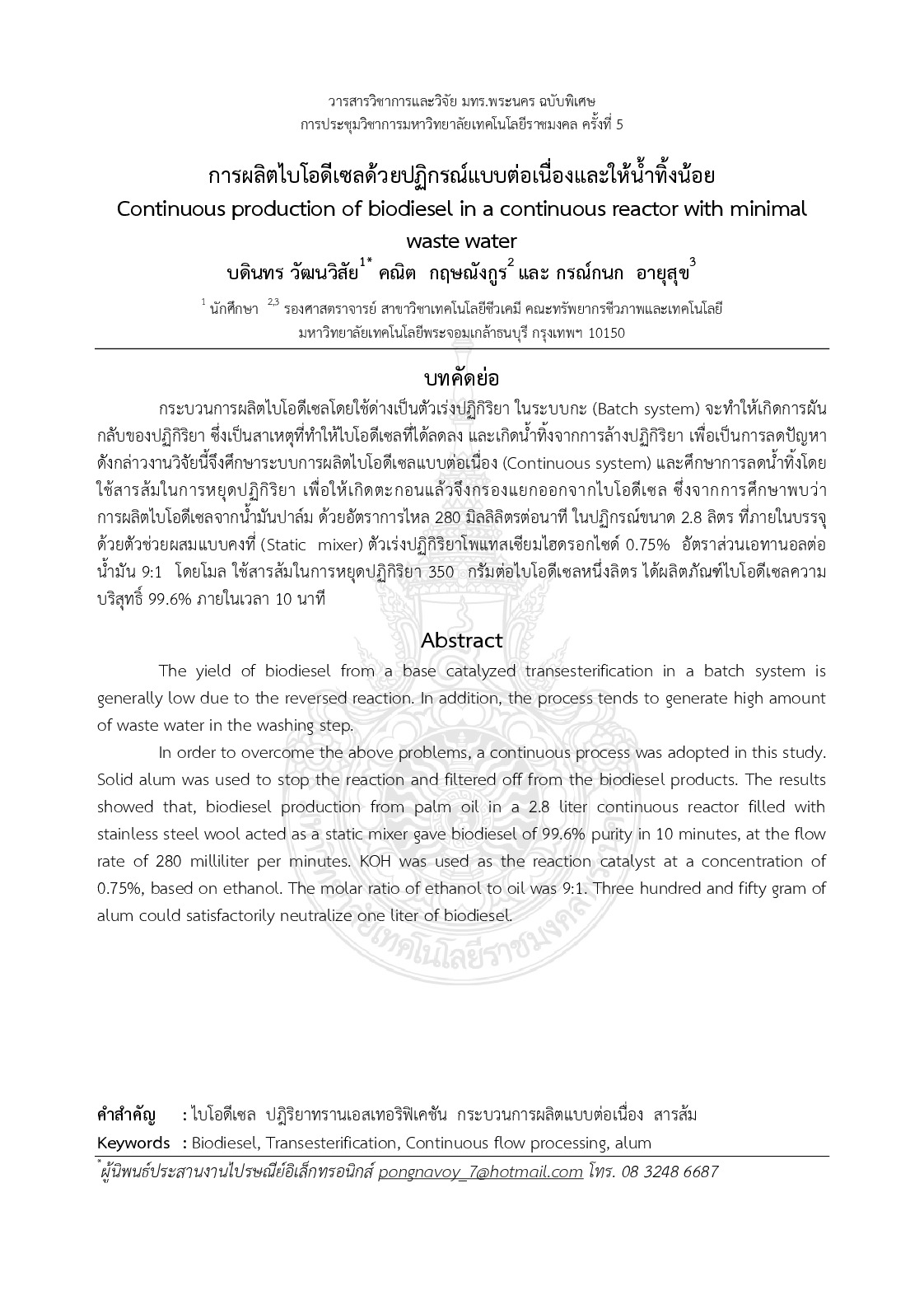
Continuous production of biodiesel in a continuous reactor with minimal
The yield of biodiesel from a base catalyzed transesterification in a batch system is generally low due to the reversed reaction. In addition the process tends to generate high amount of waste water in the washing step. In order to overcome the above problems a continuous process was adopted in this study. Solid alum was used to stop the reaction and filtered off from the biodiesel products. The results showed that biodiesel production from palm oil in a 2.8 liter continuous reactor filled with stainless steel wool acted as a static mixer gave biodiesel of 99.6% purity in 10 minutes at the flow rate of 280 milliliter per minutes. KOH was used as the reaction catalyst at a concentration of 0.75% based on ethanol. The molar ratio of ethanol to oil was 9:1. Three hundred and fifty gram of alum could satisfactorily neutralize one liter of biodiesel.
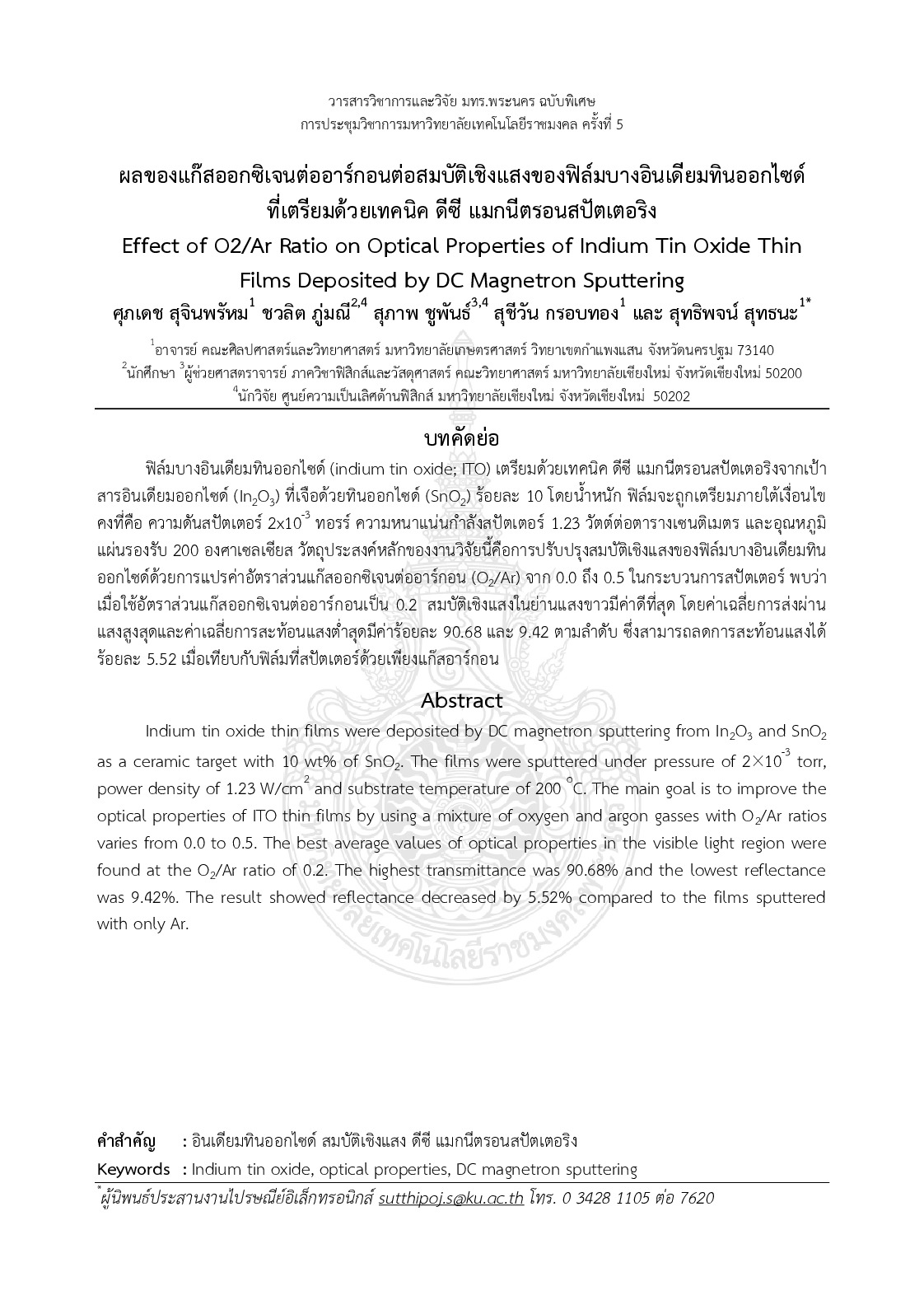
Effect of O2/ar ratio on optical properties of indium tin oxide thin films deposited by dc magnetron sputtering
Indium tin oxide thin films were deposited by DC magnetron sputtering from In2O3 and SnO2 as a ceramic target with 10 wt% of SnO2. The films were sputtered under pressure of 2?10-3 torr power density of 1.23 W/cm2 and substrate temperature of 200 oC. The main goal is to improve the optical properties of ITO thin films by using a mixture of oxygen and argon gasses with O2/Ar ratios varies from 0.0 to 0.5. The best average values of optical properties in the visible light region were found at the O2/Ar ratio of 0.2. The highest transmittance was 90.68% and the lowest reflectance was 9.42%. The result showed reflectance decreased by 5.52% compared to the films sputtered with only Ar.
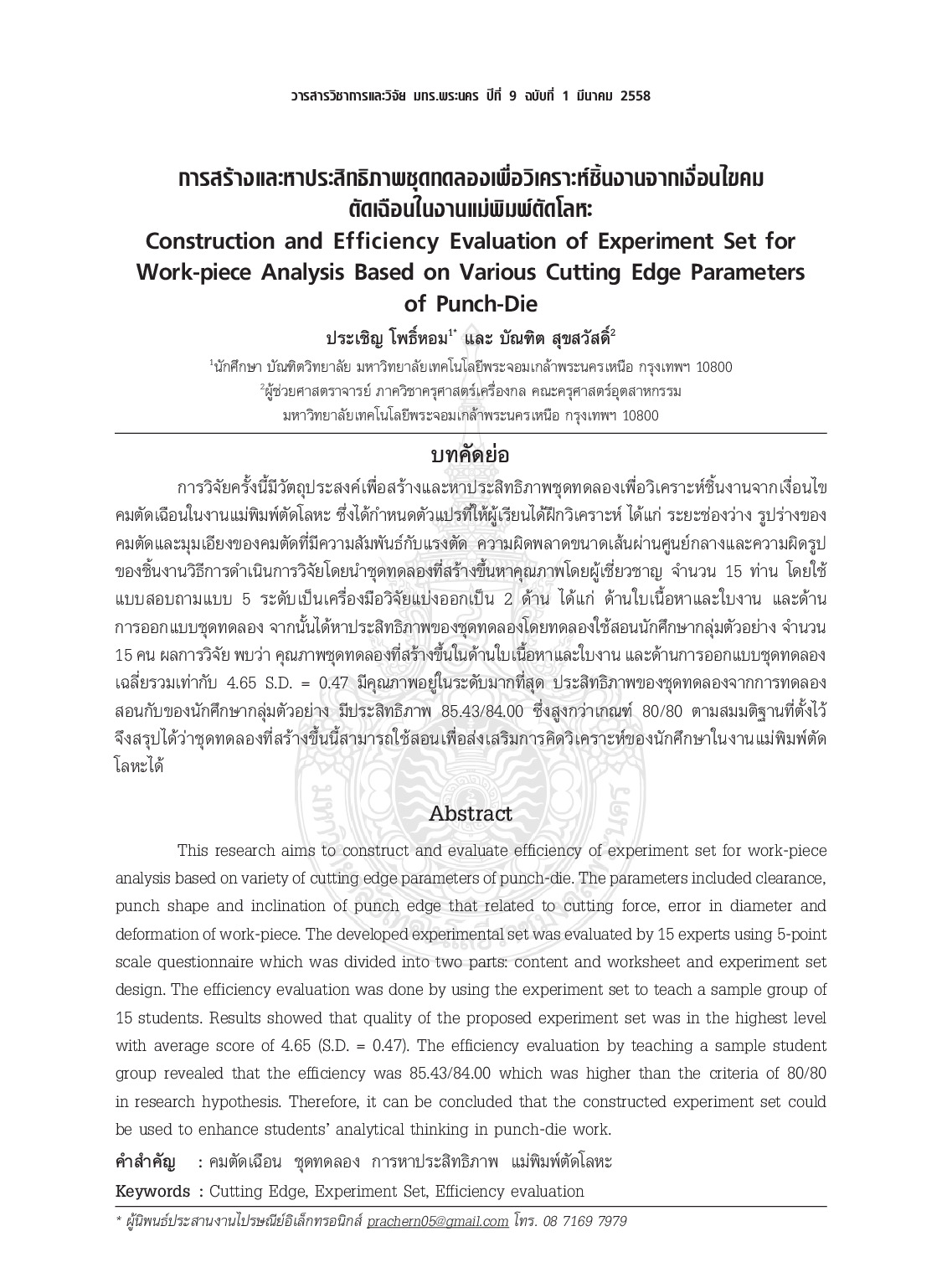
Construction and efficiency evaluation of experiment set for work-piece analysis based on various cutting edge parameters of punch-die
This research aims to construct and evaluate efficiency of experiment set for work-piece analysis based on variety of cutting edge parameters of punch-die. The parameters included clearance punch shape and inclination of punch edge that related to cutting force error in diameter and deformation of work-piece. The developed experimental set was evaluated by 15 experts using 5-point scale questionnaire which was divided into two parts: content and worksheet and experiment set design. The efficiency evaluation was done by using the experiment set to teach a sample group of 15 students. Results showed that quality of the proposed experiment set was in the highest level with average score of 4.65 (SD = 0.47). The efficiency evaluation by teaching a sample student group revealed that the efficiency was 85.43/84.00 which was higher than the criteria of 80/80 in research hypothesis. Therefore it can be concluded that the constructed experiment set could be used to enhance students’ analytical thinking in punch-die work.
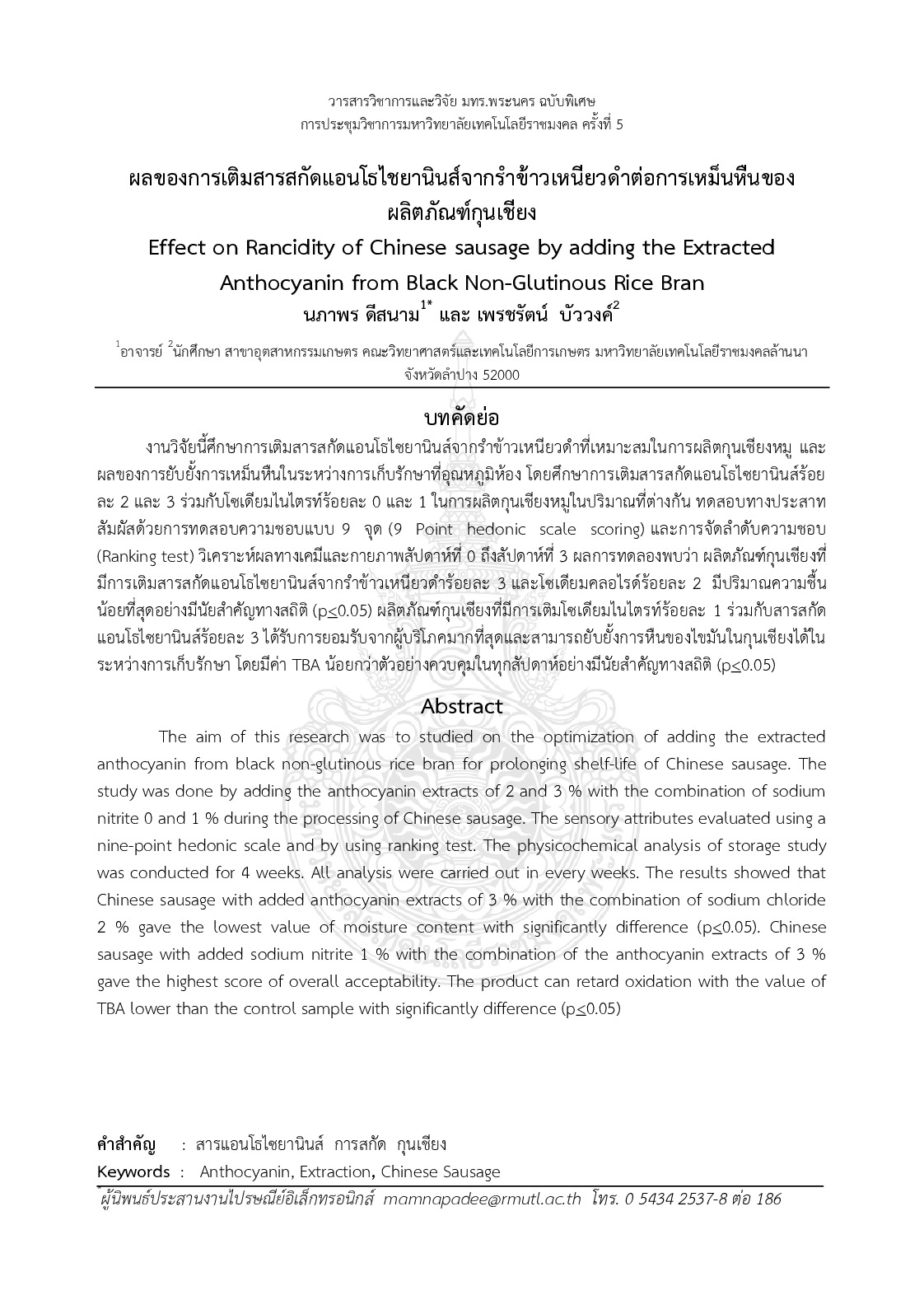
Effect on rancidity of chinese sausage by adding the extracted anthocyanin from black non-glutinous rice bran
The aim of this research was to studied on the optimization of adding the extracted anthocyanin from black non-glutinous rice bran for prolonging shelf-life of Chinese sausage. The study was done by adding the anthocyanin extracts of 2 and 3 % with the combination of sodium nitrite 0 and 1 % during the processing of Chinese sausage. The sensory attributes evaluated using a nine-point hedonic scale and by using ranking test. The physicochemical analysis of storage study was conducted for 4 weeks. All analysis were carried out in every weeks. The results showed that Chinese sausage with added anthocyanin extracts of 3 % with the combination of sodium chloride 2 % gave the lowest value of moisture content with significantly difference (p<0.05). Chinese sausage with added sodium nitrite 1 % with the combination of the anthocyanin extracts of 3 % gave the highest score of overall acceptability. The product can retard oxidation with the value of TBA lower than the control sample with significantly difference (p<0.05)