จำนวน Repository ( 822 )
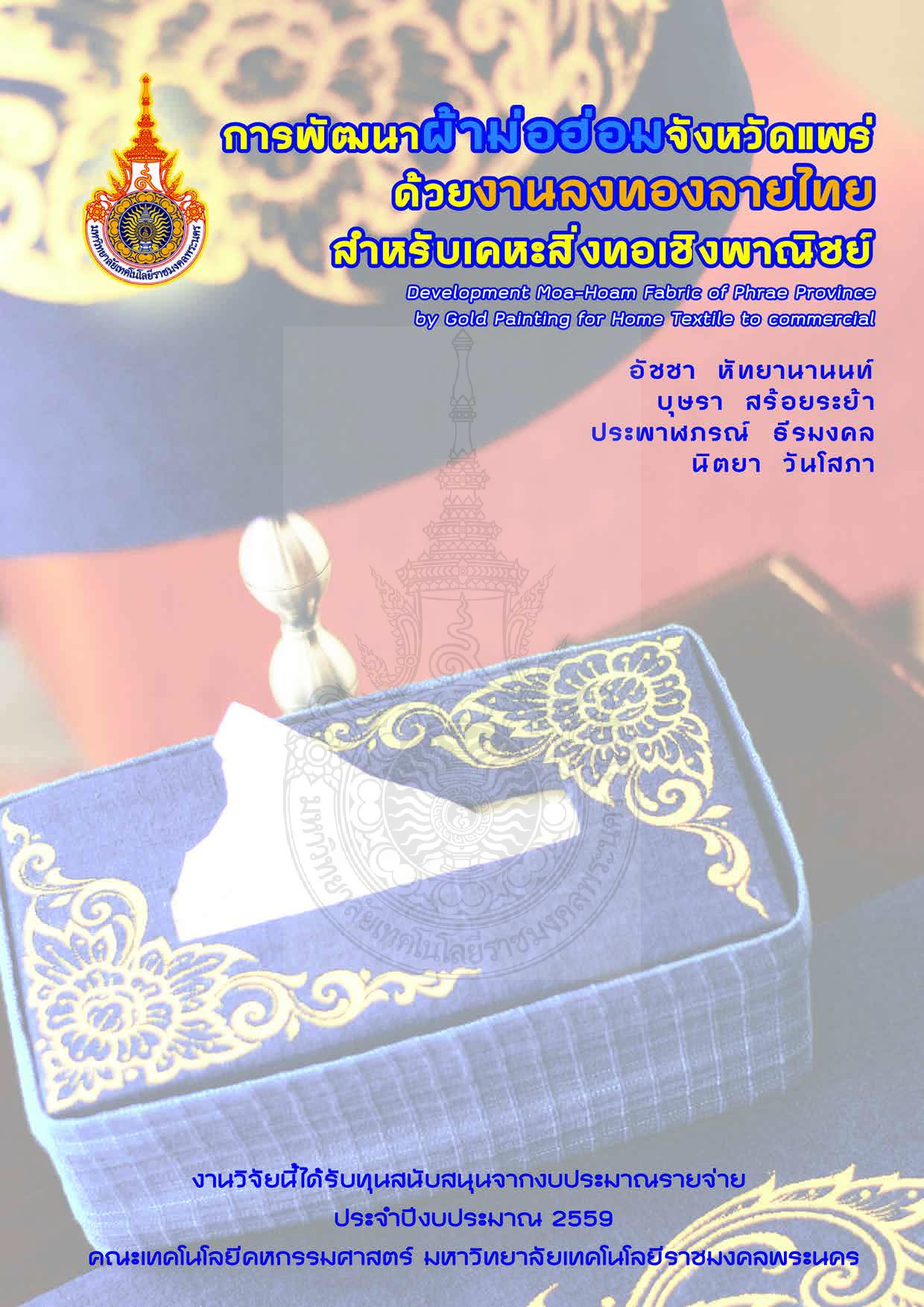
การพัฒนาผ้าม่อฮ่อมจังหวัดแพร่ ด้วยงานลงทองลายไทยสำหรับเคหะสิ่งทอเชิงพาณิชย์
This research is Development Moa-Hoam Fabric of Phrae Province by Gold Painting for Home Textile to commercial. The purpose of this research were 1) to design Thai pattern by Gold Painting for Home Textile to commercial for Moa-Hoam Fabric of Phrae Province. 2) to produce Moa-Hoam Fabric of Phrae Province products for Home Textile to commercial and 3) to assessment the consumers satisfaction towards development Moa-Hoam Fabric of Phrae Province by Gold Painting for Home Textile to commercial. The research instruments used to collect data: 1) a draft design of Thai pattern (Decorative moldings a specific pattern on the North of Thailand) 2) a draft product design 10 prototypes 3) to produce 10 prototypes as table cloth a sofa cover Wall picture cushion curtain tissue box lamp versatile fabric and trash 4) Questionnaire of consumers satisfaction towards Development Moa-Hoam Fabric of Phrae Province by Gold Painting for Home Textile to commercial of 50 people: Moa-Hoam Fabric sellers and manufacturers Hotel Entrepreneur Tourists and those interested in Moa-Hoam Fabric of Phrae Province by Gold Painting for Home Textile to commercial. The evaluation data was analyzed by using SPSS program in frequency mean and percentage. All in conclusion as table and descriptive The research showed that the design pattern that is unique to Thailand. According landmarks Phrae is wire moldings a striped pattern that is unique and original. The cutbacks on product design and textiles. The researchers made the interior of the room. Using fabric Moa Hoam write down gold striped Thailand. Living area Using fabric Moa-Hoam Fabric painted down gold striped Thailand and sewing products. Then Asking the satisfaction of Moa-Hoam Fabric sellers and manufacturers Hotel Entrepreneur Tourists and those interested were found that mostly respondents were male aged 46 years up and over by many as Hotel entrepreneurs a Bachelors degree with a monthly income of up to 30001. The respondents were satisfied with development Moa-Hoam Fabric of Phrae Province by Gold Painting for Home Textile to commercial terms at the most an average of 4.74. In the part of the ability to attract is well in average maximum 4.88. It is about of possible market average satisfaction was 4.84 at the most. Moreover The design enhances for the Moa Hoam fabric promotional image was 4.76 at the most. Exquisite designs are appropriate for the utility to add value to their products (Moa Hoam fabric) was 4.72 at the most and also the commercial customer satisfaction is at the highest level. Application of unique art in Phrae to use in textiles was 4.68 the average customer satisfaction is at the highest level. And to help promote tourism in the province to the other one the average satisfaction was 4.62 in the highest level.
การพัฒนามาลัยจากผ้าด้วยเทคโนโลยีการตกแต่งกลิ่น
This research studies the development of fabric garland with fragrance addition technology by investigating the method of covering microcapsule fragrance on fabric which is the material of making garland. The result of the study shows that: The study of covering gelatin on polyester fabric shows that the small amounts of gelatin applied on polyester lower the strength of the fabric which is not suitable for marking garland. Due to the requirement of the strength in making garland by folding fabrics and passing them through thread into round shape lacking of the strength causes the difficulty for the making process. Gelatin provides stiffness and hardness to the fabric which is easy to form into various shapes. Before adding fragrance the result of stiffness test shows that the fabric has bending length of warp yarn at 5.9 centimeters and weft yarn at 4.1 centimeters; however after adding fragrance bending length of warp yarn is at 2.7 centimeters and weft yarn is at 1.9 respectively. Then the efficiency of covering microcapsule fragrance on fabric is tested by Scanning Electron Microscope (SEA). After adding fragrance the result shows that: (1) the numbers of microcapsule are higher (2) microcapsules form in round shape and (3) the size of microcapsules are similar. However after 30 day of applying microcapsule to the fabric it shows that (1) the numbers of microcapsule are lower and (2) microcapsules are not in complete round shape due to the deterioration. For the process of making garland with nonmicrocapsule and microcapsule fabric it demonstrates that microcapsule fabric does not impact the process of making garland but it adds the value for fragrance addition which is able to be considered as added value.
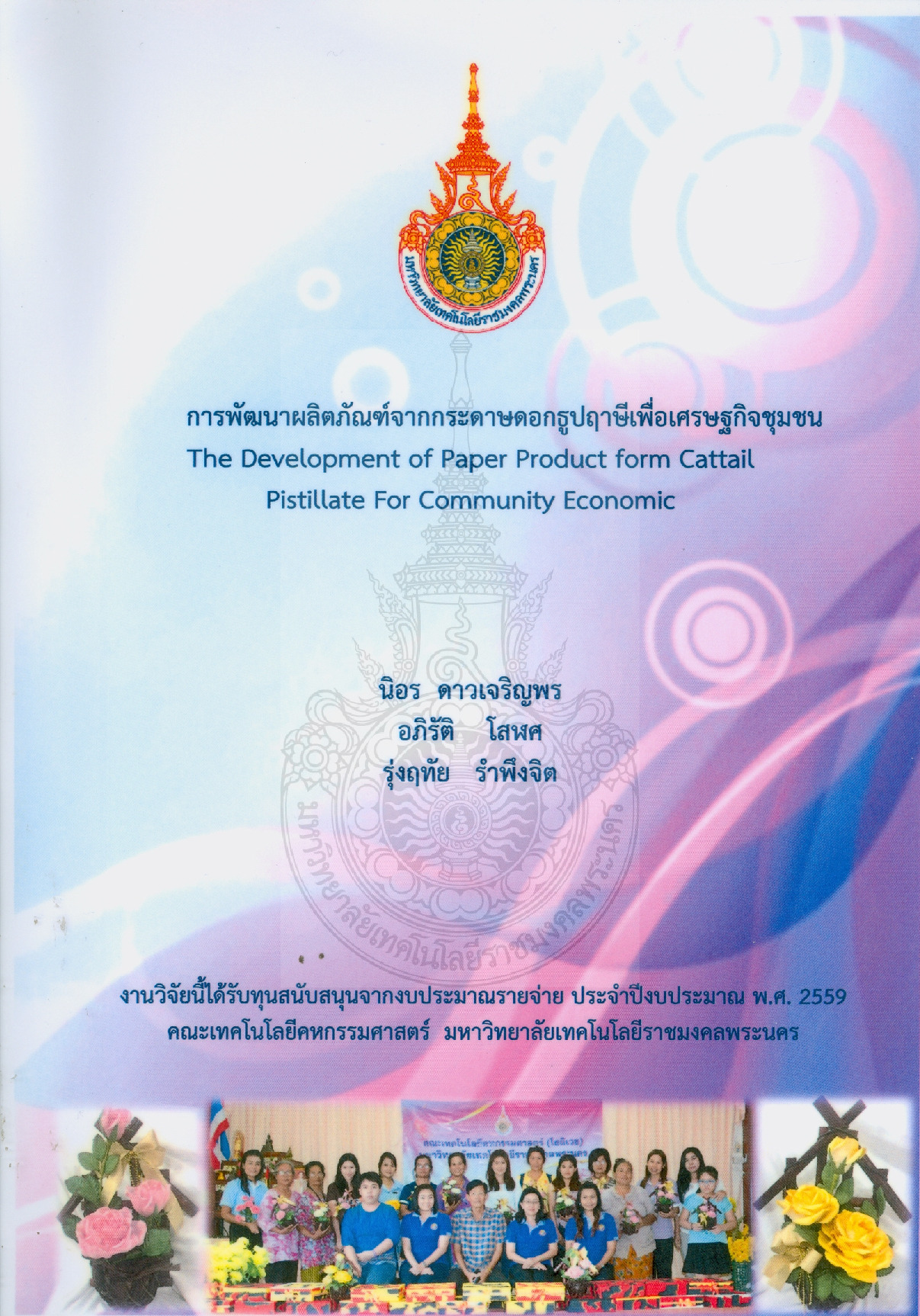
การพัฒนาผลิตภัณฑ์จากกระดาษดอกธูปฤาษีเพื่อเศรษฐกิจชุมชน
This research aims at studying the product development from Cattail flower paper for community economy by (1) studying the paper making process from Cattail flower (2) testing the efficiency of the paper made of Cattail flower (3) studying the product development process of Cattail flower paper and (4) propagating the knowledge on product made of Cattail flower paper for the community economy to the Women Group for Basketry Product Development in Laem Phak Bia sub-district Ban Laem district Phetchcburi province. The process of paper making from Cattail flower in its mature stage uses soda method in pulping process and hydrogen peroxide in bleaching process. Paper formation process has to be done on grate by (1) using 38 kilograms of fresh Cattail flower which requires pulp separation from the core of Cattail flower providing; 34.2 kilograms of fresh pulp considered as 90%—its average humidity at 51.04%; 3.8 kilograms of fresh core considered as 10% of the total weight (2) boiling in open system at 100 ºC for 3 hours with sodium hydroxide with the intensity at 4% 6% and 8% of its weight (3) bleaching with hydrogen peroxide with the intensity at 10% 20% and 30% of the weight of dried pulp; 2% of sodium silicate; 0.05% of magnesium sulfate; and 1.5% of sodium hydroxide at 100 ºC for 2 hours with the ratio of pulp and water at 1:15 (4) making paper with Thai traditional handmade method with the size of 72×84 centimeters then drying paper in indoor place in order to prevent paper contraction due to short pulp. The efficiency of the paper made of Cattail flower shows that the paper has average standard weight at 168.88 g2/m; average tensile strength at 26.40 N.m/g2; average tearing strength at 3.14 mN.m2/g; average bursting strength at 1.37 kPa.m2/g; average folding strength at 605; average luminance at 39.05%; average water holding capacity of dry weight at 395.65%; and total used bleach pulp at 69.90% of the bleached amount. The product development from Cattail flower paper has 3 types which are designed evaluated and suggested by the experts in accordance with the requirement of community on product development as follows: (1) Paper made of Cattail flower with various patterns; (2) Multi-purpose box made of Cattail flower and; (3) Flower made of Cattail flower paper. During 2 days of the training program the satisfaction of the 30 participants concerning the knowledge on product made of Cattail flower paper for the community economy of the Women Group for Basketry Product Development in Laem Phak Bia sub-district Ban Laem district Phetchaburi province shows that the participants who answer the questionnaire are extremely satisfied.
การพัฒนาผลิตภัณฑ์จากเปลือกนอกของก้านเผือกเหลือใช้ ในกลุ่มผู้ทานาเผือกอำเภอบ้านหมอจังหวัดสระบุรี เพื่อส่งเสริมเศรษฐกิจชุมชน
This research aims to produce paper and strands from taro fiber in order to develop into craft products and to transfer the body of knowledge and technology to community. The research consisted of 5 main steps: 1) development of paper – study concentration level of sodium hydroxide duration of pulp boiling suitable condition for breaching and softening reactive dyeing paper setting and physical testing of paper; 2) development of strand – stranding with machine strand spinning fiber combining and carding drawing reducing size of fiber and yarn spinning; 3) fiber property testing – cross-sectional test length crimp and fiber fineness; 4) product development – making evaluating and improving draft models of rubber-coated artificial flowers hanging clocks multipurpose boxes and product prototype development; and 5) transfer of technology to members of Talad Noi Agricultural Community Enterprise as well as nearby communities in Ban Moh district Saraburi province. Results of the study showed that the most suitable condition in separating fiber was boiling in 15 grams-per-liter sodium hydroxide solution at 100 Degree Celcius for 1 hour. Then breach with 9 grams-per-liter hydrogen peroxide solution at 100 Degree Celcius for 20 minutes. Next soften the fiber with 6 grams-per-liter anion softener at 60 Degree Celcius for 20 minutes. The use the fiber to set 40x40 centimeter piece of paper by spreading 20 grams of fiber equally. The resulting 0.237mg thick piece of paper was fairly resistance to piercing pressure and tearing force and was suitable to make craft products. In addition development of strands by yarn spinning method was suitable to produce strands which had more strength than strands from other plants. The strands were also suitable for further industrial production. The prototypes of utility and furnishing products were evaluated by consumers as highly suitable in 3 aspects - uniqueness of local product attractive design and size shape and weight – with mean values of 3.72 3.96 and 3.94 respectively. Price was evaluated as averagely suitable at a mean value of 3.12. Results of technology transfer showed that overall trainees were highly satisfied with the technology transfer process at a mean value of 4.55. Assessment of satisfaction and data for course improvement were both in the highest level with mean values of 4.60 and 4.51 respectively.
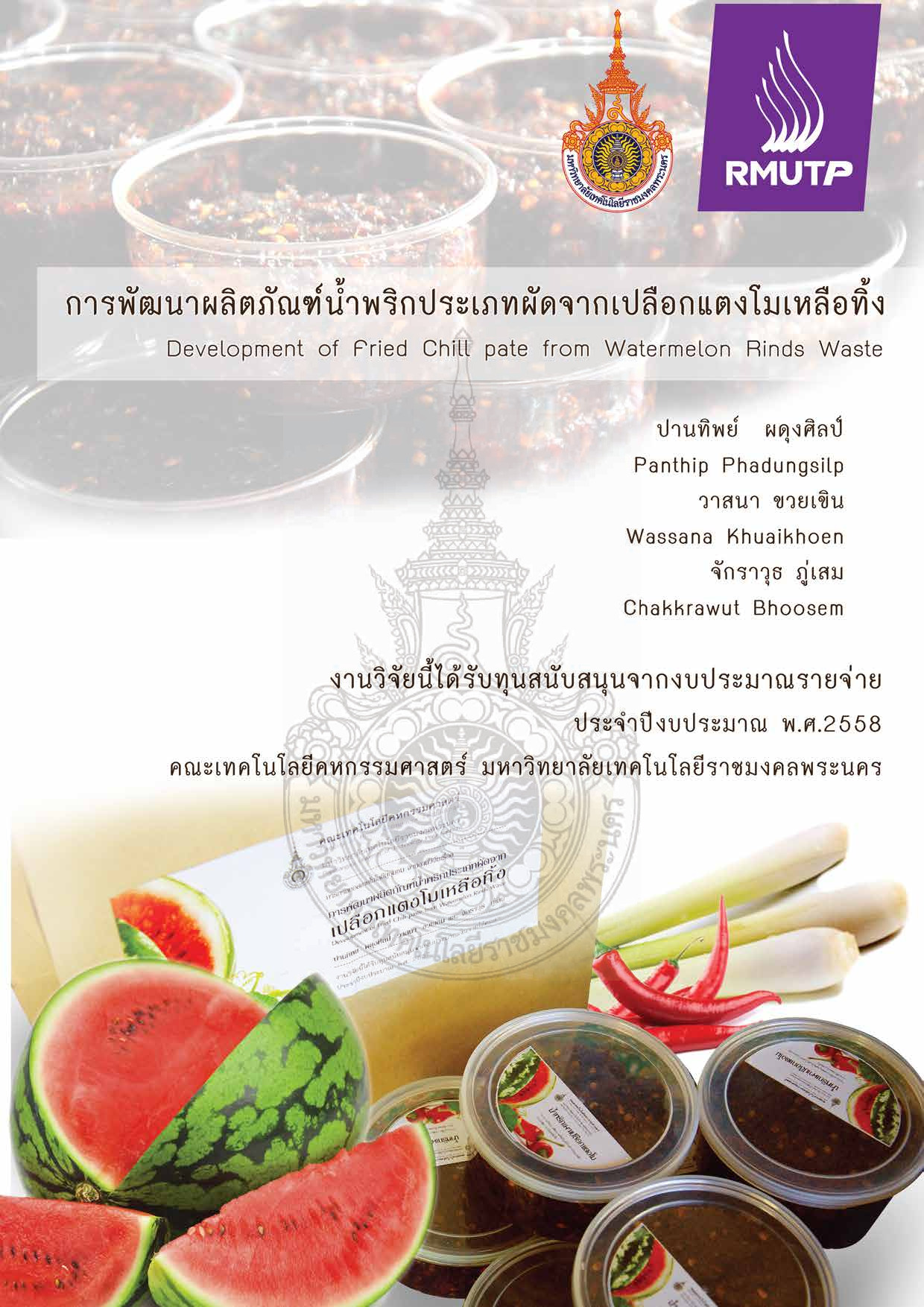
การพัฒนาผลิตภัณฑ์น้ำพริกประเภทผัดจากเปลือกแตงโมเหลือทิ้ง
The research products of chili fried watermelon rind remains were found. The decent amount enhancing of the watermelon rind in fried chili pastes are 25% 50% and 75% of total weight. The results show the 50% enhancing of the watermelon rind in fried chili pastes all of sample such as roast chili paste fermented fish chili paste Tadand chili paste and Oong chili paste were recognized in the like moderately-like very much. Increase of watermelon rind at 75% of total weight the acceptance is decrease. The texture of samples of fried chili pastes enhancing of the watermelon rind show that 1035.74-1901.16gram of the consistency -132.16- -98.07 gram: milligram of the cohesiveness and 2.15-5.67 gram of the viscosity. The chemical composition of fried chili pastes enhancing of the watermelon rind show that the 50% of watermelon rind in roasted chili pastes were 233 Kcals of total energy 7.20 of protein 9.56 of fat 4.83 of ash 29.60 of carbohydrate and 7.09 of crude fiber. The 50% of watermelon rind in fermented fish chili paste were 152 Kcals of total energy 5.93 of protein 5.60of fat 4.21of ash 19.4of carbohydrate and 5.41of crude fiber. The 50% of watermelon rind in Tadand chili paste were 183 Kcals of total energy 6.68 of protein 3.26 of fat 7.34 of ash 31.80 of carbohydrate and 11.10 of crude fiber. The 50% of watermelon rind in Oong chili paste were 182 Kcals of total energy 6.77 of protein 12.80 of fat 2.61 of ash 9.92 of carbohydrate and 3.21 of crude fiber For the technology transfer of Fried Chili paste from Watermelon Rinds Waste to Center Concert career womens groups Don Kang. The participants were satisfied with the course of 92.67